


+1 More

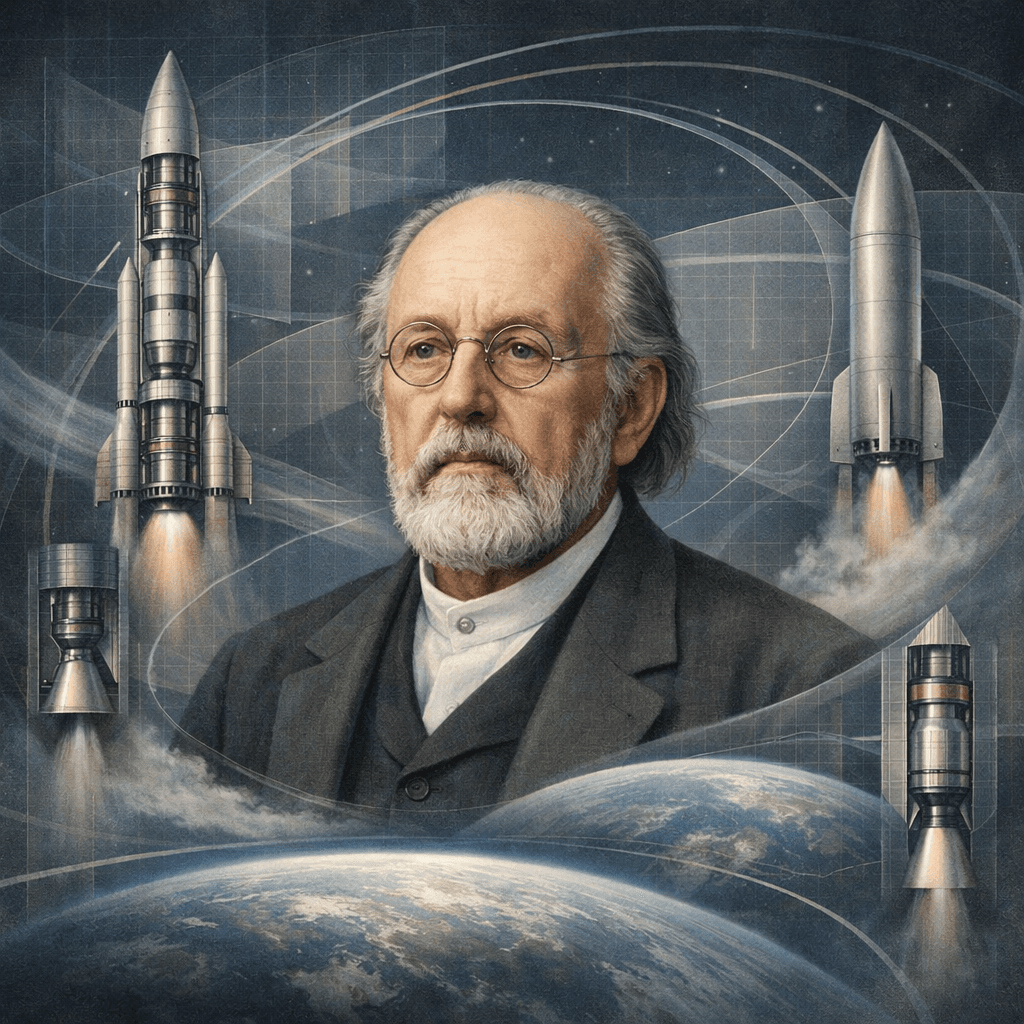
Konstantin Eduardovich Tsiolkovsky (generated by AI)
Birth | 17 September 1857, Izhevskoye, Ryazan Oblast | ||||||||
|---|---|---|---|---|---|---|---|---|---|
Death | 19 September 1935, Kaluga | ||||||||
Nationality | Russian Empire later Soviet Union | ||||||||
Occupation | Teacher Writer Theorist | ||||||||
Areas of Work | Rocket dynamics, space flight theory, aerodynamics, airship design, science fiction and philosophical texts | ||||||||
Experimental Studies | Measurements and reported experiments on aerodynamic drag and surface pressure effects via artificial airflow setups | ||||||||
Konstantin Eduardovich Tsiolkovsky (17 September 1857, Izhevskoye, Ryazan Oblast; 19 September 1935, Kaluga) was a Russian scientist and teacher who worked on rocket dynamics and spaceflight theory, as well as aerodynamic experiments, airship designs, science fiction and philosophical texts. His work centered on the application of variable mass motion to rocket flight, the implications of the reaction propulsion principle in space environments, the concept of multistage rockets and systemic assumptions enabling long-term life in space. Parallel to his technical output, he wrote cosmic philosophical texts addressing issues such as the structure of the universe, the origin of life and the limits of knowledge.
Tsiolkovsky suffered hearing loss following an illness in childhood, which limited his access to formal education. During adolescence he engaged in intensive self-study in mathematics and physics and during his youth in Moscow established contact with philosophical and scientific circles. In 1879 he obtained a teaching qualification through external examinations and began working in 1880 as a teacher of arithmetic and geometry in Borovsk, in the Kaluga region. From 1892 onward he continued his teaching career in Kaluga, spending the remainder of his life largely in this city where he produced much of his significant work.
Tsiolkovsky’s early work was situated within the context of aviation technology developing around “lighter-than-air” vehicles and aerodynamic problems. In the mid-1880s he began systematically examining airship designs and produced theoretical justifications for the concept of a metal-hulled gas-tight airship. Within this design line he proposed technical solutions to operational challenges such as shaping the metal skin, adjusting lift during flight and heating the lifting gas. In 1890 a study and a small model of the metal airship concept were submitted to contemporary scientific circles; although they received positive evaluations, practical implementation and financial support remained limited.
Tsiolkovsky also participated in early discussions on “heavier-than-air” flight, publishing in the mid-1890s an article arguing that an aircraft could be designed with a metal framework, streamlined hull and single-wing configuration. In this design approach aerodynamic form structural strength and control issues were addressed together; ideas such as counter-rotating propellers gyroscopic stabilization and the delegation of certain flight control functions to automatic mechanisms were debated during the same period. This framework implied that flight control could be supported not only by pilot skill but also by mechanical and electrical feedback systems【1】.
One of the fundamental challenges in airship and aircraft design was the reliable measurement of air resistance, prompting Tsiolkovsky to turn to experimental aerodynamics. To overcome the limitations of natural conditions he constructed in 1897 in Kaluga a device generating artificial airflow to test objects of various shapes under controlled flow conditions. This apparatus is recognized as the first wind tunnel used in Russia for aviation problems. He published his observations in a study discussing pressure distribution and drag behavior on surfaces and in 1899 petitioned scientific institutions for continued funding. In 1900 he built a larger-scale tunnel expanding his experimental program and reported his findings on air resistance. This line of work demonstrates that Tsiolkovsky did not merely produce theoretical proposals but also placed importance on measurement and experimental design as tools for engineering validation【2】.
Tsiolkovsky’s work on spaceflight was grounded in a mechanical analysis treating the rocket as a system whose mass decreases during flight. This approach established the relationship between the velocity a rocket can attain and the relative exhaust velocity and the ratio of propellant mass consumed to total mass. The assumption of constant exhaust velocity later became one of the standard idealizations in rocket dynamics. The theoretical conclusion emphasized that the key determinants for achieving high velocities are exhaust velocity and mass ratio and discussed the theoretical possibility of reaching “cosmic velocities”【3】.
His 1903 study systematically addressed the use of the reaction propulsion principle for motion in space. Within this framework atmospheric drag acceleration conditions different flight phases and the concept of achieving target velocities through multistage systems were detailed. The text was later expanded and republished between 1911 and 1912 with additional discussions on atmospheric effects. It also introduced early design concepts such as the use of liquid fuels and oxidizers for spaceflight the functional role of multistage architectures in reaching target velocities and the possibility of thrust vectoring【4】.
Tsiolkovsky’s approach to space was not centered on a single vehicle but envisioned a comprehensive system for sustaining human presence in space. Space stations airlock chambers for vacuum transition long-term habitation in Earth orbit and technical requirements for space settlements were examined in this context. In some writings he discussed the idea of closed-loop biological systems for producing food and oxygen. During the 1920s he focused on methods such as using atmospheric drag for return without fuel consumption and also contemplated transportation systems operating on principles similar to air cushions. These works present a framework that views spaceflight not merely as an “access” problem but as an engineering ecosystem encompassing energy life support and operational sustainability【5】.
In addition to technical texts Tsiolkovsky wrote science fiction works using them as narrative platforms to explore assumptions about living conditions in space and humanity’s place in the universe. His philosophical writings addressed themes such as possible forms of life in the cosmos the limits of human knowledge and the conditional nature of scientific understanding. His concept of “conditional truth” proposed that knowledge is not an absolute and unchanging certainty but a constructed process bounded by observation and conceptual frameworks. In texts on the origin of life he examined alternative explanations for the emergence of life through the lens of observational limits and future technological possibilities.
Alameh, Adel. “Rocket Motion.” arXiv preprint (2024). Accessed January 10, 2026.https://arxiv.org/abs/2406.00055
Bozhüyük, Bayram. “Sovyet Uzay Programının Görsel Sanat Mirası Üzerine Bir İnceleme.” *Eskişehir Osmangazi Üniversitesi Sosyal Bilimler Dergisi* 3 (November 2025): 919–938. Accessed January 10, 2026.https://dergipark.org.tr/tr/download/article-file/5072960
Bruce, Adam L. “A General Quadrature Solution for Relativistic, Non-Relativistic, and Weakly-Relativistic Rocket Equations.” arXiv preprint (2015). Accessed January 10, 2026.https://arxiv.org/abs/1504.07205
European Space Agency. "Konstantin Tsiolkovsky." ESA Science and Exploration Portal. Accessed January 10, 2026.https://www.esa.int/Science_Exploration/Human_and_Robotic_Exploration/Exploration/Konstantin_Tsiolkovsky
National Museum of Space History. "Konstantin E. Tsiolkovsky." Hall of Fame Biography. Accessed January 10, 2026.https://nmspacemuseum.org/inductee/konstantin-e-tsiolkovsky/
Tertychny-Dauri, V. Yu. “Hyperreactive Model in Dynamics of a Variable-Mass Point.” arXiv preprint (2011). Accessed January 10, 2026.https://arxiv.org/abs/1109.3597
Tsiolkovsky, Konstantin E. *Autogenesis*. Translated into English. The Radiant Humanity Project, 1929. Accessed January 10, 2026.https://www.tsiolkovsky.org/wp-content/uploads/2024/05/129-tsiolkovsky-autogenesis-english-1929.pdf
Tsiolkovsky, Konstantin E. *Beings of Different Evolutionary Stages of the Universe*. Translated into English. The Radiant Humanity Project. Accessed January 10, 2026.https://www.tsiolkovsky.org/en/cosmic-philosophy-by-tsiolkovsky/
Tsiolkovsky, Konstantin E. *Citizens of the Universe*. Translated into English. The Radiant Humanity Project. Accessed January 10, 2026.https://www.tsiolkovsky.org/wp-content/uploads/2024/04/27-tsiolkovsky-citizens-of-the-universe-english.pdf
Tsiolkovsky, Konstantin E. *Conditional Truth*. Translated into English. The Radiant Humanity Project. Accessed January 10, 2026.https://www.tsiolkovsky.org/wp-content/uploads/2024/04/156-tsiolkovsky-conditional-truth-english.pdf
Tsiolkovsky, Konstantin E. *Creatures of Higher Levels of Development Than Humans*. Translated into English. The Radiant Humanity Project. Accessed January 10, 2026.https://www.tsiolkovsky.org/wp-content/uploads/2024/04/147-tsiolkovsky-creatures-of-higher-levels-of-development-than-humans-english.pdf
Tsiolkovsky, Konstantin E. *Selected Works*. Edited by M. Ya. Marov. 2nd ed. Moscow, 2006. Accessed January 10, 2026.https://www.tsiolkovsky.org/wp-content/uploads/2021/10/287-tsiolkovsky-selected-works-english-2006.pdf
Tsiolkovsky, Konstantin E. *The Cosmic Philosophy*. The Radiant Humanity Project. Accessed January 10, 2026.https://www.tsiolkovsky.org/en/cosmic-philosophy-by-tsiolkovsky/
Tsiolkovsky, Konstantin E. “Biography of Konstantin Tsiolkovsky.” Tsiolkovsky.org. Accessed January 10, 2026.https://www.tsiolkovsky.org/en/biography/
Youvan, Douglas. *From Earth to the Skies: The Legacy of Konstantin Tsiolkovsky and the Evolution of Airship Technology*. 2023. Accessed January 10, 2026.https://doi.org/10.13140/RG.2.2.20054.01608
Çebi, Ezgi. *Evrendeki İzler: Uzay Mimarisi Tarihi ve Evriminden Perspektifler*. Master's thesis, Mimar Sinan Güzel Sanatlar Üniversitesi, Mimarlık Tarihi Programı, 2024. Accessed January 10, 2026.https://acikerisim.msgsu.edu.tr/xmlui/bitstream/handle/20.500.14124/7004/882433.pdf
[1]
Tsiolkovsky, Konstantin E. Selected Works. Edited by M. Ya. Marov. 2nd ed. Moscow, 2006. Erişim Tarihi: 10 Ocak 2026. https://www.tsiolkovsky.org/wp-content/uploads/2021/10/287-tsiolkovsky-selected-works-english-2006.pdf
[2]
Tsiolkovsky, Konstantin E. Selected Works. Edited by M. Ya. Marov. 2nd ed. Moscow, 2006. Erişim Tarihi: 10 Ocak 2026. https://www.tsiolkovsky.org/wp-content/uploads/2021/10/287-tsiolkovsky-selected-works-english-2006.pdf
[3]
Alameh, Adel. “Rocket Motion.” arXiv preprint (2024). Erişim Tarihi: 10 Ocak 2026. https://arxiv.org/abs/2406.00055
[4]
Alameh, Adel. “Rocket Motion.” arXiv preprint (2024). Erişim Tarihi: 10 Ocak 2026. https://arxiv.org/abs/2406.00055
[5]
Tsiolkovsky, Konstantin E. Selected Works. Edited by M. Ya. Marov. 2nd ed. Moscow, 2006. Erişim Tarihi: 10 Ocak 2026. https://www.tsiolkovsky.org/wp-content/uploads/2021/10/287-tsiolkovsky-selected-works-english-2006.pdf

Konstantin Eduardovich Tsiolkovsky (generated by AI)
Birth | 17 September 1857, Izhevskoye, Ryazan Oblast | ||||||||
|---|---|---|---|---|---|---|---|---|---|
Death | 19 September 1935, Kaluga | ||||||||
Nationality | Russian Empire later Soviet Union | ||||||||
Occupation | Teacher Writer Theorist | ||||||||
Areas of Work | Rocket dynamics, space flight theory, aerodynamics, airship design, science fiction and philosophical texts | ||||||||
Experimental Studies | Measurements and reported experiments on aerodynamic drag and surface pressure effects via artificial airflow setups | ||||||||
No Discussion Added Yet
Start discussion for "Konstantin Eduardovich Tsiolkovsky" article
Life and Professional Context
Airships, Aerostats and Early Aviation Designs
Aerodynamic Experiments and Wind Tunnel Studies
Rocket Dynamics and Spaceflight Theory
Life in Space Stations and Systemic Thinking
Science Fiction and Philosophical Writings
Works
Honors and Official Recognitions