


This article was automatically translated from the original Turkish version.
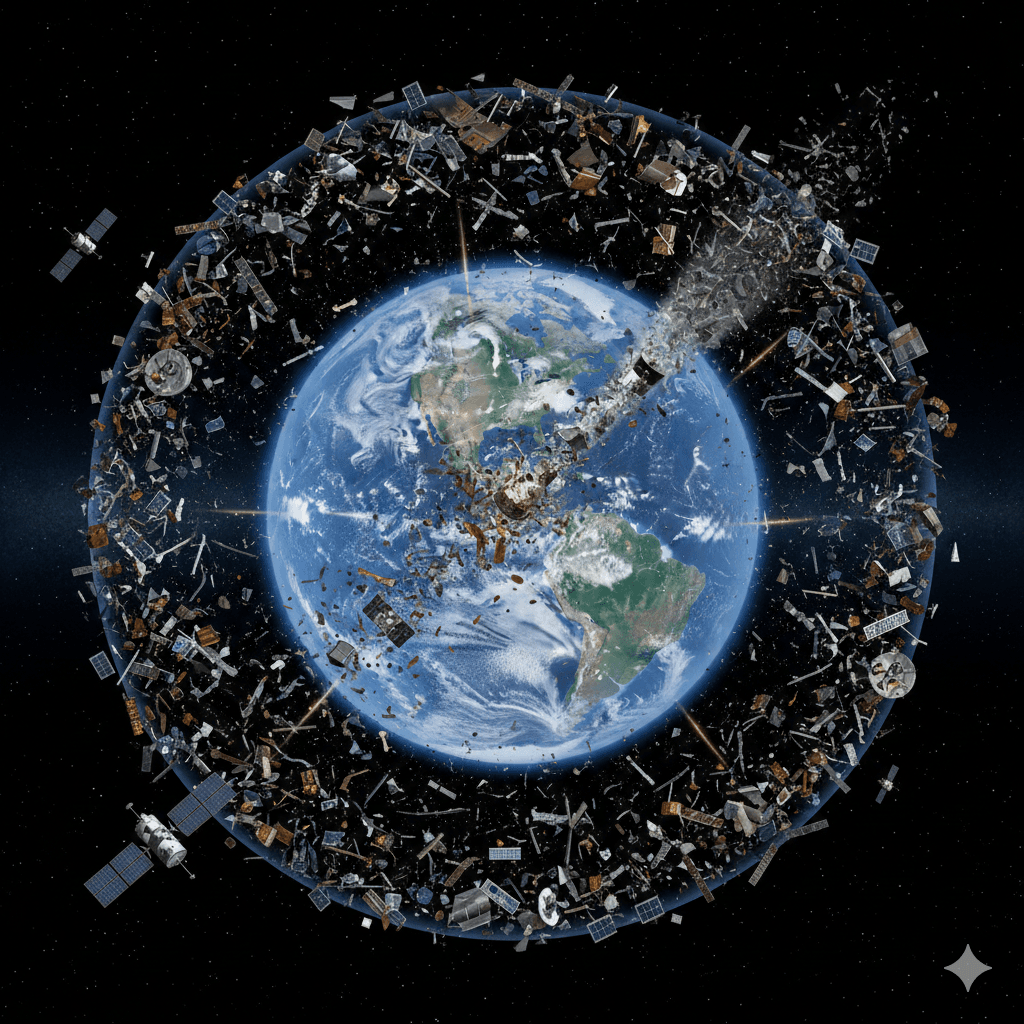
Kessler Syndrome (Generated by Artificial Intelligence)
Leading Researcher | Donald J. Kessler | ||||||||
|---|---|---|---|---|---|---|---|---|---|
Basic Mechanism | High object density, particle production from collisions, particles triggering further collisions, cumulative degradation in orbit | ||||||||
Critical Region | Low Earth orbit (LEO), the altitude band where debris density increases most rapidly | ||||||||
Source of Risk | Defunct satellites, rocket bodies, fragmentation debris, untrackable small particles | ||||||||
Kessler Syndrome is a space environmental issue describing how the increasing density of artificial objects in Earth orbit can trigger a self-sustaining cascade of collisions and fragmentation. This concept is based on the possibility that once the density of objects in low Earth orbit reaches a critical threshold, collisions will generate new debris in a chain reaction, rendering the orbit unusable for extended periods.
The model proposed by Donald J. Kessler and Burton Cour-Palais in 1978 demonstrated that random collisions among objects at a certain density would over time increase the population of small fragments, which in turn would further accelerate the process by damaging larger objects. This process implies that even without launching new satellites, the number of fragments could continue to grow. Subsequent studies by NASA and international research groups popularized the term “Kessler Syndrome” to describe this cascading effect.
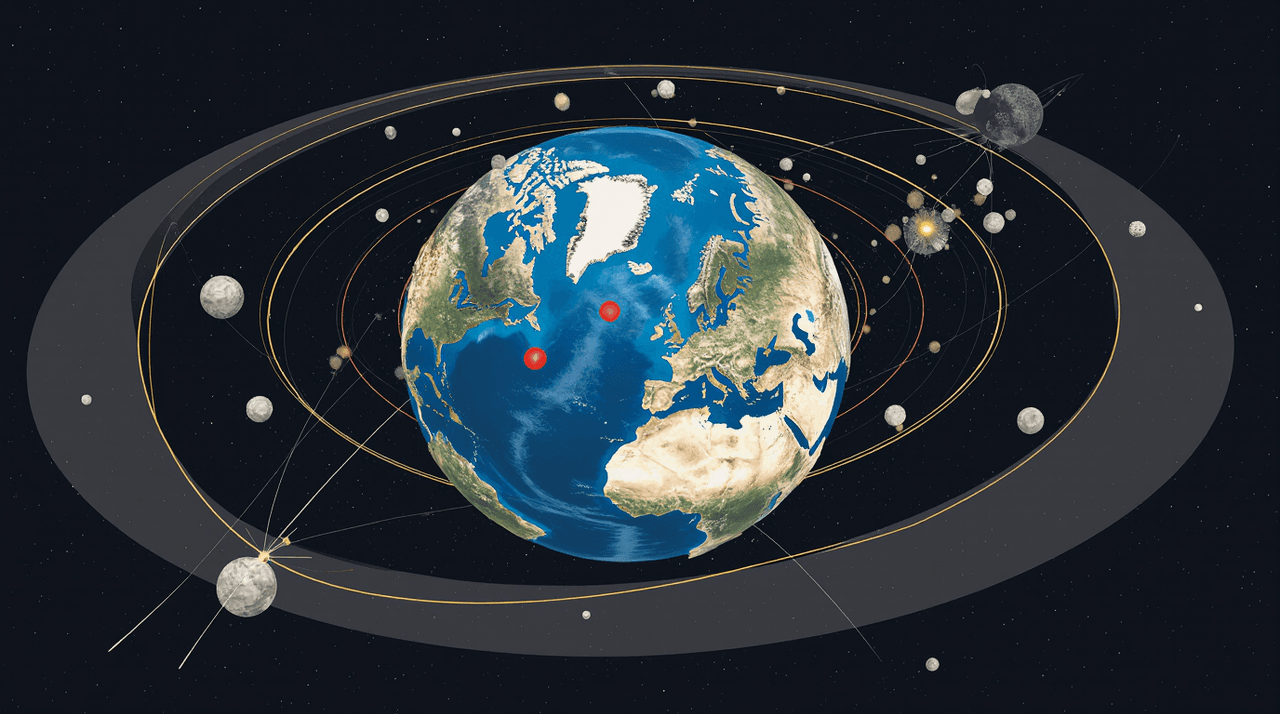
Kessler Sendromu (Yapay Zeka ile Oluşturulmuştur.)
The core dynamics of Kessler Syndrome are determined by altitude, object density, collision energy, and the increasing probability of collisions over time. Debris generated by collisions remains in orbital layers and, due to high relative velocities, even small fragments pose a serious threat to operational satellites. Collision frequency is proportional to the square of the object population; thus, as orbital congestion increases, collisions rapidly become a critical concern. Modern simulation tools such as NASA’s LEGEND model indicate that collision velocities approach critical densities particularly in the 700–1000 km altitude range.
Current observations show that in the LEO region, numerous defunct satellites, rocket bodies, and fragmentation fragments exist alongside operational satellites. Detailed classifications confirm that, in addition to trackable large objects, vastly more numerous small fragments (such as particles under 1 cm in size) represent a significant risk. Since these small particles cannot be directly tracked, collision probabilities are estimated using statistical methods. While atmospheric drag gradually removes some objects from orbit at lower altitudes, this effect is weak at higher altitudes, where debris can remain for thousands of years.
The cascading fragmentation effect can disrupt the stable equilibrium of the orbital environment when the population exceeds a critical threshold. Economic models define this threshold as a function of satellite operational costs combined with collision risk, indicating that as collision-related losses increase, the orbit may become economically unusable in the long term. Stochastic models show that if current trends continue, the cascading collision effect could become a natural outcome over centuries.
If the syndrome materializes, access to orbit will become increasingly difficult, disrupting satellite-based communication, navigation, meteorology, and observation services. This could create widespread vulnerabilities for global trade, transportation, energy infrastructure, and defense systems. Studies emphasize that sectors such as GNSS systems, aviation, and maritime transport are exceptionally vulnerable to such disruptions.
Assessment of Kessler Syndrome employs observation-based catalogs, collision kinetics models, Monte Carlo simulations, and economic optimization models. NASA’s collision models show strong alignment with historical collision statistics and confirm a slow but steady upward trend in collision velocities. Stochastic studies indicate that under certain conditions, the cascading collision process may become inevitable, but can be delayed through effective regulation and technological interventions.
To delay or prevent the onset of the syndrome, international guidelines mandate practices such as post-mission deorbiting, fuel venting, passivation, and collision avoidance. Technical solutions include active debris removal systems, orbital transfer strategies, electromagnetic propulsion systems, and controlled re-entry methods.
Space, in terms of property rights, functions as a global commons. Consequently, the debris generated affects all actors as an externality. Economic models show that regulatory gaps incentivize satellite operators to underinvest in debris mitigation technologies, underscoring the necessity for coordinated international policies. National and multinational space agencies emphasize the importance of shared governance mechanisms to ensure the long-term sustainability of orbital use.
Kessler Syndrome is a slow-moving but long-lasting process triggered when object density in orbit reaches critical levels. Current research indicates that the risk of cascading collisions is currently low under existing densities but may intensify due to rising satellite numbers and mega-constellation projects. Whether the syndrome becomes an inevitable future outcome depends on the effectiveness of technological capacity, international cooperation, and regulatory implementation.
(Official journal link added. I can change it if you'd like.)
Anelí Bongers and José L. Torres. “Orbital Debris and the Market for Satellites.” *Ecological Economics* 209 (2023): 107831. Accessed December 9, 2025.https://doi.org/10.1016/j.ecolecon.2023.107831
Bennett, M. M. “Orbital Debris Requires Prevention and Mitigation across the Satellite Life Cycle.” *Communications Engineering* 4, no. 1 (May 26, 2025): 95. Accessed December 9, 2025.https://doi.org/10.1038/s44172-025-00430-5
Hudson, Julia. “KESSYM: A Stochastic Orbital Debris Model for Evaluation of Kessler Syndrome Risks and Mitigations.” *Journal of Student Research* 12, no. 1 (2023). Accessed December 9, 2025.https://doi.org/10.47611/jsrhs.v12i1.4013
Kessler, Donald J., Nicholas L. Johnson, J. C. Liou, and Mark Matney. “The Kessler Syndrome: Implications to Future Space Operations.” Accessed December 9, 2025.https://aquarid.physics.uwo.ca/kessler/Kessler%20Syndrome-AAS%20Paper.pdf
Mariappan, Amrith, and John L. Crassidis. “Kessler’s Syndrome: A Challenge to Humanity.” *Frontiers in Space Technology* 4 (2023). Accessed December 9, 2025.https://doi.org/10.3389/frspt.2023.1309940
Muralidhar, Arjun. “Unraveling the Kessler Syndrome.” IJCSPUB 13, no. 3 (2023). Accessed December 9, 2025.https://rjpn.org/ijcspub/papers/IJCSP23C1222.pdf
Nomura, K., S. Rella, H. Merritt, M. Baltussen, D. Bird, A. Tjuka, and D. Falk. “Tipping Points of Space Debris in Low Earth Orbit.” *International Journal of the Commons* 18, no. 1 (2024): 17–31. Accessed December 9, 2025.https://www.thecommonsjournal.org/articles/10.5334/ijc.1234
Pasiecznik, Celina, Andrea D'Ambrosio, Daniel Jang, and Richard Linares. “A Dynamical Systems Analysis of the Effects of the Launch Rate Distribution on the Stability of a Source-Sink Orbital Debris Model.” arXiv preprint (2022). Accessed December 9, 2025.https://arxiv.org/abs/2212.01000
Rao, Akhil, and Giacomo Rondina. “The Economics of Orbit Use: Open Access, External Costs, and Runaway Debris Growth.” arXiv preprint (2023). Accessed December 9, 2025.https://arxiv.org/abs/2202.07442
Roll, Daniel S., Zeyneb Kurt, and Wai Lok Woo. “CosmosDSR: A Methodology for Automated Detection and Tracking of Orbital Debris Using the Unscented Kalman Filter.” arXiv preprint (2023). Accessed December 9, 2025.https://arxiv.org/abs/2310.17158

Kessler Syndrome (Generated by Artificial Intelligence)
Leading Researcher | Donald J. Kessler | ||||||||
|---|---|---|---|---|---|---|---|---|---|
Basic Mechanism | High object density, particle production from collisions, particles triggering further collisions, cumulative degradation in orbit | ||||||||
Critical Region | Low Earth orbit (LEO), the altitude band where debris density increases most rapidly | ||||||||
Source of Risk | Defunct satellites, rocket bodies, fragmentation debris, untrackable small particles | ||||||||
Historical Context
Physical Mechanism and Collision Dynamics
Current State of the Orbital Environment
Cascading Effect and Threshold Conditions
Sectoral and Societal Impacts
Economic and Political Dimensions