


This article was automatically translated from the original Turkish version.
15 July Coup Attempt
July 15 Coup Attempt
History | 2016-07-15 | ||||||||
|---|---|---|---|---|---|---|---|---|---|
Result | The coup attempt ended in failure | ||||||||
Losses | 253 martyrs 2737 veterans | ||||||||
Commemoration Day | July 15 Democracy and National Unity Day | ||||||||
On July 15–16, 2016, a coup attempt was carried out by a group of so-called military personnel affiliated with the Fethullahist Terrorist Organization (FETO/PDY) under the name “Council for Peace at Home” within the Turkish Armed Forces. Planned under the orders of FETO’s leader Fetullah Gülen, this attempt involved plotting an assassination against President Recep Tayyip Erdoğan, who was elected by the people’s votes, bombing the Türkiye Grand National Assembly, closing the Bosphorus and Fatih Sultan Mehmet Bridges to traffic, targeting strategic institutions, and causing harm to civilians.
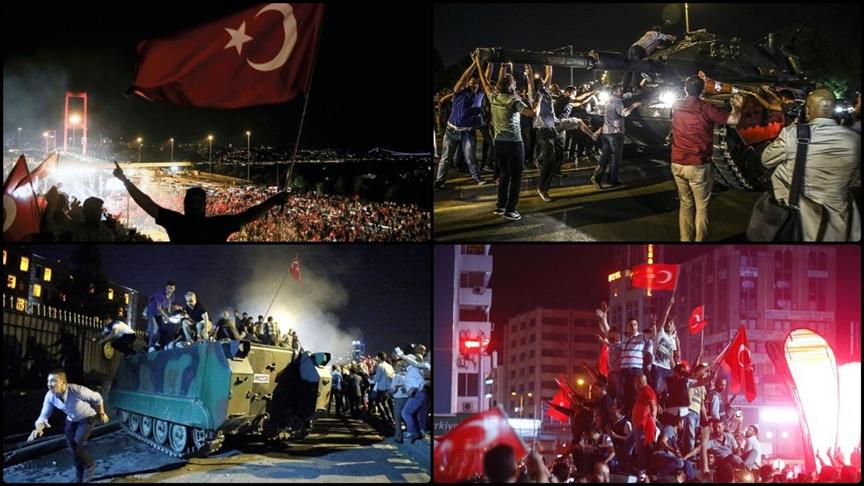
An Image Depicting the July 15 Coup Attempt (AA)
Thanks to the resistance of citizens who took to the streets following President Recep Tayyip Erdoğan’s appeal to the nation, the coup attempt was thwarted and Türkiye achieved a significant victory in its democratic history. This event has been recorded in history as a concrete example of the Turkish nation’s commitment to democracy and national will. A total of 253 people were martyred and 2,737 were wounded during the events. Since July 15, 2017, this day has been officially declared as a public holiday known as July 15 Democracy and National Unity Day. Today, it has become a symbol of our nation’s struggle for democracy and unity.
For many years, the FETO/PDY terrorist organization infiltrated the Turkish Armed Forces and other key state institutions to establish a parallel structure. The organization sought to weaken state institutions and eliminate patriotic personnel. Upon learning in the 2016 High Military Council meeting that its own members were to be purged, it launched the coup attempt. This event is regarded as a serious threat to the Republic of Türkiye and national will.
FETO’s aim to seize control of the state has been thoroughly documented in official indictments and the report of the TBMM July 15 Coup Attempt Investigation Commission. The organization infiltrated institutions through its “imam” and “abi” system, creating major risks to national security. This parallel structure aimed to weaken the state’s fundamental institutions and ultimately bring them under its control. FETO’s long-term strategy was based on infiltrating and taking command positions within all critical state institutions.
On July 15, 2016, FETO-affiliated coup plotters launched their operation under the code name “Operation Peace at Home.” Based on intelligence gathered by the National Intelligence Organization, the General Staff took precautionary measures; however, upon realizing they had been compromised, the plotters accelerated their timetable and initiated their operation on the evening of July 15. The initial warnings received during this period were crucial in revealing the scale of the coup attempt.
The Bosphorus Bridge and Fatih Sultan Mehmet Bridge were closed to traffic by a group of coup-affiliated soldiers. At the same time, F-16 fighter jets and helicopters began low-altitude flights over Ankara’s skies. KC-135R tanker aircraft that had taken off from Incirlik Air Base enabled the fighter jets to remain airborne for extended periods.
A coup declaration signed by the “Council for Peace at Home” was broadcast from the official website of the Turkish Armed Forces and TRT television channels. The announcement declared that the military had taken control of the government, imposed martial law, and instituted a curfew. It also contained negative propaganda targeting the government and the President.
President Recep Tayyip Erdoğan connected live via CNN Türk. In a conversation with Ankara correspondent Hande Fırat, he condemned the coup attempt and called on the public to “go to the squares, head to the airports, and do not allow the coup plotters passage.” This historic appeal was heard immediately across all corners of Türkiye and became a turning point in mobilizing citizens to take to the streets. Simultaneously, following a directive from the Directorate of Religious Affairs, congregational prayers began to be recited from mosques.
President Erdoğan’s Call to the Public (Yeni Şafak)
The General Directorate of Security also urgently summoned all personnel. Throughout the night, intense clashes occurred at the Bosphorus and Fatih Sultan Mehmet Bridges in Istanbul, in front of the Presidential Complex and the Grand National Assembly in Ankara, at the General Directorate of Security, and at the National Intelligence Organization building. The coup plotters bombed the Grand National Assembly four times. Attacks were carried out against the Presidential Complex, security buildings, and TÜRKSAT facilities.
Citizens stood in front of tanks, helicopters, and F-16s, demonstrating heroic resistance. After midnight, civilians walked onto tanks at the Bosphorus Bridge. In Ankara, the overwhelming resistance of the public in front of the Presidential Complex and in Kızılay repelled the coup plotters. Even as the Grand National Assembly was being bombed, members of parliament remained inside maintaining a democratic vigil. Clashes also occurred at the General Staff headquarters and the National Intelligence Organization building. The coup plotters attempted to seize control of TÜRKSAT facilities but were blocked by security forces. Intense fighting also erupted at Çengelköy Police Station and Vezneciler.
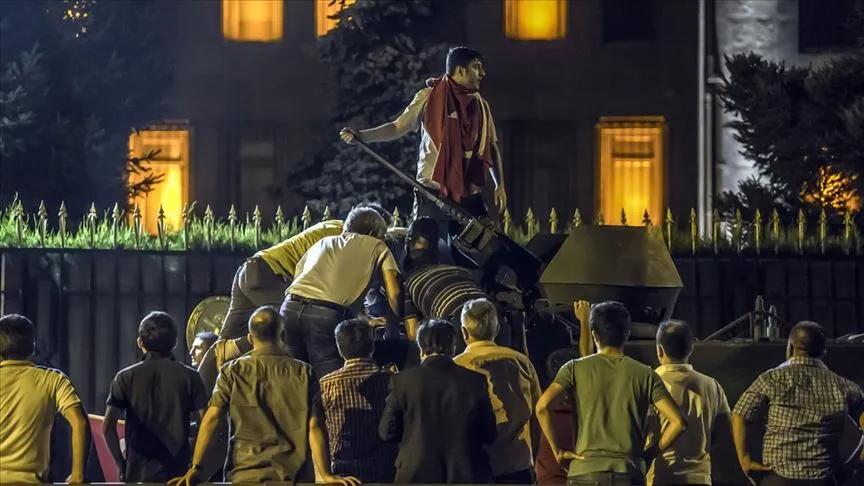
Citizens Who Took to the Streets Against the Coup (AA)
President Recep Tayyip Erdoğan landed at Atatürk Airport aboard the TC-ATA aircraft. A large crowd had gathered at the airport to welcome him. In his press statement at the airport, the President encouraged the nation and emphasized that the struggle against the coup attempt was ongoing.
Footage of Martyred Junior Sergeant Ömer Halisdemir Shooting and Killing Coup-Loyal Brigadier General Semih Terzi (Anadolu Agency)
At Akıncı Air Base, where the air operations of the coup were coordinated, FETO’s Special Forces Commander Brigadier General Semih Terzi arrived with a group of soldiers to seize control of the base. At that moment, Junior Sergeant Ömer Halisdemir, serving at the 2nd Main Jet Base, shot and neutralized terrorist leader Semih Terzi. This courageous intervention largely disrupted the coup plotters’ air operations and altered the course of the coup attempt. Ömer Halisdemir was martyred during this act and became one of the most important symbols of July 15.
The coup attempt was fully suppressed through a joint operation by the Turkish Armed Forces and the General Directorate of Security, and the coup plotters surrendered. Point operations were conducted at strategic locations of the coup, beginning with Akıncı Air Base. Commanders such as 1st Army Commander General Ümit Dündar and Special Forces Commander Zekai Aksakallı issued statements opposing the coup.
Coup attempts in cities such as Adana, Bitlis, Denizli, Kars, Kocaeli, Malatya, Marmaris, Mersin, Sakarya, and Şırnak were thwarted by the resistance of security forces, gendarmerie, and citizens. Heroic acts occurred in every city, and the coup plotters were quickly neutralized. This resistance across the country prevented the coup attempt from spreading nationwide.
FETO attempted to assassinate President Recep Tayyip Erdoğan in Marmaris. Helicopters and special forces units that had taken off from Çiğli 2nd Main Jet Base attacked the hotel where the President was staying, but President Erdoğan had already left the area. The attempt failed. This assassination plot clearly revealed FETO’s hatred toward the President and the Turkish nation.
During the events of the night of July 15, 253 people were martyred and 2,737 were wounded. Of the martyrs, 184 were civilian citizens, 63 were police officers, and six were soldiers. Among these losses are Erol Olçok and his son Abdullah Tayyip Olçok, who stood in front of tanks at the Bosphorus Bridge; İlhan Varank, who was martyred in Saraçhane; and many other citizens. Our wounded continue to live in the memory of this nation with their injuries. The sacred memories of our martyrs and the sacrifices of our wounded are the most concrete manifestations of the price the Turkish nation paid for democracy and love of homeland. Each martyr has become a shared grief of the nation and a symbol of unity and solidarity. Our wounded continue to serve as examples through their heroism despite their injuries. Significant material damage also occurred during the events.
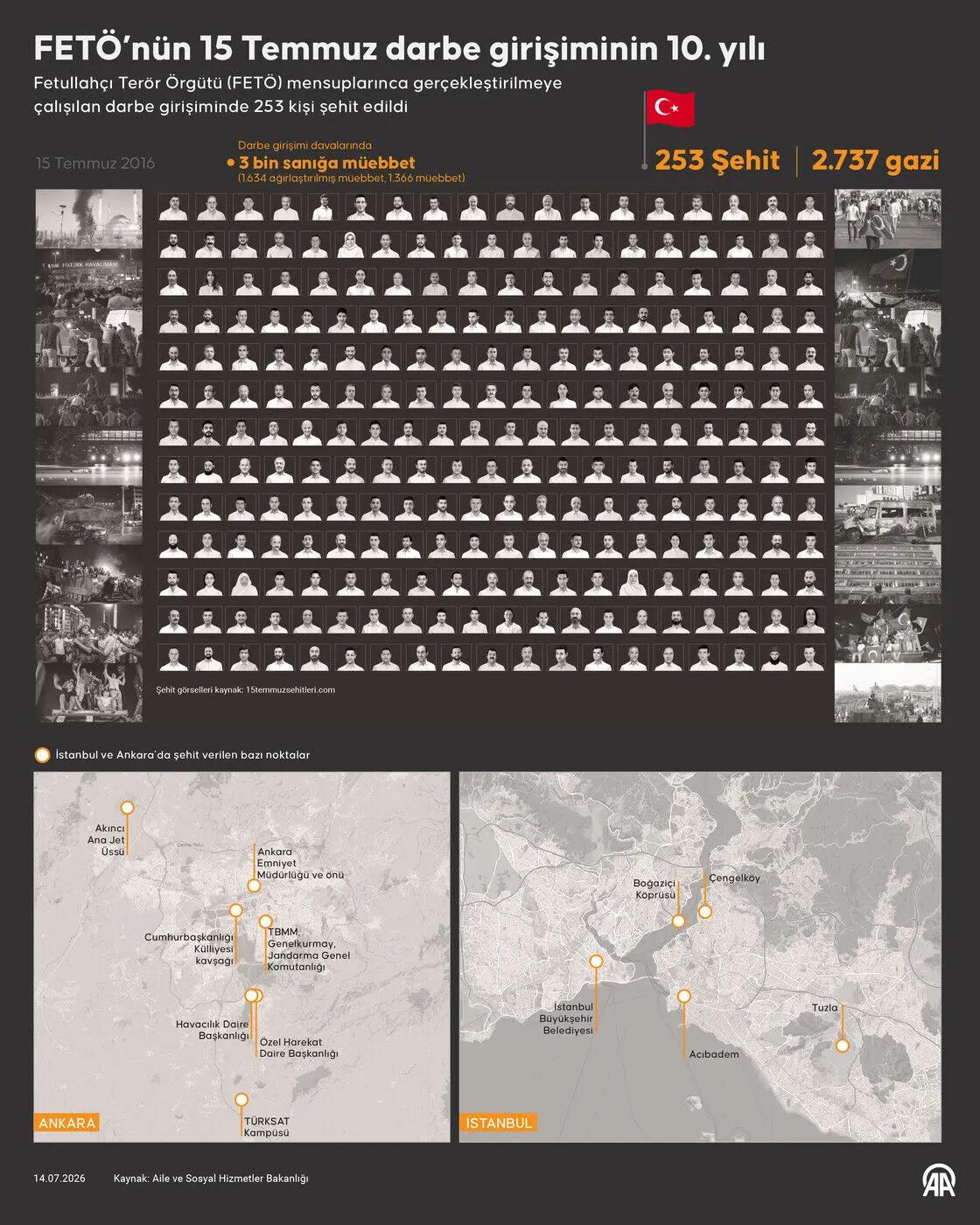
15 July Martyrs (AA)
The Grand National Assembly building suffered heavy damage, the Presidential Complex and General Directorate of Security were targeted, TÜRKSAT facilities were attacked, and bridges, roads, and other strategic structures were damaged. The coup attempt caused billions of dollars in public losses. These damages were rapidly repaired by the state, and the affected buildings were reopened for service in a short time.
Although July 15 is one of the darkest nights in Turkish history, it has also become one of the brightest victories due to the resistance shown by our nation. These losses once again demonstrated the immense sacrifice required to defend democracy.
Following the coup attempt, large-scale operations were launched against the FETO/PDY terrorist organization. A State of Emergency (OHAL) was declared and decrees with the force of law were issued. The State of Emergency ended on July 19, 2018. These measures were taken to combat the terrorist organization and ensure state security. Through these operations, state institutions were cleansed of FETO’s influence and strengthened with personnel loyal to national will. FETO-linked structures within the Turkish Armed Forces, security forces, judiciary, and bureaucracy were largely eliminated. This process strengthened Türkiye’s internal security and made the country more prepared to confront future threats.
The July 15, 2016 coup attempt turned the information domain into an intense battlefield alongside physical interventions. While the coup elements sought to take control of traditional media outlets, an alternative narrative was rapidly organized through social media and mobile communication tools. President Recep Tayyip Erdoğan’s live broadcast on CNN Türk, calling the public to the streets, along with widespread hashtag campaigns, significantly undermined the narrative the coup plotters tried to control. Throughout the night and afterward, FETO’s disinformation campaigns, conducted through various methods, aimed to create panic among the public. Much of this false information was quickly debunked by official statements and visual verification.
After the events, there emerged a need for a more systematic approach to combating disinformation. During this period, initiatives under the Presidency of Communication strengthened inter-institutional coordination. The Disinformation Combat Center (DMM) played a key role in monitoring disinformation content and ensuring the public received accurate information.
Communication Director Burhanettin Duran emphasized that the fight against terrorist organizations’ digital activities was being carried out with determination, highlighting that identified digital structures were systematically producing disinformation and engaging in organized efforts to manipulate public opinion. Duran stated that Türkiye continues its fight against terrorism not only on the physical battlefield but also in digital spaces with the same determination, legal legitimacy, and coordination. Under the coordination of the Presidency of Communication, the Ministry of Justice, the General Directorate of Security’s Cybercrime Prevention Unit, and the Information and Communication Technologies Authority blocked access to more than 4,300 accounts linked to FETO. The spread of FETO’s black propaganda on Siber Vatan was prevented.
From the outset of its terrorist activities, FETO employed the tactic of infiltrating media and deploying influence agents. While establishing its own media outlets, it secretly placed operatives within other institutions to conduct propaganda campaigns and engage in perception operations during the December 17–25 operations involving the judiciary-police-media triangle. Its goal was to gradually discredit the legitimate government and condition public opinion.
In the weeks and months preceding the coup, FETO conducted perception preparation through subliminal and symbolic messages. Through advertisements, headlines, and speeches by its leader Fetullah Gülen, it delivered hidden messages to lay the groundwork for the coup and motivate its base.
On the night of July 15, during the execution phase, FETO deployed the tactic of “big lies” and chaos creation. Through rapidly spreading falsehoods on social media, it attempted to break public resistance by claiming, for example, that “President Erdoğan’s plane had fled,” “the Director of Security had ordered surrender,” and by broadcasting footage of foreign conflicts as if they were occurring in Türkiye. Its aim was to create an atmosphere of civil war and demoralize the resistance.
FETO continued its perception management using its primary tool: social media troll armies and bot networks. Through fake accounts and organized troll groups, it poisoned the public agenda and attempted to spread international chaos under the hashtag #TurkeyCoup. Its aim was to conceal the truth and incite public condemnation against those standing against the coup.
In its long-term post-coup strategy, FETO effectively employed the narrative of victimhood and the “innocent movement” image alongside the KHK narrative. It attempted to preserve its image as educators and preachers by calling itself the “Service Movement,” and labeled those dismissed under KHKs as victims of “human rights violations” and “witch hunts.” Through videos on KHK TV and Facebook groups with slogans such as “We were acquitted but not reinstated,” it sought to reverse the state’s self-defense reflex, isolate Türkiye on international platforms, and motivate its base.
Since the night of the coup and continuing to the present day, FETO has consistently used the narrative of obfuscating responsibility and alleging a “conspiracy” or “staged event.” It has attempted to blame state institutions for the coup to conceal its own role and cultivate a victim image in international public opinion.
Since 2018, FETO has shifted to perception operations on YouTube. After its traditional media channels were shut down, it began publishing long videos and victim narratives through channels that appeared “independent,” aiming to influence younger generations and the diaspora.
Due to its inability to access traditional media and the exposure of its propaganda, FETO has continued producing disinformation through masked and cryptic social media accounts. The organization has created fake accounts under leftist, liberal, or conservative identities without using the “FETO” label, continuing to poison the agenda and target specific groups. Through this method, the organization not only evades administrative and legal measures but also seeks to present its terrorist ideology as widely accepted views.
With the failure of the July 15 coup attempt, Türkiye’s struggle against FETO/PDY gained new momentum. The name of the Bosphorus Bridge in Istanbul was changed to July 15 Martyrs Bridge, and Kızılay Square, along with numerous streets, squares, buildings, schools, and institutions, have been named in memory of the July 15 martyrs. Every year on July 15, commemoration ceremonies are held with the participation of President Recep Tayyip Erdoğan, honoring the martyrs and recognizing the wounded.
Democratic vigils have become one of the most important symbols of July 15 Democracy and National Unity Day. This event demonstrated Türkiye’s resistance to internal threats and accelerated reform processes within state institutions.
During the State of Emergency period, FETO’s parallel structure was largely dismantled. July 15 has also become a lasting reminder that the will of the people and democratic vigilance will prevail over any threat. This legacy will be passed on to future generations and will continue to guide Türkiye’s journey toward democracy. July 15 has secured its place in the collective memory as one of the strongest examples of the Turkish nation’s historic struggle for independence.
Anadolu Ajansı. Bozğun, Mehmet Yaren. “FETÖ’nün 15 Temmuz Darbe Girişiminin 10. Yılı.” Infographic. July 14, 2026. Accessed July 14, 2026.https://www.aa.com.tr/tr/info/infografik/52977.
Anadolu Ajansı. Budak, Cemil Murat, and Neriman Senanur Torun. “FETÖ’nün Darbe Girişiminin Üzerinden 9 Yıl Geçti.” July 13, 2025. Updated July 16, 2025. Accessed July 14, 2026.https://www.aa.com.tr/tr/15-temmuz-darbe-girisimi/fetonun-darbe-girisiminin-uzerinden-9-yil-gecti/3629530.
Anadolu Ajansı. Şahin, Halil. “Türkiye’nin En Karanlık ve Kanlı Gecesinde Yaşananlar.” July 13, 2019. Updated July 15, 2019. Accessed July 14, 2026.https://www.aa.com.tr/tr/15-temmuz-darbe-girisimi/turkiyenin-en-karanlik-ve-kanli-gecesinde-yasananlar/1530628.
Anadolu Ajansı. “Boğaziçi Köprüsü’nün Yeni Adı 15 Temmuz Şehitler Köprüsü Oldu.” July 25, 2016. Accessed July 14, 2026.https://www.aa.com.tr/tr/gunun-basliklari/bogazici-koprusunun-yeni-adi-15-temmuz-sehitler-koprusu-oldu/615533
Anadolu Ajansı. “FETÖ’nün Askerî Kanat Planlayıcısı General Harmancık’a 141 Kez Ağırlaştırılmış Müebbet.” Barış Kılıç. June 20, 2019. Updated July 12, 2019. Accessed July 14, 2026.https://www.aa.com.tr/tr/15-temmuz-darbe-girisimi/fetonun-askeri-kanat-planlayicisi-general-harmancika-141-kez-agirlastirilmis-muebbet/1510719
Anadolu Ajansı. “FETÖ’nün Güncel Yapılanmasında İzlenen Yeni Yöntemler Deşifre Oldu.” Emrah Gökmen and Zeynep Yeşildal. July 14, 2026. Accessed July 14, 2026.https://www.aa.com.tr/tr/gundem/fetonun-guncel-yapilanmasinda-izlenen-yeni-yontemler-desifre-oldu/3997294
Anadolu Ajansı. “Kazan İlçesinin Adı ‘Kahramankazan’ Oldu.” October 25, 2016. Updated October 26, 2016. Accessed July 14, 2026.https://www.aa.com.tr/tr/gunun-basliklari/kazan-ilcesinin-adi-kahramankazan-oldu/672250
Anadolu Ajansı. “OHAL 3 Ay Daha Uzatıldı.” April 18, 2017. Updated April 19, 2017. Accessed July 14, 2026.https://www.aa.com.tr/tr/gunun-basliklari/ohal-3-ay-daha-uzatildi/799943
Anadolu Ajansı. “Şehit Ömer Halisdemir’in İsmi 251 Bebeğe Verildi.” Sertaç Bulur ve Orhan Onur Gemici. September 21, 2016. Accessed July 14, 2026.https://www.aa.com.tr/tr/yasam/sehit-omer-halisdemirin-ismi-251-bebege-verildi/649666
BBC News Türkçe. “OHAL 3 Ay Daha Uzatıldı.” Accessed July 14, 2026.https://www.bbc.com/turkce/haberler-dunya-39628464
BBC News Türkçe. “TBMM Darbe Komisyonu 15 Temmuz Raporu: ‘Sorumlu FETÖ.’” Accessed July 14, 2026.https://www.bbc.com/turkce/haberler-turkiye-40047809
CNN TÜRK. “Başkomutan’dan Halkına Çağrı!” YouTube, Accessed July 14, 2026.https://www.youtube.com/watch?v=czCknVm14dc.
Hâkimler ve Savcılar Yüksek Kurulu. “Genel Kurul Kararı, Karar No. 2016/428.” August 31, 2016. PDF. Accessed July 14, 2026.https://www.hsk.gov.tr/Eklentiler/files/gerekceli-karar.pdf
Hürriyet. “TBMM Bombalandı.” Accessed July 14, 2026.https://www.hurriyet.com.tr/tbmm-bombalandi-40148612
Karar. "Malatya 2. Ordu Komutanlığı’nda Hareketli Saatler: 2 Tank Halka Ateş Açtı." July 16, 2016. Updated July 16, 2016. Accessed July 14, 2026.https://www.karar.com/malatya-2-ordu-komutanliginda-hareketli-saatler-2-tank-halka-ates-acti-son-dakika-188532.
Milliyet. “Marmaris’te Helikopterden Ateş.” Accessed July 14, 2026.https://www.milliyet.com.tr/marmaris-te-helikopterden-ates-gundem-2278703/
NTV Haber. “Kamu Kurumlarında İzinler İptal.” Accessed July 14, 2026.https://www.ntv.com.tr/ekonomi/kamu-kurumlarinda-izinler-iptal,6vtS7RtJqUKVf0n3pymzTQ
NTV Haber. “MİT’ten Açıklama: Genelkurmay Başkanı Görevinin Başındadır.” July 16, 2016. Updated July 16, 2016. Accessed July 14, 2026.https://www.ntv.com.tr/turkiye/mit-darbe-puskurtuldu,40idhwEqWEexMJUdwRwwUw
Police Academy Presidency. *Yeni Nesil Terör: FETÖ’nün Analizi—FETÖ Çalıştay Raporu*. Report no. 10. Police Academy Publications 31. Ankara: Police Academy Presidency, 2017. PDF. Accessed July 14, 2026.https://cdn2.pa.edu.tr/Upload/Rapor/Dosya/yeni-nesil-teror-fetoe28099nun-analizi.pdf
Presidency of Communications. *Halkın Gücünün Üstünde Bir Güç Yoktur*. Ankara: Presidency of Communications Publications, 2026. Accessed July 14, 2026.https://yayinlar.iletisim.gov.tr/detay/halkin-gucunun-ustunde-bir-guc-yoktur
Presidency of Communications. _15 July Epic at Its 10th Anniversary: Memory, Resistance, and Future_. Ankara: Presidency of Communications Publications, 2026. Accessed July 14, 2026.https://yayinlar.iletisim.gov.tr/detay/10-yilinda-15-temmuz-destani-hafiza-direnis-ve-gelecek.
Presidency of Communications. _15 Temmuz Darbe Girişimi ve Toplumsal Belleğin Hafıza Mekânları_. Ankara: Presidency of Communications Publications, 2023. Accessed July 14, 2026.https://yayinlar.iletisim.gov.tr/detay/15-temmuz-darbe-girisimi-ve-toplumsal-bellegin-hafiza-mekanlari.
TRT Haber. “FETÖ ile Bağlantılı 2 Bin 702 Sosyal MedyaHesabına Erişim Engeli.” July 12, 2026. Accessed July 14, 2026.https://www.trthaber.com/haber/gundem/feto-ile-baglantili-2-bin-702-sosyal-medya-hesabina-erisim-engeli-950986.html
Yargıtay Başkanlığı. “Fettullahçı Terör Örgütüne (FETÖ/PDY) Yönelik Mücadeleye İlişkin Kamuoyu Açıklaması.” Accessed July 14, 2026.https://www.yargitay.gov.tr/sayfa/fettullahci-teror-orgutune-fetopdy-yonelik-mucadeleye-iliskin-kamuoyu-aciklamasi/1309
Yeni Şafak. Duyan, Uğur. “Yalanların Kaynağı FETÖ ve Sol Örgütler: Dezenformasyonun Kaynağı FETÖ.” Accessed July 14, 2026.https://www.yenisafak.com/gundem/yalanlarin-kaynagi-feto-ve-sol-orgutler-dezenformasyonun-kaynagi-feto-3857758

15 July Coup Attempt
July 15 Coup Attempt
History | 2016-07-15 | ||||||||
|---|---|---|---|---|---|---|---|---|---|
Result | The coup attempt ended in failure | ||||||||
Losses | 253 martyrs 2737 veterans | ||||||||
Commemoration Day | July 15 Democracy and National Unity Day | ||||||||
No Discussion Added Yet
Start discussion for "July 15 Coup Attempt" article
Background
Development of Events
Preceding Events and Initial Warnings
Critical Hours in Ankara and Istanbul
Around 10:00 PM on July 15, 2016
10:30 PM
11:00 PM
4:00 AM
Critical Development at Akıncı Air Base
Morning of July 16
Resistance in Other Cities
Assassination Attempt Against the President
Losses and Damage
Struggle Against FETO
Struggle Against FETO’s Media Wing
FETO’s Disinformation Tactics
Infiltration of Media and Influence Agents
Preparation of Perception Through Subliminal and Symbolic Messages
“Big Lies” and Chaos Creation During the Coup
Perception Management Through Social Media Troll Armies and Bot Networks
Creating a Victim and “Innocent Movement” Image and the KHK Narrative
Conspiracy and “Staged Event” Allegations
Perception Operations on YouTube
Masked and Cryptic Social Media Accounts
Outcomes and Legacy