


This article was automatically translated from the original Turkish version.
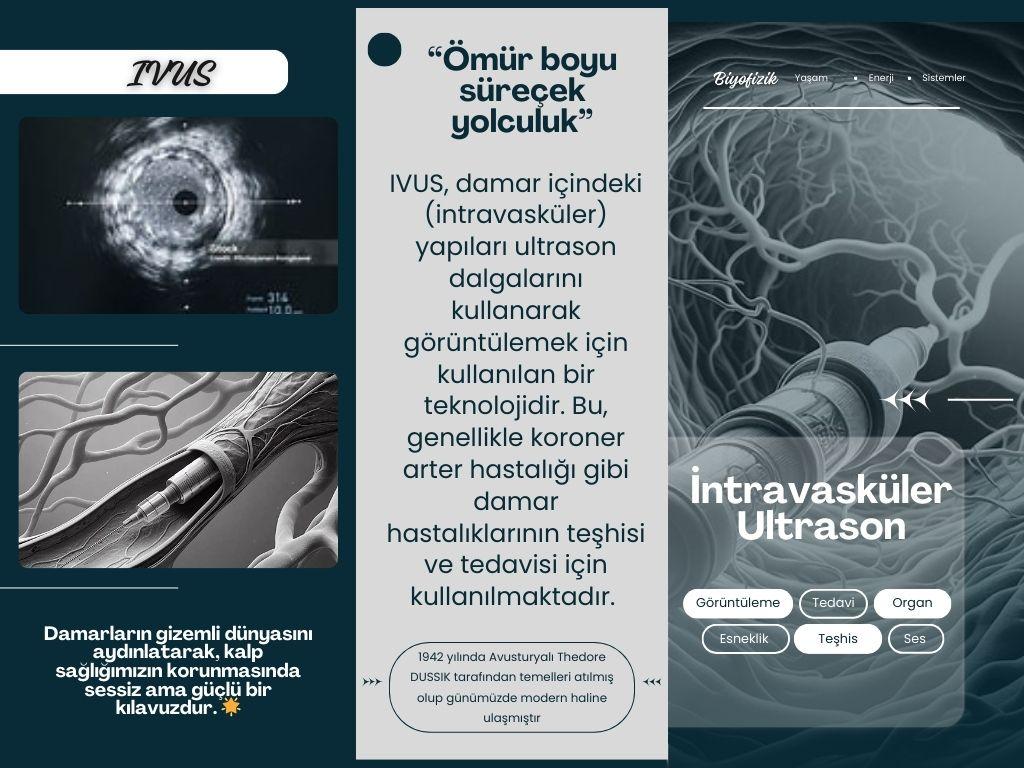
Intravascular Ultrasound
Frequency Range | 10 MHz – 60 MHz | ||||||||
|---|---|---|---|---|---|---|---|---|---|
Catheter Diameter | 2.6F – 3.5F (1F = 0.33 mm) | ||||||||
Imaging Depth | 5 mm – 10 mm | ||||||||
Processing Time | 5 – 15 minutes | ||||||||
Intravascular ultrasound (IVUS) is a minimally invasive imaging technique whose foundations were laid in 1942 by Austrian scientist Theodore Dussik to examine the internal structure of blood vessels in detail. This technology plays a critical role in the diagnosis and treatment planning of vascular diseases. Today it is primarily used for detecting pathological formations in the cardiovascular system common. The high-resolution images provided by IVUS support clinical decision-making by offering information unattainable through conventional angiographic methods.
Fundamental Principles of IVUS Technology
Cardiovascular diseases are one of the most prevalent health problems worldwide world, necessitating early diagnosis and effective treatment approaches. Standard angiographic techniques provide a two-dimensional view of the vascular lumen but offer limited information regarding structural changes in the vessel wall. IVUS, by imaging the interior of blood vessels from a circumferential perspective, enables detailed analysis of plaque formation, stenoses, and changes in vessel wall thickness.
Intravascular ultrasound (IVUS) operates by inserting a thin catheter equipped with a transducer at its tip that emits high-frequency ultrasound waves into the blood vessel. As the catheter advances within the vessel, the ultrasound waves strike the vessel wall and reflect back. These reflections are analyzed by computer-assisted systems to generate real-time, high-resolution cross-sectional images, allowing the vascular structure to be detailed in three dimensions.
1. Coronary Artery Disease and Plaque Assessment: Atherosclerotic plaques in coronary arteries can lead to severe vessel narrowing that may trigger heart crises. IVUS aids in guiding treatment by determining the composition, density, and relationship of these plaques to the vessel wall.
2. Follow-up After Stenting and Balloon Angioplasty: Achieving optimal stent placement is essential for successful outcomes importance supply. IVUS can verify that the stent has been fully expanded and properly apposed to the vessel wall. In cases of inadequate expansion or irregular placement, it enables necessary corrections.
3. Imaging of Complex Vascular Structures: In complex vascular conditions such as bifurcation lesions and chronic total occlusions like, IVUS provides detailed characterization of lesion features, facilitating more accurate treatment planning.
In recent years, IVUS systems have increasingly incorporated high-frequency ultrasound waves and artificial intelligence-assisted analytical methods. These advancements enable clearer visualization of vascular structures and the development of automated diagnostic algorithms. Particularly when used in conjunction with optical coherence tomography (OCT) combination, IVUS’s diagnosis sensitivity is significantly enhanced important. In the future, IVUS technology is expected to be supported by more miniaturized and flexible catheters, advanced image processing algorithms, and wireless systems small.
Chen, Z., Wang, Y., Li, X., and Yang, X. "Mechanically Rotating Intravascular Ultrasound (IVUS) Transducer: A Review." Sensors 21, no. 11 (2021): 3907.
Mintz, G. S., and Maehara, A. "Advances in Intravascular Imaging." Circulation: Cardiovascular Interventions 2, no. 5 (2009): 482–90.
Nissen, S. E., and Yock, P. "Intravascular Ultrasound: Novel Pathophysiological Insights and Current Clinical Applications." Circulation 103, no. 4 (2001): 604–16.
Intravascular Ultrasound
Frequency Range | 10 MHz – 60 MHz | ||||||||
|---|---|---|---|---|---|---|---|---|---|
Catheter Diameter | 2.6F – 3.5F (1F = 0.33 mm) | ||||||||
Imaging Depth | 5 mm – 10 mm | ||||||||
Processing Time | 5 – 15 minutes | ||||||||
No Discussion Added Yet
Start discussion for "Intravascular Ultrasound" article
Principle of IVUS Operation
Clinical Applications
Technological Advancements and Future Perspectives