


This article was automatically translated from the original Turkish version.
Hydrogels are biomaterials that can be engineered to respond sensitively to numerous parameters such as temperature, pH, magnetic field, electric field, and light among others, and are frequently used for various purposes. They are applied either invasively, by injection into the body, or non-invasively, through external contact with the body.
Hydrogels are defined as three-dimensional hydrophilic networks. Their most fundamental characteristic is their ability to retain water within their structure without deformation. Although they are known to be resistant to organic solvents, in suitable solvent environments they can swell up to nearly 1000 times their original physical dimensions, with a minimum water absorption of 10–20%. Since hydrogels interact with living tissues, the most important requirements during their development are that they be biodegradable and biocompatible. Another key requirement is that they must be non-cytotoxic, meaning they should not produce toxic effects when applied to the body. In particular, hydrogels intended for skin contact must be produced in a porous form with antimicrobial properties.
The main components of hydrogels are: Polymer, water or another biological fluid, and a cross-linking agent that binds them together. The composition of the developed hydrogel is enriched according to its target region and purpose. A single polymer may be used, or multiple polymers may be combined to leverage their respective properties. While water was traditionally the most common liquid component, in modern hydrogels developed for drug delivery, the liquid phase often includes the drug itself.
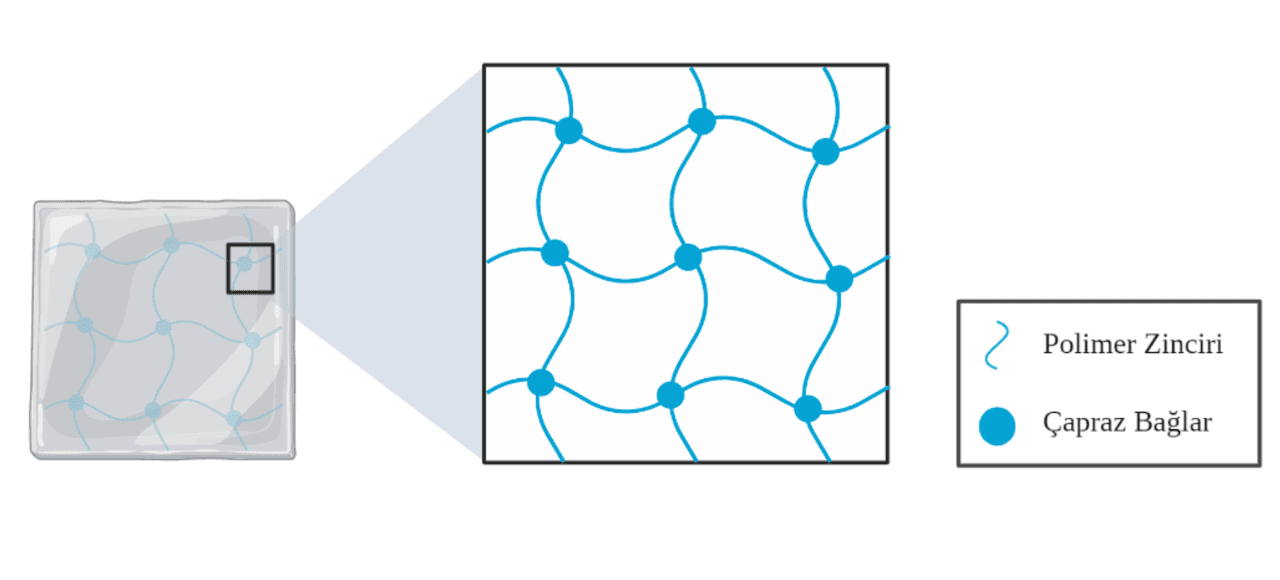
An image showing the polymer structure of a hydrogel
Selecting a polymer suitable for the intended purpose of the hydrogel is one of the most critical stages in its production. Both natural and synthetic polymers can be chosen. For example, in wound healing applications, chitosan derived from crustacean shells or fungi, or polyvinyl alcohol as a synthetic polymer, may be selected. However, the target site, the intended effect, and other factors such as incompatible substances must differ between these two polymers. Beyond these two examples, numerous other polymer options exist, including natural polymers such as keratin, collagen, cellulose, gelatin, and alginate, or synthetic polymers such as poly(ethylene glycol) (PEG), poly(acrylic acid) (PAA), and poly(lactic-co-glycolic acid) (PLGA). The most fundamental principle in hydrogel production is selecting the most appropriate polymer for the target application or combining multiple polymers to achieve desired properties, followed by integrating them with compatible materials using optimal methods to maximize functionality.
To enhance swelling and water absorption capacity, cross-linking agents such as glutaraldehyde or calcium are used. Stabilizers and preservatives extend shelf life, while fillers help achieve desired mechanical properties. In systems designed for use with magnetic or electric fields—recent studies have shown that specific frequencies at controlled doses can promote resolution of certain bodily conditions—nanocomposite and nanoparticle materials are added to improve conductivity and antimicrobial properties.
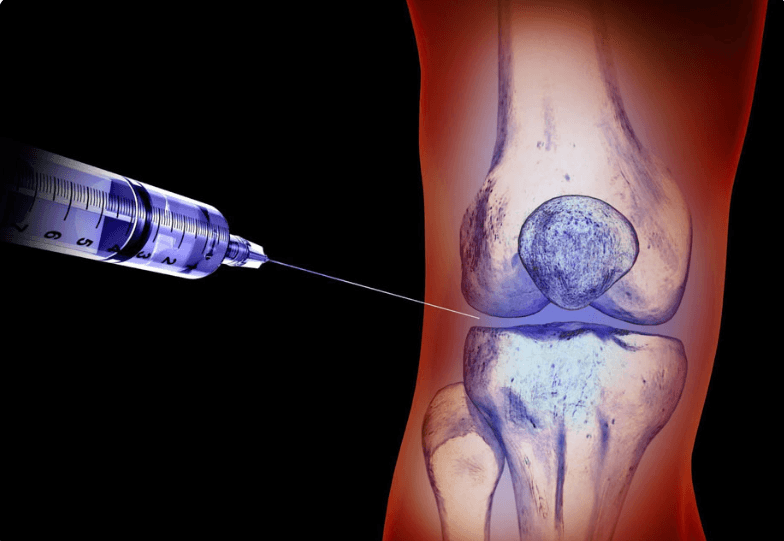
An image of a hydrogel injected in liquid form
Depending on their intended use, hydrogels can be applied in a more liquid form via injection into the body. Alternatively, after all components are prepared according to requirements, they can be dried under appropriate conditions or fabricated using 3D printing techniques to form solid gel structures.
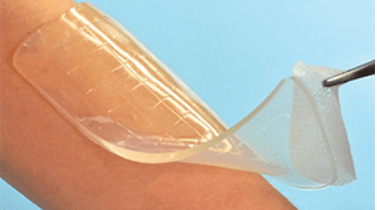
An image of a hydrogel used as a wound dressing
Hydrogels are widely used in tissue engineering as structural scaffolds, in bone tissue engineering for bone repair and prosthetics, in surgery to seal cavities and prevent air leaks, and as wound dressings or in liquid form to promote wound healing. They are also employed in controlled drug delivery, cell transport, tissue regeneration, artificial organ production, contact lenses, and many other fields. Generally, materials engineers and biomedical engineers develop these multifunctional biomaterials by drawing on chemistry to design the material composition and using medical and biological approaches to ensure biocompatibility with living systems.
Bashir, S., Hina, M., Iqbal, J., Rajpar, A. H., Mujtaba, M. A., Alghamdi, N. A., ... & Ramesh, S. (2020). Fundamental concepts of hydrogels: Synthesis, properties, and their applications. Polymers, 12(11), 2702.
Bustamante-Torres, M., Romero-Fierro, D., Arcentales-Vera, B., Palomino, K., Magaña, H., & Bucio, E. (2021). Hydrogels classification according to the physical or chemical interactions and as stimuli-sensitive materials. Gels, 7(4), 182.
Caló, E., & Khutoryanskiy, V. V. (2015). Biomedical applications of hydrogels: A review of patents and commercial products. European Polymer Journal, 65, 252-267.
Figure 3: Plastic Packaging. (n.d.). *Natural biopolymers used in hydrogel-based wound dressings*. Plastic Packaging. Accessed April 8, 2025.https://www.plastik-ambalaj.com/tr/plastik-ambalaj-makale/3135-hidrojel-temelli-yara-oertuelerinde-kullan-lan-dogal-biyopolimerler
Görsel 1: Dr. Bioengineer. (2025, April 8). Yeni nesil madde hidrojeller. Dr. Bioengineer.
Kopeček, J., & Yang, J. (2007). Hydrogels as smart biomaterials. Polymer International, 56(9), 1078-1098.
Sahiner, M., Sagbas, S., Turan, A., Erdugan, H., & Sahiner, N. (2018). Yara kaplama malzemesi olarak kollajen esaslı hidrojel filmleri. Çanakkale Onsekiz Mart Üniversitesi Fen Bilimleri Enstitüsü Dergisi, 4(2), 103-116.
Visual 2: Biological Therapies Clinic. (n.d.). *Hidrojel tedavisi*. Biological Therapies Clinic. Accessed April 8, 2025.https://www.biyolojiktedavilerklinigi.com/hidrojel-tedavisi-C1535/-P1.html
WICHTERLE, O., LÍM, D. Biyolojik Kullanıma Yönelik Hidrofilik Jeller. Nature, 185, 117–118 (1960).
ZOHOURIAN, M. M., & Kabiri, K. (2008). Superabsorbent polymer materials: a review.

Structure and Properties of Hydrogels
Composition of Hydrogels
Polymer Selection
Other Components
Forms of Use and Applications