


This article was automatically translated from the original Turkish version.
An astronaut’s day in space is an experience that constantly reminds the human being of their belonging to Earth, while simultaneously pushing its boundaries outward into the depths of the universe. Living in orbit bears no resemblance to any routine on Earth. Here, there is no dawn brightening the horizon nor complete darkness of night. On the International Space Station (ISS), which orbits Earth at a speed of eight kilometers per second, astronauts witness a new sunrise approximately every ninety minutes. This means that an astronaut sees the sun rise and set about sixteen times in every twenty-four-hour period.【1】 However, the human body must remain anchored to its biological rhythm on Earth; otherwise, sleep patterns, attention span, and mental balance are disrupted. For this reason, days on the station are scheduled according to Greenwich Mean Time, and every aspect of the astronauts’ lives follows a meticulously planned program down to the second.【2】
When an astronaut wakes around six in the morning, the first thing they see upon looking out the window is the silent rotation of the blue planet below. Clouds glide like white silk over continents, while the thin line of the atmosphere glimmers in sunlight. Yet life on the station leaves little room for emotion; every task is scheduled minute by minute. As soon as they wake, astronauts measure vital signs: heart rate, blood pressure, body temperature… Everything is recorded. Every minute spent in space provides scientific data on how the human body responds to these extraordinary conditions.
Astronauts Performing Personal Hygiene in Space (Generated by Artificial Intelligence)
When it is time for personal hygiene, the challenges of a microgravity environment become immediately apparent. Water behaves entirely differently here. Even a single droplet, if released freely, floats through the air as a tiny sphere and can collide uncontrollably with electronic devices. For this reason, astronauts clean their faces with damp wipes and wash their hair with no-rinse shampoo. Brushing teeth is itself a small experiment: a small amount of water is squeezed onto the toothbrush, mixed with paste, and then the mouth is wiped clean with a damp cloth. Instead of spitting, the paste is swallowed, because a floating liquid droplet could enter the ventilation system and cause problems.
Breakfast serves as both an energy source and a morale booster. Yet eating in space has been entirely redefined. Astronauts’ food is stored in vacuum-sealed pouches and rehydrated with hot water before consumption. Menus typically consist of freeze-dried eggs, cereal flakes, fruit purees, protein bars, and powdered drinks. Due to microgravity, bodily fluids distribute evenly throughout the body, leading to nasal congestion and a reduced sense of taste. As a result, astronauts often add spicy sauces, mustard, or spices to their meals. NASA develops special menus to help astronauts maintain their palates; each country’s astronaut may also bring along certain foods from their own culture. Among the camp-style meals, Japanese curry or Russian cereals and soups may be included.【3】
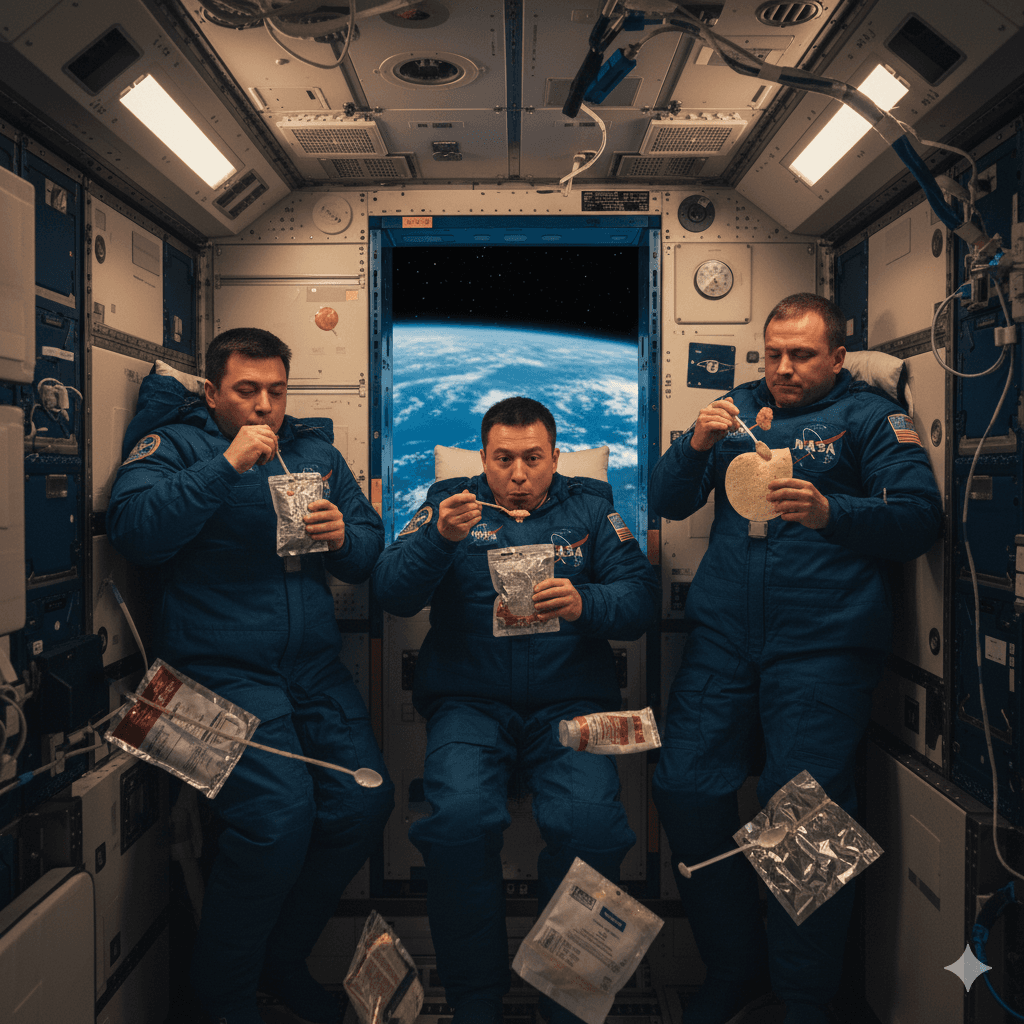
Food in Vacuum Pouches Consumed by Astronauts at Breakfast (Generated by Artificial Intelligence)
After breakfast, a long and intense workday begins. The daily schedule is determined by task lists sent from ground control centers on Earth. Astronauts work as scientists, technicians, engineers, and even repair specialists aboard the station. On some days they conduct biological experiments studying how human cells behave under microgravity; on others they test new materials technologies. For example, experiments on surface tension of liquids or how fire behaves in low-oxygen environments cannot be performed on Earth.
Maintenance of the station’s technical systems is also the astronauts’ responsibility. Dozens of small daily tasks are repeated every day: replacing air filters, monitoring water recycling systems, checking the condition of solar panels, and testing communication systems.【4】 Because even the smallest malfunction in space can pose a life-threatening risk, no detail is overlooked. Every task is a team effort; astronauts remain in constant communication with their ground team. All activities performed during the day are recorded, images are transmitted to Earth, and engineers provide real-time feedback.
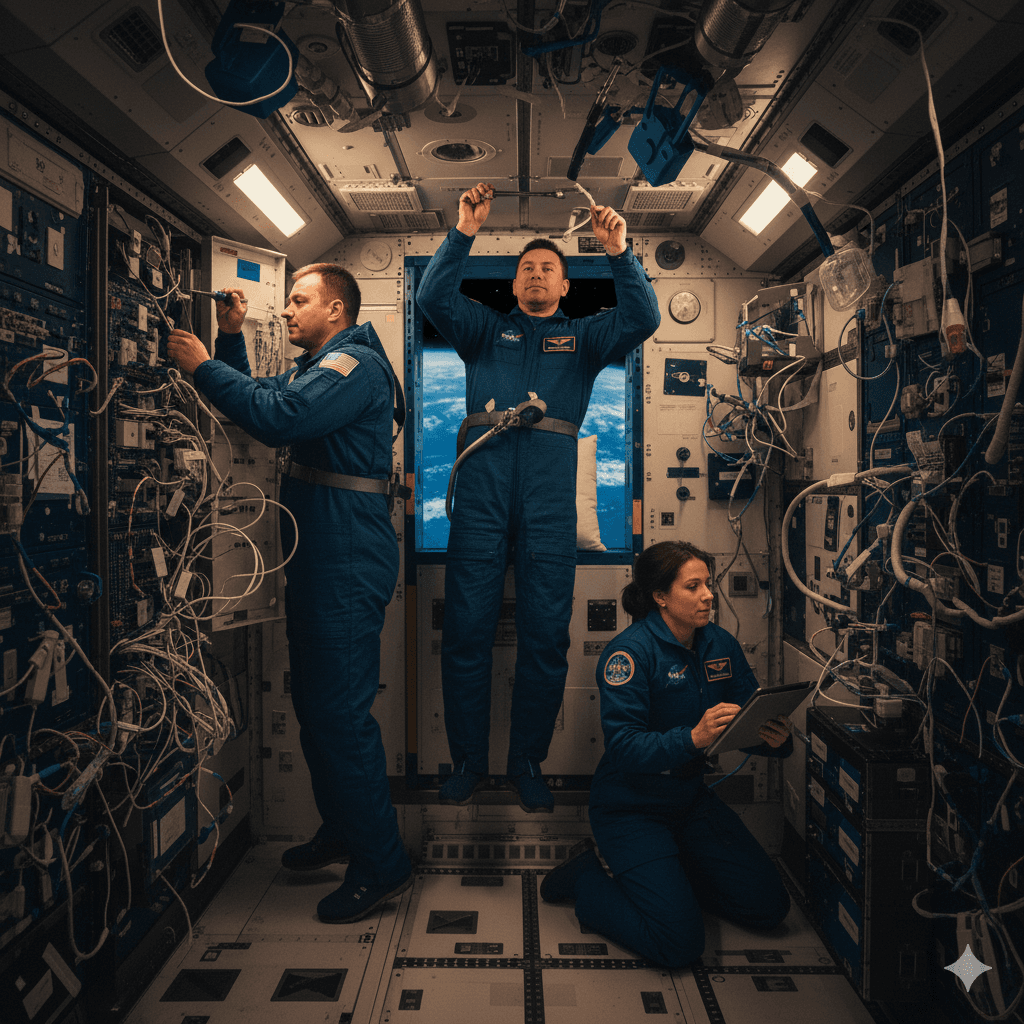
Astronauts Maintaining Technical Systems in Space (Generated by Artificial Intelligence)
The most demanding aspect of life in space is the human body’s response to microgravity. Muscle mass decreases daily, bone density declines, and fluids accumulate in the head. To counteract these effects, astronauts must exercise for nearly two hours every day.【5】 The station is equipped with a treadmill, a stationary bicycle, and a device called ARED, which provides resistance. To stay anchored to the treadmill, astronauts secure themselves with a special harness; otherwise, their feet would lift off the ground and collide with the ceiling. The ARED system simulates weightlifting through piston-based resistance. These exercises are not only physically necessary but also psychologically essential. The silence of space, the isolated environment, and the constant discipline of duty can create psychological pressure. Exercise not only strengthens the body but also keeps the mind alert. Astronauts often work to music and sometimes run while watching Earth pass below.
At designated times during the day, astronauts have scheduled communication windows with Earth. Each astronaut can have video calls with family members several times a week, send emails, or receive messages. Communication in space is not merely about exchanging information; it is vital for preserving the astronaut’s emotional well-being. NASA emphasizes that an astronaut’s morale directly affects mission performance. For this reason, every astronaut participates in psychological support sessions. In the boundless silence of space, it is not easy for a person to be alone with their inner world. Talking to family, listening to a favorite piece of music, or celebrating a birthday on Earth via video call serve as powerful sources of morale for astronauts.
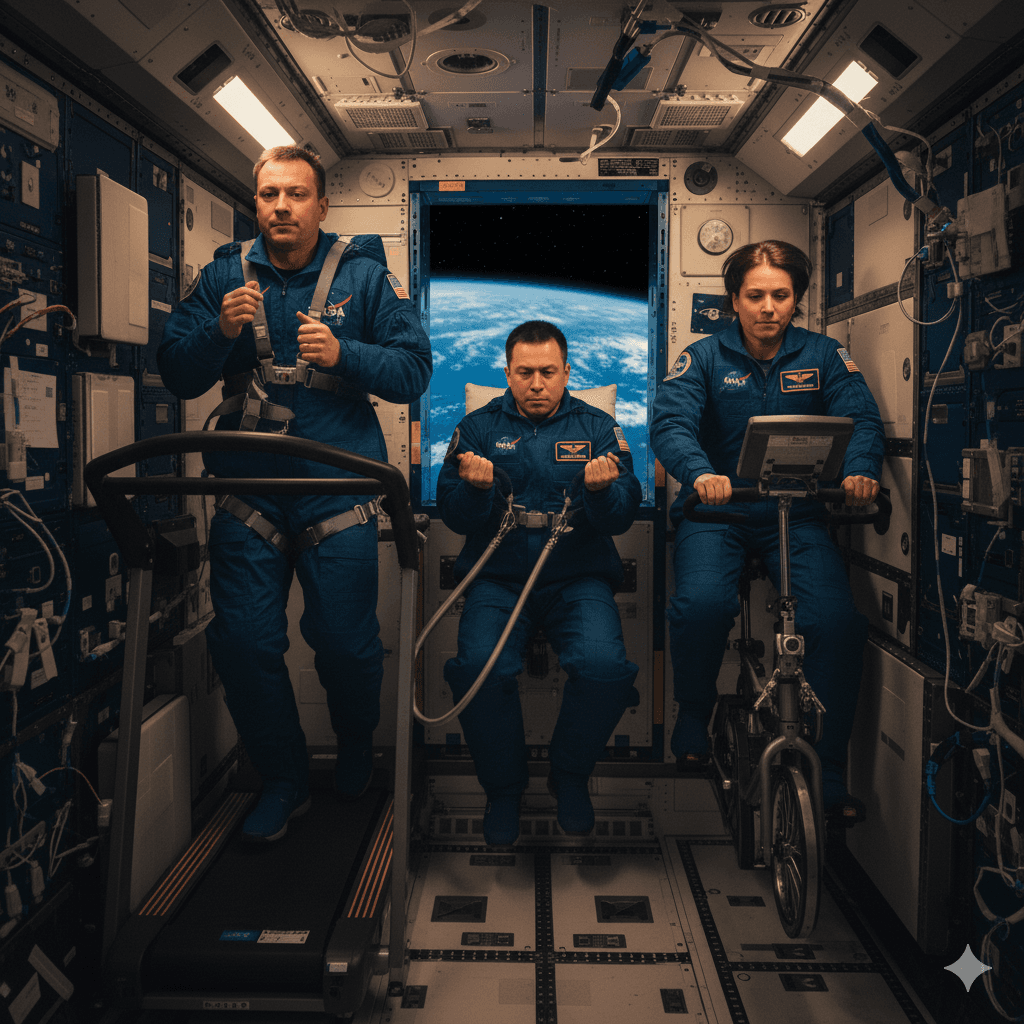
Astronauts Exercising in Space (Generated by Artificial Intelligence)
As evening approaches, the fatigue of the day begins to set in. Dinner is usually a quieter affair. Sometimes astronauts eat simultaneously with friends on Earth; other times they eat in silence while gazing out the station’s window. Outside, the night lights of cities on Earth glow brightly. The borders of Europe, the densely populated cities of India, the dark deserts of Africa, the dancing auroras over the poles… All these views simultaneously remind astronauts of humanity’s smallness and unity.
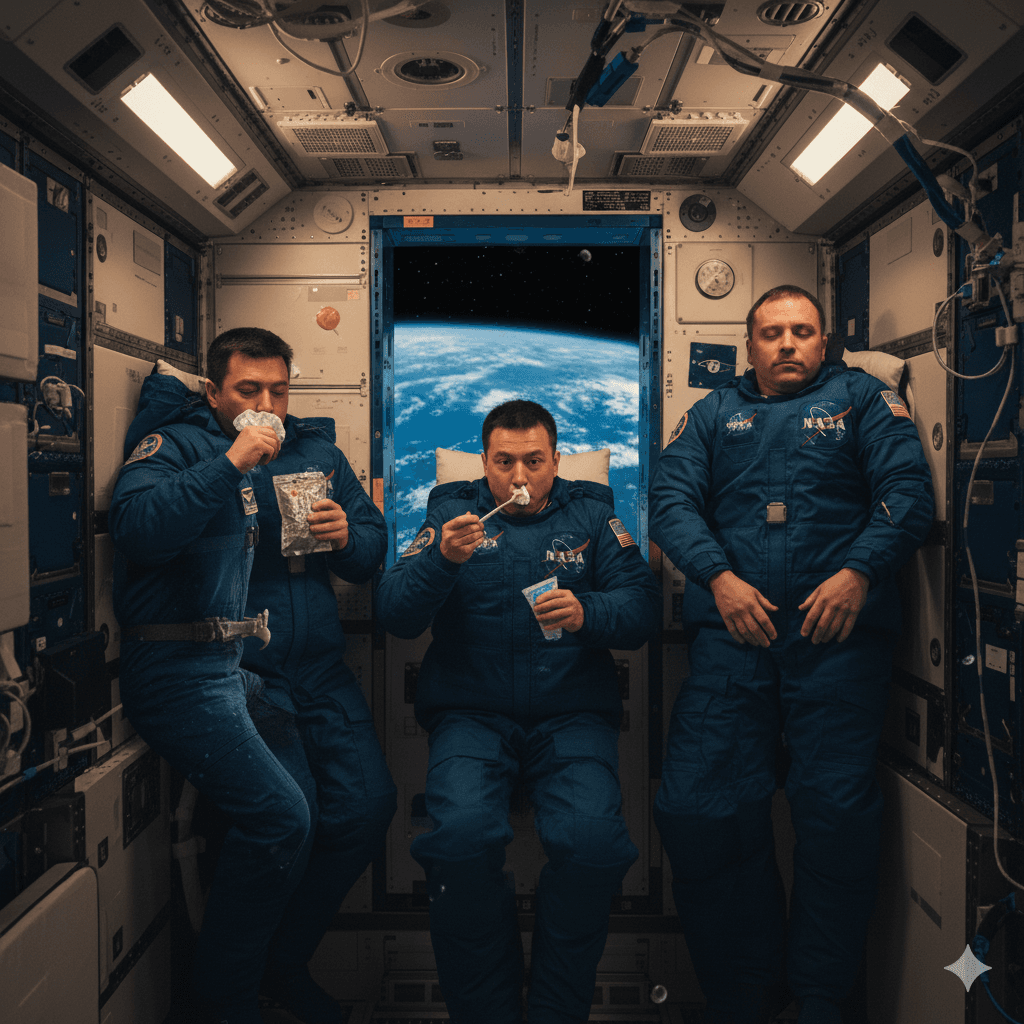
When it is time to sleep, each astronaut retreats into their own sleep capsule. These capsules are small, quiet, and personal spaces containing a sleep sack, a few photographs, and sometimes a book or a small memento. Astronauts attach their sleep sacks to the wall; otherwise, they would drift while sleeping and collide with surfaces. Special lighting systems are used on the station to improve sleep quality. These systems mimic Earth’s natural daylight cycle to regulate the biological clock. Before falling asleep, most astronauts take one last look out the window. At that moment, the blue planet is passing beneath them. This delicate sphere, spinning in the darkness of space, remains both their home and their longing.
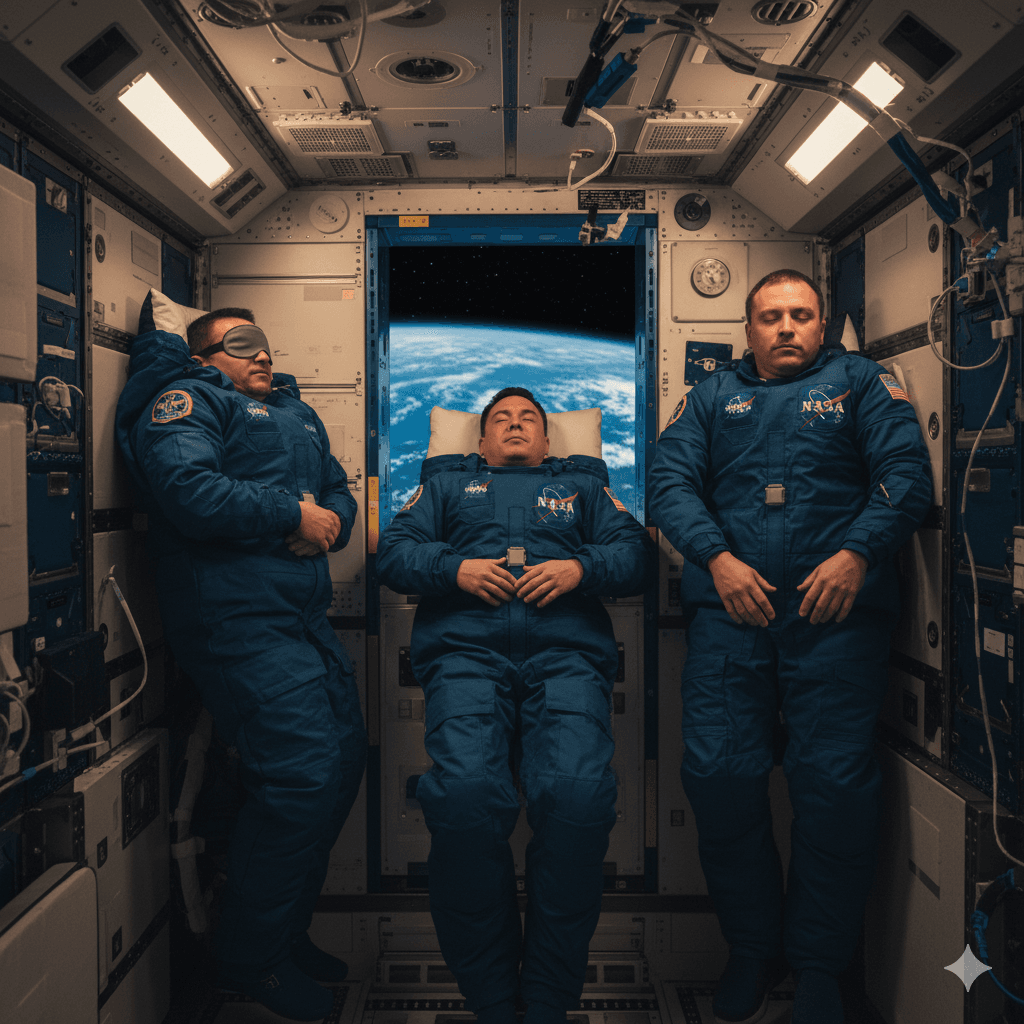
Astronauts Sleeping in Space (Generated by Artificial Intelligence)
A day spent in space tests human resilience, adaptability, and curiosity at every moment. For astronauts, the meaning of a day is not merely completing their tasks. They are pioneers testing whether humanity can live permanently in space. Each morning, as they awaken, every step they take in microgravity represents a rehearsal for future lunar bases and journeys to Mars. Far from Earth, hundreds of kilometers away in the dark, these humans quietly remind us all of the same question: Can humanity survive elsewhere in the universe? Perhaps the answer to that question is taking shape right now, inside the silent capsule where an astronaut is drifting peacefully into sleep.
Anadolu Ajansı. “Uluslararası Uzay İstasyonu, 2000’den bu yana bilinmezlere ışık tutuyor.” Accessed November 5, 2025.https://www.aa.com.tr/tr/bilim-teknoloji/uluslararasi-uzay-istasyonu-2000den-bu-yana-bilinmezlere-isik-tutuyor/3114109
Anadolu Ajansı. “İnsanoğlunun uzaya açılan penceresi — Astronotların bir günü.” Accessed November 5, 2025.
BBC News Türkçe. "Uzayda astronotların bir günü nasıl geçiyor?" Accessed November 5, 2025.https://www.bbc.com/turkce/articles/cx2kk7lnry7o
TÜBİTAK Bilim Genç. "Uzayda Uzun Süre Kalan Astronotların Vücudunda Neler Değişir?" Accessed November 5, 2025.https://bilimgenc.tubitak.gov.tr/makale/uzayda-uzun-sure-kalan-astronotlarin-vucudunda-neler-degisir
[1]
Anadolu Ajansı, ‘’Uluslararası Uzay İstasyonu, 2000’den bu yana bilinmezlere ışık tutuyor’, Anadolu Ajansı, son erişim tarihi 5 Kasım 2025, https://www.aa.com.tr/tr/bilim-teknoloji/uluslararasi-uzay-istasyonu-2000den-bu-yana-bilinmezlere-isik-tutuyor/3114109
[2]
Anadolu Ajansı, ‘’İnsanoğlunun uzaya açılan penceresi — Astronotların bir günü’’, Anadolu Ajansı, son erişim tarihi 5 Kasım 2025, https://www.aa.com.tr/tr/dosya-haber/insanoglunun-uzaya-acilan-penceresi-astronotlarin-bir-gunu/2976593
[3]
BBC News Türkçe, ‘‘Uzayda astronotların bir günü nasıl geçiyor? ’, BBC News Türkçe, son erişim tarihi 5 Kasım 2025, https://www.bbc.com/turkce/articles/cx2kk7lnry7o
[4]
BBC News Türkçe, ‘‘Uzayda astronotların bir günü nasıl geçiyor? ’, BBC News Türkçe, son erişim tarihi 5 Kasım 2025, https://www.bbc.com/turkce/articles/cx2kk7lnry7o
[5]
Anadolu Ajansı, ‘’İnsanoğlunun uzaya açılan penceresi — Astronotların bir günü’’, Anadolu Ajansı, son erişim tarihi 5 Kasım 2025, https://www.aa.com.tr/tr/dosya-haber/insanoglunun-uzaya-acilan-penceresi-astronotlarin-bir-gunu/2976593
