


This article was automatically translated from the original Turkish version.
+1 More
Optics, according to the Kubbealtı Lugatı Sözlüğü, is defined as "the branch of physics that studies light and phenomena related to light" . The earliest concepts of light were rooted in religious origins. For example, in Ancient Egypt, light was regarded as a divine power emanating from the eye of the sun god Ra. Similarly, in the Bible, light is described as a being created by God on the first day of creation. In these sacred texts, light is associated with goodness, while darkness is linked to evil. The perception of light as a divine entity reflects how ancient societies were more concerned with religious and symbolic meanings than with scientific explanations.
Ancient Greek philosophers initiated studies to understand the nature of light and the mechanism of vision. The Pythagoreans believed that vision occurred when something emitted from the eye reached the object, while followers of Democritus proposed that a solid substance traveled from the object to the eye. Followers of Empedocles argued that vision resulted from a movement in both directions: from the eye to the object and from the object to the eye.
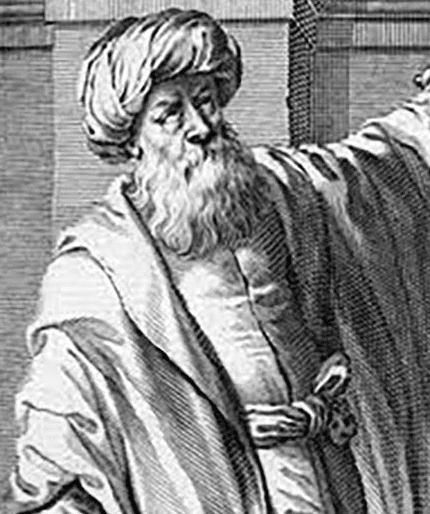
During the Middle Ages, Ibn al-Haytham (known in Latin as Alhazen) conducted significant experimental work on the nature of light and the mechanism of vision. Ibn al-Haytham deduced that vision does not occur through rays emitted from the eye, but rather through light rays entering the eye from objects, based on the pain felt when looking directly at bright objects and the afterimages that follow. He also examined the anatomy of the eye and proposed that vision occurs not on the surface of the crystalline lens, but on the retina. His work diverged from ancient Greek thought by relying on empirical observation, while in the West, the ancient Greek concept of rays emanating from the eye remained influential for a long time.
class=\
The centerpiece of Ibn al-Haytham’s optical corpus is the Kitāb al-Manāzir, organized into seven “books” or volumes: the first three focus on vision, the fourth to sixth on reflection, and the seventh on refraction. Its circulation in the Latin world began in the late 12th and early 13th centuries, and Friedrich Risner’s 1572 Basel edition (Opticae Thesaurus) had a foundational influence on European thinkers such as Roger Bacon, John Pecham, Witelo, Kepler, Snell, Fermat, and Descartes. In the Eastern tradition, Kamāl al-Dīn al-Fārisī’s Tanqīḥ al-Manāzir and Taqiyy al-Dīn’s Kitāb-i Nūr show deep engagement with his work. Within this framework, the treatise Risāla fī al-Nūr complements the Kitāb al-Manāzir by elaborating on themes such as the propagation of light, transparency and opacity, and “secondary light” (the faint light emitted by illuminated objects). Additionally, the corpus includes independent treatises on specific topics such as parabolic and spherical mirrors, lenses, rainbows and halos, eclipses, shadows, and starlight.
Theory of Vision: Ibn al-Haytham criticized the ancient notion of “emission of rays from the eye” (the Emission Theory) and argued that vision occurs through the effect of light and color entering the eye from objects. The core of his argument is this: even if rays were emitted from the eye, no vision would occur unless something returned from the object to the eye; the pain felt when looking at bright objects further demonstrates that the eye is a receiver. Vision is established by a cone of light with its source at the object and its target at the eye; the distance or proximity of the object alters the angle of the cone entering the eye, thereby determining the perception of size.
Reflection: Ibn al-Haytham experimentally examined the behavior of primary and secondary light rays on flat, spherical, cylindrical, and conical mirrors, and grounded the principle of angle of incidence = angle of reflection in an original geometric structure. This approach, known as the “Quadrilateral of Velocities,” is based on decomposing the incident motion into components perpendicular and tangential to the surface; the surface’s “resistance” reverses the perpendicular component while preserving the tangential component, forcing the resultant motion to reflect at an equal angle to the normal. This justification also provided a systematic basis for classifying image distortions observed in mirrors with various curvatures.
Refraction: The same component analysis is applied to refraction: when light strikes the interface between two media at an angle, it encounters resistance dependent on density; when moving from a less dense to a denser medium, it bends toward the normal, and in the reverse case, it bends beyond the normal. Ibn al-Haytham explained this using mechanical analogies (e.g., a stone dropped perpendicularly penetrates a plate more easily); based on the principle that “perpendicular motion is stronger, and motion closer to perpendicular is easier than motion farther from it,” he constructed the geometry of refraction using a velocity-component scheme.
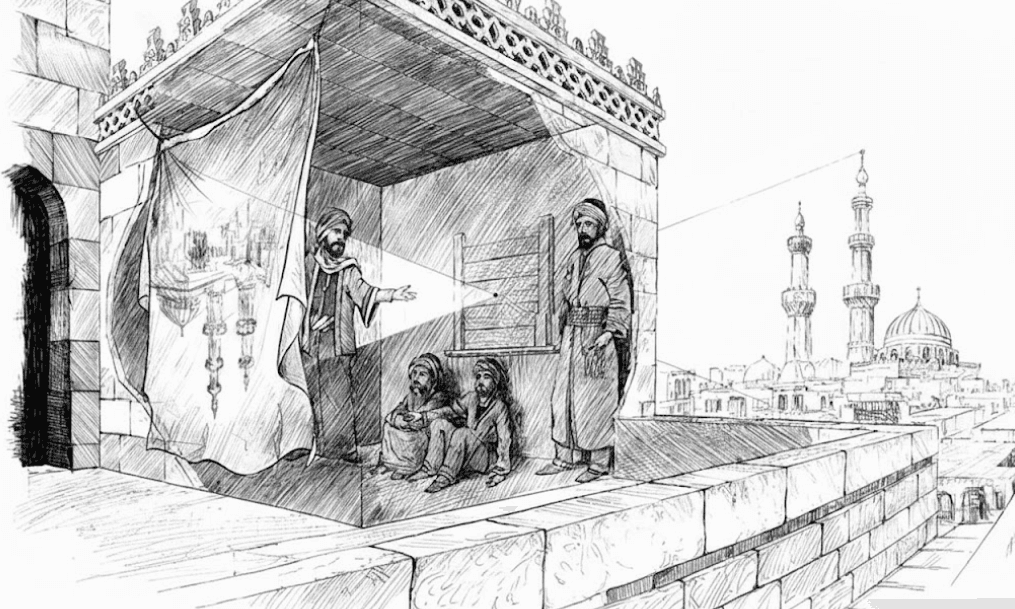
The camera obscura, the earliest known form of the photographic camera, was one of Ibn al-Haytham’s most important tools in his optical experiments. In this device, a small aperture is made in one wall of a light-tight box; light reflected from external objects passes through this aperture and forms an inverted image on the inner surface of the box. As the aperture becomes smaller, the image becomes sharper but less bright; thus, the use of lenses can enhance image clarity.
Ibn al-Haytham observed that during a solar eclipse, light entering a room through a small hole in a window projected a crescent-shaped image on the wall, thereby demonstrating experimentally that light travels in straight lines. He referred to this device as “bayt al-muzlim” (Arabic: dark room). The concept was later translated into Latin as camera obscura and formed the theoretical foundation of photographic technology.
class=\
By the end of the 13th century, Italian glassmakers invented corrective lenses to address presbyopia (age-related farsightedness). However, this invention did not generate scientific interest at the time, and lenses were regarded merely as magical objects. Centuries later, Kepler analyzed how light rays are refracted by lenses and explained how corrective lenses rectify vision impairments. Kepler claimed that vision occurs through an inverted image formed on the retina. Leonardo da Vinci had previously described a similar mechanism by comparing the eye to a camera obscura.
By the end of the 14th century, Dutch lensmakers combined two lenses to invent the telescope. Galileo was the first to recognize its scientific potential, improving the instrument and using it to observe celestial bodies. He discovered four moons of Jupiter and observed the phases of Venus. Galileo’s observations supported Copernicus’s heliocentric model of the universe. Kepler, in turn, developed the theoretical foundation for these discoveries, explaining the principles of light refraction and the operation of telescopes. During this period, a new scientific method based on observation began to emerge, contrasting with earlier approaches that relied on assumptions rather than empirical verification.
As a result of these scientific approaches, significant insights were gained into the nature of light and vision. Light is understood as a substance traveling from every point of an object toward the observer’s eye. Objects may either be direct sources of light or reveal their shapes and colors through reflected light. Light rays pass through the pupil and form an image on the retina, which is then transmitted to the brain.
Topdemir, Hüseyin Gazi. “Bütün Zamanların En Büyük Optikçisi: İbn el-Heysem.” Bilim ve Teknik 43, no. 698 (2010): 84–89. TÜBİTAK. Accessed October 28, 2025.https://e-dergi.tubitak.gov.tr/edergi/yazi.pdf?dergiKodu=4&cilt=43&sayi=698&sayfa=84&yaziid=30123
Topdemir, Hüseyin Gazi. “İbn el-Heysem’in 1,51K Üzerine Adlı Çalışması.” *Felsefe ve Sosyal Bilimler Dergisi* 2018 (25): 93–112. Accessed October 28, 2025.https://dergipark.org.tr/tr/download/article-file/1643612
TÜBİTAK Bilim Genç. "Fotoğraf Makinesinin Atası: Karanlık Kutu." *Bilim Genç* (TÜBİTAK). Accessed October 28, 2025.https://bilimgenc.tubitak.gov.tr/makale/fotograf-makinesinin-atasi-karanlik-kutu
Vohnsen, Brian. “A Short History of Optics.” *Physica Scripta* T109 (2004): 75–79. IOP Publishing. Accessed October 28, 2025.https://www.researchgate.net/publication/230955293_A_Short_History_of_Optics

Optics in the Medieval Islamic World
Camera Obscura
Renaissance and Modern Optics