This article was automatically translated from the original Turkish version.
+2 More
Location | Hisardere Necropolis İznik - Bursa / Türkiye | ||||||||
|---|---|---|---|---|---|---|---|---|---|
Dating | 3rd century (Early Christian Period) | ||||||||
Year(s) of Discovery | 2025 | ||||||||
Technique | Fresco (painting on wall plaster) | ||||||||
Discovering Institution | İznik Museum and the Republic of Türkiye Ministry of Culture and Tourism | ||||||||
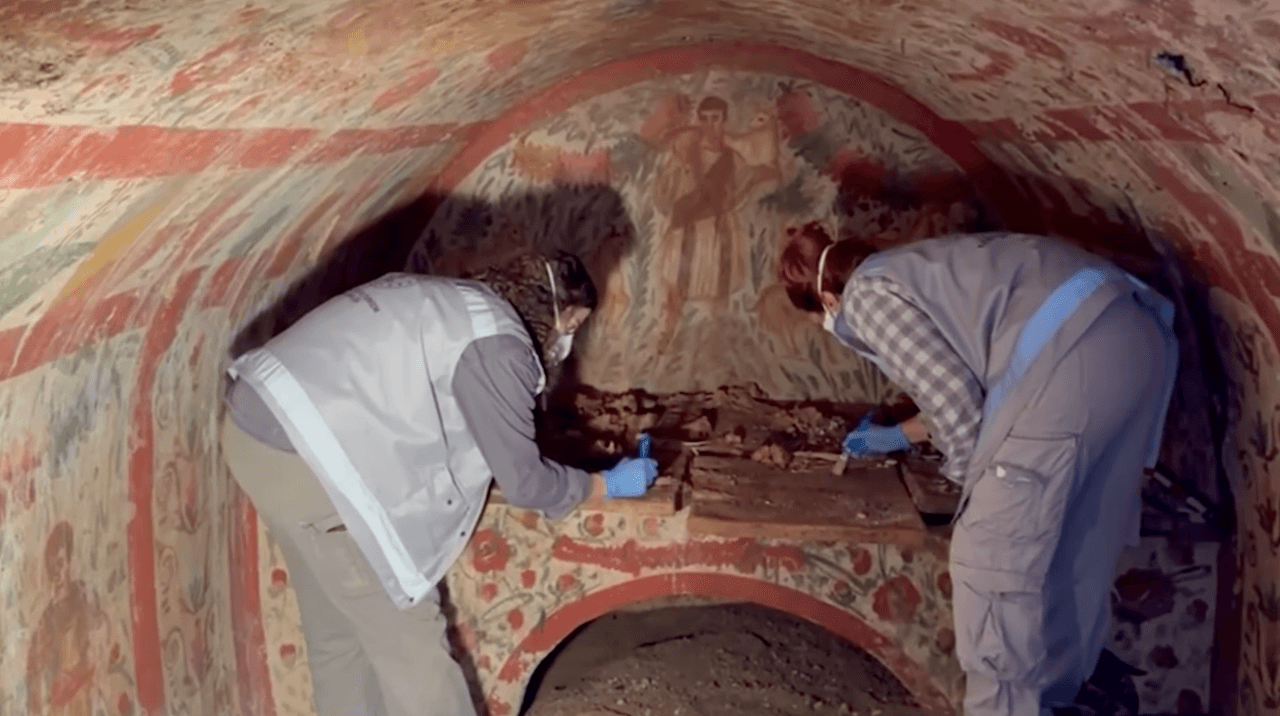
The Good Shepherd Fresco is a wall painting composition dating to the early Christian period, uncovered in 2025. The fresco, dated to the 3rd century, is located in a burial chamber whose north wall is richly decorated and depicts Jesus Christ as a young, beardless figure carrying a large horned ram on his shoulders.
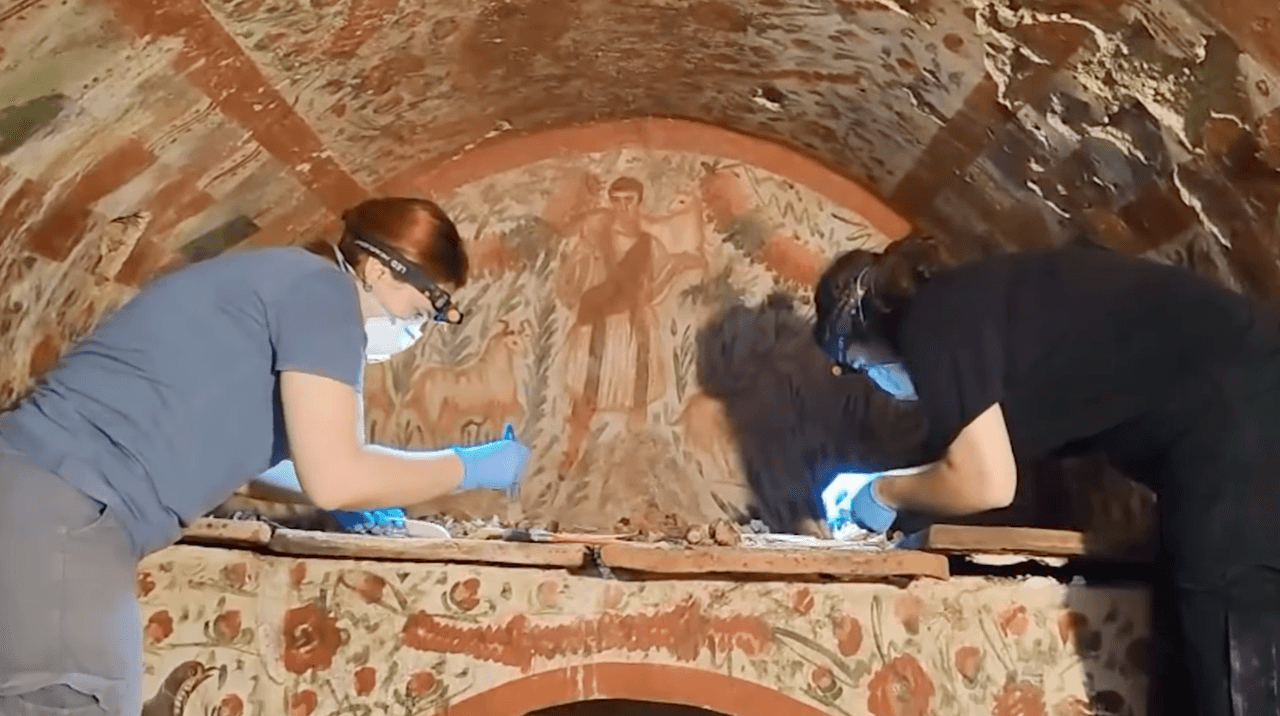
The Good Shepherd Fresco, Excavation Work (Panoramanews)
The Good Shepherd fresco was discovered in a burial chamber with a north wall richly adorned, within the Hisardere Necropolis in Iznik. Based on its architectural structure, fresco technique, and stylistic analysis, the necropolis was in use between the 2nd and 5th centuries AD. The burial chamber contains an interior arrangement constructed of brick and stone; in this space, three individuals—two adults and an infant—were buried on a klinē (a four-legged rectangular funerary couch), decorated with plant motifs and pairs of birds.
On the wall where the fresco is located, a young, beardless figure carrying a horned ram on his shoulders is depicted symmetrically alongside two goats. On the western wall of the same burial structure, a married couple dressed in attire emphasizing their aristocratic status and two small servant figures attending them are portrayed. The coexistence of animal and plant motifs with human figures on the walls indicates that the artwork reflects the transitional period between pagan traditions and early Christian artistic sensibilities.
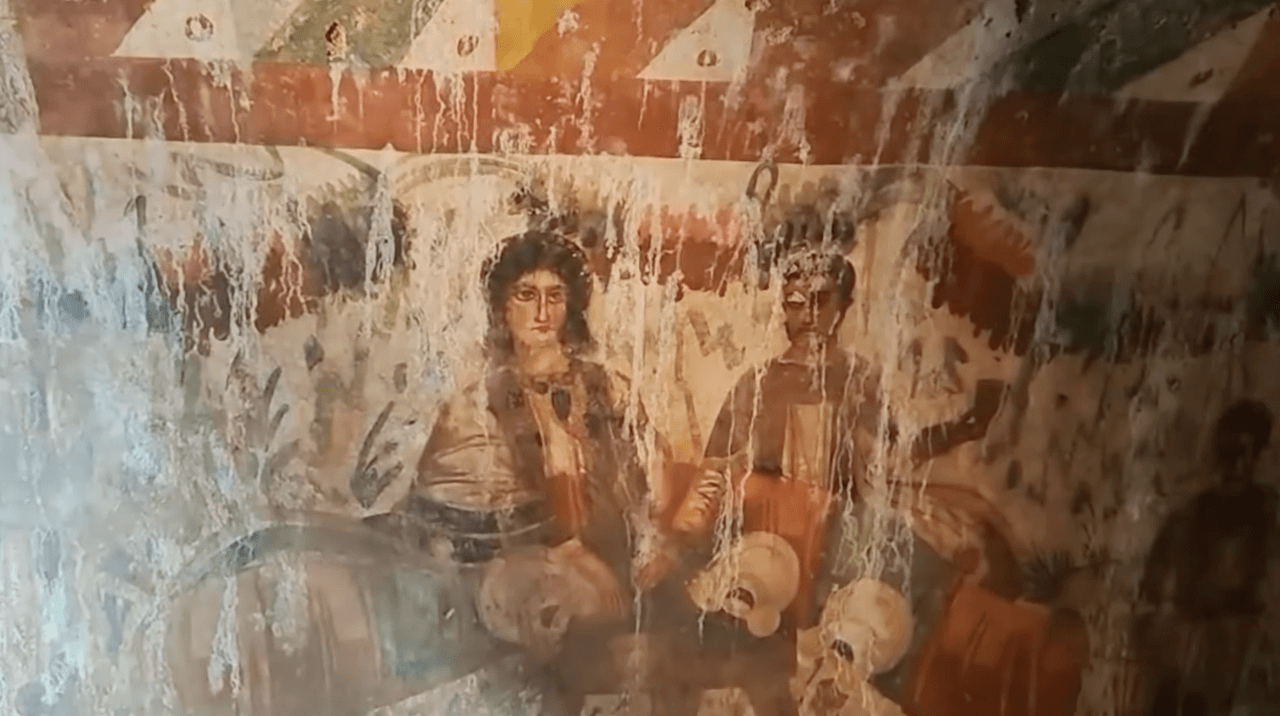
The Couple on the Western Wall (Panoramanews)
On Thursday, 27 November 2025, during his first official foreign visit to Türkiye, President Recep Tayyip Erdoğan presented Pope Leo XIV with a ceramic replica of the Good Shepherd fresco as a gift.
The gift was presented at a ceremony held in Ankara. This fresco, dated to the early Christian period, attracts attention due to its iconographic structure. According to archaeological evidence, it is the first known example of its kind discovered outside Italy and holds international significance.【1】 It has been reported that the Vatican delegation, which conducted investigations at the site prior to the Pope’s visit, was deeply impressed by the artistic and historical value of the artwork.【2】
Similarly, scenes depicting Orpheus playing his lyre and charming animals align with the shepherd imagery through concepts of pastoral peace and guidance. These figures are typically portrayed as young, beardless males carrying a ram or goat on their shoulders. This iconography later evolved into the Christian depiction of Jesus Christ as the “Good Shepherd,” symbolizing his spiritual leadership and protection. This transformation is clearly visible in wall paintings found in the catacombs of Priscilla, Domitilla, and Callixtus in Rome. These pagan-derived motifs were reinterpreted within Christian iconography, acquiring new religious meaning in both content and form.
In Christian belief, Jesus’ self-identification as the “Good Shepherd” has established this figure as a central theological symbol. The Gospels portray Jesus as a shepherd who protects his sheep, lays down his life for them, and gathers them together.【3】 In early Christian art, this representation was concretely expressed through frescoes, mosaics, and sculptures.
In this context, early depictions of the Good Shepherd represent a visual and symbolic continuity from ancient pagan art to early Christian art. The origins of these portrayals were shaped by the mythological, symbolic, and socio-religious meanings associated with the shepherd figure.
In ancient Greek and Roman times, the shepherd figure carried divine and heroic attributes. Mythological characters such as Hermes and Orpheus prominently adopted shepherd identities; Hermes as Kriophoros—the ram-bearer—serves as the precursor to Good Shepherd imagery. Orpheus, depicted gathering animals around him with his lyre, embodies a savior and guide role analogous to later depictions of Jesus.
The most distinctive feature of these early portrayals is the depiction of the figure as youthful, beardless, and rendered with soft, flowing lines. The lamb carried on the shoulder symbolizes the shepherd’s guidance and the sacrificial animal. At the same time, these images embody a transition from pagan imagery to Christian iconography.
The Good Shepherd fresco uncovered in 2025 at the Hisardere Necropolis in Iznik, Anatolia, has been recorded as one of the earliest examples of this iconography in Anatolia. This fresco, showing parallels with similar depictions in Roman-era catacombs, draws attention through its figural details and symmetrical composition.
Erduran, Görkem Yasin. “Cumhurbaşkanı Erdoğan'dan Papa Leo'ya anlamlı hediye: Nadir Hristiyan freski verildi.” *gzt.* Accessed November 30, 2025.https://www.gzt.com/jurnalist/turkiyede-iznikte-kesfedilen-nadir-hristiyan-freski-papa-leonun-ziyareti-sirasinda-tanitildi-3822608
Kasap, Sena. “Sümer’den Bizans’a Çoban İkonografisi.” Master's thesis, Bursa Uludağ Üniversitesi, 2020.https://acikerisim.uludag.edu.tr/entities/publication/73263d8c-58b2-4737-94f2-e65a6dba5951
Middle East Eye. “Turkey unveils rare and ancient Christian fresco during the pope’s visit.” Accessed November 30, 2025.https://www.middleeasteye.net/news/turkey-unveils-rare-christian-artefact-during-popes-visit
NOVINATA.BG. “Историческо откритие за християнския свят в Изник, Турция.” Accessed November 30, 2025.https://novinata.bg/obsthestvo/istorichesko-otkritie-za-hristiqnskiq-svqt-v-iznik-turciq/
Panoramanews. “İznik’te 1800 yıllık keşif! Erken Hristiyan dönemine ait resimli taş mezar bulundu.” YouTube, 1:40. Accessed November 30, 2025.https://www.youtube.com/watch?v=Qd9Eo2qYKYE
[1]
Görkem Yasin Erduran, “Cumhurbaşkanı Erdoğan'dan Papa Leo'ya anlamlı hediye: Nadir Hristiyan freski verildi,” gzt, son erişim: 30 Kasım 2025, https://www.gzt.com/jurnalist/turkiyede-iznikte-kesfedilen-nadir-hristiyan-freski-papa-leonun-ziyareti-sirasinda-tanitildi-3822608
[2]
Middle East Eye, “Turkey unveils rare and ancient Christian fresco during the pope’s visit,” Middle East Eye, son Erişim: 30 Kasım 2025, https://www.middleeasteye.net/news/turkey-unveils-rare-christian-artefact-during-popes-visit
[3]
Sena Kasap, “Sümer’den Bizans’a Çoban İkonografisi,” Yüksek Lisans Tezi, Bursa Uludağ Üniversitesi, 2020, syf 57, https://acikerisim.uludag.edu.tr/entities/publication/73263d8c-58b2-4737-94f2-e65a6dba5951

Location | Hisardere Necropolis İznik - Bursa / Türkiye | ||||||||
|---|---|---|---|---|---|---|---|---|---|
Dating | 3rd century (Early Christian Period) | ||||||||
Year(s) of Discovery | 2025 | ||||||||
Technique | Fresco (painting on wall plaster) | ||||||||
Discovering Institution | İznik Museum and the Republic of Türkiye Ministry of Culture and Tourism | ||||||||
No Discussion Added Yet
Start discussion for "Good Shepherd (Fresco)" article
Archaeological Findings
The Good Shepherd Replica Presented to Pope Leo XIV
Origins of Early Depictions of the Good Shepherd