


This article was automatically translated from the original Turkish version.

Science explains the workings of the universe through mathematics and experiments, and typically draws on the languages of the past, especially Ancient Greek and Latin, to name its findings. The nuclear terminology that describes immense energy potential and complex engineering systems is no exception to this rule. The etymological origins of these words, stretching from laboratories to reactor cores, reveal the academic depth of science’s evolution over centuries.
The word "atom," the foundational concept of nuclear science, embodies one of the greatest ironies in the history of science. It derives from the Ancient Greek word atomos, formed from the prefix a- (meaning "not") and the root temnein (to cut or divide). Thus, it literally means "uncuttable" or "indivisible."
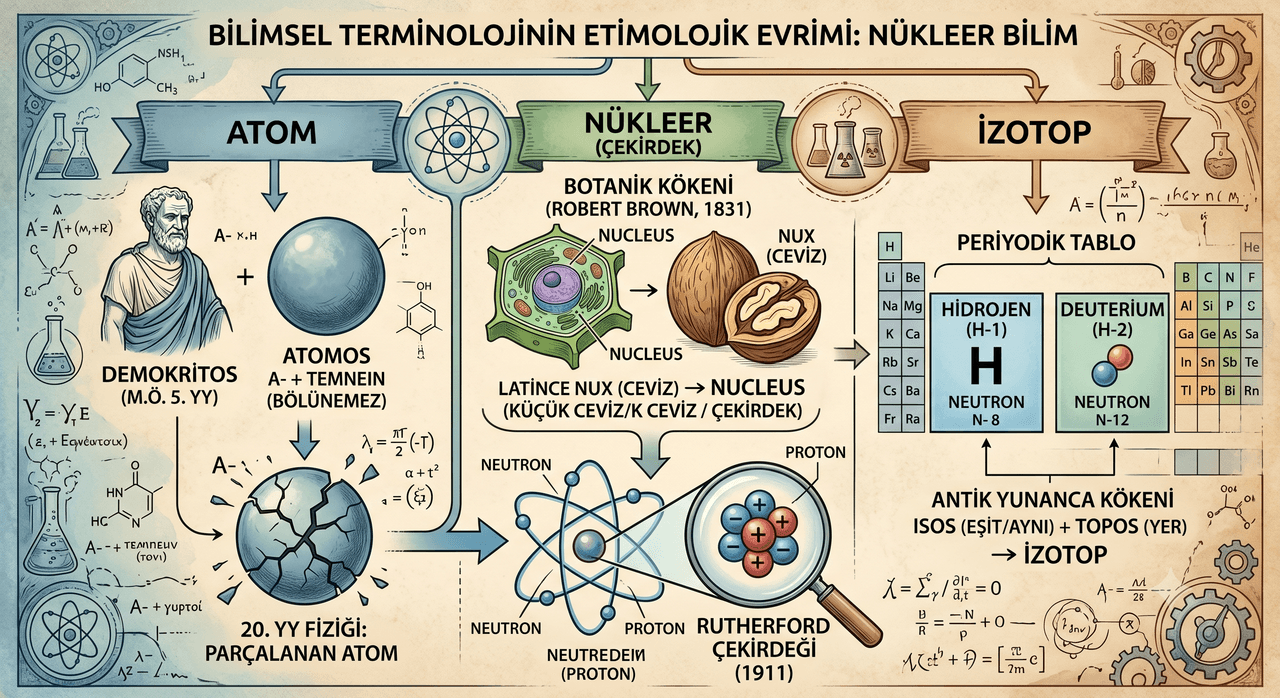
Regarding the Etymological Evolution of the Atom (Generated by Artificial Intelligence)
In the 5th century BCE, Democritus proposed that matter could not be divided indefinitely and that the smallest, indivisible building block should be called atomos.【1】 In the early 20th century, when physicists succeeded in splitting this structure, the etymological meaning of the word underwent a technical transformation.
The origin of the word "nuclear" lies not in the atom itself but in a more organic source. The Latin word nux (walnut, hazelnut) gave rise to nucleus, meaning "little nut" or "kernel."【2】 Interestingly, this term was used in botany before it entered physics. In 1831, botanist Robert Brown chose this word to describe the dense central structure in plant cells. In 1911, Ernest Rutherford, upon discovering that the mass of the atom was concentrated in a tiny, dense point at its center, adopted this biological metaphor to name the atomic nucleus.
The term "isotope," which describes variants of an element differing in neutron number, is derived from the Ancient Greek words isos (equal, same) and topos (place).【3】 Popularized by Frederick Soddy, this term refers to the fact that different atomic weight variants of an element occupy precisely the "same place" in the periodic table.
Berryman, Sylvia. "Ancient Atomism." *The Stanford Encyclopedia of Philosophy*. Accessed April 24, 2026. https://plato.stanford.edu/entries/atomism-ancient/.
Harper, Douglas. "Atom." *Online Etymology Dictionary*. Accessed April 24, 2026. https://www.etymonline.com/word/atom.
Harper, Douglas. "Nucleus." *Online Etymology Dictionary*. Accessed April 24, 2026. https://www.etymonline.com/word/nucleus
Harper, Douglas. "Radiation." *Online Etymology Dictionary*. Accessed April 24, 2026. https://www.etymonline.com/word/radiation.
Scerri, Eric R. The Periodic Table: Its Story and Its Significance. 2nd ed. New York: Oxford University Press, 2020.
[1]
Sylvia Berryman, "Ancient Atomism," The Stanford Encyclopedia of Philosophy (Winter 2022 Edition), Access date: 24 April 2026. https://plato.stanford.edu/entries/atomism-ancient/.
[2]
Douglas Harper, "Nucleus," Online Etymology Dictionary, Access date: 24 April 2026, https://www.etymonline.com/word/nucleus.
[3]
Eric R. Scerri, The Periodic Table: Its Story and Its Significance, 2nd edition (New York: Oxford University Press, 2020), p. 182.
Atom: The Fragmentation of the Indivisible
Nuclear (Nucleus): A Botanical Term in Physics
Isotope: "Same Place" in the Periodic Table