


This article was automatically translated from the original Turkish version.
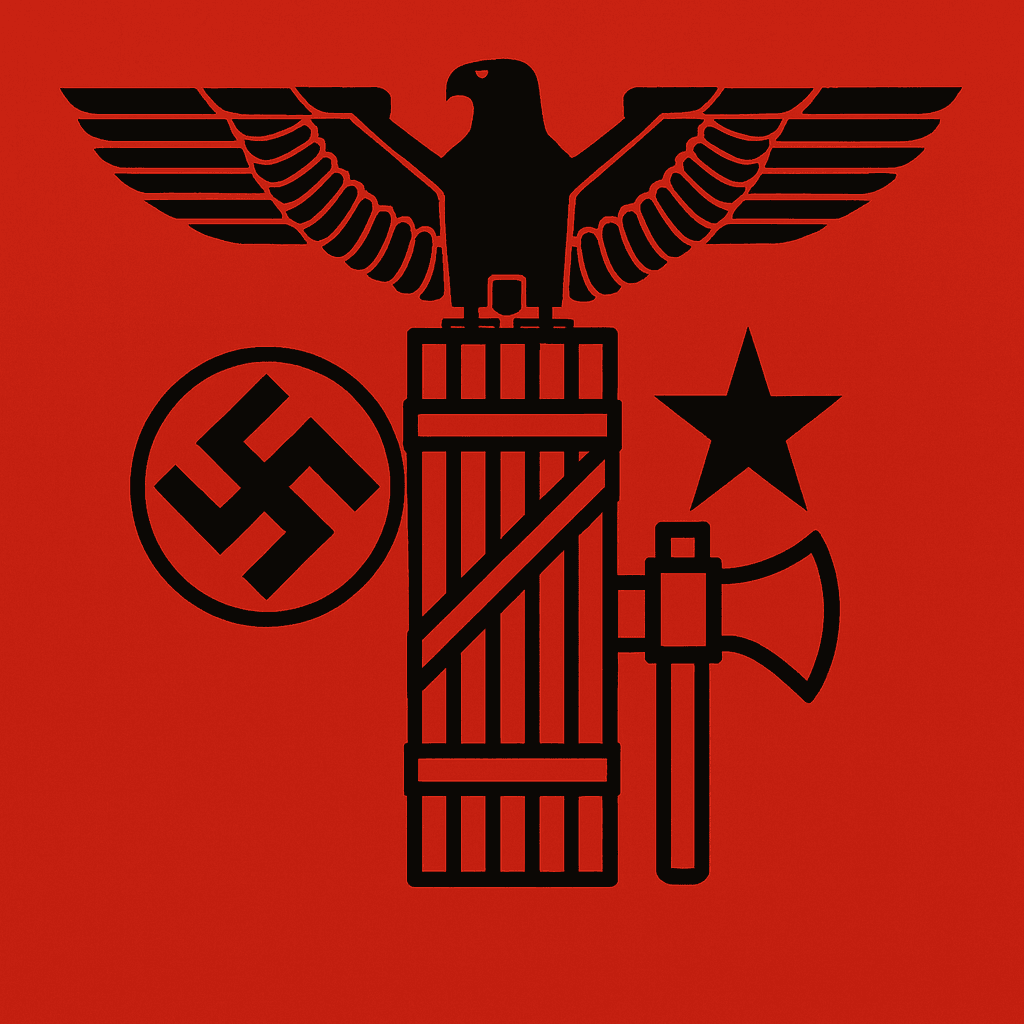
Fascism (Generated by Artificial Intelligence)
Definition | Authoritarian / Nationalist / Anti-Capitalist / Anti-Communist Political Ideology | ||||||||
|---|---|---|---|---|---|---|---|---|---|
Active Process | 1920-1945 | ||||||||
Fundamental Principles | State Supremacy Cult of the Leader Mass Mobilization Rejection of Class Conflict | ||||||||
Origin | Italy | ||||||||
Goal | Unity Around a Single Leader Absolute Power of the State Rebirth of the Nation Elimination of Class Conflict Management of Society within Discipline and Order Rejection of Liberal Democracy and Communism Elimination of Class Conflict | ||||||||
Economic Foundations | Corporatism, Protection of Private Property, State Economic Intervention, Autarkic Policy, Large Public Investments, Rapid Decision-Making Mechanism in Economic Planning | ||||||||
Fascist Regimes | Spain – Francisco Franco (1939-1975) Hungary – Ferenc Szálasi (1944-1945) Romania – Ion Antonescu (1940-1944) Italy – Benito Mussolini (1922–1943) Germany – Adolf Hitler (1933-1945) Portugal – António de Oliveira Salazar (1933-1974) | ||||||||
Fascism is a political ideology that emerged in Italy at the beginning of the 20th century, characterized by authoritarianism, nationalism, and opposition to both capitalism and communism. Fascism elevates the state, rejects democratic pluralism, and views society as a hierarchical and organic structure unified under a single leader. It seeks the rebirth (palingenesis) of the nation through mass movements.
Fascism is an authoritarian, nationalist, and totalitarian ideology derived from the Italian word “fascio” (bundle, group) and first named after the Fasci di Combattimento organization founded in 1919 under Benito Mussolini’s leadership. The term fascio originates from the Roman imperial symbol “fasces” (a bundle of rods bound around an axe), which symbolized state authority superior to individual freedoms and prioritized the unity and interests of the nation over individual rights. Under Mussolini, this term evolved into a new ideology centered on unity, discipline, and strong state authority in political and social life.
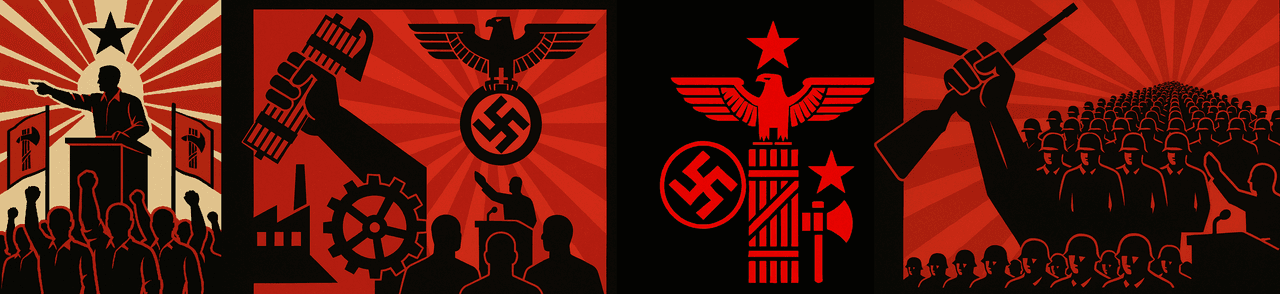
Symbols of Fascism (Generated by Artificial Intelligence)
Fascism fundamentally rejects liberal democracy, individual freedoms, and socialist ideologies based on class struggle. It asserts that the nation is an organic whole and that individuals derive meaning only through their contribution to the interests of the state and the nation. Consequently, fascism envisions a disciplined, hierarchical society unified under the absolute authority of a leader, rejecting class distinctions. It regards violence as a natural and legitimate tool of politics, with mass mobilization, militarism, absolute loyalty to authority, and total state control over all aspects of society forming its core elements.
The aim of fascism is to rescue the nation from crisis, disintegration, and “collapse” and achieve its rebirth (palingenesis). In this process of rebirth, fascism seeks to ideologically restructure all areas of society—politics, economy, culture—and place the individual under the absolute control of the state and the leader. Fascism accepts the state and the leader as the concrete manifestation of the “national will”; therefore, pluralistic elements such as opposition, free press, and multi-party systems are rejected. Fascism aims to establish a totalitarian political order based not on individuals but on the “exaltation” of the nation and the state. This model emerged as an authoritarian response to the crises of capitalism and the class struggle of socialism.
The philosophical and intellectual roots of fascism lie in various currents and social crises that developed in Western thought at the end of the 19th century and the beginning of the 20th century. These roots were shaped by anti-liberal, anti-democratic, and anti-Marxist tendencies that opposed the rationalism of the Enlightenment and the egalitarian ideals of the French Revolution. Fascism rose on an ideological foundation that championed the organic unity of society and the absolute supremacy of the nation, in opposition to liberal thought centered on individual freedom and pluralism and to Marxism based on class struggle and collective equality.
At the philosophical level, the “elite theory” of Italian theorists such as Vilfredo Pareto and Gaetano Mosca laid the groundwork for fascism’s understanding of social structure. Pareto argued that history is continuously shaped by the replacement of elites and insisted that the masses must be kept distant from governance. Mosca divided society into a ruling minority (elites) and a governed majority (masses), asserting that the masses’ decisive role in politics would threaten social order. These elitist approaches formed the theoretical basis for fascism’s concept of “rule for the people but without the people.”
Friedrich Nietzsche’s ideas also hold a significant place in fascism’s intellectual origins. Nietzsche’s radical critiques of individualism and bourgeois values merged with the desire to overcome modern human weakness and attain the ideal of the “Übermensch.” Concepts such as the “will to power,” “reconstruction of order,” and “national rebirth” (palingenesis) were interpreted within fascist ideology as counterpoints to the egalitarian demands of the masses. However, fascism transformed Nietzsche’s individual-centered philosophy into a collective “political religion” centered on the leader-mass relationship, turning it into an ideology of mass mobilization.
Equally central to fascism’s intellectual sources is Georges Sorel’s concept of myth and violence. Sorel argued that social revolutions occur not through rational planning but through mass violence ignited by myths. Fascism drew inspiration from Sorel’s ideas, elevating the “creative power of violence” to the central element of politics and instrumentalizing revolutionary violence as a means to achieve national rebirth.
Fascism emerged in early 20th-century Europe, particularly in Italy, as a political movement that found a mass base during a period of intertwined social, political, and economic crises. To understand the birth of fascism, one must first analyze the political and social transformations that took shape in the late 19th century. This period witnessed the acceleration of capitalist industrialization and the formation of a new social structure known as the mass society. Industrialization spurred urbanization, eroded traditional social bonds, and placed individuals en masse within production relations, leading the working class to organize for collective struggle. Unionization, strikes, and socialist movements politicized broad segments of the population, while the bourgeoisie and traditional elites perceived the “rise of the masses” as a threat.
During this period, the contradictions of capitalism deepened, class struggle intensified, and parliamentary democracy proved inadequate in meeting the growing demands of the masses. The increasing political and social presence of the masses threatened the traditional functioning of bourgeois democracy, prompting capital classes and state institutions to generate authoritarian responses. Thinkers like Vilfredo Pareto viewed the decline of elites and the rise of the masses as “disintegration of social order” and advocated for “strong leadership” and the “reconstruction of elites” as remedies to this chaos.
Within this tension, the outbreak of the First World War became a historical turning point for the birth of fascism. The war caused massive destruction, unprecedented societal disintegration, the deaths or maiming of millions of soldiers, and economic paralysis. Italy emerged from the war plunged into a severe economic crisis, high unemployment, inflation, and social unrest. The liberal parliamentary system became incapable of addressing social demands, while socialist and communist movements gathered mass support, and worker strikes and land occupations increased. This situation prompted large landowners, industrialists, and nationalist circles within the military to demand an authoritarian response to prevent collapse and counter the threat of Bolshevism.
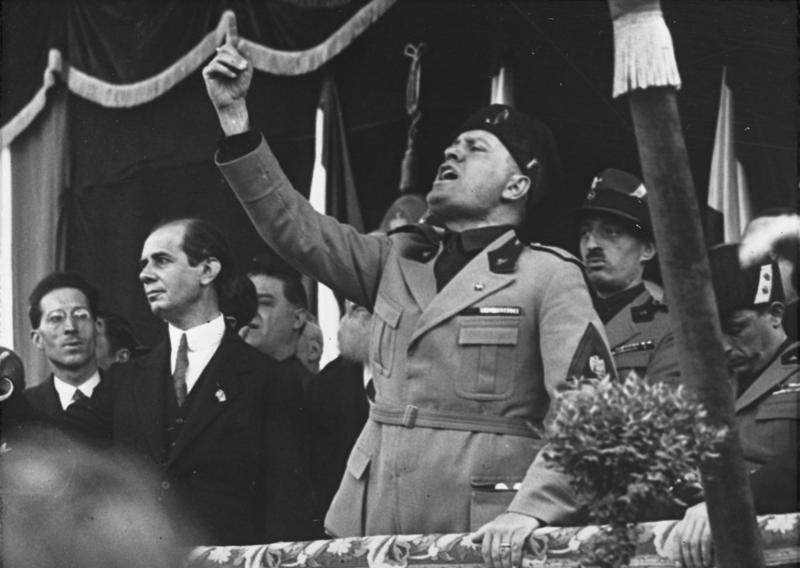
Mussolini Speaking - 1930 (WorldHistory)
In this historical context, Benito Mussolini entered the political scene in 1919 by founding the fascist combat groups known as Fasci di Combattimento. Mussolini organized war veterans who felt abandoned after the conflict, the petty bourgeoisie, and the middle classes threatened with dispossession, laying the foundation for a mass fascist movement. The fascist movement rejected class struggle and developed a discourse of organic unity encompassing the entire nation. Exploiting postwar chaos, the weakness of political authority, and the fear of socialist revolution, Mussolini seized power in 1922 through the March on Rome, establishing the fascist regime.
Three key elements emerged ideologically in the birth of fascism: (1) the rebirth and exaltation of the nation (palingenetic ultra-nationalism), (2) the rejection of liberal parliamentary democracy and Marxist socialism, and (3) the construction of a totalitarian state centered around a charismatic leader. Roger Griffin defines fascism’s essence as a political ideology built upon the “palingenetic myth”—the goal of rescuing the nation from moral and cultural decay and achieving its rebirth.
According to Emilio Gentile, the birth of fascism is not only linked to political crisis but also directly tied to its function as an ideological “political religion,” a cultural reorganization project that subordinates the individual absolutely to the nation and the state. Fascism is structured on the principles of the sanctity of the state, the absolute authority of the leader, and the sacrifice of the individual to the nation. In this sense, fascism redirected the political energy of the masses into an authoritarian framework that prevented social transformation.
Nicos Poulantzas links the emergence of fascism to a crisis of hegemony within the capitalist system. According to him, fascism emerged as a mass movement during moments of crisis when class contradictions deepened and parliamentarianism entered a phase of dissolution, manipulating the discontent of the petty bourgeoisie and lumpenproletariat to suppress class struggle. The relative autonomy of fascist movements enabled them to seize power during such crises by gaining support from specific fractions of the capital class.
The Italian fascist movement was the product of the political, social, and economic turmoil that followed the First World War in Italy. After the war, Italy was plunged into what was termed “the defeat of victory,” experiencing economic crisis, high unemployment, waves of socialist strikes, and land occupations that threatened social order. In this environment, the rise of socialist and communist movements generated serious “fear of Bolshevism” among landowners, industrialists, and monarchical elites. Benito Mussolini, in this crisis context, founded the Fasci Italiani di Combattimento in 1919 and began mobilizing the discontented masses with a nationalist, anti-liberal, and anti-socialist rhetoric. The movement’s mass base consisted of unemployed veterans, the petty bourgeoisie, the lumpenproletariat, and rural middle classes fearing the loss of their land. The fascist movement defined Italy’s fragmented political structure, class conflict, and liberal parliamentarianism as threats to “national unity,” sanctified the state as absolute authority, and legitimized violence as a political tool.
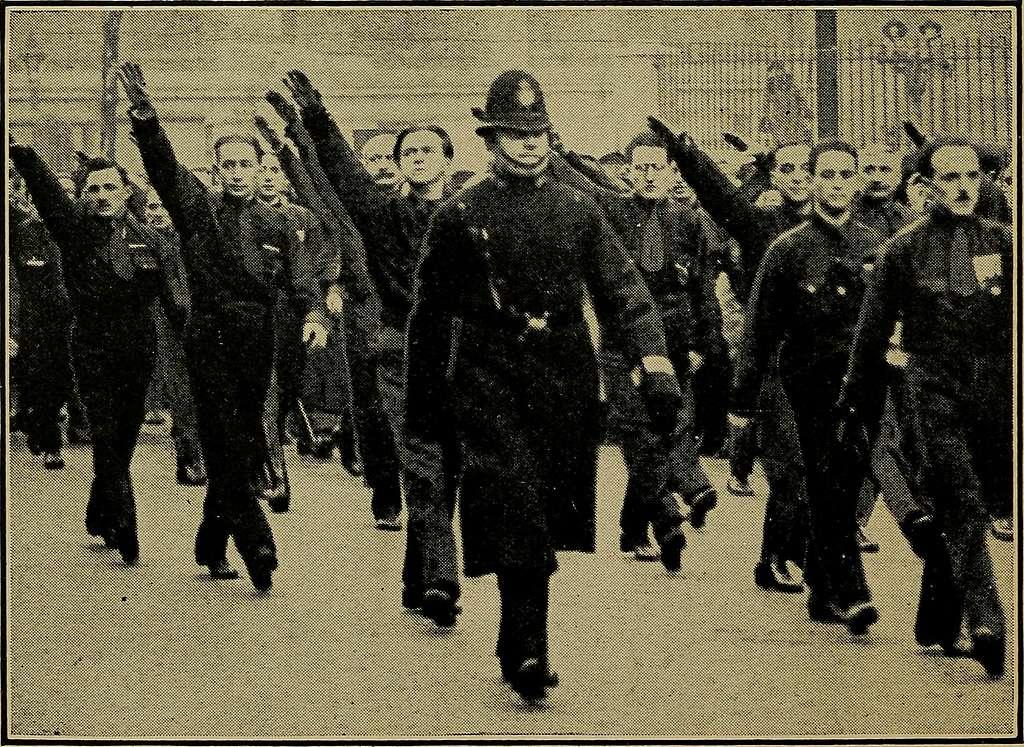
March of the Blackshirts - 1922 (ITOLDYA)
Between 1920 and 1922, the fascist movement rapidly expanded, organizing organized terror campaigns against socialist unions, peasant land occupations, and worker strikes through armed fascist militias known as “Blackshirts.” During this period, the fascist movement was directly financed by large landowners and industrial bourgeoisie, while the army and police either remained indifferent or provided indirect support. Fascist street violence led to the suppression of socialist movements and the paralysis of the parliamentary system. Mussolini shaped the fascist movement not merely as a street force but as an ideological “national revolution” project, centering its message on organic national unity under a single leader against liberalism, socialism, and the pluralist principles of democracy. In October 1922, Mussolini and fascist militias staged the March on Rome; the monarchy and the army, rather than resist, chose to transfer power to him. King Victor Emmanuel III appointed Mussolini prime minister on 29 October 1922, legitimizing the fascist movement’s rise to power.
Between 1922 and 1925, Mussolini consolidated his authoritarian rule by eliminating political opposition, and after 1925 Italy became a one-party fascist dictatorship. The fascist movement, defining the state as the “embodiment of the national will,” suppressed individual freedoms, placed trade unions under state control, and censored the press. The fascist corporatist policy, aiming to integrate the state and society, ostensibly sought to end class conflict but in reality functioned as a model serving the interests of large capital. At the center of fascist ideology were concepts such as “the absolute authority of the leader,” “the purifying power of violence,” and “national rebirth” (palingenesis). Italian fascism was not merely a political movement but an organized totalitarian project aiming to reconstruct society from top to bottom on the basis of fascist values.
Fascism emerged in 1919 with Benito Mussolini’s founding of the Fasci di Combattimento movement in Italy and became a prominent model in world public opinion after the 1922 March on Rome and Mussolini’s rise to power. Fascist Italy’s model of “authoritarian modernization” was closely observed in many countries, particularly in European societies struggling with postwar crises. The Mussolini regime claimed to restore social order by establishing strong authority against the weaknesses of liberal parliamentary systems, gaining support among conservative elites and radical nationalist groups. The authoritarian structure of Italy’s fascist government and its project of “fusion of state and society” provided a foundation for the emergence of similar movements in other countries during the 1920s and 1930s.
In Germany, the most radical form of fascism took shape through the National Socialist German Workers’ Party (NSDAP), founded in the 1920s under Adolf Hitler’s leadership. German fascism (Nazism), unlike Mussolini’s fascism, placed biological racism and antisemitism at its core, aiming for the rebirth of the German nation as the “Aryan race.” With Hitler’s rise to power in 1933, Nazism constructed a totalitarian regime and became one of the most extreme applications of fascist ideology. Germany’s success accelerated the international spread of fascist ideology. Germany and Italy formed ideological and military alliances to promote the fascist model across Europe, providing military support to Francisco Franco’s nationalist forces during the Spanish Civil War, thereby facilitating the fascist takeover in Spain. Franco’s regime, having received direct military and logistical aid from Mussolini and Hitler, seized power in 1939 and established a fascist dictatorship in Spain.
Fascist movements appeared in various mass or elite variants across many European countries during the 1930s. In Britain, Oswald Mosley’s British Union of Fascists (BUF); in France, Croix-de-Feu and Parti Populaire Français; in Romania, Iron Guard (Garda de Fier); in Hungary, Arrow Cross Party (Nyilaskeresztes Párt); and in Portugal, Salazar’s Estado Novo regime represented different versions of fascist ideology. However, most of these movements failed to seize full power, unlike their Italian and German counterparts. Another factor in the spread of fascism was the tendency of liberal democracies during capitalist crises to turn toward authoritarian rule, with fascism serving as a political tool occasionally employed by capital circles to suppress revolutionary left movements.
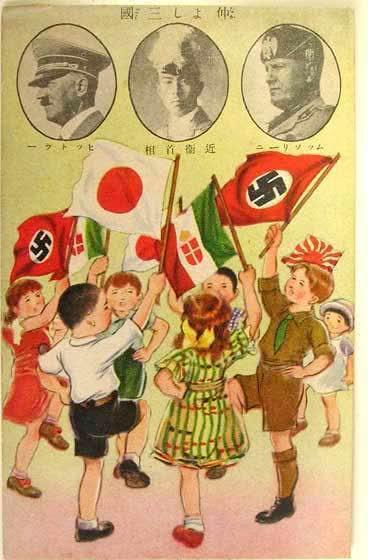
Japanese Propaganda Drawing (SNL)
Fascism also exerted ideological influence beyond Europe. In Japan, militarist-nationalist movements emerging in the early 1930s adopted a structure regarded as the Japanese variant of fascism. In Latin America, authoritarian regimes in Argentina, Brazil, and Chile were influenced by Italian and German fascist practices, particularly adopting corporatism and state-centered nationalism. However, fascism suffered military defeat in 1945 with the end of the Second World War, leading to the collapse of the fascist regimes in Germany and Italy. Nevertheless, fascism continued to exert ideological and cultural influence, reorganizing after the war under the label of neo-fascism, particularly among far-right movements.
The global spread of fascism was fundamentally rooted in the social collapse, economic crises, and weaknesses of liberal democracies following the First World War. Fascism gained support from elites and social sectors seeking authoritarian solutions during crises, generating ideological and political influence in many countries and finding opportunities for radical implementation amid the destructive consequences of war. However, the success of fascism depended not only on military and political conjunctures but also on the mass mobilization of social fears and the search for authority.
The fascist economic model was conceived as a unique system based on “state-directed guidance,” situated between the free-market principles of classical liberal capitalism and the collectivist structure of Marxist socialism. In this model, private property rights were preserved, but freedom in production, consumption, and capital circulation was placed under state control and direction. The fundamental principle of economic operation was to direct the different segments of society—workers, employers, peasants, industrialists—not through class-based conflict but toward a common goal aligned with national unity under state mediation.
In Italy, under Benito Mussolini’s leadership, the Corporate State system implemented from 1926 institutionalized this core logic of the economy. In this system, professional groups and productive classes were organized into state-affiliated corporations (professional associations). These corporations consisted of representatives of workers and employers, but final decisions and regulations were executed within frameworks determined by the state. Wages, working conditions, production quotas, and labor-management relations were regulated by decisions made within the corporations, and actions disrupting production such as strikes and lockouts were banned. This structure aimed to eliminate conflicts between workers and employers and ensure uninterrupted production.
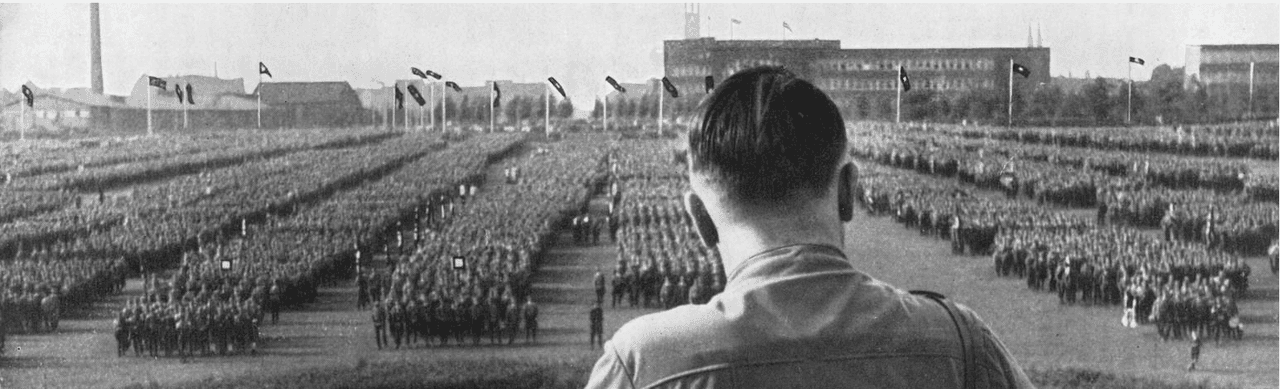
Hitler Addressing Soldiers (SNL)
Another distinctive structural feature of the fascist economy was direct state intervention in strategic sectors. State control was strengthened in transportation, energy, heavy industry, and banking, and private enterprises operated according to state-planned directives. These interventions aimed to enhance efficiency and planned development in production processes. Particularly during Mussolini’s era, significant emphasis was placed on public investment, with agricultural reform projects, rural development, and infrastructure initiatives (highways, bridges, irrigation systems) launched to stimulate economic dynamism. The state assumed the role of generating employment, combating unemployment, and revitalizing the domestic market through these projects.
In foreign trade and industrial policy, the fascist economy oriented itself toward autarky (self-sufficiency). Reducing external dependency, increasing domestic production of essential goods, and protecting the national economy from external influences were primary objectives. Accordingly, import quotas, foreign exchange controls, incentives for domestic industry, and projects to boost agricultural production were developed. Simultaneously, large industrial conglomerates were encouraged to grow through cooperation with the state, while small producers were directed through cooperatives or corporate associations.
The fascist economic model restricted individual decision-making processes in capital movements and labor markets within the framework of the state’s national planning ideology. Thus, the economy was centrally managed not based on individual interests and free competition but to achieve national development and preserve social order. Fascist regimes sought to construct a disciplined and controlled structure by making economic decisions rapidly through centralized authorities, aiming to shield the economy from market fluctuations.
The Second World War (1939–1945) marked the period when fascist ideology’s expansionist and authoritarian policies were most extensively implemented and simultaneously entered their decline. The leadership of fascism was assumed by Adolf Hitler’s National Socialist (Nazi) Party in Germany and Benito Mussolini’s Fascist Party in Italy. These two fascist regimes formed military and political alliances based on ideological ties centered on national rebirth (palingenesis), militarism, racism, and anti-democratic ideals, and supported Francisco Franco’s nationalist forces during the Spanish Civil War to establish an international fascist bloc.
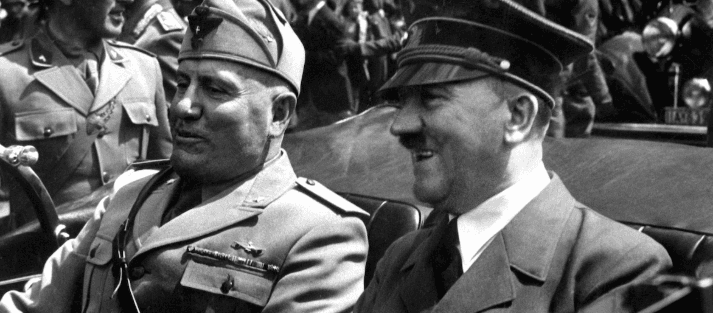
Mussolini and Hitler - Munich 1940 (SNL)
Germany’s invasion of Poland in 1939 marked the beginning of the Second World War. The militaristic and expansionist nature of fascist ideology merged with Germany’s aggressive policies in Eastern Europe and Italy’s ambitions in the Mediterranean and Africa. Throughout the war, fascist regimes sought to realize the ideological goals of fascism not only through military occupations but also through social engineering projects such as the Holocaust, ethnic cleansing, and political purges. The totalitarian state concept of fascism manifested itself through centralized practices in cultural, social, and economic spheres, asserting absolute state authority across all areas of society.
However, in the later stages of the war, the fascist bloc began to weaken militarily, economically, and socially. Italy, following the Allied invasion of Sicily in 1943, descended into internal collapse; Mussolini was removed from office and arrested, ending fascist rule in Italy. Germany continued fighting until 1945 but entered a collapse process as the Soviet Union advanced from the east and the Western Allies from the west. In April 1945, Mussolini was captured and executed by partisans; Hitler committed suicide in Berlin during the same period. The military defeat of the fascist regimes brought about their collapse as political powers.
Eco, Umberto. “Ur-Fascism.” *The New York Review of Books*. Accessed July 15, 2025.https://archive.org/details/umberto-eco-ur-fascism/umberto-eco-ur-fascism.lt/
Einzig, Paul. The Economic Foundations of Fascism. London: Macmillan and Co., 1934.
Gentile, Emilio. Who Is a Fascist? Trans. Betül Parlak. Istanbul: İletişim Yayınları, 2021.
Griffin, Roger. The Nature of Fascism. London and New York: Routledge, 2006.
Guichonnet, Paul. Mussolini and Fascism. Trans. Tanju Gökçöl. Istanbul: İletişim Yayınları, 1998.
Landa, İshay. Fascism and the Masses: Revolt Against the 'Last Men' (1848–1945). Trans. Utku Özmakas. Istanbul: İletişim Yayınları, 2023.
Pareto, Vilfredo. The Rise and Fall of the Elites: An Application of Theoretical Sociology. Trans. Merve Zeynep Doğan. Ankara: Doğu Batı Yayınları, 2013.
Poulantzas, Nicos. Fascism and Dictatorship. Trans. Ahmet İnsel. Istanbul: İletişim Yayınları, 2016.
Renton, David. Fascism: History and Theory. Trans. Meral Kasap Harzem. Istanbul: Nora Yayınları, 2021.
Store Norske Leksikon. "Adolf Hitler." Accessed July 15, 2025.https://snl.no/Adolf_Hitler
Store Norske Leksikon. "Aksenmaktene, Japansk Propagandaplakat." Accessed July 15, 2025.https://snl.no/aksemaktene
The Red Dragon and the Black Shirts: How Italy Found Her Soul: The True Story. GetArchive.net. Accessed July 15, 2025.https://itoldya420.getarchive.net/media/the-red-dragon-and-the-black-shirts-how-italy-found-her-soul-the-true-story-ee8143
Togliatti, Palmiro. Lectures on Fascism. Trans. Şiar Yalçın and Yüksel Demirekler. Ankara: Bilim ve Sosyalizm Yayınları, 1979.
“Benito Mussolini.” *World History Encyclopedia*. Accessed July 15, 2025.https://www.worldhistory.org/Benito_Mussolini/

Fascism (Generated by Artificial Intelligence)
Definition | Authoritarian / Nationalist / Anti-Capitalist / Anti-Communist Political Ideology | ||||||||
|---|---|---|---|---|---|---|---|---|---|
Active Process | 1920-1945 | ||||||||
Fundamental Principles | State Supremacy Cult of the Leader Mass Mobilization Rejection of Class Conflict | ||||||||
Origin | Italy | ||||||||
Goal | Unity Around a Single Leader Absolute Power of the State Rebirth of the Nation Elimination of Class Conflict Management of Society within Discipline and Order Rejection of Liberal Democracy and Communism Elimination of Class Conflict | ||||||||
Economic Foundations | Corporatism, Protection of Private Property, State Economic Intervention, Autarkic Policy, Large Public Investments, Rapid Decision-Making Mechanism in Economic Planning | ||||||||
Fascist Regimes | Spain – Francisco Franco (1939-1975) Hungary – Ferenc Szálasi (1944-1945) Romania – Ion Antonescu (1940-1944) Italy – Benito Mussolini (1922–1943) Germany – Adolf Hitler (1933-1945) Portugal – António de Oliveira Salazar (1933-1974) | ||||||||
Philosophical Origins of Fascism
The Birth of Fascism
The Italian Fascist Movement
The Global Spread of Fascism
The Fascist Economic Model
The Second World War and the Fall of Fascism