This article was automatically translated from the original Turkish version.
+2 More
Names | Erzurum İdadisi, Erzurum Sultanisi, Erzurum Erkek Lisesi, Erzurum Lisesi, Erzurum Lisesi (Anadolu Lisesi) | ||||||||
|---|---|---|---|---|---|---|---|---|---|
Educational Format | Tam Gün | ||||||||
Founder | Sultan II. Abdülhamid | ||||||||
Foundation Year | 1889 | ||||||||
School Name | Erzurum Lisesi | ||||||||
School Name | Erzurum Anadolu Lisesi Erzurum Lisesi Erzurum Erkek Lisesi Erzurum Sultanisi Erzurum İdadisi | ||||||||
Foundation Year | 1889 | ||||||||
Founder | Sultan II. Abdülhamid | ||||||||
School Type | Anadolu Lisesi | ||||||||
Names | Erzurum İdadisi Erzurum Sultanisi Erzurum Erkek Lisesi Erzurum Lisesi Erzurum Lisesi (Anadolu Lisesi) | ||||||||
Address | Yakutiye Erzurum Yakutiye | ||||||||
Language of Instruction | Turkish | ||||||||
Total Campus | Main Building Additional Building Cultural Site Sports Hall Building Dormitory Building Dining Hall Building | ||||||||
Foreign Languages | English German | ||||||||
Preparatory Class | No | ||||||||
Teaching Format | Full Day | ||||||||
Boarding Status | Yes | ||||||||
Website | https://erzurumlisesi.meb.k12.tr/ | ||||||||
Erzurum Lisesi is a historic Anatolian high school under the Ministry of National Education, located in the Yakutiye district of Erzurum. It was established in 1889 by Sultan II. Abdülhamid. Historically, it was the 25th high school opened within the Ottoman Empire and the 8th high school directly inaugurated by Sultan II. Abdülhamid. As one of the oldest educational institutions in Eastern Anatolia, the school has been providing education for over 135 years and has produced more than 50,000 graduates, including many prominent figures.
Erzurum Lisesi’s establishment is rooted in the Ottoman Empire’s efforts to modernize education in the late 19th century. According to the 1293 (1876/77) State Yearbook, Erzurum had 20 rüştiye schools and 450 students at the time.【1】 However, the absence of institutions offering higher-level education led to the initiation in 1885 of a project to expand idadis (high schools) across the country. In this context, local authorities were contacted regarding the construction of the Erzurum İdadisi, and careful attention was paid to the architectural style of the building.
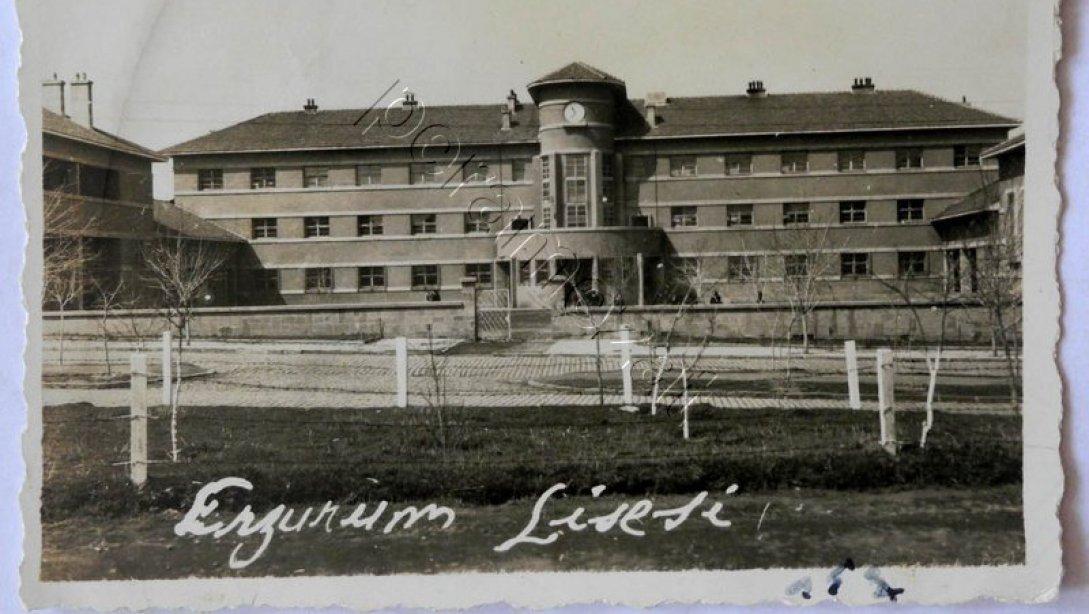
Erzurum Lisesi (Erzurum İl Milli Eğitim Müdürlüğü)
Erzurum Lisesi was founded in June 1889 under the name Erzurum İdadisi. Historically, it was the 25th high school established within the Ottoman Empire and the 8th high school directly opened by Sultan II. Abdülhamid Han. The school’s first principal was Abdi Namık Bey. From its inception, the institution was designed to serve as a central educational hub for the entire region and began operations with the status of İdadi – Leyl-i Meccani (Free Boarding).【2】
At its founding, the school’s educational structure was aligned with the rüştiye schools in the region. Starting in 1889, funding for rüştiye schools in locations with idadis was redirected toward the construction of idadi buildings, and rüştiye instruction was integrated into the idadi system. Initially a five-grade institution, Erzurum İdadisi was expanded in 1891 by incorporating the final two grades of the Mülki Rüştiye, transforming it into a fully developed seven-grade school.【3】
In the early years of education, the first grade was divided into two separate branches: one for students who knew French and one for those who did not. The then Director of Education in Erzurum, Tevfik Efendi, quickly unified the two branches by raising the level of French instruction for non-speakers. Graduates of the five-year section received the İdadi Şahadetnamesi, while those graduating from the final year (the seven-year section) received the Mülazemat Rüsulu. The institution awarded its first graduates in 1311 (1895).【4】
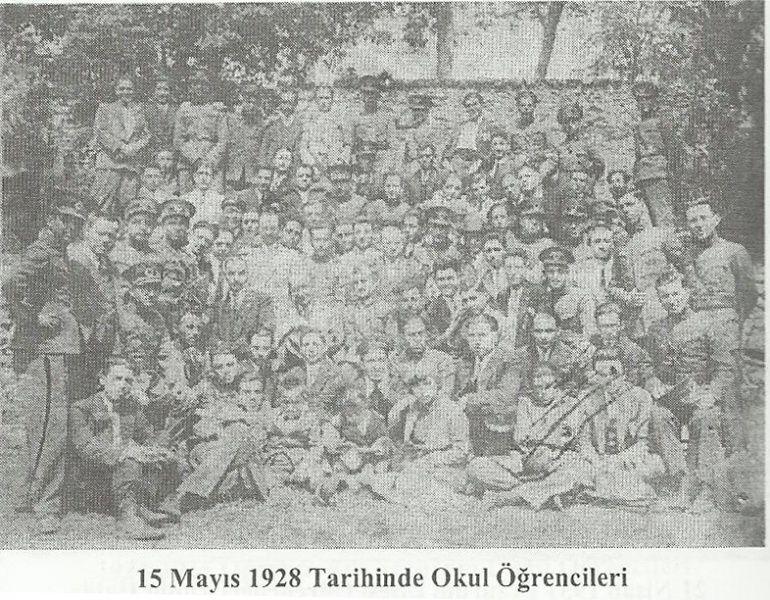
Erzurum Lisesi Öğrencileri - 1928 (Erzurum Lisesi)
When founded in 1889 by Sultan II. Abdülhamid Han, the school began its educational life under the name Erzurum İdadisi. In 1913, following an upgrade in its status, the name was changed to Erzurum Sultanisi, reflecting its position as one of the highest-level secondary schools in the region.【5】
With the proclamation of the Republic and the transition to a modern education system, the institution became Erzurum Erkek Lisesi in 1922 and later adopted the name Erzurum Lisesi. By 2004, like many historic schools in Türkiye, it retained its traditional name while adopting the designation Anadolu Lisesi to continue its educational activities.【6】
Since its founding in 1889, Erzurum Lisesi has operated in four distinct buildings.
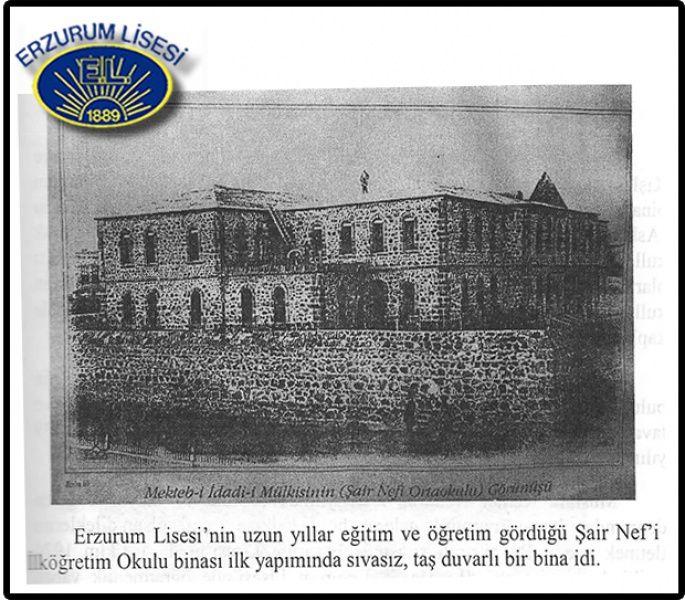
Erzurum Lisesi'nin İlk Binası (Erzurum Lisesi)
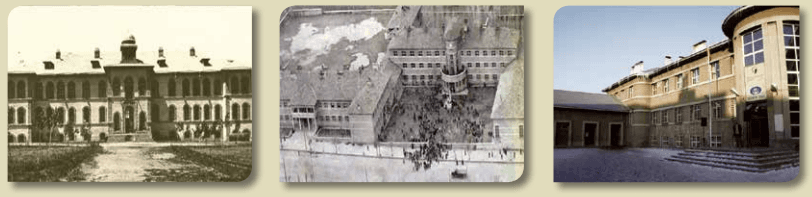
Erzurum Lisesi Binaları (MEB)
The building currently used by Erzurum Lisesi and known as the Main Building is a product of early Republican-era planned urbanism.
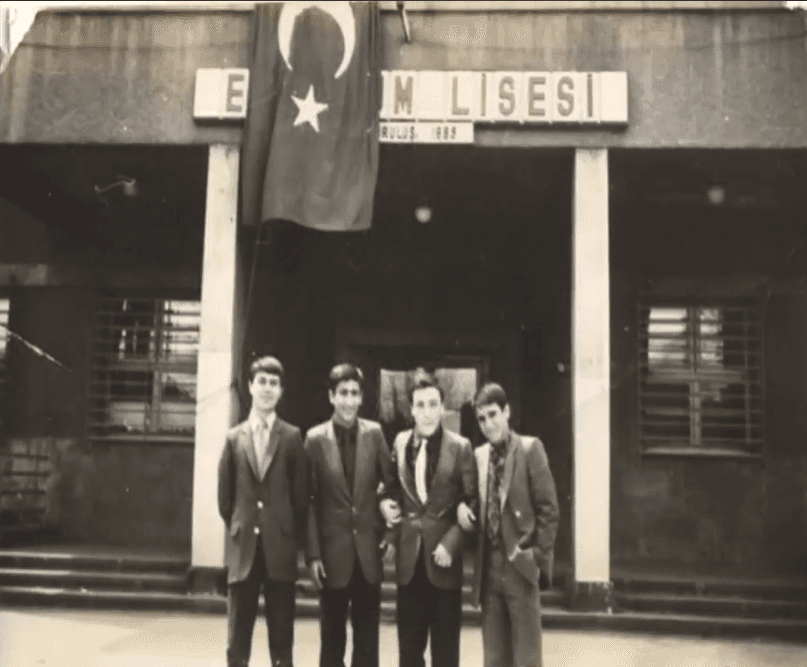
Erzurum Lisesi Öğrencileri (Protokol Kapısı Önünde) - (Murat Bulut)
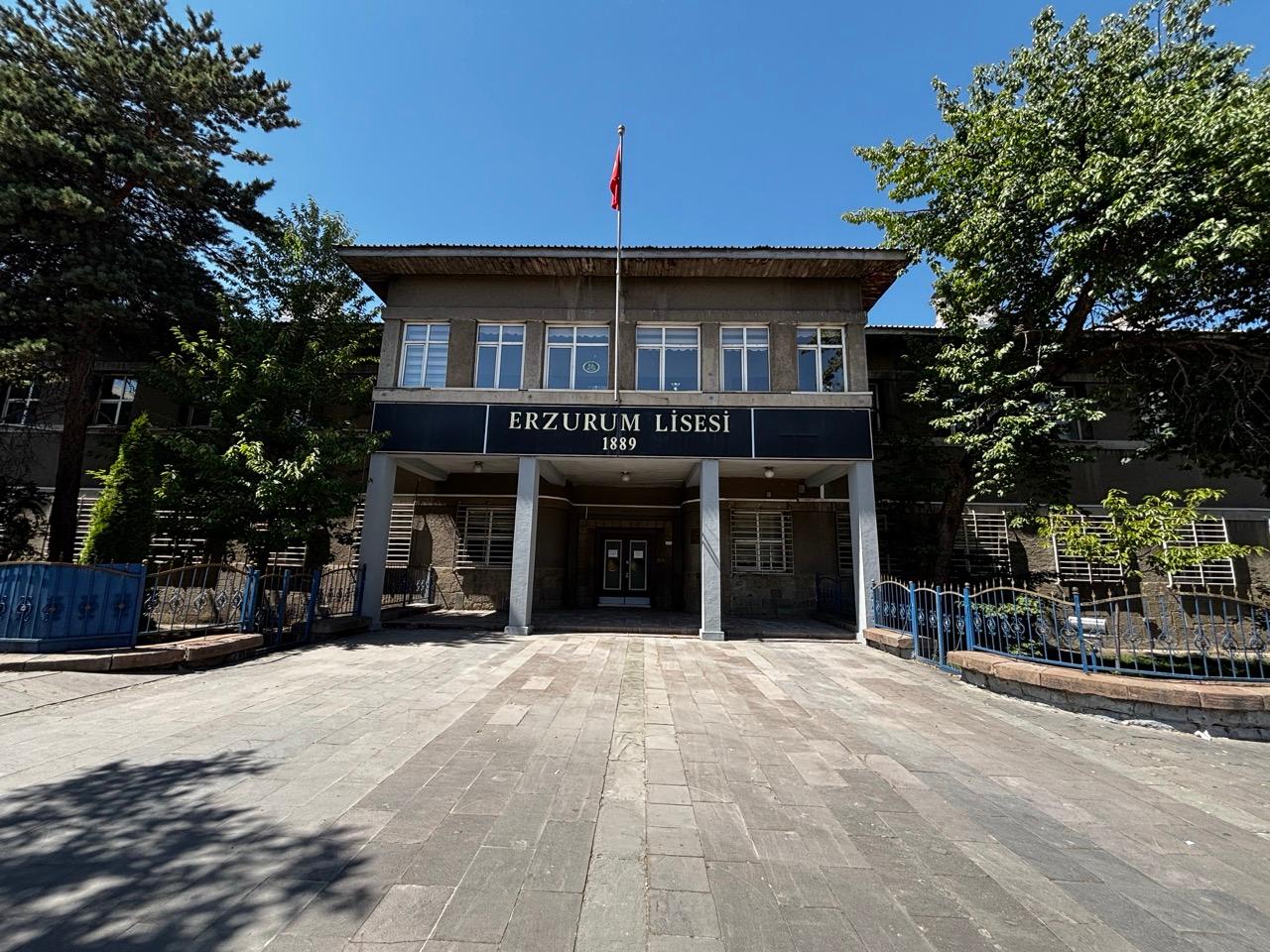
Günümüzde Protokol Kapısı (EBA)
The school grounds cover a total area of 16,154 square meters. The main building, completed in 1939, has been officially registered as a SİT area by the Council for the Protection of Cultural and Natural Heritage.【7】
The inauguration ceremony of the current main building, completed in 1939, acquired historical significance with the attendance of President İsmet İnönü. During his visit, İnönü meticulously examined the building and, with his military and technical discipline, pointed out architectural details. He specifically noted that the windows had not been constructed strictly according to the original plans.【8】
According to an anecdote linked to this visit, as İnönü ascended the stairs, he sensed that one step differed from the others. Following his observation, subsequent technical measurements confirmed that the step was 2.5 cm different from the others.【9】 This inauguration at the presidential level confirmed that the building was not merely an educational facility but also a symbol of the state’s ideals of planned urbanism and modernization in Erzurum.
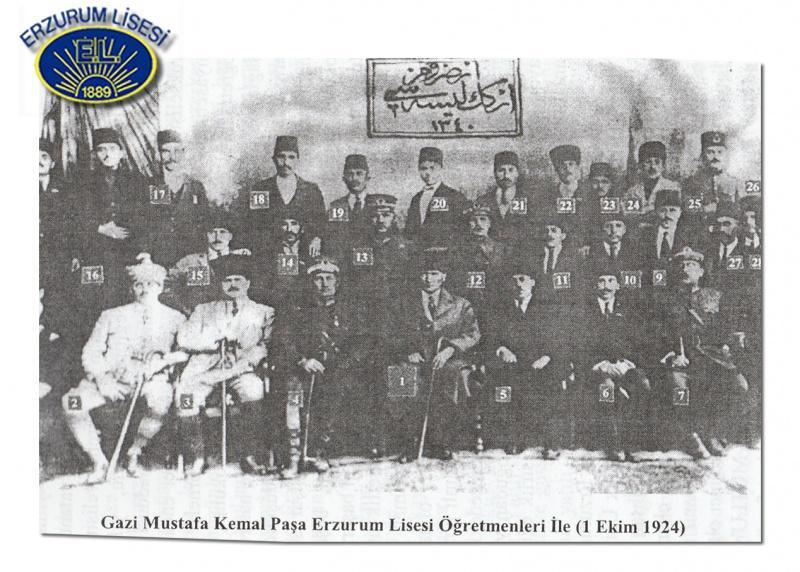
Atatürk, Erzurum Lisesi Öğretmenleri ile Bir Arada (Erzurum Lisesi)
Mustafa Kemal Atatürk’s visit to Erzurum in 1924 occurred following the devastating earthquake on 13 September 1924 in the Pasinler region, which caused widespread destruction. While traveling to Trabzon, Atatürk learned of the earthquake and altered his itinerary, arriving in Erzurum on the evening of 30 September 1924.
On the second day of his visit, 1 October 1924, Atatürk visited Erzurum Lisesi. One witness to this historic visit was the writer Ahmet Hamdi Tanpınar, who was then a young teacher at the school. Tanpınar described this encounter in his work Beş Şehir. According to Tanpınar, upon arriving at the school, Atatürk immediately separated from his official delegation and mingled with the teachers, dedicating his entire day to them and the students. Tanpınar recounts the first meeting in the teachers’ room as follows:
"I saw Atatürk for the first time in Erzurum. My only conversation with him took place at Erzurum Lisesi. The man we had welcomed with the entire city at Kars Gate, upon entering the school, detached himself from his entourage and joined us. He was calm, courteous, always attentive, and interested in everything. He devoted his entire day to the teachers and students of Erzurum Lisesi. He would not stay for a meal, but he agreed to drink afternoon tea. He planned to leave in half an hour. He stayed with us for three and a half hours."【10】
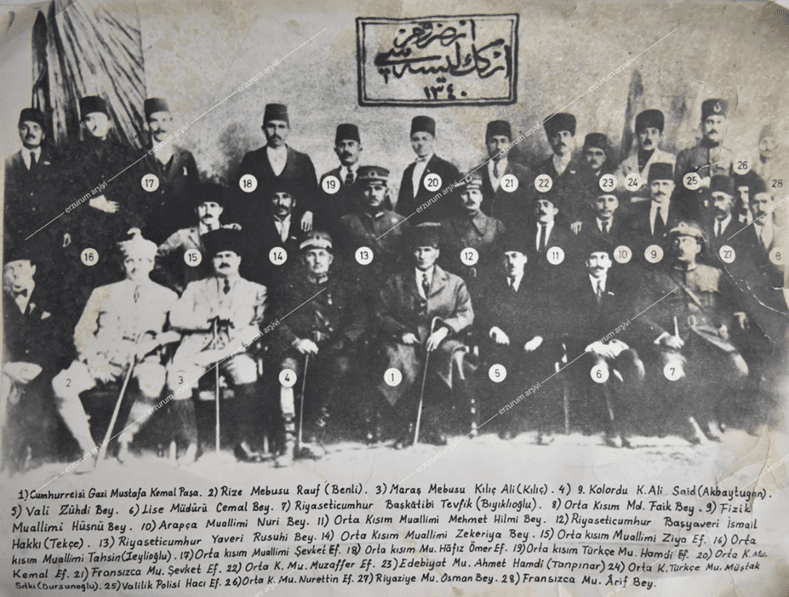
Ziyaret Esnasında Orada Bulunanlar (İsimlerle) (Darüşşafaka)
The most remarkable aspect of the visit was that it lasted a full three and a half hours, despite being initially planned for only half an hour. During this conversation in the teachers’ room, Atatürk first asked Tanpınar personal questions and then turned to contemporary issues. Tanpınar elaborates on their dialogue as follows:
"While answering the questions Atatürk asked me in Erzurum Lisesi’s white-plastered, single broken-couch teacher’s room, my mind was certainly filled with him."【11】
"He first asked me who I was, what I did, how long I had been in Erzurum, where I had studied, and who my teachers were. Then suddenly he turned to the contemporary issue of the closure of madrasas and wanted to know my opinion on its impact on the public."【12】
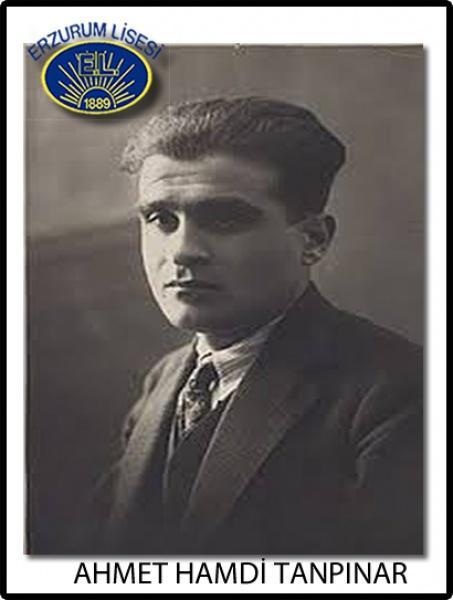
Erzurum Lisesi Öğretmenlerinden Ahmet Hamdi Tanpınar (Erzurum Lisesi)
In response to Tanpınar’s view that this change would not provoke resistance, Atatürk, raising a finger, warned: "Don’t be so sure!", emphasizing the need for constant vigilance regarding social dynamics.
The end of the visit was described as follows:
"It would certainly have continued. But Rize deputy Rauf Bey entered the room and reminded the delegation."【13】
Additionally, the first bust of Atatürk in the city was erected in the school’s courtyard. Until the completion of the Havuzbaşı Atatürk Monument in the city, all official ceremonies and celebrations were held before this bust.【14】
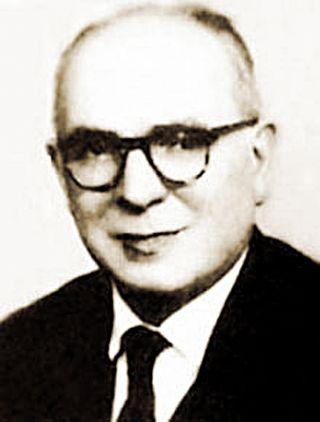
Erzurum Lisesi Öğretmenlerinden Ord. Prof. Dr. Ziyaeddin Fahri Fındıkoğlu (DİA)
Mustafa Kemal Paşa observed the school’s influence on city life during the War of Independence and, after the proclamation of the Republic, ensured that prominent educators of the era served here. 【15】
Among the teachers and educational staff who served at Erzurum Lisesi are notable figures who left their mark in their respective fields: Ahmet Hamdi Tanpınar, Behçet Kemal Çağlar, Ord. Prof. Dr. Ziyaeddin Fahri Fındıkoğlu, Cihat Baban, Bahadır Dülger, Mehmet Cevdet Karlıdağ (son of Ahmet Cevdet), Cevat Dursunoğlu, Sıtkı Dursunoğlu, Nurdoğan İlgün, Fevzi Budak, Nurettin Taşçı, Zahit Önal, Mukaddes Coşkun, Abdurrahim Şerif Beygu, and Ahmet Somunoğlu. Many other significant individuals have also joined this faculty, enriching the school’s contribution to literature, thought, and culture. Additionally, Dr. Haydar Dümen served at the school as a doctor, contributing to the provision of health services.
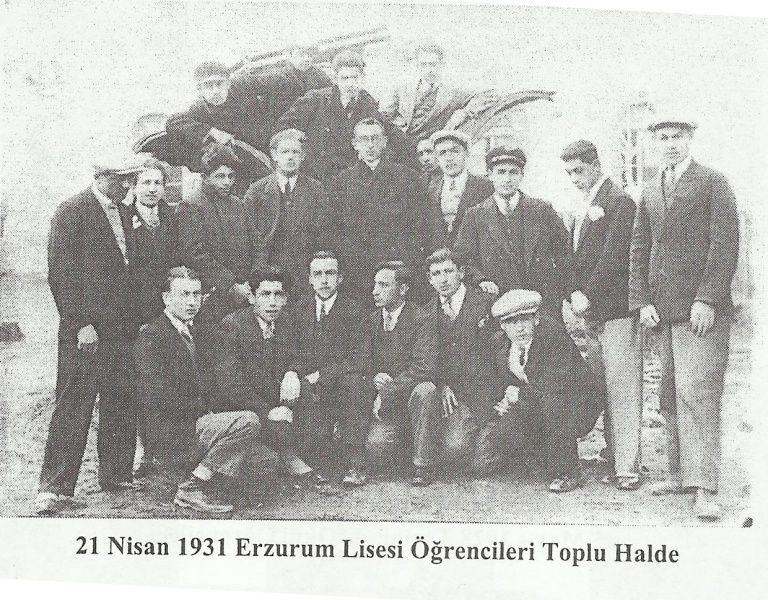
Erzurum Lisesi Öğrencileri -1931 (Erzurum Lisesi)
The Turkish Educational Foundations Solidarity Council High Schools Association (TEVDAK) is a civil society organization that unites educational foundations of historic state high schools across various provinces of Türkiye with over a century of history: (Ankara Atatürk Lisesi, Beyoğlu Anadolu Lisesi, Edirne Lisesi, Erzurum Lisesi, Eyüp Anadolu Lisesi, Galatasaray Lisesi, Haydarpaşa Lisesi, İstanbul Erkek Lisesi, İzmir Atatürk Lisesi, Kabataş Erkek Lisesi, Kadıköy Anadolu Lisesi, Nişantaşı Anadolu Lisesi, Pertevniyal Lisesi, Vefa Lisesi, Zonguldak Mehmet Çelikel Lisesi). Erzurum Lisesi, with its institutional culture and historical legacy, is among the foundational institutions of TEVDAK.
TEVDAK was established in 1991 as an educational platform under the leadership of then Minister of National Education Avni Akyol and chaired by Feyyaz Tokar, and gained association status on 31 July 1996. Its fundamental aim is to preserve the institutional identities of historic high schools established during the late Ottoman period and early Republic, which produced important figures for the state bureaucracy and society, and to advance contemporary educational standards.
In this context, Erzurum Lisesi is one of the 15 historic state high schools within TEVDAK. The Erzurum Lisesi Culture and Education Foundation, established by its alumni, is officially listed among the “Community-Supported State Educational Institutions” within TEVDAK.
Erzurum Lisesi Kültür ve Eğitim Vakfı (TEVDAK)
The Erzurum Lisesi Culture and Education Foundation is a civil society organization established in 1986 through the initiative of a group of Erzurum Lisesi alumni to operate in the field of education. The foundation is one of the founding members and active participants of the Turkish Educational Foundations Solidarity Council High Schools Association (TEVDAK).
The foundation’s administrative structure and decision-making mechanism consist of 74 members of the Board of Trustees. Currently, the chairmanship of the board is held by Prof. Dr. Adnan Okur.
The foundation’s primary objective, as stated in its founding charter, is to preserve the historical identity of Erzurum Lisesi, with its deep-rooted past and tradition, and to elevate the quality of its education and instruction to higher contemporary standards. To this end, the foundation undertakes initiatives to meet the school’s physical infrastructure needs and address deficiencies in educational materials.
In addition to improving the physical conditions of the educational institution, student-centered activities are among the foundation’s priorities. The foundation supports social and cultural activities to foster students’ development as individuals respectful of national and universal values. Furthermore, in accordance with the principle of equal opportunity in education, the foundation provides scholarships to students in need of financial assistance and offers various social aid programs.
The Erzurum Lisesi Culture and Education Foundation assumes an important mission under the umbrella of TEVDAK. Through this membership, the foundation collaborates with the educational foundations of Turkey’s leading historic high schools such as Galatasaray Lisesi, İstanbul Erkek Lisesi, Kabataş Erkek Lisesi, and Ankara Atatürk Lisesi. This network of solidarity aims to preserve Erzurum Lisesi's institutional identity in the 21st century and contribute to the enhancement of national educational quality through coordinated projects with the Ministry of National Education.
In addition to social support for students, the Erzurum Lisesi Culture and Education Foundation conducts publication activities to contribute to academic and cultural literature. In this context, with the support of the Ministry of Culture, the foundation published its first book, "Erzurum'da Eğitim Tarihi Kronolojisi". This work, prepared to address the lack of sources on the region’s educational history, has been made accessible to school and city libraries.
Erzurum Lisesi conducts its educational activities on a Full Day basis, with classes beginning at 08:30 and ending at 15:50. The school does not have a preparatory class; education begins directly at the high school level. The primary language of instruction is Turkish, and a foreign language program is implemented. English is taught as the first foreign language and German as the second foreign language.
Erzurum Lisesi is a central project school under the Ministry of National Education. Student admissions are conducted annually through the centralized examination scores of the High School Transition System (LGS) organized by the Ministry. No other admission method is applied; students are placed in the school based on their ranking and score during the preference period.
The main building, completed in 1939, is a large structure composed of four interconnected sections. It houses administrative offices, classrooms, a computer laboratory, a dormitory, a cafeteria, and a snack bar. The building features spacious and well-ventilated classrooms. Ventilation openings are present on interior walls, and classrooms with a height of approximately 3.80 meters aim to provide a comfortable learning environment. Music, art, geography, and information technology classrooms are located in this building. The three-story structure, consisting of basement, ground, and first floors, has classroom doors arranged along both sides of the corridor. There is a protocol entrance facing the street and a second entrance opening to the courtyard.
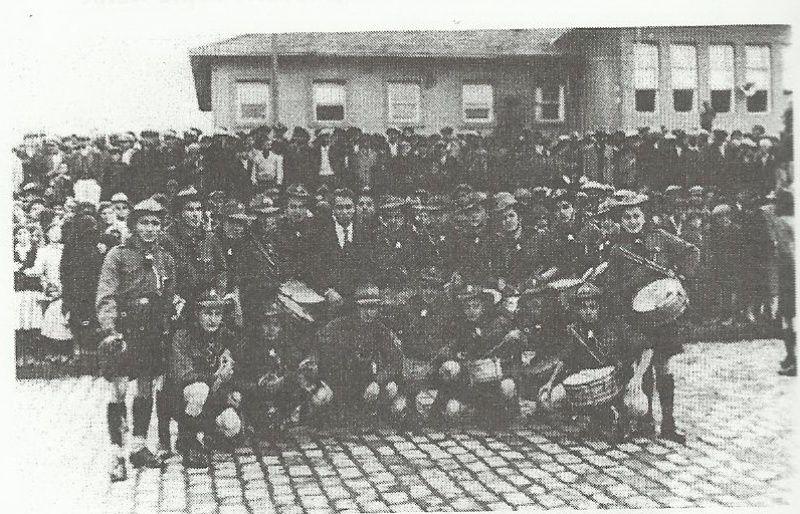
Erzurum Lisesi Bando Takımı (Erzurum Lisesi)
Until the construction of the Culture Site, the physics, chemistry, and biology laboratories and the library were located in this building, while theater and similar activities took place in the sports hall. The wooden paneling in the principal’s office was installed by Fikri Ertek in 1986. The three balconies originally present in the building were later enclosed and converted into rooms. Historical paintings created by students and teachers adorn the corridor walls.
Additionally, the building contains passageways and tunnels. These were designed to serve as shelters and escape routes in case of an attack and also to house the building’s sanitary systems (water and heating) and electrical network. The passageways begin at the boiler room, pass beneath the kitchen, and reach the basement classrooms. Another separate channel runs from the corridor of the basement classrooms to the ground-floor restrooms. There is also a widespread rumor of an exit route extending southward from this point. This underground system, serving both technical and security purposes, constitutes an essential component of the main building.
Constructed in 1970, this building consists of a half-basement, ground floor, and first floor and was built using the rubble masonry technique with harman bricks. In 2000, its windows were reduced in size and its roof was replaced. It contains classrooms, workshops, and a guidance service. This building no longer exists.
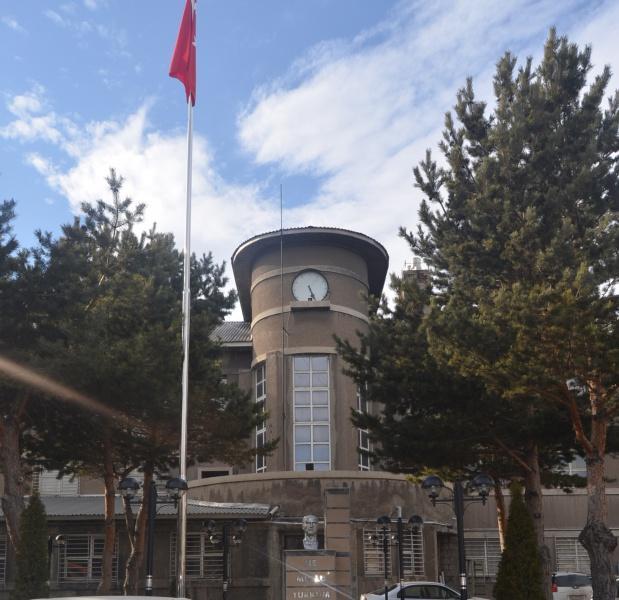
Saat Kulesi (Erzurum Lisesi)
The dormitory building has four floors including the basement. The ground floor houses the infirmary, laundry room, bathrooms, staff room, and student archive. It also connects to the cafeteria building. The first and second floors contain study rooms, a library, and dormitories, while the top floor houses a mosque. On the building’s facade is a historic electric clock synchronized with the main building.
The sports hall building, constructed separately from the main school building, is a two-story structure. The basement contains areas for student sports, changing rooms, showers, and storage. In this storage area is a device known as the "earthquake stone", an earthquake measurement system that has been periodically inspected by experts to assess potential structural movement and seismic risk.
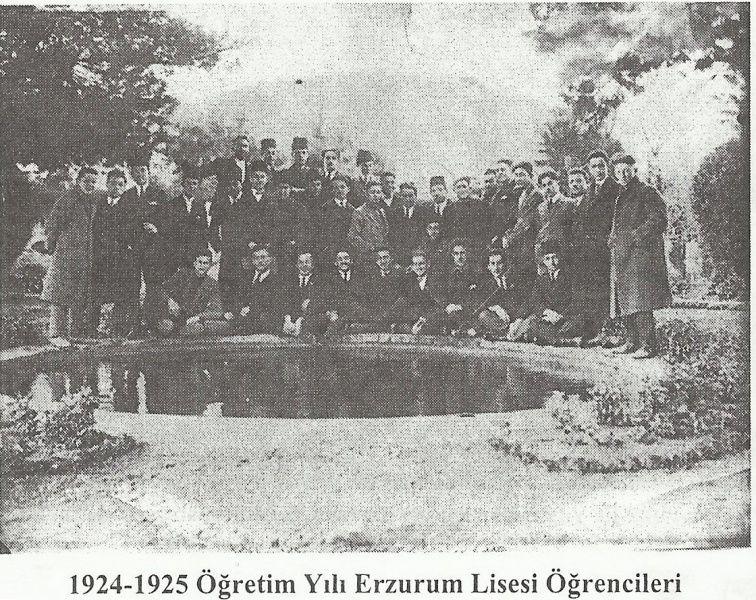
Erzurum Lisesi Öğrencileri 1924-1925 (Erzurum Lisesi)
The ground floor contains a large sports hall with a stage on which theater and other events were originally staged. On either side of the stage were small stepped rooms providing access. Before the Culture Site was built, concerts, ceremonies, and meetings were held in this hall, which served as a vital center for student theater performances and social activities.
The sports hall is equipped with facilities for basketball, volleyball, handball, indoor football, and gymnastics, and also houses equipment necessary for physical education classes.
The cafeteria building, constructed in connection with the main building, is three stories high including the basement. The basement contains shower areas, archives, a Turkish bath, and storage. The ground floor houses the kitchen and student and staff cafeterias. The first floor contains food and material storage. This structure was specifically planned to meet the needs of boarding students.
The Culture Site building, initiated in 1986 under the leadership of the school’s then principal, the late Necip Çadırcı, and through collaboration between the school and parents, was constructed with financial contributions from alumni, school resources, and support from public institutions. The construction progressed with the architectural drawings provided by former Erzurum Lisesi alumnus Ekrem Ceyhun, but was temporarily halted due to financial constraints. Later, with Ekrem Ceyhun’s re-engagement and negotiations with the provincial governor’s office, the project was incorporated into the Ministry of National Education’s planned investment program, accelerating the process.
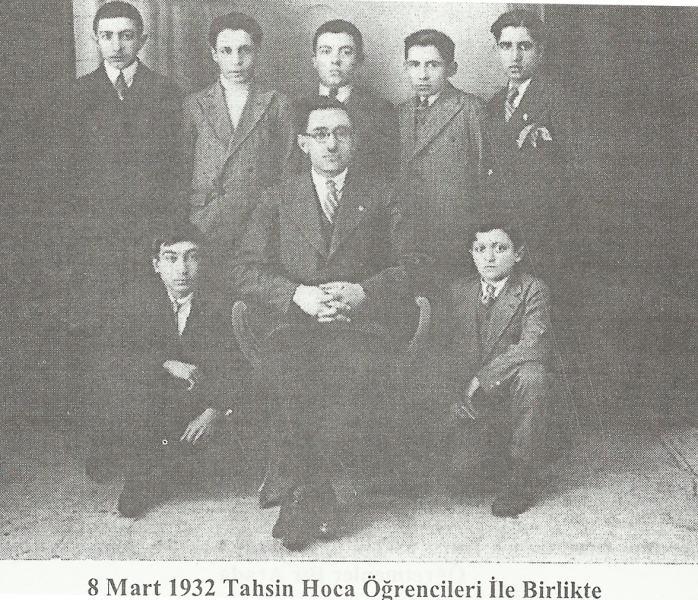
Tahsin Hoca ve Öğrencileri - 1932 (Erzurum Lisesi)
The building was finally completed and inaugurated in 2000 as the Erzurum Lisesi Culture Site, with the opening ceremony conducted by former Minister of National Education Metin Bostancıoğlu. Covering an area of approximately 1,200 square meters, the Culture Site is a multi-purpose complex integrating educational and cultural activities.
Basement houses the Necip Çadırcı Republican Education Museum and the Turkish History of Education and Technology Museum. Additionally, there are boiler rooms, staff rest areas, storage areas, and restrooms. This section serves as an archive and museum, preserving the school’s historical heritage and contributing to the preservation of educational memory.
Ground Floor contains four classrooms, chemistry, physics, and biology laboratories, a map room, a folkloric room, a teachers’ room, a photocopy room, a cafeteria, a foyer, a staff room, an elevator for disabled persons, and restrooms.
First Floor houses a 670-seat large conference hall, a 120-seat seminar hall, a foyer, and restrooms. This section hosts the school’s academic events, meetings, ceremonies, and cultural programs.
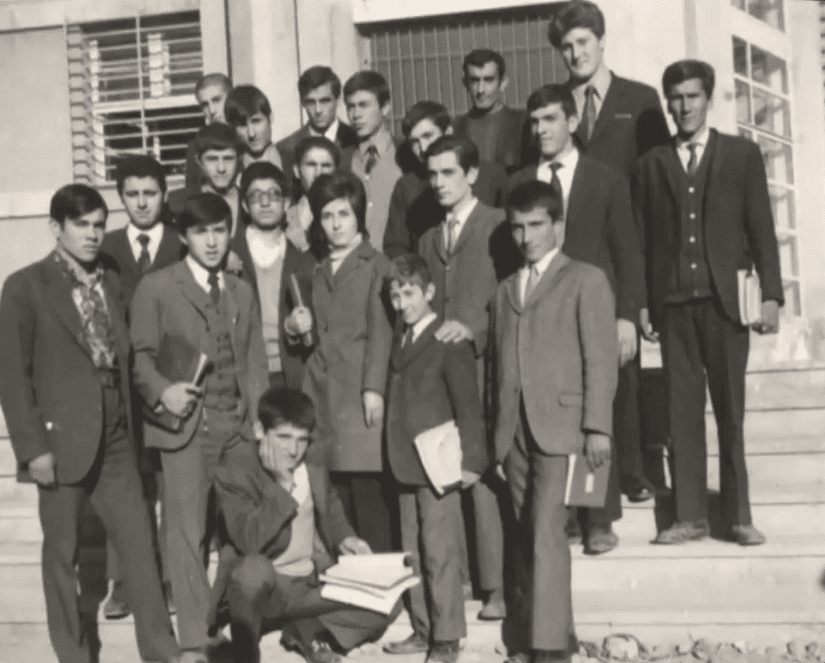
Erzurum Lisesi Öğrencileri (Murat Bulut)
Second Floor contains the lobby of the conference hall, a library hall with 13,900 books, a mosque, a multi-purpose room, and restrooms, organized as a structure supporting academic activities. In this way, the Culture Site functions as a significant structure integrating Erzurum Lisesi’s educational, cultural, and scientific activities under a unified framework.
The school has multiple courtyards. The total area of the grounds is approximately 16,154 square meters, of which 6,500 square meters are built-up area. The courtyards are landscaped with green spaces and sports areas. The campus has been designated as a SİT area by the Council for the Protection of Cultural and Natural Heritage. It is also located within a military security zone. The courtyards feature green areas and trees, asphalted play areas (basketball and volleyball courts) for student use, and a memorial forest composed of trees planted by former alumni.
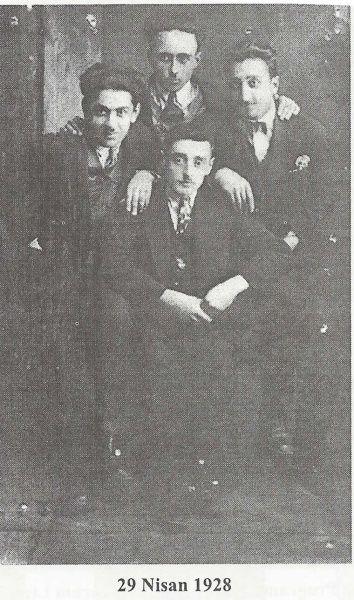
Erzurum Lisesi Öğrencileri - 1928 (Erzurum Lisesi)
Erzurum Lisesi has a coeducational system with both male and female students studying together. Education is conducted on a full-day basis, and students are divided into day students and boarders based on their residential status. The student body consists of students from Erzurum city center as well as surrounding districts and villages.
The student population actively participates in scientific, athletic, and social activities during non-academic hours. In addition to TÜBİTAK projects, TEKNOFEST teams, and licensed sports such as basketball, skiing, and futsal, there is strong participation in school-based student clubs (Culture and Literature, Science-Fen and Technology, Environmental Protection, Yeşilay, Disaster Preparedness, Visual Arts, etc.). Through these clubs, students directly implement cultural, artistic, and social responsibility projects such as theater performances, literary panels, choir activities, feeding stray animals, zero-waste initiatives, and peer education.
Erzurum Lisesi implements a multifaceted activity program to support students’ academic development as well as their social, cultural, artistic, and athletic dimensions. Through active clubs within the school (Visual Arts, Culture and Literature, Science-Fen and Technology, Sports, Yeşilay, Disaster Preparedness, Environmental Protection, Values, Music, Energy Efficiency, Red Crescent and Blood Donation, Traffic Safety and First Aid), events are organized ranging from the school level to the national level.
Theater arts, visual arts, and literary activities are maintained as institutional traditions at the school. Key initiatives include:
Projects, academic seminars, and external academic activities are organized to develop students’ scientific thinking skills:
The school’s longstanding athletic tradition continues with regional and national achievements in official competitions:
Community service projects are implemented to foster awareness of the environment, nature, and social responsibility among students:
Erasmus+ accredited, the institution integrates its local experience with global educational standards by involving teachers and students in scientific projects in European countries such as Italy and Finland. The school has earned the European Quality Label through eTwinning projects.
Erzurum Lisesi has achieved academic success on national and international platforms. Supporting a culture of scientific research, the school has won regional first place in the TÜBİTAK 2204 Project Competitions and provides students opportunities to showcase their projects at the 4004 and 4006 Science Fairs. Aiming to keep pace with technological transformation, the school actively participates in UAV competitions and various technology festivals under TEKNOFEST. Additionally, its achievements in knowledge competitions, including district first place and participation in the Science Olympiads, have strengthened its academic reputation.
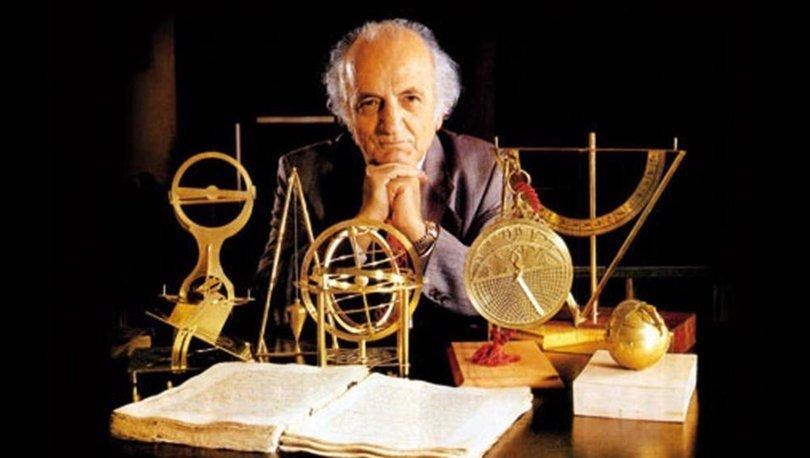
Erzurum Lisesi Mezunlarından Prof. Dr. Fuat Sezgin (Uludağ Üniversitesi)
Since 1889, Erzurum Lisesi has produced numerous graduates who have held significant positions in state administration, science, culture, and the arts.
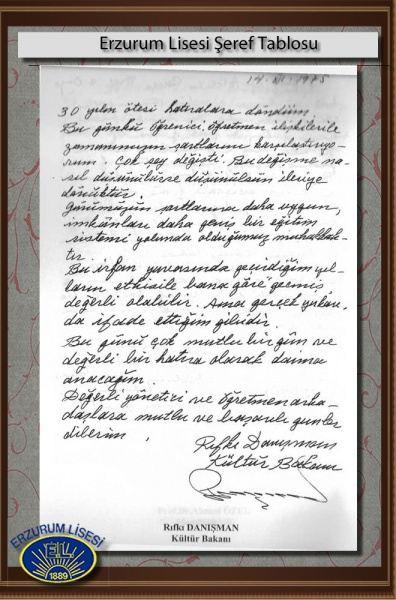
Erzurum Lisesi Mezunlarından Kültür Bakanı Rıfkı Danışman'a ait Şeref Defteri Yazısı (Erzurum Lisesi)
Among its graduates are former Speaker of the Turkish Grand National Assembly Cahit Karakaş, former Minister of National Education Rıfkı Danışman, former Minister of Justice Mehmet Necat Eldem, State Minister Ekrem Ceyhun, Minister of Culture Rıfkı Danışman, Minister of Village Affairs and Cooperatives Münir Raif Güney, Deputy Minister of National Education Rıfkı Salim Burçak, Members of Parliament Suat Pamukçu and Mehmet Sait Erdinç, and numerous other political figures. Additionally, prominent figures in science and academia such as Prof. Dr. Fuat Sezgin, Prof. Dr. Mehmet Fahrettin Kırzıoğlu, and Prof. Dr. Yaşar Sütbeyaz are among its graduates.
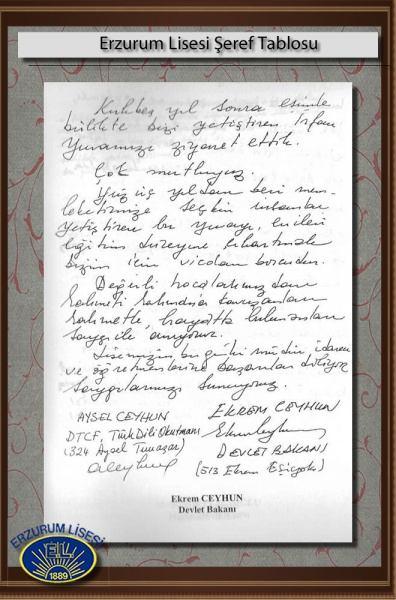
Erzurum Lisesi Mezunlarından Devlet Bakanı Ekrem Ceyhun'a ait Şeref Defteri Yazısı (Erzurum Lisesi)
Erzurum Lisesi graduates have contributed to the governance and development of the country across a broad spectrum, from members of the Turkish Grand National Assembly to academics, commanders, and bureaucrats. This is exemplified by the fact that in 1958, 60 members of the TBMM were Erzurum Lisesi graduates.
Since 1975, Erzurum Lisesi students have achieved success in TÜBİTAK-organized Physics, Chemistry, and Mathematics competitions across Turkey and have actively participated in sports, folklore, and other social activities, winning numerous cups, medals, shields, and commendation certificates for the school. Particularly, regional rankings in scientific competitions have been among the most important indicators of the school’s academic success:
Some of Erzurum Lisesi’s graduates have become internationally recognized figures who have contributed to world scientific history beyond the borders of Türkiye.
Graduates Prof. Dr. Ahmed Cemal Eringen, Halis Morkoç, and Suat Gültekin are among the few Turkish scientists who have worked within the U.S.-NASA organization and are internationally acknowledged.【18】
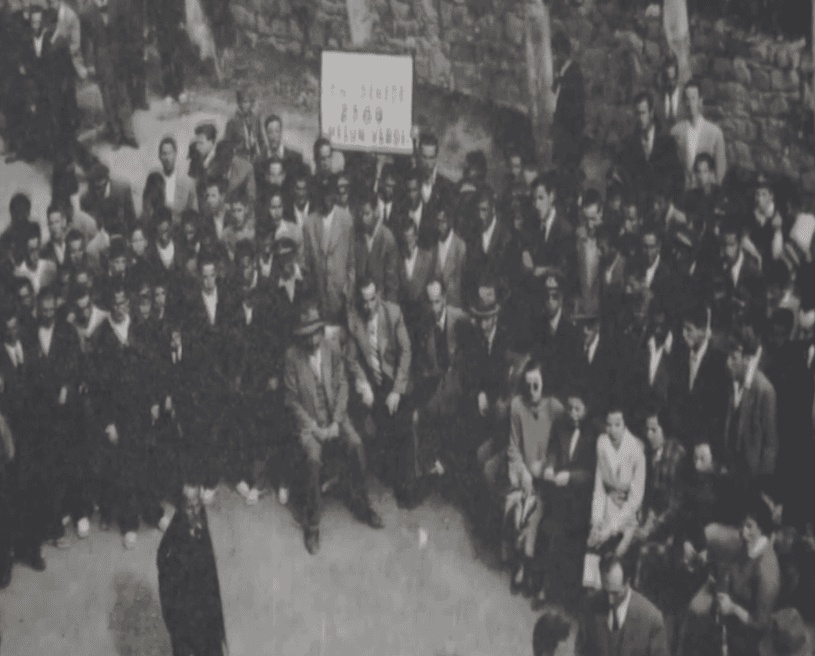
Mezun Buluşması (Murat Bulut)
Erzurum Lisesi’s institutional culture encompasses various traditions and symbols formed since 1889. One of the school’s historical symbols is the "Heroes of Erzurum’s Children" relief, created on the school wall in memory of students who died while delivering supplies to the front during the 1914 Sarıkamış Campaign. Additionally, the use of the "yellow-striped cap", once part of the school’s dress code, is recognized as one of its historical symbols.
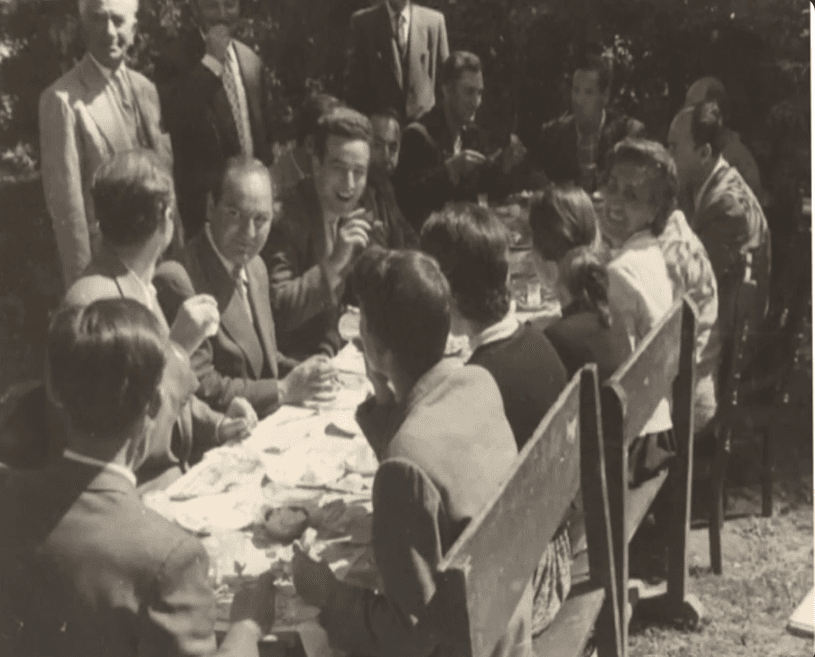
Mezun Buluşması (Murat Bulut)
Erzurum Lisesi, which has produced over 50,000 graduates, holds alumni gatherings. During these events, former graduates, now serving in diverse professional fields (academia, science, bureaucracy, etc.), gather on campus. These gatherings help maintain alumni’s institutional affiliation and facilitate knowledge exchange between alumni and current students.
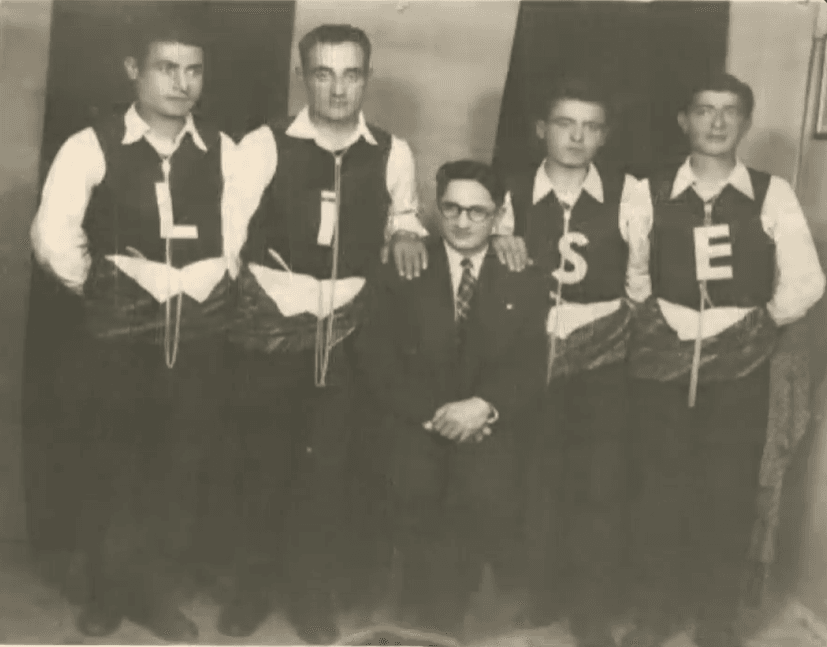
Erzurum Lisesi Bar Ekibi (Murat Bulut)
In the past, these gatherings were integrated into the annual institutional tradition of the "Ayran Aşı Day", held every June since 1951. This traditional event, initiated by İhsan Coşkun Atılcan as a mentorship and naming tradition, involved alumni from all generations regardless of graduation year, although it is no longer practiced today.
During World War I, the Çanakkale Front, and the Sarıkamış Campaign, Erzurum Lisesi held strategic importance. The majority of its teachers and students who went to the front were martyred, resulting in three consecutive periods during which the school did not graduate any students. This reflects the school’s tangible human sacrifice for national defense.
On 22 December 1914, during the Sarıkamış Campaign, the army faced severe logistical challenges. Due to shortages of food and ammunition, the Third Army Commander Hasan İzzet Paşa and Ragıp Paşa urgently requested aid from Erzurum. Since nearly the entire adult male population of the city was at the front, this responsibility fell upon teenagers aged 15 to 17 and the boarding students of Erzurum Lisesi.
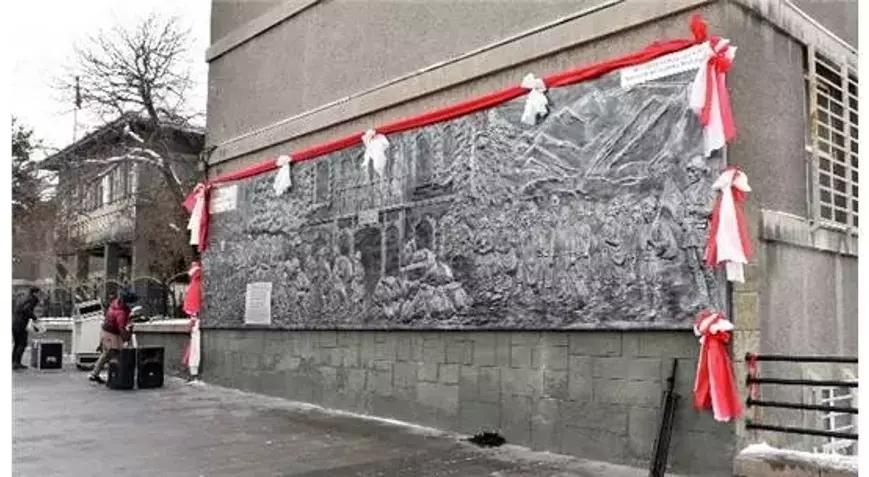
Erzurum’un Kahraman Çocukları Rölyefi (Erzurum Lisesi)
Departing from the governor’s mansion, the children loaded onto their backs sacks of food weighing 30 kilograms each and set out into freezing cold. Upon reaching the village of Nebi Hanı on the Hasankale route, many children succumbed to pneumonia and cholera due to extreme exertion and cold, and became martyrs.
To commemorate this historical event, a relief was created with the contributions of the Sarıkamış Solidarity Group and Atatürk University. Completed in 2009 and representing 100 children, the relief was mounted on the outer walls of Erzurum Lisesi in 2016, as the school had been unable to hold graduation ceremonies due to the loss of its students. This monument displays the logistical duties undertaken and the martyrdom experienced during the Sarıkamış Campaign to future generations.
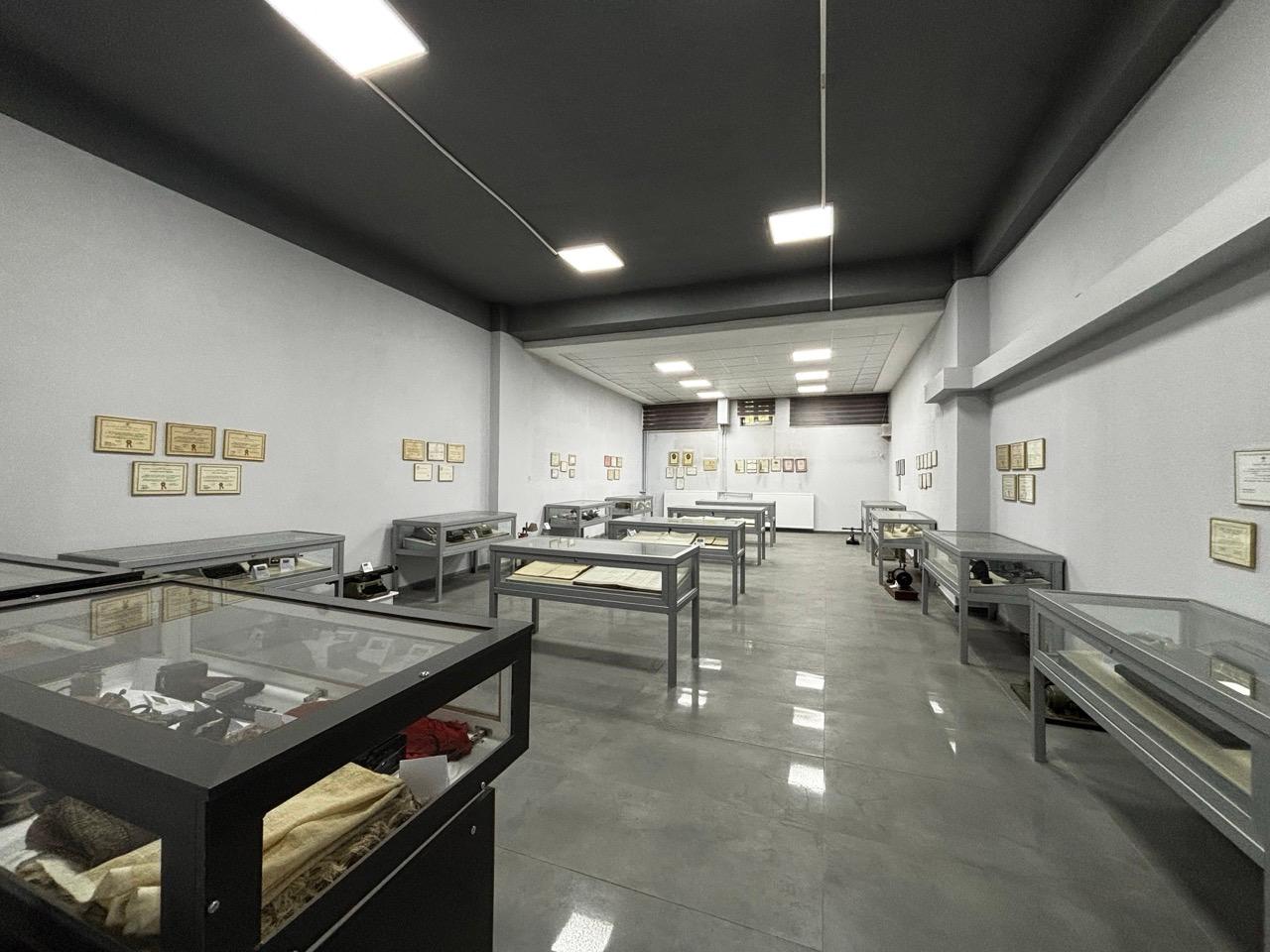
Erzurum Lisesi Eğitim Tarihi Müzesi (EBA)
The Erzurum Lisesi History of Education Museum, located within the Culture Site building, was established to preserve the educational heritage spanning from 1889 to the present and to bring forgotten or neglected artifacts to light. Initially established as a museum unit in 2001, it was expanded in 2017 under the Ministry of National Education’s “History of Education Museums” project to become a central museum representing Erzurum’s educational memory. The museum presents a comprehensive cross-section of the stages Turkish education has undergone, from archival documents and technical equipment used at the school to artistic objects and military memorabilia.
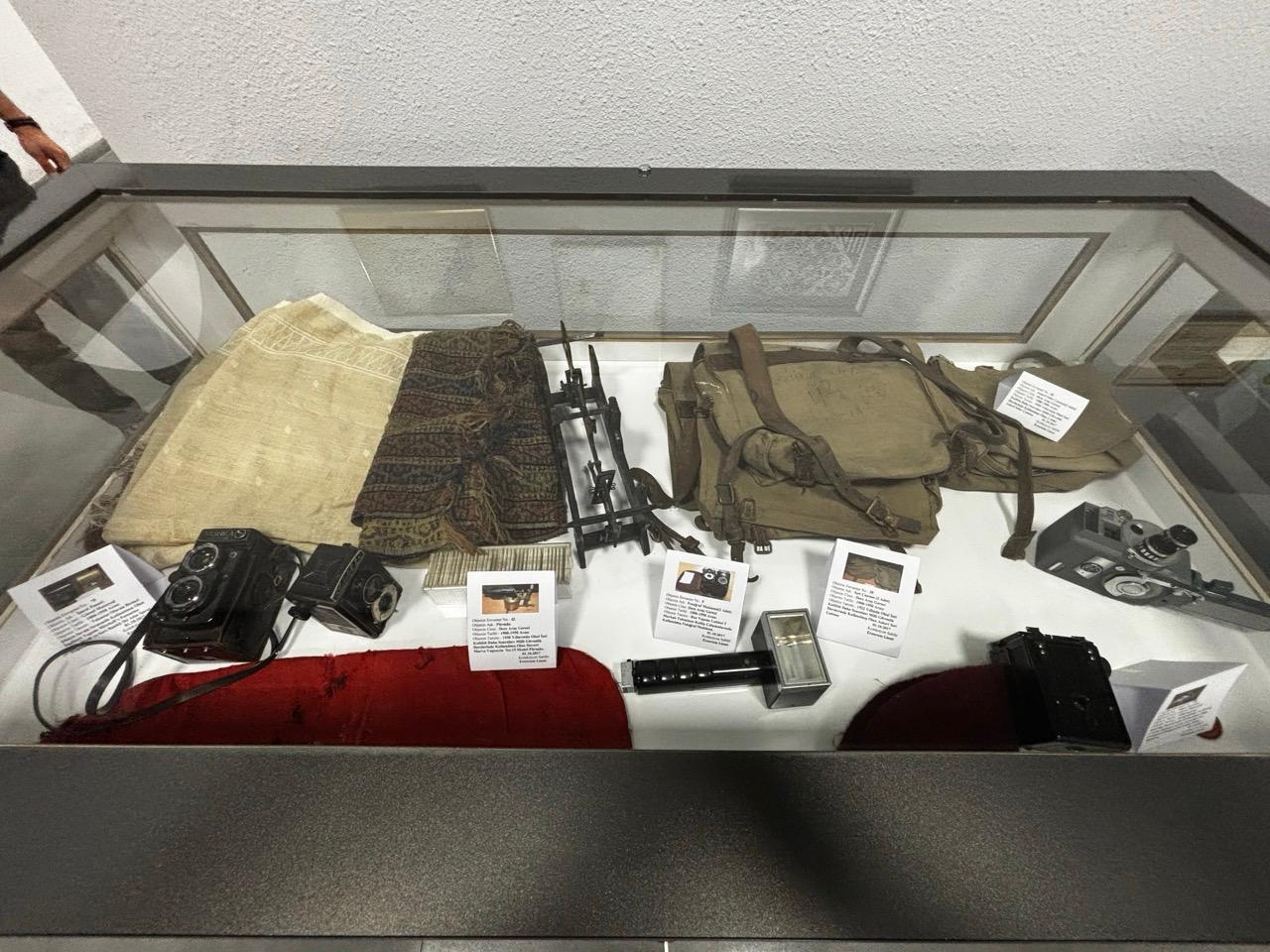
Müzede Sergilenen Eşyalar (EBA)
The museum preserves the earliest official records of figures who have shaped Türkiye’s scientific and intellectual life:
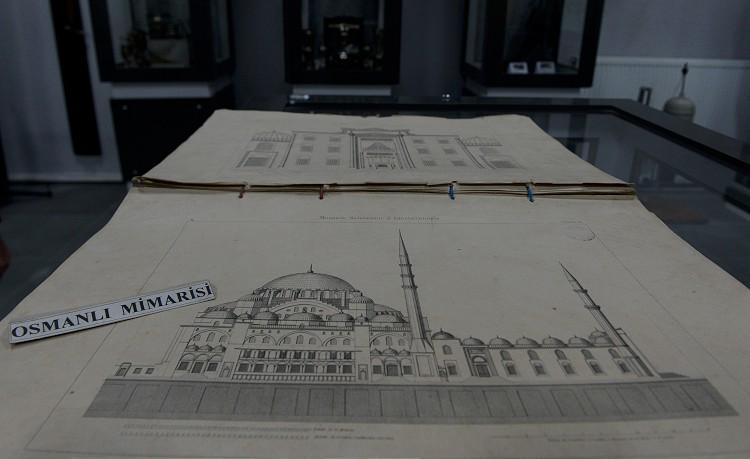
Müzede Sergilenen Sultan Ahmet Camii'nin Orijinal Çizimleri (AA)
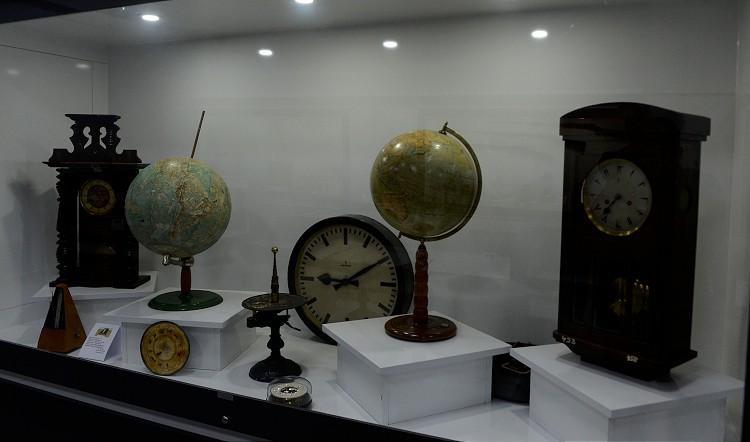
Müzede Sergilenen Eşyalar (AA)
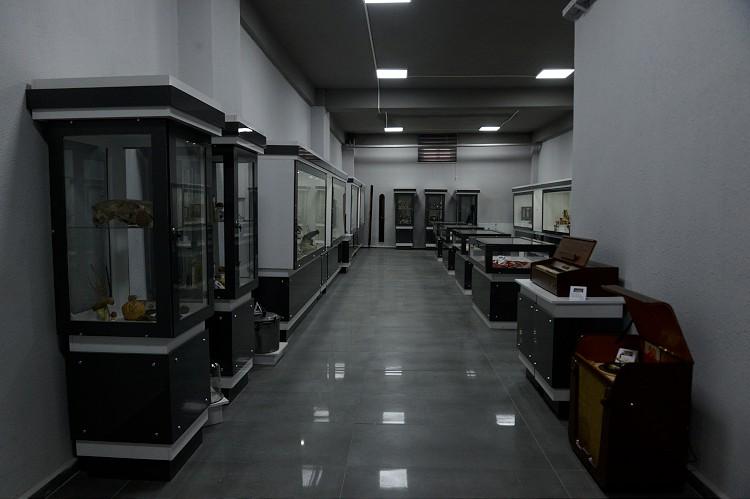
Erzurum Lisesi Eğitim Tarihi Müzesi (AA)
The museum’s inventory consists of objects used at the school for over a century, each carrying hundreds of memories:
Erzurum Lisesi Belgeseli (Murat Bulut)
The museum aims to cultivate students as individuals who embrace national and cultural values and who can form meaningful connections with the past through tangible artifacts. Through this mission, the institution preserves valuable heritage for future generations and keeps alive a historical segment of Turkish educational history.
Aksu, Ayşe. "Tarihî Türk Liseleri." *Türk Maarif Ansiklopedisi*, December 18, 2022. Accessed April 26, 2026. https://turkmaarifansiklopedisi.org.tr/tarihi-turk-liseleri/#yazar-1
Anadolu Ajansı. "Erzurum'un Asırlık Lisesindeki Müze Eserleriyle Tarihe Işık Tutuyor." Accessed April 26, 2026. https://www.aa.com.tr/tr/kultur-sanat/erzurumun-asirlik-lisesindeki-muze-eserleriyle-tarihe-isik-tutuyor/2204237
Bianet. "Eğitim Tarihi Kronolojisi Kitabı Çıktı." February 18, 2014. Accessed April 26, 2026. https://bianet.org/haber/egitim-tarihi-kronolojisi-kitabi-cikti-5035
Bursa Uludağ Üniversitesi Kütüphanesi. "Prof. Dr. Fuat Sezgin Kimdir?" Bilgi Bankası. Accessed April 26, 2026. https://uludag.edu.tr/kutuphane/prof-dr-fuat-sezgin-kimdir-78213
Dayanç, Muharrem. "Atatürk’ün ‘Sonbahar Seyahatleri’, ‘Erzurum Depremi’ ve Ahmet Hamdi Tanpınar." *Eskişehir Osmangazi Üniversitesi Sosyal Bilimler Dergisi*. Accessed April 26, 2026. https://izlik.org/JA55UW73EM.
Director Murat Bulut. "Erzurum Lisesi Belgeseli." YouTube Video, June 20, 2016. Accessed April 26, 2026. https://www.youtube.com/watch?v=ak6dSzgyTN4
EBA (Eğitim Bilişim Ağı). "Erzurum Lisesi Eğitim Müzesi." Okul Dışı Öğrenme Portalı. Accessed April 26, 2026. https://okuldisiogrenme.eba.gov.tr/place-detail/erzurum-lisesi-egitim-muzesi-5069
Erkal, Mustafa E. "Fındıkoğlu, Ziyaeddin Fahri." *TDV İslâm Ansiklopedisi*. Accessed April 26, 2026. https://islamansiklopedisi.org.tr/findikoglu-ziyaeddin-fahri.
Erzurum Gazetesi. "Erzurum Lisesi Okul Müzesinden Tarihe Yolculuk." Accessed April 26, 2026. https://www.erzurumgazetesi.com.tr/haber/Erzurum-Lisesi-Okul-muzesinden-tarihe-yolculuk/137357
Erzurum Gazetesi. "Sultan 2. Abdulhamid’in Açtığı 8’inci Lise." June 13, 2014. Accessed April 26, 2026. https://www.erzurumgazetesi.com.tr/haber/Sultan-2-Abdulhamid-in-actigi-8-inci-Lise/82532
Erzurum Lisesi. "Basında Biz." T.C. Millî Eğitim Bakanlığı Kurumsal Portalı. Accessed April 26, 2026. https://erzurumlisesi.meb.k12.tr/tema/dosyadetay.php?KATEGORINO=1098872&git=2.
Erzurum Lisesi. "Erzurum Lisenin Adı." T.C. Millî Eğitim Bakanlığı Kurumsal Portalı. Accessed April 26, 2026. https://erzurumlisesi.meb.k12.tr/icerikler/erzurumliseninadi_481682.html.
Erzurum Lisesi. "Erzurum Lisesi Müdürleri." T.C. Millî Eğitim Bakanlığı Kurumsal Portalı. Accessed April 26, 2026. https://erzurumlisesi.meb.k12.tr/icerikler/erzurumlisesimudurleri_481677.html
Erzurum Lisesi. "Erzurum Lisesi." T.C. Millî Eğitim Bakanlığı Kurumsal Portalı. Accessed April 26, 2026. https://erzurumlisesi.meb.k12.tr/tema/okulumuz_hakkinda.php.
Erzurum Lisesi. "Erzurum Lisesinde Görev Yapanlar." T.C. Millî Eğitim Bakanlığı Kurumsal Portalı. Accessed April 26, 2026. https://erzurumlisesi.meb.k12.tr/icerikler/erzurumlisesindegorevyapanlar_481671.html
Erzurum Lisesi. "Erzurum Lisesini Tanıma Forumları." T.C. Millî Eğitim Bakanlığı Kurumsal Portalı. Accessed April 26, 2026. https://erzurumlisesi.meb.k12.tr/icerikler/erzurumlisesinitanimaforumlari_481637.html
Erzurum Lisesi. "Erzurum Lisesinin Binasının Yapımı." T.C. Millî Eğitim Bakanlığı Kurumsal Portalı. Accessed April 26, 2026. https://erzurumlisesi.meb.k12.tr/icerikler/erzurumlisesininbinasininyapimi_481670.html
Erzurum Lisesi. "Eski Arşiv." T.C. Millî Eğitim Bakanlığı Kurumsal Portalı. Accessed April 26, 2026. https://erzurumlisesi.meb.k12.tr/tema/dosyadetay.php?KATEGORINO=653673&git=3
Erzurum Lisesi. "Etkinlikler." T.C. Millî Eğitim Bakanlığı Kurumsal Portalı. Accessed April 26, 2026. https://erzurumlisesi.meb.k12.tr/tema/etkinlik.php.
Erzurum Lisesi. "Okul İçi Görseller." T.C. Millî Eğitim Bakanlığı Kurumsal Portalı. Accessed April 26, 2026. https://erzurumlisesi.meb.k12.tr/tema/dosyadetay.php?KATEGORINO=667962&git=4
Erzurum Lisesi. "Tarihte Başarılarımız." T.C. Millî Eğitim Bakanlığı Kurumsal Portalı. Accessed April 26, 2026. https://erzurumlisesi.meb.k12.tr/icerikler/tarihtebasarilarimiz_481679.html.
Erzurum Lisesi. "Tarihçe." T.C. Millî Eğitim Bakanlığı Kurumsal Portalı. Accessed April 26, 2026. https://erzurumlisesi.meb.k12.tr/icerikler/tarihce_374050.html
Erzurum Lisesi. "Şeref Tablosu ve Fotoğraf Galerisi." T.C. Millî Eğitim Bakanlığı Kurumsal Portalı. Accessed April 26, 2026. https://erzurumlisesi.meb.k12.tr/meb_iys_dosyalar/25/21/969413/fotograf_galerisi_2273066.html?CHK=28b6ccf01124ba5be81de564f00b15f3
Erzurum İl Millî Eğitim Müdürlüğü. "Tarihî Erzurum Lisesi Proje Okulu Oldu." April 5, 2019. Accessed April 26, 2026. https://erzurum.meb.gov.tr/www/tarihi-erzurum-lisesi-proje-okulu-oldu/icerik/1251
Milliyet. "'Erzurum'un Kahraman Çocukları' Rölyefi Erzurum Lisesi Duvarına Asıldı." Accessed April 26, 2026. https://www.milliyet.com.tr/yerel-haberler/erzurum/erzurumun-kahraman-cocuklari-rolyefi-erzurum-lisesi-duvarina-asildi-11148043
Ortaöğretim Genel Müdürlüğü (OGM). "Tarihî 100 Lise (İnteraktif Harita)." T.C. Millî Eğitim Bakanlığı. Accessed April 26, 2026. https://ogm.meb.gov.tr/yuz-tarihi-lise/1889-ERZURUM-LISESI.html
TEVDAK (Foundation for Community-Supported State Educational Institutions). "Our Member Foundations: Foundations Member to Community-Supported State Educational Institutions." Accessed April 26, 2026. http://www.tevdak.org/uye-vakiflarimiz/
TEVDAK (Toplum Destekli Devlet Eğitim Kurumları Vakfı). "TEVDAK Liseleri: Toplum Destekli Devlet Eğitim Kurumlarıyla İlişkili Liseler." Accessed April 26, 2026. http://www.tevdak.org/uye-okullarimiz/
TEVDAK (Toplum Destekli Devlet Eğitim Kurumları Vakfı). "Tarihçe: TEVDAK’ı Tanıyalım." Accessed April 26, 2026. http://www.tevdak.org/tarihce/.
TEVDAK (Toplum Destekli Devlet Eğitim Kurumları Vakfı). "Üye Okullarımız: Erzurum Lisesi." Accessed April 26, 2026. http://www.tevdak.org/erzurum-lisesi/
Tanpınar, Ahmet Hamdi. *Beş Şehir*. İstanbul: Dergâh Yayınları, September 2019. Internet Archive Digital Edition. Accessed April 26, 2026. https://dn721507.ca.archive.org/0/items/ahmet-hamdi-tanpinar-bes-sehir-dergah-yayinlari/Ahmet%20Hamdi%20Tanp%C4%B1nar%20Be%C5%9F%20%C5%9Eehir%20Dergah%20Yay%C4%B1nlar%C4%B1.pdf
Yazıcı Şahinli, Hatice. "İTÜ’de ‘İlk’ler: Öncü Bilim İnsanları ile İstanbul Teknik Üniversitesi." *İTÜ Vakfı Dergisi*, April 24, 2025. Accessed April 26, 2026. https://www.ituvakif.org.tr/itu-de-ilk-ler-oncu-bilim-insanlari-ile-istanbul-teknik-universitesi
Özmen, Beşir. "Arif Dilmen ve Ahmet Hamdi Tanpınar: Erzurum Lisesi’nde Atatürk’le Tarihî Buluşma." Darüşşafaka Cemiyeti. Accessed April 26, 2026. https://www.darussafaka.org/hakkimizda/cemiyet/tarihimizde-bu-ay/eylul/arif-dilmen-ve-ahmet-hamdi-tanpinar-erzurum-lisesinde-ataturkle-tarihi-bulusma
[1]
Ortaöğretim Genel Müdürlüğü. “Tarihî 100 Lise (İnteraktif Harita).” OGM. Erişildi 26 Nisan 2026.https://ogm.meb.gov.tr/yuz-tarihi-lise/1889-ERZURUM-LISESI.html
[2]
Ortaöğretim Genel Müdürlüğü. “Tarihî 100 Lise (İnteraktif Harita).” OGM. Erişildi 26 Nisan 2026.https://ogm.meb.gov.tr/yuz-tarihi-lise/1889-ERZURUM-LISESI.html
[3]
Ortaöğretim Genel Müdürlüğü. “Tarihî 100 Lise (İnteraktif Harita).” OGM. Erişildi 26 Nisan 2026.https://ogm.meb.gov.tr/yuz-tarihi-lise/1889-ERZURUM-LISESI.html
[4]
Ortaöğretim Genel Müdürlüğü. “Tarihî 100 Lise (İnteraktif Harita).” OGM. Erişildi 26 Nisan 2026.https://ogm.meb.gov.tr/yuz-tarihi-lise/1889-ERZURUM-LISESI.html
[5]
Ortaöğretim Genel Müdürlüğü. “Tarihî 100 Lise (İnteraktif Harita).” OGM. Erişildi 26 Nisan 2026.https://ogm.meb.gov.tr/yuz-tarihi-lise/1889-ERZURUM-LISESI.html
[6]
Ortaöğretim Genel Müdürlüğü. “Tarihî 100 Lise (İnteraktif Harita).” OGM. Erişildi 26 Nisan 2026.https://ogm.meb.gov.tr/yuz-tarihi-lise/1889-ERZURUM-LISESI.html
[7]
Erzurum Lisesi. “Erzurum Lisenin Adı.” Erzurum Lisesi. Erişim tarihi 26 Nisan 2026.https://erzurumlisesi.meb.k12.tr/icerikler/erzurumliseninadi_481682.html
[8]
Erzurum Lisesi. “Erzurum Lisesinin Binasının Yapımı.” Erzurum Lisesi. Erişim tarihi 26 Nisan 2026.https://erzurumlisesi.meb.k12.tr/icerikler/erzurumlisesininbinasininyapimi_481670.html
[9]
Erzurum Lisesi. “Erzurum Lisenin Adı.” Erzurum Lisesi. Erişim tarihi 26 Nisan 2026.https://erzurumlisesi.meb.k12.tr/icerikler/erzurumliseninadi_481682.html
[10]
Ahmet Hamdi Tanpınar, Beş Şehir, Dergâh Yayınları, İstanbul, Eylül 2019, 45. Baskı, s. 45.
[11]
Ahmet Hamdi Tanpınar, Beş Şehir, Dergâh Yayınları, İstanbul, Eylül 2019, 45. Baskı, s. 45.
[12]
Ahmet Hamdi Tanpınar, Beş Şehir, Dergâh Yayınları, İstanbul, Eylül 2019, 45. Baskı, s. 46.
[13]
Ahmet Hamdi Tanpınar, Beş Şehir, Dergâh Yayınları, İstanbul, Eylül 2019, 45. Baskı, s. 46.
[14]
Erzurum Lisesi. "Tarihçe." T.C. Millî Eğitim Bakanlığı Kurumsal Portalı. Erişim tarihi: 26 Nisan 2026. https://erzurumlisesi.meb.k12.tr/icerikler/tarihce_374050.html.
[15]
Ayşe Aksu, "Tarihî Türk Liseleri," Türk Maarif Ansiklopedisi, 18 Aralık 2022, erişim 26 Nisan 2026,https://turkmaarifansiklopedisi.org.tr/tarihi-turk-liseleri/#yazar-1.
[16]
Erzurum Lisesi. “Tarihte Başarılarımız.” Erzurum Lisesi. Erişim tarihi 26 Nisan 2026.https://erzurumlisesi.meb.k12.tr/icerikler/tarihtebasarilarimiz_481679.html
[17]
Erzurum Lisesi. “Tarihte Başarılarımız.” Erzurum Lisesi. Erişim tarihi 26 Nisan 2026.https://erzurumlisesi.meb.k12.tr/icerikler/tarihtebasarilarimiz_481679.html
[18]
Erzurum Lisesi. “Tarihte Başarılarımız.” Erzurum Lisesi. Erişim tarihi 26 Nisan 2026.https://erzurumlisesi.meb.k12.tr/icerikler/tarihtebasarilarimiz_481679.html

Names | Erzurum İdadisi, Erzurum Sultanisi, Erzurum Erkek Lisesi, Erzurum Lisesi, Erzurum Lisesi (Anadolu Lisesi) | ||||||||
|---|---|---|---|---|---|---|---|---|---|
Educational Format | Tam Gün | ||||||||
Founder | Sultan II. Abdülhamid | ||||||||
Foundation Year | 1889 | ||||||||
School Name | Erzurum Lisesi | ||||||||
School Name | Erzurum Anadolu Lisesi Erzurum Lisesi Erzurum Erkek Lisesi Erzurum Sultanisi Erzurum İdadisi | ||||||||
Foundation Year | 1889 | ||||||||
Founder | Sultan II. Abdülhamid | ||||||||
School Type | Anadolu Lisesi | ||||||||
Names | Erzurum İdadisi Erzurum Sultanisi Erzurum Erkek Lisesi Erzurum Lisesi Erzurum Lisesi (Anadolu Lisesi) | ||||||||
Address | Yakutiye Erzurum Yakutiye | ||||||||
Language of Instruction | Turkish | ||||||||
Total Campus | Main Building Additional Building Cultural Site Sports Hall Building Dormitory Building Dining Hall Building | ||||||||
Foreign Languages | English German | ||||||||
Preparatory Class | No | ||||||||
Teaching Format | Full Day | ||||||||
Boarding Status | Yes | ||||||||
Website | https://erzurumlisesi.meb.k12.tr/ | ||||||||
No Discussion Added Yet
Start discussion for "Erzurum High School" article
History
Historical Background of the Foundation
Institutional Foundations and Status
Educational Structure and Curriculum Development
Historical Name Changes
Initial Buildings and Foundation Period
Construction and Architecture of the Current Main Building
Inauguration of the Main Building and İsmet İnönü
Mustafa Kemal Atatürk’s Visit to Erzurum Lisesi
Notable Personnel
Institutional Structure and Affiliations
TEVDAK
Establishment Process and Position of Erzurum Lisesi
Erzurum Lisesi Culture and Education Foundation
Aim and Areas of Activity
Institutional Networks and Collaborations
Foundation Publications
Educational Structure
Student Admissions
Physical Structure and Campus
Main Building
Additional Building
Dormitory Building
Sports Hall Building
Cafeteria Building
Culture Site Building
Courtyards
Student Profile
Social, Cultural, and Athletic Activities
Artistic and Cultural Activities
Scientific and Technological Activities
Athletic Activities
Social Responsibility and Community Service
Projects and International Activities
Achievements and Rankings
Graduates
Historical Achievements
TÜBİTAK Competitions and Scientific Awards
Achievements in Sports and Arts
International Scientific Legacy and NASA Graduates
School Culture and Symbols
Alumni Gatherings
War Years and Educational Activities
Logistical Support and Martyrdom during the Sarıkamış Campaign
"Heroes of Erzurum’s Children" Relief
Erzurum Lisesi History of Education Museum
Rare Documents and Personal Archives
Thematic Collections and Historical Artifacts
Educational and Spiritual Mission