


This article was automatically translated from the original Turkish version.
Dayton Peace Agreement is an international peace agreement designed to end the war in Bosnia and Herzegovina that lasted from 1992 to 1995. It was initialed on 21 November 1995 in Dayton and formally signed on 14 December 1995 in Paris. The agreement consists of eleven annexes that define the political structure, constitutional framework, administrative organization of Bosnia and Herzegovina, and the international mechanisms for implementing the post-war peace. Although hostilities officially ended after the agreement, its complex political structure has created certain obstacles to Bosnia and Herzegovina’s development, progress and resolution of its own issues.
In the early 1990s, the process of the Yugoslavia Federation’s disintegration accelerated. Ethnic differences within the federal structure intensified political competition and strengthened ethnic nationalist movements. Within this political climate, a referendum was held in Bosnia and Herzegovina between 29 February and 1 March 1992. Despite a large-scale boycott by the Serb population, nearly all participating voters chose independence. As a result, Bosnia and Herzegovina declared its independence.
Following Bosnia and Herzegovina’s independence, Serb political and military structures advocating the idea of a “Greater Serbia,” with support from the Yugoslav People’s Army, launched systematic massacres against non-Serb communities in the country. As a result of these policies, more than two million people were forced to flee their homes and hundreds of thousands, mostly civilians, lost their lives. Serb forces carried out massacres in numerous settlements including Prijedor, Visegrad, Foca, Bijelina, Zvornik and Srebrenitsa as part of their campaign of ethnic cleansing. In July 1995, more than eight thousand Bosniak civilians in and around Srebrenitsa were killed in a short period.
Srebrenitsa Massacre (TRT Documentary)
The largest-scale mass killings in Europe since the end of the Second World War occurred during the Bosnian War. The conflict ended with the signing of the Dayton Peace Agreement in 1995.
Proposals by Vance–Owen, Owen–Stoltenberg and the Contact Group failed to secure a lasting ceasefire. In the summer of 1995, under U.S. leadership and in response to escalating Serb attacks and international pressure, a new peace process was initiated.
Representatives from Bosnia and Herzegovina, Croatia and the Federal Republic of Yugoslavia participated in negotiations at Wright-Patterson Air Force Base in the U.S. state of Ohio. The ceasefire terms were transformed into a permanent peace framework, and the agreement envisioned the reconstitution of Bosnia and Herzegovina as a state within its internationally recognized borders.
After the negotiations in the United States, the agreement was initialed and formally signed on 14 December 1995 in France by the President of Bosnia and Herzegovina Aliya Izetbegović, the President of Serbia Slobodan Milošević and the President of Croatia Franjo Tuđman.
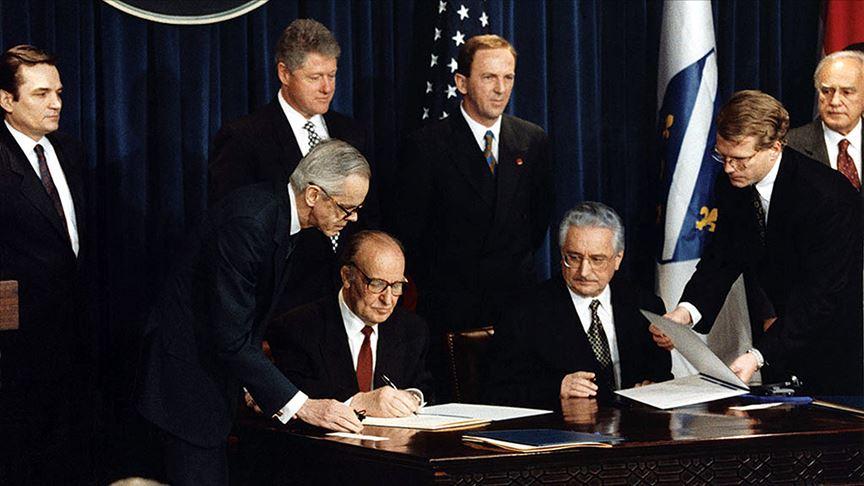
Signing Ceremony of the Agreement (Anadolu Agency)
The Dayton Peace Agreement consists of a main text titled “General Framework Agreement for Peace” and eleven annexes. As a result of the agreement, Bosniaks, Croats and Serbs were recognized as the constituent peoples of the country.
The agreement includes provisions on military arrangements, regional stability, border demarcation, elections, the constitution, arbitration, human rights, refugees, protection of national monuments, public institutions, civil implementation mechanisms and international police forces.
The agreement provided for the continued existence of Bosnia and Herzegovina as a state within its internationally recognized borders, with its political powers divided between a limited central structure and two entities. These entities are the Federation of Bosnia and Herzegovina and the Republika Srpska. After the agreement, the Federation of Bosnia and Herzegovina controlled 51 percent of the territory while the Republika Srpska controlled 49 percent.
Bosnia and Herzegovina was defined by the Dayton Agreement as a state composed of two entities. The state structure established at the federal level distributed limited powers to a central administration and broad powers to two entities.
In addition, a special status was provided for the Brčko District, which later acquired autonomous administrative status through an international arbitration decision.
The entities possess their own legislative, executive and judicial bodies and are endowed with extensive administrative autonomy. This structure has led to the implementation of key aspects of state governance at the entity level.
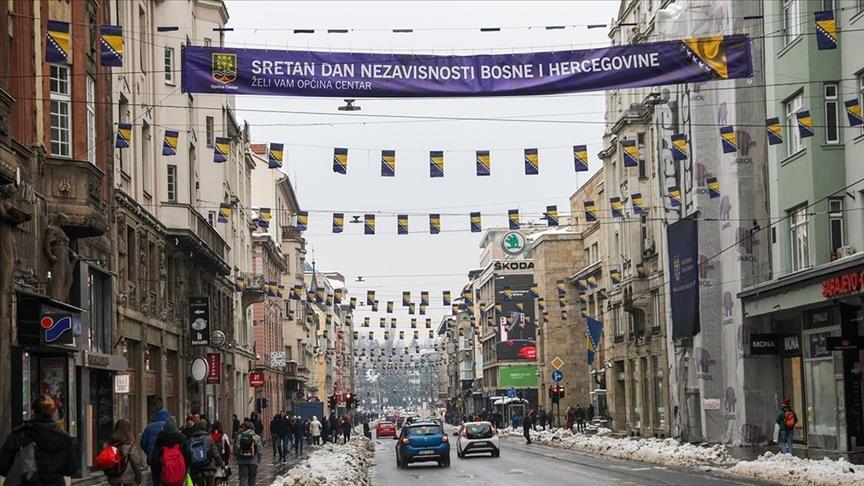
Bosnia and Herzegovina (Anadolu Agency)
The creation of cantons was determined by ethnic distribution. The Federation of Bosnia and Herzegovina was divided into ten cantons under the agreement:
The cantons are responsible for education, healthcare, internal security and cultural affairs through their own governments and assemblies. Authority is shared between the cantons and the Federation across various areas.
The highest executive body at the state level is the tripartite Presidency Council, consisting of one member each from the Bosniak, Serb and Croat communities. Members of the Council are elected for four-year terms by voters within their respective entities.
The chairmanship of the Council rotates. The legislative body has a bicameral structure, and there are assemblies and governments at the state, entity and canton levels. Within this structure, there are five presidents, thirteen prime ministers and more than 130 ministers.
Bosnia and Herzegovina and NATO Flags (NATO)
The agreement aimed to make the ceasefire, which entered into force on 5 October 1995, permanent. Implementation of the military provisions of the agreement was carried out by international multinational forces.
These forces were authorized under Chapter VII of the UN Charter and carried out activities to ensure the continuity of post-war security, including arms limitation, confidence-building measures and the establishment of regional stability mechanisms. The disarmament process was conducted under the supervision of the Organization for Security and Co-operation in Europe (OSCE).
Annex 4 of the agreement has the status of the Constitution of Bosnia and Herzegovina. The Constitution defines the state’s powers within a limited framework and assigns broad powers to the entities. It includes comprehensive provisions on human rights.
The Office of the High Representative (OHR) was established under Annex 10 of the Dayton Peace Agreement to oversee the civilian aspects of peace in Bosnia and Herzegovina. The OHR is managed by a High Representative, authorized by the Peace Implementation Council, tasked with monitoring the implementation of the agreement. The Office monitors the functioning of civil institutions established by the agreement and may intervene in political decision-making processes when necessary.
The OHR was designed as a mechanism with extensive powers to support Bosnia and Herzegovina’s institutional reconstruction. These powers were created to accelerate the alignment of public institutions, ensure implementation of post-war arrangements and enable the state to establish a functional administrative framework. The Office works in areas such as establishing the constitutional order, protecting human rights and stabilizing civil society.
The international nature and broad mandate of the OHR have been described as controversial in terms of national sovereignty. While established to preserve peace, the Office has also been viewed as an institutional mechanism that limits the development of local governance capacity. The OHR’s ability to annul decisions made by elected institutions or remove officials in cases deemed necessary has exerted pressure on local democratic representation and accountability.
Critics also argue that the OHR’s interventions have not produced a transformation aimed at eliminating the ethnic-based representation system, thereby contributing to the continuation of political fragmentation.
The Peace Implementation Council is the highest structure established to coordinate the international implementation of the agreement. The PIC defines the responsibilities of the High Representative and determines general strategies regarding civil measures to be implemented. The Council regularly convenes to monitor the implementation of the agreement and guide the international community’s policies toward Bosnia and Herzegovina.
Under the agreement, the OSCE was tasked with implementing regional military stability measures and overseeing the conduct of post-war democratic elections. The organization fulfilled functions such as arms limitation, confidence-building measures and election monitoring.
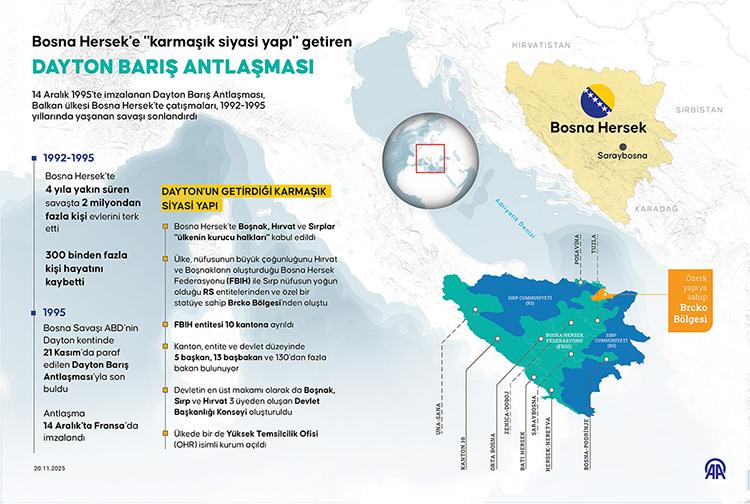
Infographic on Criticisms of the Agreement(Anadolu Agency)
The Dayton Peace Agreement institutionalized ethnic power-sharing at the constitutional level. It transformed ethnic division into a legal framework and created enduring distinctions among the three constituent peoples. The organization of political representation mechanisms based on ethnic identity has led to decision-making processes within state institutions being tied to communal divisions. This model has produced a structure that frequently results in political gridlock, particularly due to the veto mechanisms and representation quotas established by the Constitution.
The administrative system established by the agreement has led to the emergence of numerous institutions at the state, entity and canton levels. This structure is unusually complex compared to conventional governance models and imposes a heavy bureaucratic burden. Critics argue that the presence of multiple assemblies, governments, ministries and public bodies in a state with a limited population has fragmented administrative functions and weakened political coordination.
The broad powers granted to international oversight mechanisms have hindered democratic institutions from independently developing their own functioning. The institutionalization of ethnic-based divisions within political decision-making has led democratic competition to operate within a framework that reinforces societal fragmentation.
The extensive powers granted to the Office of the High Representative, as a civil implementation body, are seen as having placed this institution above domestic state institutions, thereby limiting local democratic processes. The prolonged presence of international oversight has sustained the perception of external interference in local politics.
Akgönenç Mughisuddin, Oya. “Barış ve Dayton Anlaşması Sonrası: Gerçek Barış Süreci mi, Geçici Bir Ateşkes mi?” *Bilig.*, no. 1 (Spring 1996). Accessed November 20, 2025.https://bilig.yesevi.edu.tr/shw_artcl-3702.html.
Anadolu Ajansı. "'Son kullanma tarihi geçmiş' bir barış anlaşması: Dayton." Accessed November 20, 2025.https://www.aa.com.tr/tr/analiz/son-kullanma-tarihi-gecmis-bir-baris-anlasmasi-dayton/1651577.
Anadolu Ajansı. “Bosna Hersek'te Savaşı Sonlandıran Dayton Barış Antlaşması'nın 30. Yılı.” Accessed November 20, 2025.https://www.aa.com.tr/tr/dunya/bosna-hersekte-savasi-sonlandiran-dayton-baris-antlasmasinin-30-yili/3748838.
Cretu, Anca Doina. “Twenty Years After: The Dayton Accords, Legacies and Opportunities.” Fondation Pierre du Bois, no. 6, July 2015. Accessed November 20, 2025.https://www.fondation-pierredubois.ch/wp-content/uploads/2017/01/no6_2015_dayton.pdf.
Dalar, Mehmet. “Dayton Barış Antlaşması ve Bosna-Hersek’in Geleceği.” *Sosyal Bilimler Enstitüsü Dergisi* 1, no. 16 (2008): 9–25. Accessed November 20, 2025.https://dergipark.org.tr/tr/pub/basbed/issue/43957/174822
Gedik, Ömer, and İsmail Köküsarı. “14 Aralık 1995 Dayton Anlaşması ile Oluşturulan Hükûmet Biçiminin Bosna Pratiğindeki Sorunları ve Çözüm Önerileri.” *Erciyes Üniversitesi Hukuk Fakültesi Dergisi (EÜHFD)* 18, no. 1–2 (2014): 101–120. Accessed November 20, 2025.https://www.researchgate.net/publication/322288726_14_ARALIK_1995_DAYTON_ANLASMASI_ILE_OLUSTURULAN_HUKUMET_BICIMININ_BOSNA_PRATIGINDEKI_SORUNLARI_VE_COZUM_ONERILERI
NATO. "Peace support operations in Bosnia and Herzegovina (1995–2004)." Accessed November 20, 2025.https://www.nato.int/en/what-we-do/operations-and-missions/peace-support-operations-in-bosnia-and-herzegovina-1995-2004.
Organization for Security and Co-operation in Europe (OSCE). *Dayton Peace Agreement*. December 14, 1995. Accessed November 20, 2025.https://www.osce.org/bih/126173
Pulat, Tunç. *Bosna-Hersek’te Devlet İnşa Süreci (1996–2013): Dayton Antlaşması Sonrasında Bosna-Hersek.* Master's thesis, Atılım Üniversitesi, Ankara, 2015. Accessed November 20, 2025.https://tez.yok.gov.tr/UlusalTezMerkezi/TezGoster?key=sY7m19PfcL6F1NUw-cr80PojP2hFNi9g33A5Zp4vtWQW--6F4QQOGZtPjSj6peKx
TRT Belgesel. "Srebrenitsa Katliamı." YouTube. Accessed November 20, 2025.https://www.youtube.com/watch?v=cLCwvEH65lg.
Yazıcı, İdil Gülnihal. “Dayton Barış Antlaşması’nın Günümüzde Bosna-Hersek’te Demokratikleşme Sürecine Etkisi.” *Uluslararası Yönetim Akademisi Dergisi* 1, no. 1 (2018): 97–105. Accessed November 20, 2025.https://tez.yok.gov.tr/UlusalTezMerkezi/tezDetay.jsp?id=drJAt7VSgoHmzhJpxjAT1w&no=VvBTj_l9xWfN2dsifA1dlg

No Discussion Added Yet
Start discussion for "Dayton Peace Agreement" article
Historical Background
Dissolution of Yugoslavia and the Bosnian War
International Initiatives and the Dayton Process
Scope of the Agreement
Political and Administrative Arrangements
Entity Structures
Canton System
Presidency and Legislative Structure
Military Arrangements
International Implementation Mechanisms
Office of the High Representative (OHR)
Peace Implementation Council
Organization for Security and Co-operation in Europe (OSCE)
Criticisms of the Agreement
Institutionalization of an Ethnic-Based Political Structure
Complex and Multi-Layered Governance System
Impact on the Democratization Process