


This article was automatically translated from the original Turkish version.
Civil inattention is one of the fundamental concepts developed by Canadian sociologist Erving Goffman to explain face-to-face interactions between strangers in everyday life. The concept refers to individuals briefly acknowledging the presence of unfamiliar people they encounter in public spaces through a fleeting glance or body language, then withdrawing their attention to respect the other person’s privacy. Thus, the individual demonstrates that they do not ignore the other person, yet also do not engage with them to a degree that would violate their personal space.【1】 This behavior is regarded as one of the unwritten interaction rules that enable the orderly continuation of public life.【2】
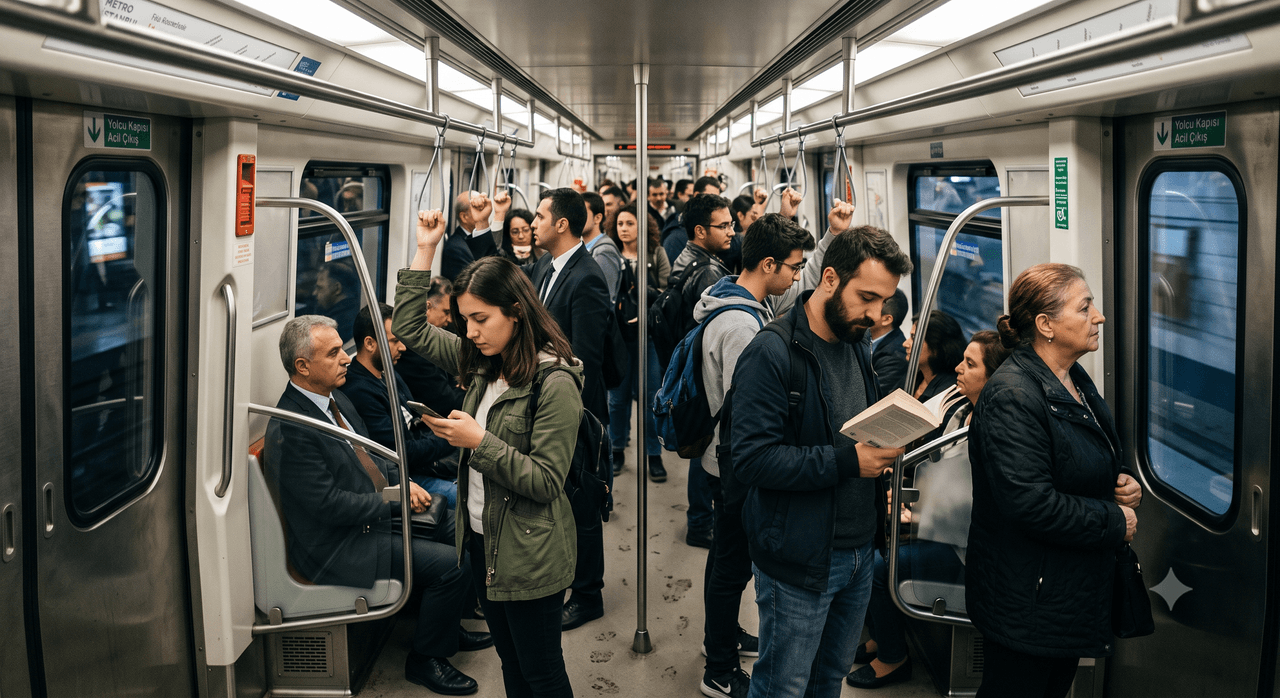
Toplu Taşımada Yolculuk Yapan İnsanlar (Yapay Zekâ ile Oluşturulmuştur.)
Goffman’s micro sociological approach seeks to understand everyday life through face-to-face interactions between individuals rather than through large-scale social structures. In this perspective, social order is reproduced not only through laws, politics or economic institutions but also through the patterns of behavior individuals display in their daily encounters.【3】 Civil inattention is one of the essential elements of this interaction order.
When Goffman explained everyday life through the metaphor of theater, he viewed individuals as actors performing specific roles. People engage in various performances in different social settings, attempting to create particular impressions on others through these performances.【4】 However, the sustainability of these performances depends not only on the actor’s behavior but also on the appropriate responses of the audience. Civil inattention is one such interaction pattern that facilitates this mutual accommodation. A brief glance directed at the encountered person signals recognition, while the absence of prolonged eye contact ensures the protection of their privacy.【5】
In this sense, the concept is not merely a visual behavior but is also interpreted as a symbolic expression of mutual respect and social trust. In dense urban environments, constantly scrutinizing others or completely ignoring them are both seen as behaviors that may generate social tension. Civil inattention mediates between these two extremes, making the continuity of social interaction possible.【6】
According to Goffman, individuals in public spaces are constantly evaluating one another and interpreting their immediate situation. People make inferences about others’ social status, intentions, and circumstances based on their appearance, posture, and behavior.【7】 However, this evaluative process must remain within certain limits; otherwise, the other person’s personal space is violated.
Civil inattention is the primary interaction mechanism that defines these boundaries. For example, in public transportation, elevators, sidewalks, or waiting rooms, strangers acknowledge each other’s presence but avoid prolonged eye contact, unnecessary verbal communication, or excessive interest. In this way, both parties share the common public space while preserving their individual privacy.【8】
This behavior also enhances the predictability of everyday life. If everyone in a public space constantly observed or attempted to communicate with others, the flow of social life would be disrupted. In contrast, civil inattention provides individuals with a safe social distance, supporting the sustainability of shared living.【9】Goffman’s dramaturgical approach reveals that civil inattention also helps individuals maintain their performance on the social stage. When a person performs a specific role in public, others around them refrain from unnecessarily interrupting that performance, allowing impression management to proceed more stably.【10】
Civil inattention is a key component of the interaction order developed by Goffman. The interaction order refers to the entire set of unwritten rules expected to be followed during face-to-face encounters. This order encompasses not only the physical coexistence of individuals in the same space but also their interpretation of each other’s behavior according to specific social expectations.【11】 Civil inattention functions as a symbolic behavior that sustains this order. By recognizing the presence of the other without intruding into their private sphere, this behavior is regarded as one of the everyday practices of politeness that prevent public life from descending into conflict.
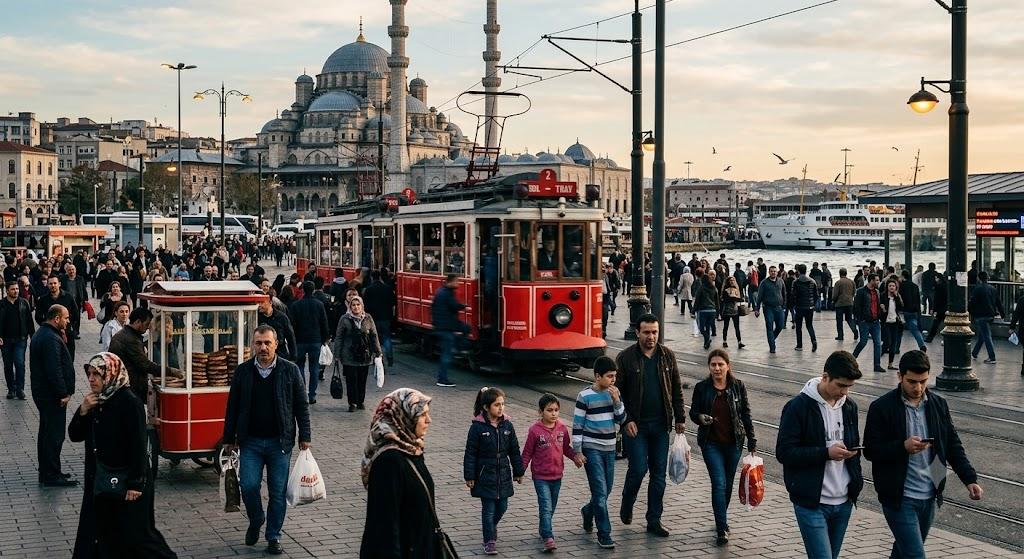
Kent Meydanında Yaya Trafiği (Yapay Zekâ ile Oluşturulmuştur.)
Considering Goffman’s approach to self-presentation, individuals assume specific roles in different contexts of everyday life and perform accordingly. The success of these performances depends not only on the actor’s behavior but also on the audience’s appropriate responses.【12】 Civil inattention enables audiences to refrain from interfering with the actor’s performance, thereby contributing to the continuity of impression management. Thus, individuals can fulfill their social roles in public spaces without feeling constantly monitored or questioned.
In his later work, Goffman developed the framing analysis approach, which argues that individuals interpret events through specific meaning frameworks. The central question of this approach is “What is going on here?”【13】 People make sense of their situation by drawing on previously learned social frameworks. The brief glances exchanged between strangers in public spaces, followed by the withdrawal of attention, gain meaning precisely through these shared frameworks.
A stranger’s brief glance followed by redirecting attention is socially interpreted as “non-threatening,” “respectful of privacy,” and “appropriate.” In contrast, prolonged staring, following someone, asking unnecessary questions, or constant observation disrupt the existing interaction frame and generate social discomfort.【14】 Therefore, civil inattention is not merely an individual preference but a social practice learned and reproduced within shared processes of meaning-making.
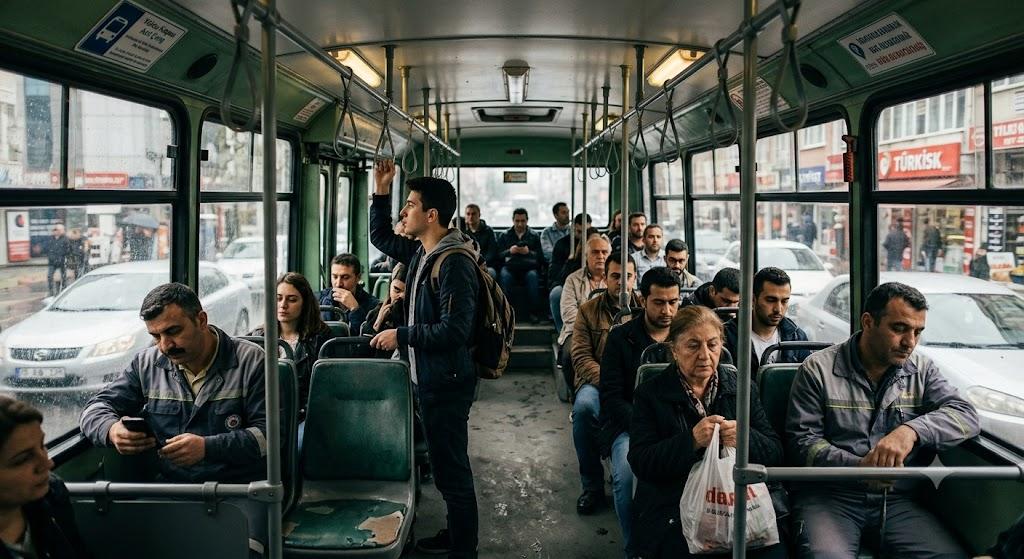
Bus Passengers in Istanbul (Generated by Artificial Intelligence.)
The concept of civil inattention is one of the fundamental interaction mechanisms explaining how large numbers of unfamiliar individuals in modern urban life can share the same public space without conflict.【15】 In this sense, the concept serves as an analytical tool that reveals how social order is produced in everyday life, extending beyond individual acts of courtesy.
When Goffman’s dramaturgical approach, the theory of self-presentation, and framing analysis are considered together, civil inattention emerges as one of the core interaction rules that facilitate the individual’s ability to sustain their public performance, make mutual respect visible, and contribute to the continuity of social order.【16】 Although this everyday behavior occurs at a micro level and is often unnoticed, it plays a vital role in sustaining public life on the foundations of trust, predictability, and mutual respect.【17】 Thus, civil inattention is recognized as one of the foundational concepts in Goffman’s sociology of everyday life for ensuring the continuity of interpersonal interaction.【18】
Yalçın, İrfan. “Performans Olarak Benlik: The Truman Show.” Kastamonu İletişim Araştırmaları Dergisi, no. 9 (2022): 204–224. Accessed July 3, 2026.https://dergipark.org.tr/tr/download/article-file/2636838
Yılmaz, Esra. “Erving Goffman: Günlük Yaşamda Benliğin Sunumu.” Sosyal ve Beşeri Bilimler Araştırmaları Dergisi 24, sy. 52 (2023): 31–36. Accessed July 3, 2026.https://dergipark.org.tr/tr/download/article-file/3042107
Şan, Mustafa Kemal, and Öznur Yılmaz Altun. “Erving Goffman ve Çerçeve Analizi.” *Afyon Kocatepe Üniversitesi Sosyal Bilimler Dergisi* 25, no. 2 (2023): 777–787. Accessed July 3, 2026.https://dergipark.org.tr/tr/download/article-file/2853741
[1]
Esra Yılmaz, “Erving Goffman: Günlük Yaşamda Benliğin Sunumu,” Sosyal ve Beşeri Bilimler Araştırmaları Dergisi 24, no. 52 (2023): 32, https://dergipark.org.tr/tr/download/article-file/3042107
[2]
İrfan Yalçın, “Performans Olarak Benlik: The Truman Show,” Kastamonu İletişim Araştırmaları Dergisi, no. 9 (2022): 205, https://dergipark.org.tr/tr/download/article-file/2636838
[3]
Mustafa Kemal Şan ve Öznur Yılmaz Altun, “Erving Goffman ve Çerçeve Analizi,” Afyon Kocatepe Üniversitesi Sosyal Bilimler Dergisi 25, no. 2 (2023): 778, https://dergipark.org.tr/tr/download/article-file/2853741
[4]
Yılmaz, “Erving Goffman: Günlük Yaşamda Benliğin Sunumu,” 33.
[5]
Yalçın, “Performans Olarak Benlik,” 208.
[6]
Şan ve Yılmaz Altun, “Erving Goffman ve Çerçeve Analizi,” 781.
[7]
Yalçın, “Performans Olarak Benlik,” 207.
[8]
Yılmaz, “Erving Goffman: Günlük Yaşamda Benliğin Sunumu,” 34.
[9]
Şan ve Yılmaz Altun, “Erving Goffman ve Çerçeve Analizi,” 783.
[10]
Yalçın, “Performans Olarak Benlik,” 209.
[11]
Şan ve Yılmaz Altun, “Erving Goffman ve Çerçeve Analizi,” 782.
[12]
Yalçın, “Performans Olarak Benlik,” 210.
[13]
Şan ve Yılmaz Altun, “Erving Goffman ve Çerçeve Analizi,” 780.
[14]
Yılmaz, “Erving Goffman: Günlük Yaşamda Benliğin Sunumu,” 35.
[15]
Yılmaz, “Erving Goffman: Günlük Yaşamda Benliğin Sunumu,” 35.
[16]
Yalçın, “Performans Olarak Benlik,” 211
[17]
Şan ve Yılmaz Altun, “Erving Goffman ve Çerçeve Analizi,” 786.
[18]
Yılmaz, “Erving Goffman: Günlük Yaşamda Benliğin Sunumu,” 36.

Conceptual Framework
Function in Everyday Life
Place Within the Interaction Order
Relationship with Framing Analysis