

`selfperception` Related Article Results

Cryptomnesia
Cryptomnesia is the phenomenon in which a person completely forgets the source of information, an idea, or a work they previously encountered or learned, and experiences it as a new and original creation of their own mind. The term literally means "forgotten memory."【1】 It is a form of plagiarism, or appropriation, in which a writer, researcher, or individual thoroughly internalizes another person’s ideas, data, methods, or research outputs and mistakenly believes them to be their own.【2】 This c
EN
Kadriye Beyza Kirenci

Histrionic Personality Disorder
Histrionic Personality Disorder is a chronic psychiatric condition that emerges in early adulthood and is characterized by excessive emotionality and a persistent need to be the center of attention across many areas of life. Individuals display dramatic, extroverted, and seductive behaviors in social professional and personal relationships. The disorder has an ego-syntonic structure meaning the individual does not perceive their own behaviors as problematic. Due to the lack of insight and inabil
EN
Nida Üstün

Frida Kahlo
Frida Kahlo (full name Magdalena Carmen Frida Kahlo y Calderón) was born on 6 July 1907 in Coyoacán, a neighborhood of Mexico City, Mexico. Her artistic output developed within a context shaped by the health challenges she faced throughout her life, a severe traffic accident in 1925, and the cultural and political environment in which she lived. A significant portion of her work consists of self-portraits, in which she explored themes such as the body, identity, belonging, and everyday lived exp
EN
Nisanur Emral
Parenting
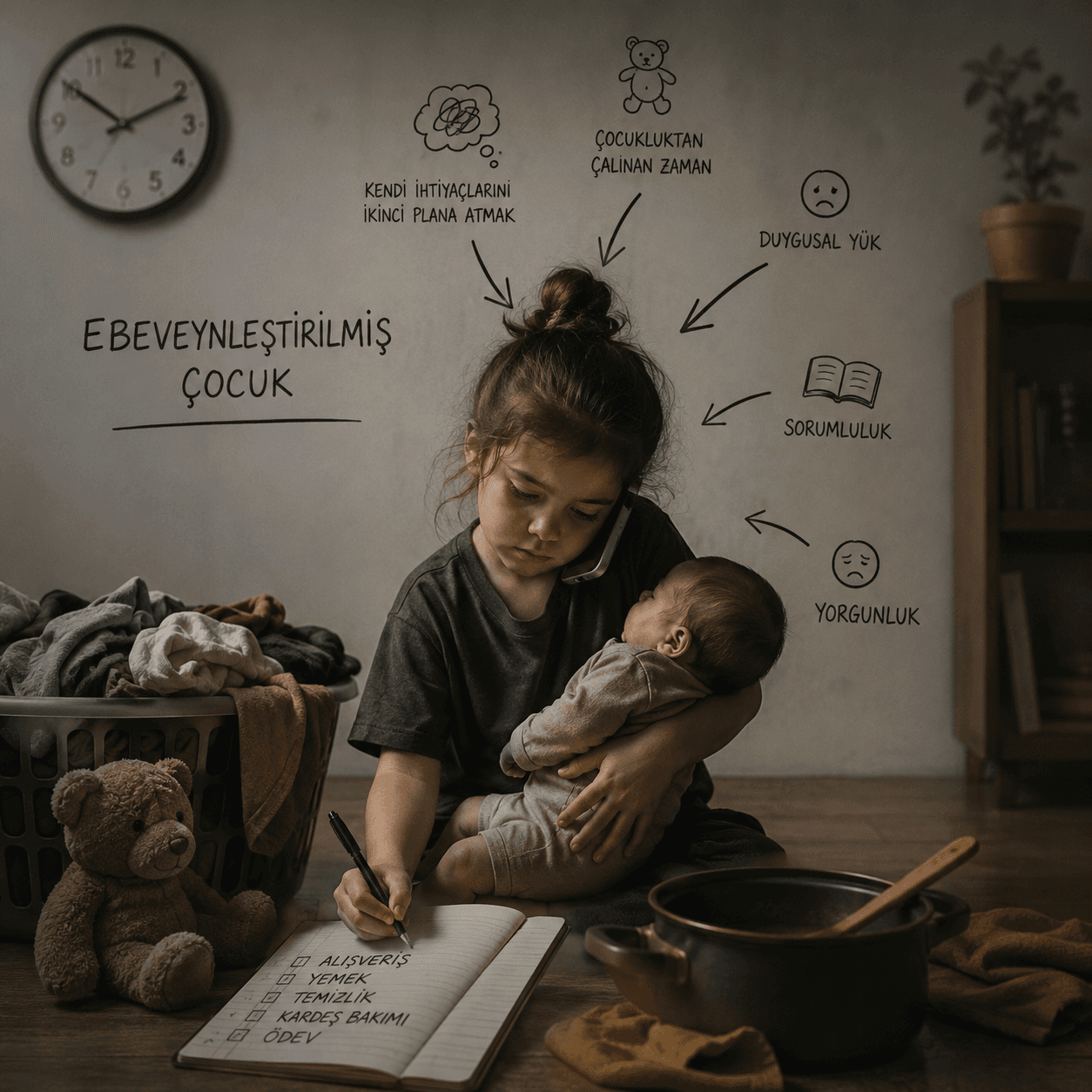
Parentification is a disrupted family interaction pattern in which a child assumes roles and responsibilities inappropriate for their developmental level and age in an attempt to meet the physical or emotional needs of their parents. In psychological and family systems literature, this concept, also known as role reversal, dissolution of intergenerational boundaries, or overburdened child, was first defined by Minuchin and colleagues under the term parent-child. 【1】 Later, representatives of con
ENNida Üstün

Civil Negligence
Civil inattention is one of the fundamental concepts developed by Canadian sociologist Erving Goffman to explain face-to-face interactions between strangers in everyday life. The concept refers to individuals briefly acknowledging the presence of unfamiliar people they encounter in public spaces through a fleeting glance or body language, then withdrawing their attention to respect the other person’s privacy. Thus, the individual demonstrates that they do not ignore the other person, yet also do
ENKadriye Beyza Kirenci

Aesthetics and Perception of Beauty: An Epistemological and Sociological Reading from Ancient Greece to the Digital Age
The concept of beauty, as one of the oldest and most contested categories in human thought, denotes not merely a domain of aesthetic judgment but a multidimensional universe of meaning encompassing ontological, epistemological and sociological dimensions. Ancient Greek thought to today’s digital society, aesthetic experience has evolved from being merely a sensory phenomenon of pleasure to becoming a foundational component of the individual’s relationship with truth, society and their own subjec
EN
İrem Naz Acar

Children's Drawings: A Piece of Paper, a Pen, and Thousands of Unspoken Emotions
When you give a child paper and a pencil, what emerges is not merely a drawing. Those lines, those colors, those arrangements are in fact a map of the child’s emotions, fears, and hopes—things they cannot yet express in words. Young children cannot articulate their feelings in sentences the way adults do. Instead of saying “I feel insecure today,” they might draw a tiny house or forget the windows. Instead of saying “I feel alone in my family,” they position themselves in the corner of the famil
ENNida Üstün