


This article was automatically translated from the original Turkish version.
+1 More
The Big Bang Theory is the most widely accepted scientific model and theory underlying modern cosmology, providing the leading explanation for the origin and evolution of the universe.
According to this theory, the universe began expanding from an extremely dense, hot state referred to as a "singularity" approximately 13.8 billion years ago. The Big Bang model provides a scientific framework for understanding the initial conditions of the universe and its subsequent changes over time.
The Big Bang theory or concept emerged from astronomical observations developed in the early 20th century. Albert Einstein's formulation of the General Theory of Relativity in 1915 led to the realization that the universe could not be static.
In 1927, Belgian physicist and priest Georges Lemaître proposed that the universe expanded from a primordial atom, laying the first theoretical foundation for the Big Bang model.
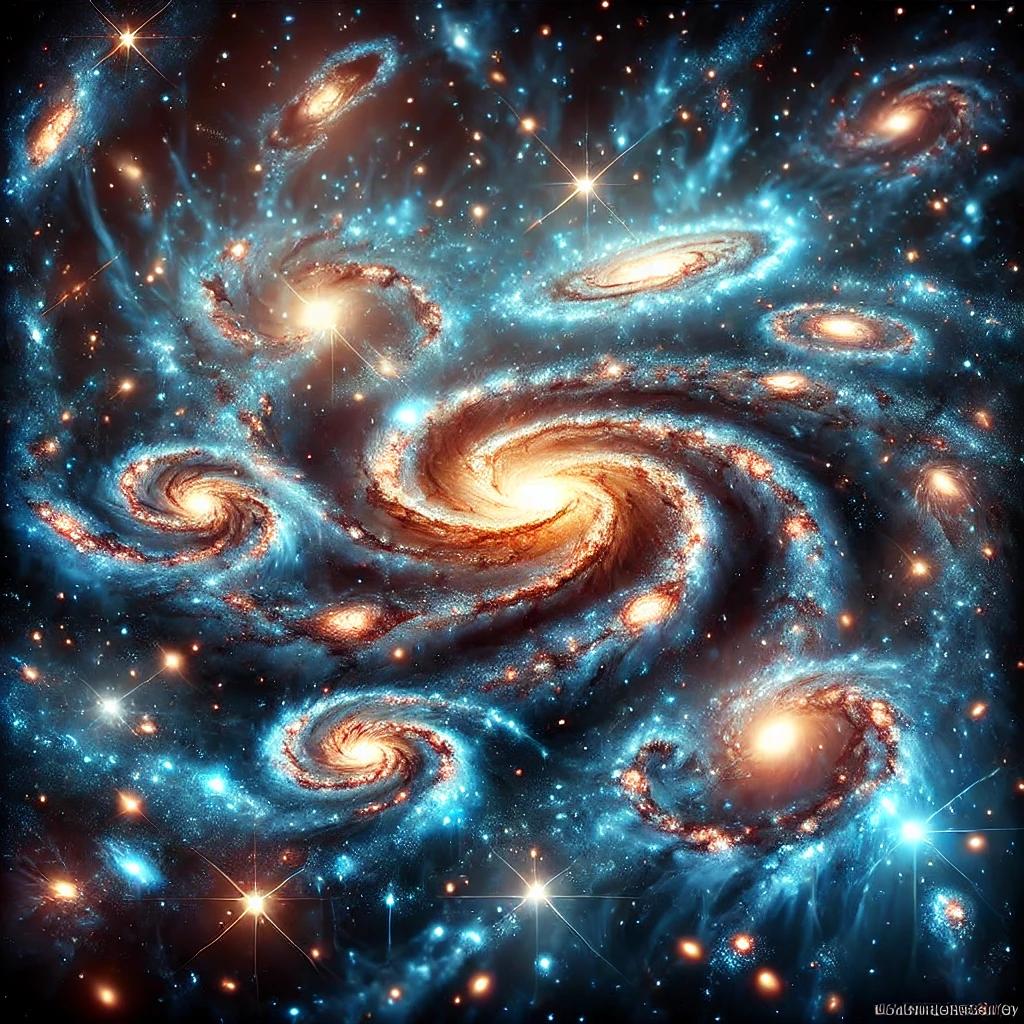
Representative image generated by artificial intelligence.
In 1929, Edwin Hubble observed that light from distant galaxies was redshifted, and this observation was interpreted as evidence that galaxies are moving away from each other, indicating that the universe is expanding. Hubble’s observations provided empirical data supporting the idea that the universe is not static but expanding over time.
In 1948, George Gamow and his collaborators proposed that the universe began in a hot, dense state and predicted the existence of cosmic microwave background radiation. In 1965, Arno Penzias and Robert Wilson detected this microwave radiation, which was recognized as a significant observational confirmation consistent with the model.
The Big Bang model rests on various observational and theoretical foundations regarding the origin and evolution of the universe. Its main principles are as follows:
Immediately after the Big Bang, the universe is thought to have been extremely hot and dense. The first 10^(-43) seconds are known as the Planck Epoch, during which the known laws of physics are not considered valid. In the subsequent Quantum Era, as the universe expanded, the fundamental forces began to separate. Within the first seconds, quarks and leptons emerged; their combination formed protons and neutrons, which later combined to form atomic nuclei.
As the universe expanded and cooled, approximately 380,000 years after the Big Bang, processes associated with the cosmic microwave background radiation occurred. During this period, free electrons combined with atomic nuclei to form neutral atoms, making the universe transparent. This event is known in cosmology as the recombination epoch.
The Hubble Space Telescope has provided data enabling the observation of galaxies from earlier, denser, and hotter periods of the universe. This image, known as the Hubble Ultra Deep Field, was created by combining data collected between 24 September 2003 and 16 January 2004, focusing on a small region of the Fornax Constellation.
The Big Bang model assumes that the universe began with a relatively homogeneous structure and that large-scale structures formed over time through gravitational attraction. The isotropic (uniform) distribution of the cosmic microwave background radiation provides evidence that large-scale structures did not exist in the early universe. Galaxies and galaxy clusters formed over time through gravitational attraction, a process associated with the Jeans Instability concept developed by James Jeans in 1902.
Representative image generated by artificial intelligence.
Because the speed of light is finite, observations of distant galaxies provide information about the universe’s past state. For example, light from a galaxy one billion light-years away shows how that galaxy appeared one billion years ago. Hubble’s Law enables the study of galaxy formation processes in the early universe through the analysis of redshifted distant galaxies.
Early galaxies are thought to have been smaller and structurally more irregular compared to today’s large galaxies. Over time, galaxy mergers and gravitational interactions are believed to have led to the formation of spiral, elliptical, and irregular galaxy types.
Observations of distant galaxies have become increasingly detailed with the development of high-resolution telescopes. In addition to the Hubble Space Telescope, large ground-based telescopes such as the VLT, Keck, and Subaru have enabled the study of galaxies with high redshift values, allowing tests of models of galaxy formation and evolution. Observing the first stars and galaxies remains one of the key research areas in astronomical studies conducted in the 21st century.
The expansion rate of the universe is accelerating due to a force known as dark energy. Within the context of the Big Bang theory, current observations suggest that the universe may expand forever. Three possible scenarios are considered:

Representative image generated by artificial intelligence.
The Big Bang Theory is one of the primary scientific models developed to explain the origin and evolution of the universe. This model is supported by various observational data, including the cosmic microwave background radiation, the recession velocities of galaxies, and the distribution of light elements in the universe. However, components such as dark matter and dark energy, whose nature is still not fully understood, indicate that significant unanswered questions remain regarding the structure and long-term evolution of the universe.
Istanbul Technical University Department of Astronomy and Space Sciences. *Astronomi Tarihi VI: Büyük Patlama ve Günümüz.* Accessedhttps://astronomi.itu.edu.tr/genel/astronomi-tarihi-vi/.
NASA WMAP Mission. *WMAP Big Bang Cosmology.* January 22, 2009. Accessedhttps://map.gsfc.nasa.gov/universe/bb_theory.html
NASA. *Big Bang.* February 6, 2009. Archived in the Wayback Machine. Accessedhttps://bigbang.ws/.

Historical Development of the Theory
Fundamental Principles of the Theory
Early Stages and Evolution of the Universe According to the Theory
Evolution of Galaxies According to the Theory
The Future of the Universe