


This article was automatically translated from the original Turkish version.
+2 More
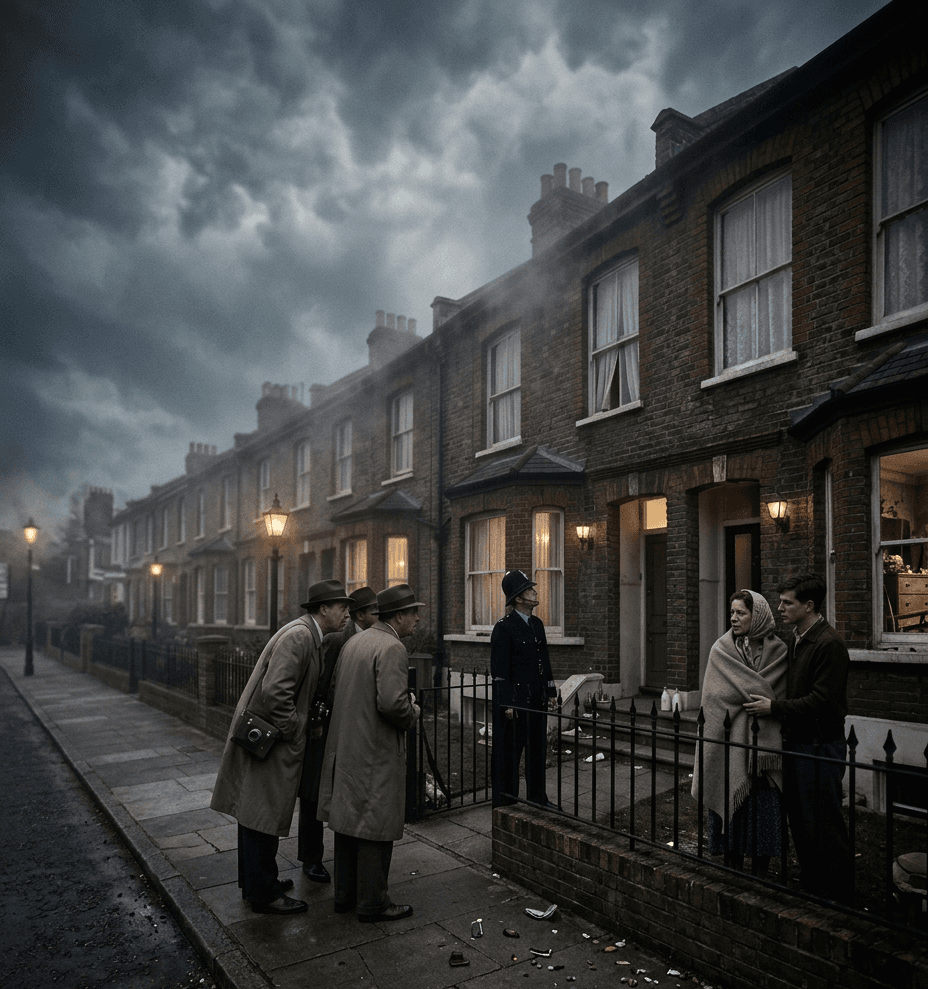
(Generated with Artificial Intelligence)
Battersea Poltergeist Case
Location | 63 Wycliffe Road, Battersea | ||||||||
|---|---|---|---|---|---|---|---|---|---|
Date | November 1927 (1st Episode) January 1956 – 1968 | ||||||||
Event Type | Poltergeist (Noisy Ghost) Phenomenon | ||||||||
Key Figures | Walter "Wally" (Father) Catherine "Kitty" (Mother) Ethel (Grandmother) "Mark" (Relative) | ||||||||
Entity Name | Donald | ||||||||
Lead Researcher | Harold Chibbett | ||||||||
The Battersea Poltergeist Case, refers to a series of poltergeist phenomena reportedly occurring between 1956 and 1968 at 63 Wycliffe Road in the Battersea district of London, England, in the home of the Hitchings family. The case became one of the most debated poltergeist incidents in the United Kingdom due to the mysterious appearance of Shirley Hitchings, numerous eyewitness accounts, extensive media coverage, and decades-long documentation by paranormal researcher Harold Chibbett.
Records of the events were maintained by Harold Chibbett, who conducted the investigation over many years. His compiled files were later reevaluated alongside Shirley Hitchings’s personal memoirs and family-held documents, allowing for a detailed reconstruction of the chronology. Researchers have interpreted the case in various ways—as a supernatural event, a psychological process, or a consciously or unconsciously human-generated phenomenon.
The Battersea Poltergeist Case occurred approximately ten years after the end of the Second World War. At the time of the events, Battersea was a working-class neighborhood in London still bearing the physical and economic scars of the war. During this period of postwar societal reorganization, housing shortages, economic hardship, and social change directly affected many families.
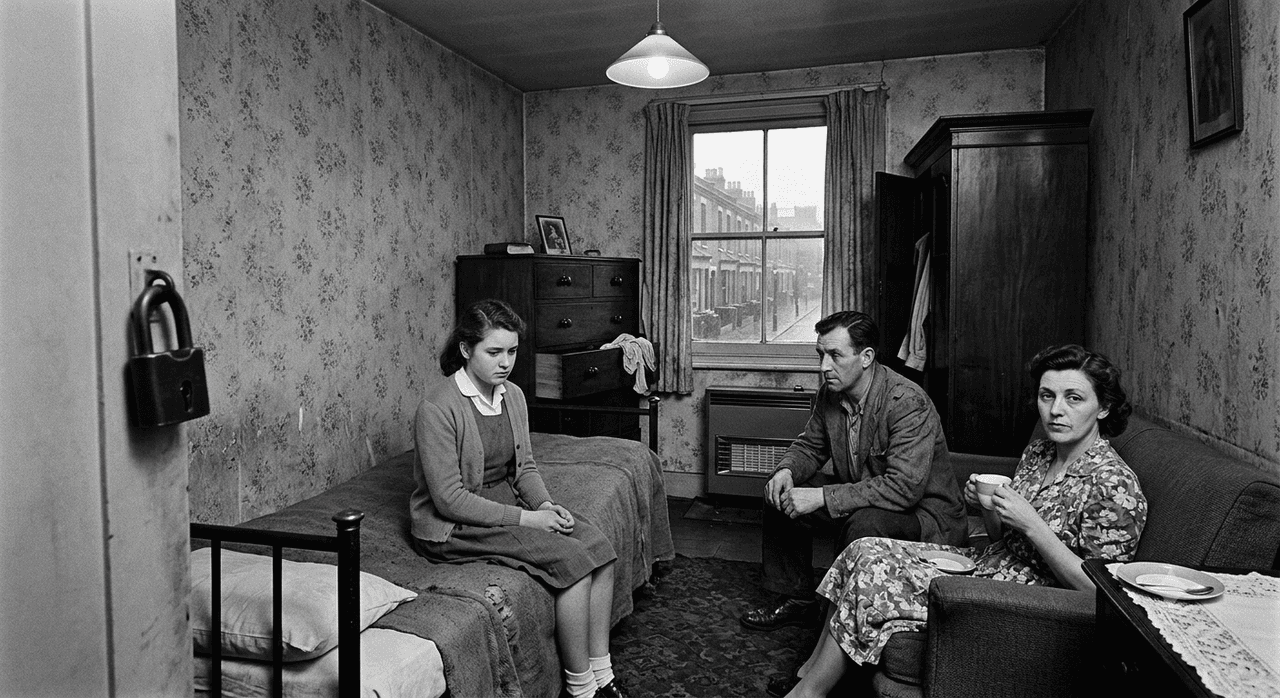
Vakanın Arka Planını İfade Eden Bir Görsel (Yapay Zeka ile Oluşturulmuştur)
The house occupied by the Hitchings family was one of many working-class dwellings of the era. The family’s living conditions were cramped due to a large household and limited space. It was noted that despite Shirley Hitchings having entered adolescence, she continued to share a room with her parents, and her nights were often disturbed by sleepwalking, leading to her door being locked.【1】
The case emerged during a period of renewed public interest in spiritualism and paranormal phenomena in Britain. Newspapers’ coverage of unusual events and continued societal fascination with mediumship contributed to the rapid spread of the Battersea incidents into the national press.
The Hitchings family lived at 63 Wycliffe Road in London’s Battersea district. The father, Walter “Wally” Hitchings, worked as a train driver for the London Underground. His wife, Catherine (Kitty), had limited mobility due to chronic arthritis. Their only child, Shirley Hitchings, was an adolescent at the time the events began and worked in tailoring at a shop. Although she later attempted to enroll in theater costume design training, she did not complete the program.
Also living in the house were Wally’s mother, Ethel, and a young male relative known to the family as “Mark.” Ethel was described as having an authoritarian presence within the household, while Walter was characterized as shy and reserved.【2】 The family maintained social connections through other relatives living on the same street, but daily life largely took place within the confines of the home.
In all accounts of the case, Shirley Hitchings emerged as the focal point of the phenomena. The majority of reported unusual events occurred in or near her rooms, leading both researchers and journalists to focus their attention on her.
The Battersea Poltergeist Case is said to have begun in late January 1956, when Shirley Hitchings reportedly found a silver key in her bed that she had never seen before. Walter Hitchings tested the key on all locks in the house but found that it did not fit any. Although the key was left in the kitchen, it was reported the next morning to have reappeared in Shirley’s bed.
Shortly after the key incident, unexplained knocking and tapping sounds began. Initially heard only at night, these sounds gradually became audible during daytime hours. Family members stated that the noises predominantly originated in Shirley’s rooms, increased in intensity over time, and eventually became loud enough to be heard outside the house. Neighbors complained, believing construction or repairs were taking place in the home during late-night hours.【3】
In the early days, the family attempted to explain the occurrences through their own means. After Walter Hitchings described the situation to a coworker, the colleague visited the house and conducted a séance. However, despite claiming to have made no contact with any entity, the family reported that the unusual events intensified following this attempt.【4】
Later, police officers, journalists, and various researchers visited the home in an effort to determine the source of the phenomena, but no common physical explanation was established. The disturbances were not confined to the house. Similar knocking sounds were reported at Shirley’s workplace, disrupting her work routine. Due to the escalating disturbances, Shirley was forced to take a leave of absence from her job for approximately two weeks.【5】
The events, initially limited to knocking and tapping sounds, soon progressed to claims of physical objects moving without apparent contact. Family members and visitors to the house reported that various items had been displaced or thrown without being touched. These occurrences were again consistently reported to occur near Shirley Hitchings.【6】
One incident reported in February 1956 described a glove falling from Shirley’s hand, rising into the air, and striking her father in the face. In the following days, claims emerged that chairs had moved, slippers had been dragged between rooms, kitchen utensils had been relocated, and Shirley’s wristwatch had spontaneously slipped from her arm.【7】 【8】 Some journalists who visited the house to report on the events also claimed to have witnessed objects moving.【9】
According to Walter Hitchings’s account, one night the family noticed that Shirley’s bedcovers were being pulled by an invisible force. Despite holding the covers together, they felt the pulling force persist, and then claimed to see Shirley rise above her bed and hover motionless for a short time.【10】 Walter stated that when he lowered Shirley back onto the bed, her body was completely rigid.【11】
It was claimed that over time the physical phenomena took on a destructive character. Some rooms were reported to be in disarray, with furniture uprooted from their positions.【12】
As the case progressed, it was reported that the phenomena extended beyond mere object movement to include threatening behavior. After media coverage, the family received messages threatening to burn down the house, followed by the appearance of burnt matches and fires on the bedcovers.【13】 Walter Hitchings reported being burned during one such incident, and the family lived in fear of fire.【14】
In later stages of the case, the Hitchings family asserted that the knocking sounds were not random but responded to specific questions. Family members and investigators began interpreting the knocks using an alphabetical code system, recording knocks corresponding to letters in sequence to form messages.【15】 According to the family, this method eventually evolved into a form of communication.
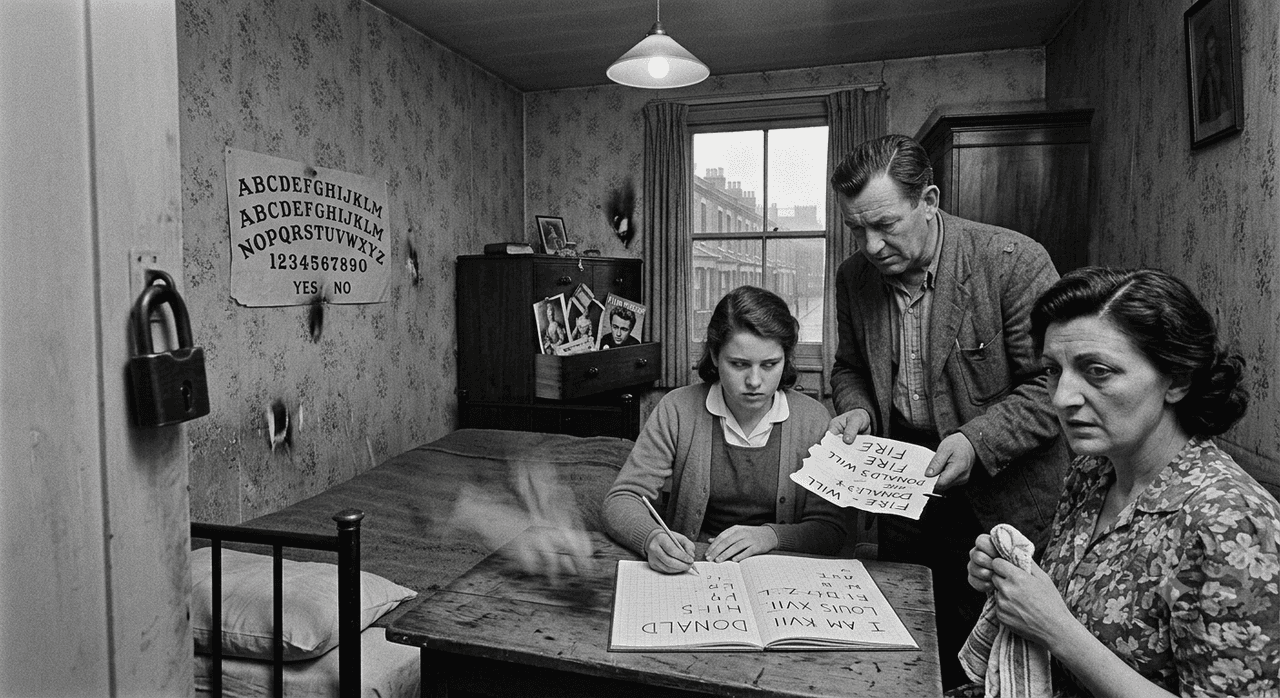
Donald ile Kurulan İletişim İddialarını İfade Eden Bir Görsel (Yapay Zeka ile Oluşturulmuştur)
The entity claiming to communicate identified itself as “Donald.” Initial descriptions portrayed Donald as a deceased child Shirley had known in childhood. Over subsequent months, alternative narratives emerged regarding his identity.【16】 Later claims suggested he was Louis XVII, the son of French King Louis XVI, who had not died as officially recorded during the French Revolution, had escaped captivity, and had perished while attempting to reach England.【17】
Communication was not limited to knocks. Eventually, unexplained writings appeared on various sheets of paper, attributed to Donald. Family members insisted the handwriting did not resemble Shirley’s. Some messages addressed Shirley directly, while others contained instructions, warnings, and threats directed at family members.【18】 In 1957, it was claimed that a new spirit emerged, identifying itself as American film actor James Dean.【19】
It was stated that Donald’s influence on the family intensified during episodes of fire threats. After messages warning of arson, fires occurred, prompting family members to take these warnings seriously.
The detailed investigation of the Battersea Poltergeist Case was conducted by paranormal researcher Harold Chibbett. A tax inspector by profession, Chibbett also researched spiritualist phenomena and was a well-known figure within Britain’s paranormal circles.【20】 Chibbett contacted the Hitchings family in early March 1956 and quickly gained their trust, beginning systematic documentation of the events.
Chibbett did not treat his investigation as a brief inquiry. Over approximately twelve years, he maintained contact with the family, recorded reported phenomena, collected witness statements, and meticulously archived messages allegedly sent by Donald. Notes kept by the family, newspaper clippings, photographs, and personal records gradually became part of this archive. In later years, these documents, evaluated alongside Shirley Hitchings’s memoirs, formed a comprehensive source base for the case.
A significant part of his research involved verifying the historical accuracy of information provided by Donald. Chibbett noted that certain details concerning eighteenth-century British theater appeared correct. However, he later discovered that the same information had appeared in a theater play published during the time the events were occurring.【21】 He concluded that these details could not serve as independent evidence.
Chibbett adopted the view that the events could not be explained solely as a deliberate hoax. After his investigations, he concluded that the phenomena in Battersea were likely the result of an independent spiritual entity.
By the late 1960s, as the events became less frequent, Chibbett’s active investigation effectively ended. However, his compiled files were preserved by Shirley Hitchings after his death and later served as primary sources for books and documentary works.
The Battersea Poltergeist Case was met with differing opinions from its inception. While some newspapers reported the extraordinary claims, others argued they lacked corroborating evidence. A newspaper article published on 15 March 1956 was among the first to question the credibility of the case.【22】
Donald’s claims also attracted criticism. One major issue was the assertion that Louis XVII had escaped France and that another child had died in his place. Subsequent scientific examinations of remains accepted as belonging to the French prince yielded results contradicting this narrative.
Andrew Green, known for his research into paranormal phenomena, evaluated the Battersea Poltergeist Case not as the activity of a supernatural entity but as a psychological process. Green rejected the notion that letters attributed to Donald were written by a genuine spirit, suggesting instead that they were produced by Shirley Hitchings herself.【23】
According to Green’s observations, Shirley would close her eyes briefly just before messages appeared, suggesting they were generated during unconscious mental processes. The researcher proposed that the knocking sounds and physical movements were the outward manifestations of Shirley’s subconscious psychological tensions, a phenomenon he termed recurrent spontaneous psychokinesis (RSPK). In his view, the disturbances reflected internal psychological stress rather than an independent spirit.【24】
During the years the events continued, Shirley Hitchings attempted to maintain her professional life. After working briefly as a secretary’s assistant in the stationery industry, she enrolled in an art school to study theater costume design. However, she left the program before completion due to difficulties balancing mandatory volunteer work with her job responsibilities.
The influence of the messages attributed to Donald began to diminish by the mid-1960s. Shirley’s marriage in 1961 and her subsequent departure from the family home were followed by a noticeable decline in the frequency of the phenomena.【25】 After relocating from London in 1967, the disturbances reported in the house ceased, and by 1968, all activities attributed to Donald had completely disappeared.【26】
The Battersea Poltergeist Case attracted local media attention soon after the events began and quickly became a nationally recognized phenomenon. The first reports were published in February 1956, focusing on the knocking sounds and moving objects. Journalists visiting the house and reporting firsthand observations of unusual events heightened public interest.
Media attention was regarded as a significant factor in the case’s development. As news stories were published, public curiosity and skepticism both increased. Some newspapers presented the events as supernatural, while others published articles arguing that natural explanations were possible.
The case was also featured on radio and television programs. Attempts to communicate with Donald were publicly conducted and sparked nationwide debate. The case even indirectly influenced political discourse; references to the Battersea events were made during parliamentary discussions on police intervention and spiritualist activities.【27】
BBC. "The Story of The Battersea Poltergeist." Accessed July 21, 2026.https://www.bbc.co.uk/programmes/articles/4b8PlyxgjRft0T7b0Sjjj3B/the-story-of-the-battersea-poltergeist
Edwards, Alicia. "‘There Are Things Going Bump in the Night All over This Town’: Gothic Tourism, Haunted London, and the Geographies of Haunted Space." PhD thesis, Manchester Metropolitan University. Accessed July 22, 2026.
Ruffles, Tom. "Review of *The Poltergeist Prince of London: The Remarkable True Story of the Battersea Poltergeist*, by Shirley Hitchings and James Clark." *Society for Psychical Research*. Accessed July 22, 2026.https://www.spr.ac.uk/book-review/poltergeist-prince-london-remarkable-true-story-battersea-poltergeist-shirley-hitchings.
UK Parliament. "House, Brixton (Police Visit)." *Hansard Parliamentary Debates*, c. 549 (March 1, 1956). Accessed July 22, 2026.https://hansard.parliament.uk/Commons/1956-03-01/debates/64d21323-df64-4470-9e84-68e5a36e6516/HouseBrixton%28PoliceVisit%29
Wehrstein, K. M. "Battersea Poltergeist (1956)." *Psi Encyclopedia*. London: The Society for Psychical Research. Accessed July 22, 2026.https://psi-encyclopedia.spr.ac.uk/articles/battersea-poltergeist-1956/.
[1]
Tom Ruffles, "Review of The Poltergeist Prince of London: The Remarkable True Story of the Battersea Poltergeist, by Shirley Hitchings and James Clark", Society for Psychical Research, erişim 22 Temmuz 2026, https://www.spr.ac.uk/book-review/poltergeist-prince-london-remarkable-true-story-battersea-poltergeist-shirley-hitchings.
[2]
Tom Ruffles, "Review of The Poltergeist Prince of London: The Remarkable True Story of the Battersea Poltergeist, by Shirley Hitchings and James Clark".
[3]
BBC, "The Story of The Battersea Poltergeist," erişim tarihi: 21 Temmuz 2026, https://www.bbc.co.uk/programmes/articles/4b8PlyxgjRft0T7b0Sjjj3B/the-story-of-the-battersea-poltergeist.
[4]
Tom Ruffles, "Review of The Poltergeist Prince of London: The Remarkable True Story of the Battersea Poltergeist, by Shirley Hitchings and James Clark".
[5]
KM Wehrstein, “Battersea Poltergeist (1956).” Psi Encyclopedia, London: The Society for Psychical Research, erişim 22 Temmuz 2026, https://psi-encyclopedia.spr.ac.uk/articles/battersea-poltergeist-1956/.
[6]
Tom Ruffles, "Review of The Poltergeist Prince of London: The Remarkable True Story of the Battersea Poltergeist, by Shirley Hitchings and James Clark".
[7]
KM Wehrstein, “Battersea Poltergeist (1956).” Psi Encyclopedia, London: The Society for Psychical Research.
[8]
KM Wehrstein, “Battersea Poltergeist (1956).” Psi Encyclopedia, London: The Society for Psychical Research.
[9]
KM Wehrstein, “Battersea Poltergeist (1956).” Psi Encyclopedia, London: The Society for Psychical Research.
[10]
KM Wehrstein, “Battersea Poltergeist (1956).” Psi Encyclopedia, London: The Society for Psychical Research.
[11]
KM Wehrstein, “Battersea Poltergeist (1956).” Psi Encyclopedia, London: The Society for Psychical Research.
[12]
BBC, "The Story of The Battersea Poltergeist,".
[13]
KM Wehrstein, “Battersea Poltergeist (1956).” Psi Encyclopedia, London: The Society for Psychical Research.
[14]
KM Wehrstein, “Battersea Poltergeist (1956).” Psi Encyclopedia, London: The Society for Psychical Research.
[15]
KM Wehrstein, “Battersea Poltergeist (1956).” Psi Encyclopedia, London: The Society for Psychical Research.
[16]
KM Wehrstein, “Battersea Poltergeist (1956).” Psi Encyclopedia, London: The Society for Psychical Research.
[17]
KM Wehrstein, “Battersea Poltergeist (1956).” Psi Encyclopedia, London: The Society for Psychical Research.
[18]
Tom Ruffles, "Review of The Poltergeist Prince of London: The Remarkable True Story of the Battersea Poltergeist, by Shirley Hitchings and James Clark".
[19]
KM Wehrstein, “Battersea Poltergeist (1956).” Psi Encyclopedia, London: The Society for Psychical Research.
[20]
BBC, "The Story of The Battersea Poltergeist,".
[21]
KM Wehrstein, “Battersea Poltergeist (1956).” Psi Encyclopedia, London: The Society for Psychical Research.
[22]
KM Wehrstein, “Battersea Poltergeist (1956).” Psi Encyclopedia, London: The Society for Psychical Research.
[23]
Tom Ruffles, "Review of The Poltergeist Prince of London: The Remarkable True Story of the Battersea Poltergeist, by Shirley Hitchings and James Clark".
[24]
KM Wehrstein, “Battersea Poltergeist (1956).” Psi Encyclopedia, London: The Society for Psychical Research.
[25]
KM Wehrstein, “Battersea Poltergeist (1956).” Psi Encyclopedia, London: The Society for Psychical Research.
[26]
Tom Ruffles, "Review of The Poltergeist Prince of London: The Remarkable True Story of the Battersea Poltergeist, by Shirley Hitchings and James Clark".
[27]
BBC, "The Story of The Battersea Poltergeist,".


(Generated with Artificial Intelligence)
Battersea Poltergeist Case
Location | 63 Wycliffe Road, Battersea | ||||||||
|---|---|---|---|---|---|---|---|---|---|
Date | November 1927 (1st Episode) January 1956 – 1968 | ||||||||
Event Type | Poltergeist (Noisy Ghost) Phenomenon | ||||||||
Key Figures | Walter "Wally" (Father) Catherine "Kitty" (Mother) Ethel (Grandmother) "Mark" (Relative) | ||||||||
Entity Name | Donald | ||||||||
Lead Researcher | Harold Chibbett | ||||||||
No Discussion Added Yet
Start discussion for "Battersea Poltergeist Case" article
Historical Context
The Hitchings Family and 63 Wycliffe Road
The Beginning of the Events
Development of Poltergeist Activity
Claims of Communication with Donald
Harold Chibbett’s Investigations
Criticism and Skeptical Perspectives
Andrew Green’s Evaluation
Shirley Hitchings’s Later Life
Media and Public Opinion