This article was automatically translated from the original Turkish version.
+2 More
Date Celebrated | The last Sunday of June each year | ||||||||
|---|---|---|---|---|---|---|---|---|---|
Place Celebrated | The town of Prusac (Akhisar), Bosnia and Herzegovina | ||||||||
Person After Whom It Is Named | Ayvaz Dede | ||||||||
Historical Process | Commencement of reorganization after 1990 Ban on celebrations between 1947 and 1990 | ||||||||
Sister Festival Announcement | Sister festival with the Akhisar Çağlak Festival in 2010 | ||||||||
Ayvaz Dede Festivals (Ajvatovica), Bosnia and Herzegovina, are a religious and cultural event held to commemorate Ayvaz Dede. The festivals take place annually on the last Sunday of June, near the town of Prusac (Akhisar), within the Donji Vakuf Municipality of Bosnia and Herzegovina. Activities include collective processions, visits, prayers, worship, and traditional rituals.
512th Ayvaz Dede Festivals in Bosnia and Herzegovina (TRT News)
The origin of the Ayvaz Dede Festivals is linked to a widely transmitted narrative in Bosnia and Herzegovina. According to this story, during a period of drought in Prusac and its surroundings, Ayvaz Dede withdrew for forty days to pray. On the fortieth day, a massive rock blocking the water source split in two, restoring water to the region. This event is said to have played a decisive role in the local population’s acceptance of Islam.【1】
It is reported that the festivals have been held continuously over the centuries, even if with limited participation. Even during wartime and under extraordinary conditions, small groups maintained the tradition through symbolic visits and prayers. During the era of former Yugoslavia, the festivals were banned starting in 1947; they were revived after the ban was lifted in 1990. Today, the Ayvaz Dede Festivals are recognized as a tradition spanning more than five centuries.
Ayvaz Dede is a dervish associated with the spread of Islam in Bosnia and Herzegovina. There are differing views regarding his real name, origins, and the time of his arrival in Bosnia:
It is stated that beliefs related to Ayvaz Dede in Bosnia and Herzegovina extend back to the 13th century. The widespread belief is that Ayvaz Dede came from Anatolia to the Balkans, with Manisa’s Akhisar district often cited as his ancestral homeland. Although opinions about him vary, his activities are universally acknowledged to have contributed significantly to the region’s Islamization.【2】
The Ayvaz Dede Festivals are held approximately 7–8 kilometers from the town of Prusac, in a forested and expansive area. The site includes the rock believed to have split open by Ayvaz Dede’s prayer and the Ayvaz Dede Spring. The location is situated at a high elevation and features a structure capable of accommodating large-scale collective worship.

Ayvaz Dede Festivals (Anadolu Agency)
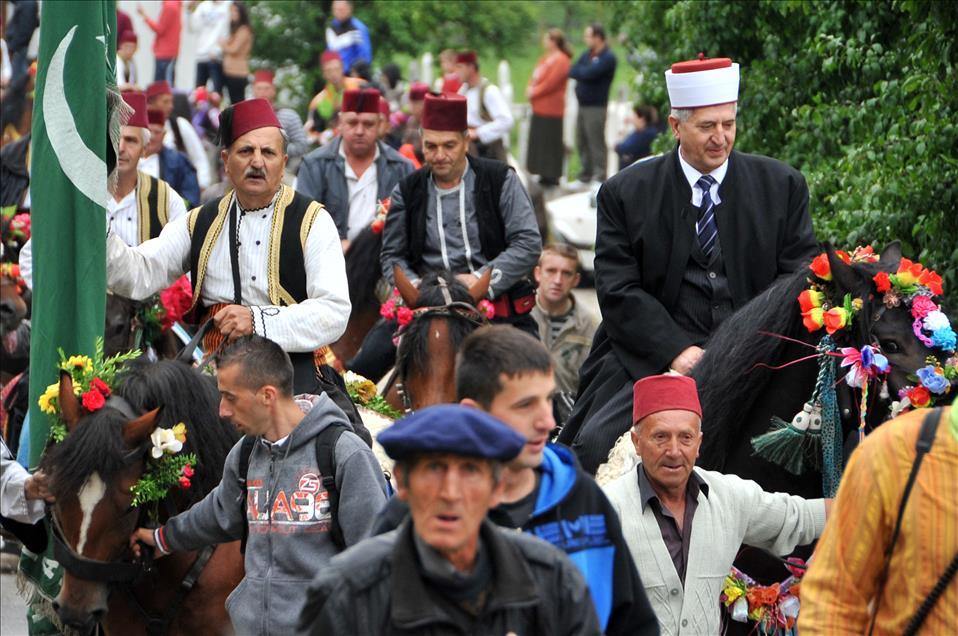
Horseback processions hold a central place among the festival’s main activities. Horsemen from various cities in Bosnia and Herzegovina gather in the village of Karaula near Travnik, dressed in traditional attire. There, the Qur’an is recited and prayers are offered. Afterwards, the horsemen begin a day-long journey toward Prusac, chanting takbirs and prayers.

Horsemen Setting Off for the Ayvaz Dede Festivals (Anadolu Agency)
On the morning of the festival, pilgrims visit the tomb of Ayvaz Dede in Prusac and offer prayers. Then, a collective procession departs from in front of the Prusac Mosque toward the festival grounds. During the march, religious leaders lead the recitation of salawat, takbirs, and hymns. Horsemen carry banners representing their home cities.

Ayvaz Dede Festivals (Anadolu Agency)
Participants pass one by one through the rock believed to have been split by Ayvaz Dede’s prayer. The rock, approximately 30 meters long and 7 meters high, ends with the recitation of the Qur’an and collective prayers. Afterwards, the gathering joins in a communal worship and prayer ceremony held in an open area near the Ayvaz Dede Spring and atop the mountain.
The Ayvaz Dede Festivals hold a place in Bosniak cultural identity as a religious and historical tradition. They are regarded as a living practice that preserves and transmits narratives linked to the acceptance of Islam in Bosnia and Herzegovina across generations. Men, women, and children of all ages participate, alongside attendees from countries beyond Bosnia and Herzegovina.

Ayvaz Dede Festivals (Anadolu Agency)
During the 2025 festivals, hundreds of horsemen from various cities in Bosnia and Herzegovina gathered in Karaula village, offered prayers, and set off toward Prusac. That same year, over 300 horsemen participated in the central events in Prusac, and a concert was performed by the Mehteran Ensemble of the Republic of Türkiye Ministry of National Defense.
Ayvaz Dede Festivals Concert (Republic of Türkiye Ministry of National Defense)
Participants included the President of the Islamic Community of Bosnia and Herzegovina, representatives of the Islamic Community of Bosnia and Herzegovina, the Ambassador of Türkiye to Sarajevo, and attendees from various countries. The festivals concluded with the recitation of the Qur’an, prayers, and the midday prayer.
Based on the belief that Ayvaz Dede originated from Akhisar, the Akhisar Municipality of Manisa and the Donji Vakuf Municipality of Bosnia and Herzegovina declared the Ayvaz Dede Festivals and the Akhisar Çağlak Festival as sister festivals in 2010. In 2015, the two municipalities formally established a sister-city relationship. Additionally, both municipalities are collaborating to have the Ayvaz Dede Festivals and the Çağlak Festival inscribed under UNESCO’s Intangible Cultural Heritage program.

Ayvaz Dede Festivals (Anadolu Agency)
Atlı, Sagıp. "Bir Sûfinin Sılaya Vuslatından Günümüze: Manisa-Akhisar Çağlak Mesiresi/Festivali." TÜRÜK Uluslararası Dil Edebiyat ve Halk Bilimi Araştırmaları Dergisi 1, no. 15 (2018): 337-357. Accessed December 28, 2025.https://dergipark.org.tr/en/pub/turuk/issue/42740/516275
Dayanç, Muharrem. "Bosna Hersek’in Ahmet Yesevî’si Ayvaz Dede." *Geçmişten Geleceğe Ahmed Yesevi Uluslararası Sempozyumu* 2 (2016): 891–902. Accessed December 28, 2025.https://istanbulturkocagi.org/kullanici/goruntu/bilgiler/el/ocak/2016aralik/yesevi_yeni2.pdf#page=211
Poturovic, Midhat. "Bosna Hersek'te Ayvaz Dede Şenlikleri." Anadolu Ajansı, June 29, 2013. Accessed December 28, 2025.https://www.aa.com.tr/tr/pg/foto-galeri/bosna-hersekte-ayvaz-dede-senlikleri/0#!
T.C. Millî Savunma Bakanlığı. “Bosna Hersek'te Düzenlenen Ayvaz Dede Şenliklerinde Konserler Verildi.” YouTube, 2:56. Accessed December 28, 2025.https://www.youtube.com/watch?v=uroJ3RzLNmg&list=RDuroJ3RzLNmg&start_radio=1
TRT Haber. “Bosna Hersek’te 512'nci Ayvaz Dede Şenlikleri.” YouTube, 1:38. Accessed December 28, 2025.https://www.youtube.com/watch?v=Tg9WNMScjxA
Özdemir, İsmail, and Vesna, Besic. "Bosna Hersek'teki 515'inci Ayvaz Dede Şenlikleri Sona Erdi." Anadolu Ajansı, June 29, 2025. Accessed December 28, 2025.https://www.aa.com.tr/tr/kultur/bosna-hersekteki-515inci-ayvaz-dede-senlikleri-sona-erdi/3616869
Özdemir, İsmail. "Bosna Hersek'te 515'inci Ayvaz Dede Şenlikleri'ne Katılacak Atlılar Yola Çıktı." Anadolu Ajansı, June 28, 2025. Accessed December 28, 2025.https://www.aa.com.tr/tr/yasam/bosna-hersekte-515inci-ayvaz-dede-senliklerine-katilacak-atlilar-yola-cikti/3615973
[1]
Sagıp Atlı. "Bir Sûfinin Sılaya Vuslatından Günümüze: Manisa-Akhisar Çağlak Mesiresi/Festivali." TÜRÜK Uluslararası Dil Edebiyat ve Halk Bilimi Araştırmaları Dergisi 1, no. 15 (2018): 352-353. Erişim 28 Aralık 2025. https://dergipark.org.tr/en/pub/turuk/issue/42740/516275
[2]
Muharrem Dayanç. "Bosna Hersek’in Ahmet Yesevî’si Ayvaz Dede." Geçmişten Geleceğe Ahmed Yesevi Uluslararası Sempozyumu 2 (2016): 892-901. Erişim 28 Aralık 2025. https://istanbulturkocagi.org/kullanici/goruntu/bilgiler/el/ocak/2016aralik/yesevi_yeni2.pdf#page=211

Date Celebrated | The last Sunday of June each year | ||||||||
|---|---|---|---|---|---|---|---|---|---|
Place Celebrated | The town of Prusac (Akhisar), Bosnia and Herzegovina | ||||||||
Person After Whom It Is Named | Ayvaz Dede | ||||||||
Historical Process | Commencement of reorganization after 1990 Ban on celebrations between 1947 and 1990 | ||||||||
Sister Festival Announcement | Sister festival with the Akhisar Çağlak Festival in 2010 | ||||||||
No Discussion Added Yet
Start discussion for "Ayvaz Dede Festivals" article
History
Ayvaz Dede
Location of the Festivals
Rituals and Practices
Social and Cultural Framework
Contemporary Practices
Institutional Relations with Türkiye