


This article was automatically translated from the original Turkish version.
+1 More
Ayaz Ata is a mythical or folkloric figure in the beliefs and folklore of certain Turkic communities, depicted as an elderly, wise, and benevolent character associated with the winter season, the annual cycle, and New Year celebrations. In contemporary academic and folkloric discussions, there are differing views on whether Ayaz Ata is an ancient and original element of Turkic mythology or a syncretic figure that emerged in a later period through interaction with the Santa Claus and Russian Ded Moroz traditions. Consequently, the origins and status of Ayaz Ata remain a contested area in the study of Turkic mythology.
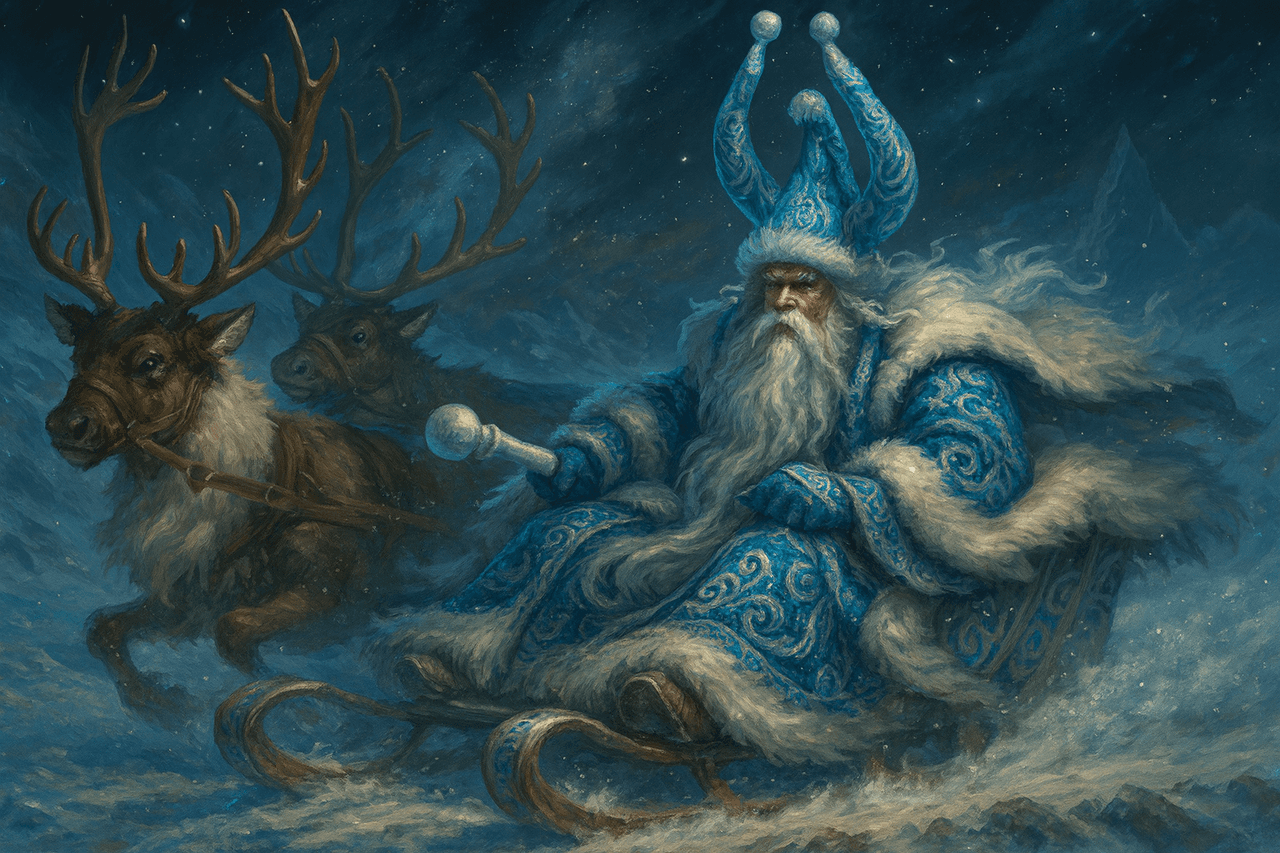
Ayaz Ata (Generated by Artificial Intelligence)
In terms of nomenclature, Ayaz Ata appears under different names among various Turkic peoples and dialects. In Central Asia, he is known as Ayaz Ota or Ayoz Bobo; among the Bashkir and Tatar communities, the figure known as “Winter Father” / Qış Babay is sometimes identified with Ayaz Ata and is accompanied by a young female figure called “Snow Girl” or “Snow Beauty.” In Azerbaijan, the pair of Şaxta Baba (Şahta Baba) and Qar Qızı (Snow Girl) fulfill a role similar to that of Ayaz Ata and the Snow Girl in function and depiction. Professor Dr. Salih Yılmaz also associates Ayaz Ata with other mythical names such as Ayaz/Ayas Han, which express the concept of “lord of cold”; in modern folk narratives, he is sometimes described as a kind of “Santa Claus” figure associated with winter and gift-giving.【1】
The context most closely associated with Ayaz Ata is the winter solstice and related seasonal festivals. It is known that the ancient Turks, from centuries before the Common Era, regarded the end of the longest night on December 21–22 and the subsequent lengthening of daylight as a “victory” and the beginning of the new year. The festival they celebrated to mark this event is referred to as Nardugan (Nardugan/Nartugan/Nardogan). Nardugan signifies the sun’s resurgence, or in a sense, the celebration of the sun’s rebirth. The Turks decorated the akçam tree, held ceremonies beneath it, and offered gifts to the divine.
In Anatolia and Azerbaijan, terms such as “Çile Night” and “Great/Little Çile” are interpreted in some studies as local forms or continuations of the Central Asian Nardugan tradition. The intense cold following the longest night is understood in this context as connected to both cosmic cycles and abundance.
Content Related to Ayaz Ata (GZT)
In these rituals, Ayaz Ata is portrayed as the symbolic bearer of the winter cycle and the new year. In some narratives, he is envisioned as the personification of the region’s wisest and oldest man, dressed in his most splendid garments, with white hair and a white beard, leading the ceremonies. He is often accompanied by a young girl of grandchild’s age, known by names such as Snow Girl, Ayaz Girl, or Snow Beauty.
It is believed that Ayaz Ata is a saintly or benevolent spirit who brings gifts to children and the poor, aids the destitute during harsh winter days, and thus balances the severity of winter with “goodness” and “abundance.” In certain mythological interpretations, Ayaz Ata is linked to cosmic elements associated with the onset of cold, such as the Ulyker constellation and holes in the sky, and is seen as an intermediary between celestial beings to end the cold.
Ayaz Ata is also associated with other concepts and figures in Turkic belief history. Some folkloric interpretations highlight the relationship between the wind (air) and ayaz in ancient Turkic mythology, where ayaz is described as the result of cold winds blowing through openings in the sky.
After the adoption of Islam, particularly among Northern Turkic peoples, Ayaz Ata came to be viewed as a saint who helps those suffering in winter, functionally resembling the Islamic cultural motif of Hızır. Some modern interpretations suggest that these attributes ascribed to Ayaz Ata may have been transferred over time from earlier wind-related personifications such as Yel Ana or Yel Ata.
The relationship between Ayaz Ata and Santa Claus and the Russian mythical figure Ded Moroz is one of the most contested points in the sources. Some scholars argue that the Turkic tradition of Ayaz Ata and Nardugan is independent of the Christian Santa Claus and the Russian Ded Moroz, representing a much older custom. Proponents of this view maintain that winter solstice celebrations among the Turks extend to very ancient times and that the Soviet-era institutionalization of the Ded Moroz cult in Russia may have been partially influenced by Turkic culture.
Conversely, other researchers argue that in practice, Ayaz Ata today has become nearly identical to Santa Claus, and that Çile/Nardugan Night is increasingly merging with New Year and Christmas-style celebrations, giving the figure a syncretic character in its current form.【2】 Thus, Ayaz Ata is viewed from two distinct perspectives: on one hand, as a continuation of an ancient winter cycle tradition, and on the other, as a modern folkloric figure intertwined with contemporary New Year–Christmas culture.
Professor Dr. Ahmet Taşağıl states that there is no evidence of a mythological figure named Ayaz Ata in Turkic culture, that no historical sources mention Ayaz Ata or the Nardugan Festival, and that even among Turkic communities that adopted Christianity, such as the Gagauz and the Chuvash, no trace of Ayaz Ata has been found.【3】
Video in Which Professor Dr. Ahmet Taşağıl Explains His Views on Ayaz Ata and Nardugan (Professor Dr. Ahmet Taşağıl)
In modern Turkic communities, the figure of Ayaz Ata continues to exist in varying forms across regions. Among Kazakhs, Kyrgyz, Uzbeks, Bashkirs, and Tatars, it is observed that Ayaz Ata/Kış Babay and the Snow Girl/Snow Beauty pair appear during the coldest period of the year, bringing gifts to children, organizing festivities, and in some places, decorating trees.
In Azerbaijan, similar rituals associated with Çile Night or the winter solstice highlight the figures of Şaxta Baba and Qar Qızı; the giving of gifts to engaged couples and the setting of large communal tables are interpreted as symbols of abundance and social solidarity. The portrayal of Ayaz Ata as a mythological hero and New Year figure in the works of contemporary writers such as Cengiz Aytmatov demonstrates that this tradition exists not only in oral culture but also in written literature.【4】
Ahmet Taşağıl. "AHMET TAŞAĞIL | SORU-CEVAP | 5 | AYAZ ATA- MOĞOLLAR TÜRK MÜDÜR?" YouTube, 0:35–1:47. Accessed December 7, 2025.https://www.youtube.com/watch?v=gSjpJr-WsVw
Anadolu Ajansı. "Noel Baba'dan önce Ayaz Ata vardı." Accessed December 7, 2025.https://www.aa.com.tr/tr/dunya/noel-babadan-once-ayaz-ata-vardi/1348888
Eşref Kaymak, “Cengiz Aytmatov’un ‘Gün Olur Asra Bedel’ Romanındaki Etnopedagojik Değerler,” *Uluslararası Etnopedagoji Dergisi* 2 (2022): 40–56. Accessed December 7, 2025.https://www.academia.edu/126053630/Cengi_z_AytmatovUn_G%C3%BCn_Olur_Asra_Bedel_Romanindaki_Etnopedagoji_k_De%C4%9Ferler
Gazanfarqızı, Aynur. “Türklerde Güneşe Saygı: Çile Gecesi.” *Motif Akademi Halkbilimi Dergisi* 16, no. 44 (2023): 1599–1605. Accessed December 7, 2025.https://dergipark.org.tr/tr/pub/mahder/issue/81489/1307056
[1]
Anadolu Ajansı. "Noel Baba'dan önce Ayaz Ata vardı." Erişim: 7 Aralık 2025. https://www.aa.com.tr/tr/dunya/noel-babadan-once-ayaz-ata-vardi/1348888.
[2]
Aynur Gazanfarqızı, “Türklerde Güneşe Saygı: Çile Gecesi,” Motif Akademi Halkbilimi Dergisi 16, sayı 44 (2023): 1599–1605. Erişim 7 Aralık 2025. https://dergipark.org.tr/tr/pub/mahder/issue/81489/1307056.
[3]
Ahmet Taşağıl. "AHMET TAŞAĞIL | SORU-CEVAP | 5 | AYAZ ATA- MOĞOLLAR TÜRK MÜDÜR?" Youtube. 0.35-1.47 sn arasında, Erişim: 7 Aralık 2025. https://www.youtube.com/watch?v=gSjpJr-WsVw.
[4]
Eşref Kaymak, “Cengiz Aytmatov’un ‘Gün Olur Asra Bedel’ Romanındaki Etnopedagojik Değerler,” Uluslararası Etnopedagoji Dergisi 2,(2022): 40-56. Erişim 7 Aralık 2025. https://www.academia.edu/126053630/Cengi_z_AytmatovUn_G%C3%BCn_Olur_Asra_Bedel_Romanindaki_Etnopedagoji_k_De%C4%9Ferler.

Various Names
Ayaz Ata’s Association with the Winter Solstice
Ayaz Ata’s Role and Function in Rituals
Connection with Ancient Turkic Beliefs and Post-Islamic Interpretations
Debates on the Relationship with Santa Claus and Ded Moroz
Ayaz Ata in Contemporary Turkic Communities