


This article was automatically translated from the original Turkish version.
Passport
Common Name | Avcı Bulutsusu | ||||||||
|---|---|---|---|---|---|---|---|---|---|
Catalog Name | Avcı Bulutsusu | ||||||||
Type | Emission nebula (H II region) | ||||||||
Location | Orion Constellation (Orion) | ||||||||
Distance | 1344 light-years (412 parsecs) | ||||||||
Angular Size | Approximately 66 × 60 arcminutes | ||||||||
Physical Size | 24 light-years | ||||||||
Gas Temperature | ~10,000 K (for ionized hydrogen) | ||||||||
Gas Composition | H I, H II, He, O, N, S, dust | ||||||||
Density | Approximately 10⁴ particles/cm³ (typical for H II region) | ||||||||
Internal Star Cluster | Trapezium Cluster (θ¹ Orionis) | ||||||||
Star Formation | Protoplanetary disks, protostars, T Tauri stars | ||||||||
Wavelengths Studied | Optical, infrared (IR), ultraviolet (UV), radio | ||||||||
Spectral Emission Lines | Hα (656.3 nm), [O III] (500.7 nm), [N II], He I | ||||||||
First Observations with Telescope | 1610 (Nicolas-Claude Fabri de Peiresc) | ||||||||
The Orion Nebula (or its scientific name, Messier 42, abbreviated as M42) is a large and bright diffuse nebula located in the constellation Orion. This nebula is approximately 1344 light years from Earth and is one of the brightest nebulae visible to the naked eye in the night sky. With a width of about 24 light years, the Orion Nebula is regarded as one of the best-known regions of star formation in the sky.
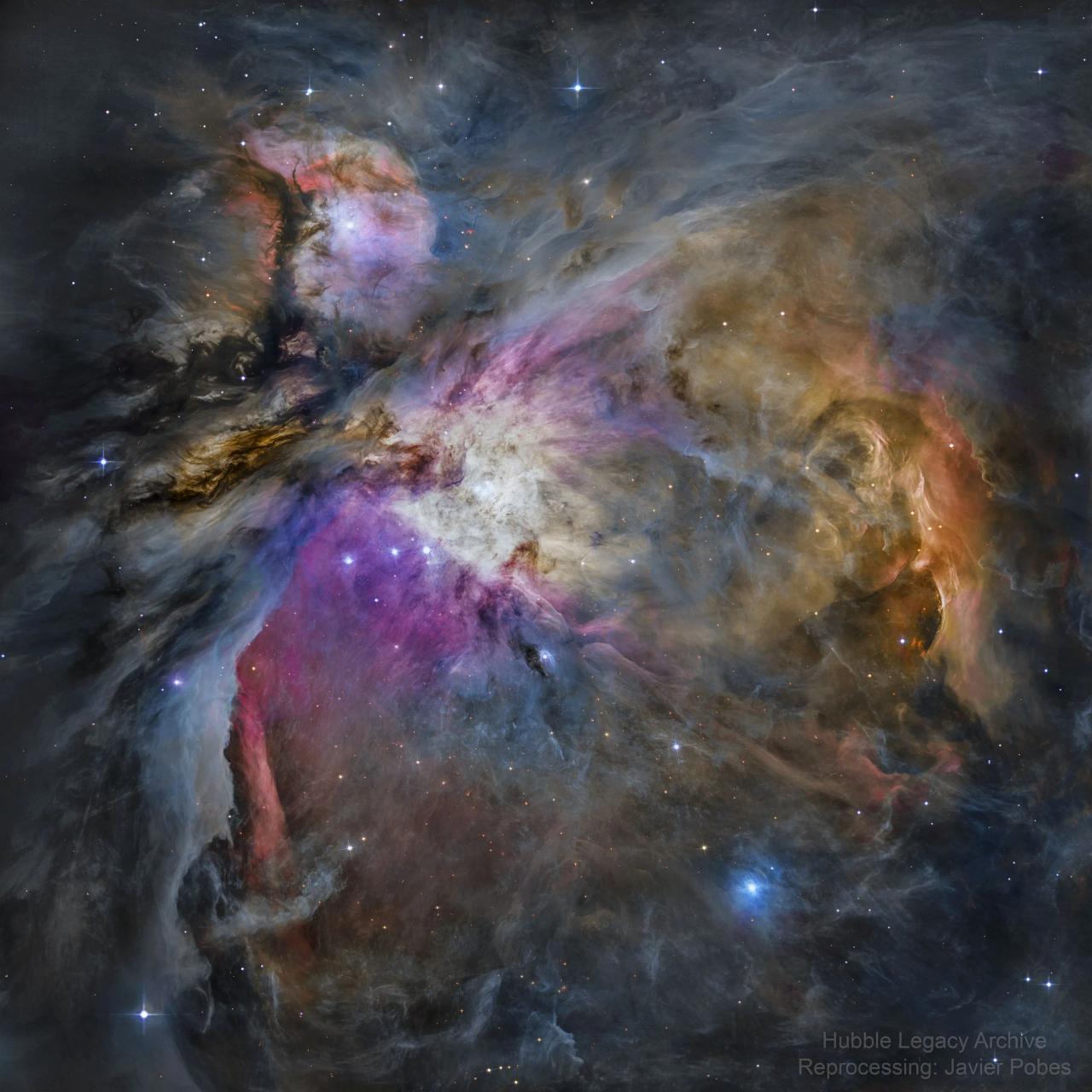
Orion NebulaHubble Space Telescope image source: NASA/ESA
Even before the invention of the telescope, the Orion Nebula was described in the night sky as a “fuzzy star.” The first telescopic observation was made in 1610 by Nicolas-Claude Fabri de Peiresc. It was later observed and cataloged by Charles Messier in 1769.
In the modern era, advanced observatories such as the Hubble Space Telescope, Spitzer, and ALMA have examined the nebula in detail across various wavelength bands. Thanks to Hubble observations, many protoplanetary disks (proplyds) were imaged directly for the first time.
The Orion Nebula is composed primarily of hydrogen gas, which becomes ionized by ultraviolet radiation from the stars within it, causing the nebula to glow brightly. At its center lies the Trapezium Cluster, a compact group of hot, young stars. These stars play a significant role in illuminating and shaping the nebula.
The nebula exhibits both emission and reflection characteristics: the light emitted by ionized gas forms the emission nebula, while starlight scattered by dust creates the reflection nebula.
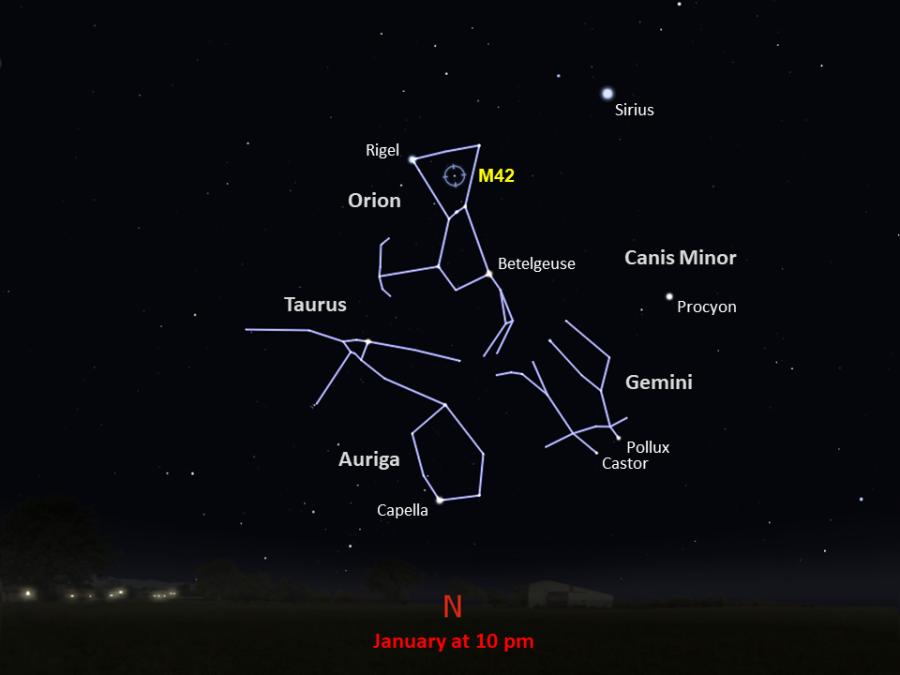
This star chart represents the view of M42 from mid-southern latitudes for the specified month and time. Source: NASA
The Trapezium Cluster (θ¹ Orionis), located at the heart of the nebula, is a tight system of four main stars accompanied by thousands of younger stars, playing a decisive role in the nebula’s radiation and morphological structure. This cluster particularly contains young, hot, and OB spectral type stars that are short-lived. The ionizing photons produced by these stars ionize the surrounding gas.
The Orion Nebula offers a unique target for studying the early evolution of planetary systems due to the hundreds of protoplanetary disks (proplyds) it contains. These disks are dense structures of gas and dust orbiting young stars and are likely the precursors to planets.
Massimo Robberto from the Space Telescope Science Institute in the USA said, “In this stellar nursery, we see the entire history of Orion’s star formation imprinted in the nebula’s features: arcs, patches, columns, and dust rings reminiscent of cigar smoke. Each tells a story of stellar winds from young stars and material ejected by other stars. This is a typical star-forming environment. Our Sun was likely born in a nebula like this about 4.5 billion years ago.”
The Orion Nebula plays a key role in helping astronomers understand the processes of star formation. Due to its proximity and brightness, it is frequently observed by amateur astronomers. Observations made using the Hubble Space Telescope and various ground-based telescopes have provided crucial data on the young stars and protoplanetary disks within the nebula.
Bally, J., Langer, W. D., Stark, A. A., & Wilson, R. W. (1987). Dynamics and structure of the Orion molecular cloud. *The Astrophysical Journal Letters*, 312(1), L45–L49.https://doi.org/10.1086/184837
HubbleSite. (1995). Hubble finds new planetary system structures in Orion Nebula.https://hubblesite.org/contents/news-releases/1995/news-1995-45.html
O'Dell, C. R. (2001). The Orion Nebula and its associated population. *Annual Review of Astronomy and Astrophysics*, 39(1), 99–136.https://doi.org/10.1146/annurev.astro.39.1.99
O'Dell, C. R., & Wen, Z. (1994). Postrefurbishment Hubble Space Telescope images of the Orion Nebula: Proplyds, Herbig–Haro objects, and measurements of a circumstellar disk. *The Astrophysical Journal*, 436(1), 194–202.https://doi.org/10.1086/174892

Passport
Common Name | Avcı Bulutsusu | ||||||||
|---|---|---|---|---|---|---|---|---|---|
Catalog Name | Avcı Bulutsusu | ||||||||
Type | Emission nebula (H II region) | ||||||||
Location | Orion Constellation (Orion) | ||||||||
Distance | 1344 light-years (412 parsecs) | ||||||||
Angular Size | Approximately 66 × 60 arcminutes | ||||||||
Physical Size | 24 light-years | ||||||||
Gas Temperature | ~10,000 K (for ionized hydrogen) | ||||||||
Gas Composition | H I, H II, He, O, N, S, dust | ||||||||
Density | Approximately 10⁴ particles/cm³ (typical for H II region) | ||||||||
Internal Star Cluster | Trapezium Cluster (θ¹ Orionis) | ||||||||
Star Formation | Protoplanetary disks, protostars, T Tauri stars | ||||||||
Wavelengths Studied | Optical, infrared (IR), ultraviolet (UV), radio | ||||||||
Spectral Emission Lines | Hα (656.3 nm), [O III] (500.7 nm), [N II], He I | ||||||||
First Observations with Telescope | 1610 (Nicolas-Claude Fabri de Peiresc) | ||||||||
No Discussion Added Yet
Start discussion for "Avcı Bulutsusu (M42)" article
Observational History
Structure and Composition
The Trapezium Cluster and Star Formation
Scientific Significance