


This article was automatically translated from the original Turkish version.
+1 More
Autophagy (Greek auto = self, phagein = to eat), literally means “eating oneself.” This biological process is an evolutionarily conserved mechanism that enables cells to degrade and recycle their own components. It involves the breakdown of damaged or nonfunctional organelles and proteins by lysosomal enzymes, followed by the recycling of their building blocks.
This intracellular process is triggered by various conditions such as physiological stress, starvation, infection and cellular aging. The degradative role of lysosomes in this process is central to maintaining cellular homeostasis.
The concept of autophagy was first defined in the 1960s by Christian de Duve, who observed it in rat liver cells and used the term “self-eating.” The molecular mechanisms were elucidated only in the 1990s through genetic and microscopic studies conducted by Yoshinori Ohsumi.
Ohsumi’s discovery of autophagy-related genes (Atg genes) in yeast cells enabled the identification of the molecular foundations of this process. This breakthrough revealed that autophagy is not merely a simple degradation pathway but a complex, regulated mechanism linked to disease.
Autophagy consists of five key stages occurring in a controlled manner within the cell:
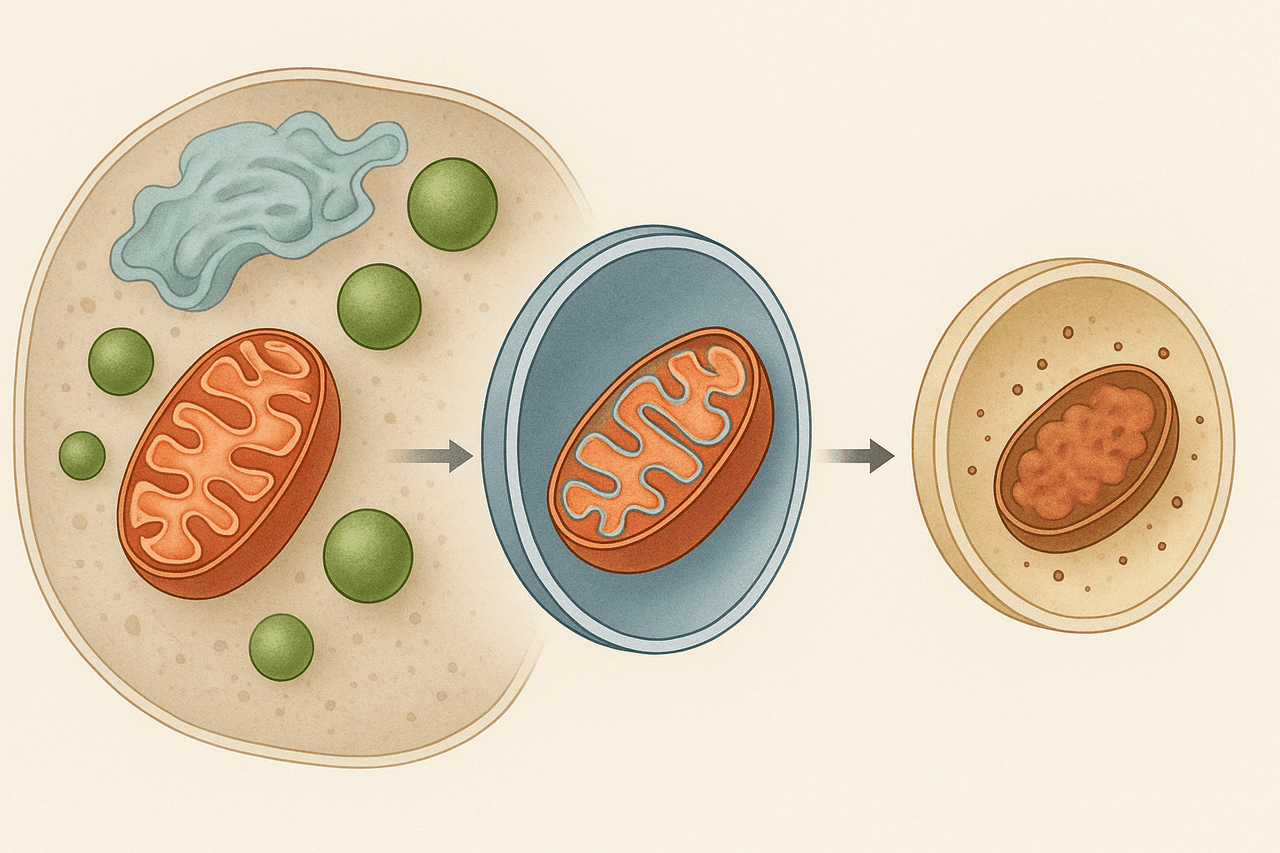
Otofaji Sürecinde Mitokondri Yıkımı Aşaması (Yapay Zeka Tarafından Oluşturulmuştur)
Autophagy mechanisms are classified into three main categories:
In selective autophagy, specific structures are targeted. For example:
Autophagy is essential for maintaining homeostasis, energy production, delaying aging and ensuring cellular quality control. Cells use this mechanism to eliminate damaged organelles, toxic proteins and foreign pathogens.
Moreover, autophagy plays a role in Type II programmed cell death. When cells cannot undergo apoptosis, they may die via autophagy. In this way, autophagy has a dual role, contributing to both cell survival and cell death.
Dysregulation or overactivation of autophagy is linked to numerous diseases:
Autophagy is activated by prolonged fasting. When fasting, cells begin breaking down their own structural components to convert them into energy. Increased glucagon levels during this period trigger autophagy. Simultaneously, growth hormone secretion increases, supporting new cell formation.
In this context, intermittent fasting practices may reduce the risk of diseases such as Alzheimer’s and Parkinson’s by promoting autophagy. This process, which encourages cellular renewal, forms the basis of therapeutic fasting approaches in modern biomedical literature.
Autophagy is a fundamental process for cellular balance and health. By playing a critical role in energy management and cellular cleansing, it acts as a protective mechanism against disease. The regulation of autophagy in molecular biology is a major research area aimed at developing novel therapeutic strategies in modern medicine.
Gözüaçık, Devrim, Gözde Korkmaz, and Devrim Öz Arslan. "Otofaji: Bir Hücresel Stres Yanıtı ve Ölüm Mekanizması." Acıbadem Üniversitesi Sağlık Bilimleri Dergisi 2, no. 4 (2011): 184–194.
Karadağ, Ahmet. 2021. "Oruç: Vücudu Arındırmanın Yolu Otofaji." Yozgat Bozok Üniversitesi Yayını. Accessed May 14, 2025.
Karadağ, Aynur. 2016. "Otofaji: Programlı Hücre Ölümü." Ankara Sağlık Hizmetleri Dergisi 15, no. 2: 19–25.
Liman, Narin, and Duygu Cemre Suna. 2017. "Hücre Koruyucu Bir Mekanizma: Otofaji." Sağlık Bilimleri Dergisi 26, no. 3: 275–281.
Sezer, İlay Çelik. "Nobel Fizyoloji veya Tıp Ödülü Otofaji Araştırmalarının Pirine: Yoshinori Ohsumi." TÜBİTAK Bilim ve Teknik Dergisi, no. 588 (November 2016): 54–59.
Sezer, İlay Çelik. 2016. "Nobel Fizyoloji veya Tıp Ödülü: Otofaji Araştırmalarının Pirine." Bilim ve Teknik Dergisi (November): 54–59.

Historical Development
The Autophagy Process
Types and Selectivity
Physiological Role and Clinical Significance
Association with Diseases
Autophagy and Fasting