


This article was automatically translated from the original Turkish version.
Assembly Line is a production system in which the components of a product are assembled in a specific sequence, and workers or machines perform designated tasks at each step of the production process. Typically, raw materials or semi-finished goods are introduced at the beginning of the line, and the final product is completed as it progresses to the end of the line. The assembly line increases production speed and efficiency while reducing labor costs.
Assembly lines hold a crucial place in the automotive industry. Ford’s developed moving assembly line became one of the foundational pillars of modern industrial production. This system enabled standardization of production processes, making time and labor savings possible at every stage.
Assembly lines can be designed differently depending on production requirements, the type of product being manufactured, and the workflow. Generally, assembly lines can be categorized into three main categories based on production methods and process management.
Fixed assembly lines keep the product stationary while workers or machines move around it according to a specific layout to perform assembly operations. This method is typically preferred for producing large, heavy, or difficult-to-move products.
Characteristics:
It is widely used in fields such as aircraft, shipbuilding, large-scale machinery, and construction equipment manufacturing such as.
Advantages:
Disadvantages:
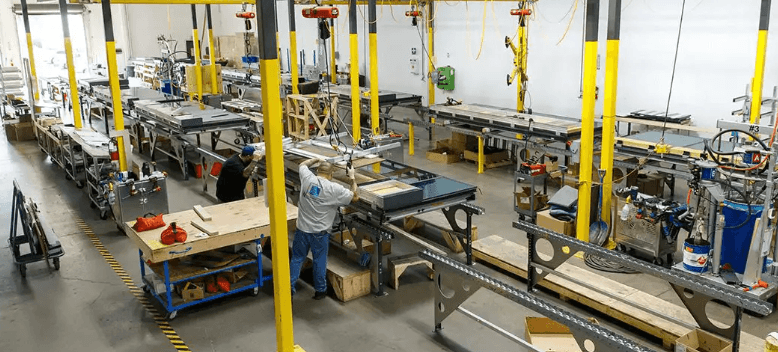
Fixed Position Assembly Line (Credit: spanco.com)
In a moving assembly line, products are transported between stations via conveyor systems or automated transport mechanisms, and specific assembly operations are performed at each station. This system is one of the most efficient solutions for mass production.
Characteristics:
It is widely used in automotive, electronics, white goods, and consumer product manufacturing.
Advantages:
Disadvantages:

Moving Assembly Line (Credit: fivesgroup.com)
A modular assembly line is designed to enhance production flexibility. Production processes are divided into specific modules, where different components are assembled, and then integrated into the main assembly line.
Characteristics:
Advantages:
Disadvantages:
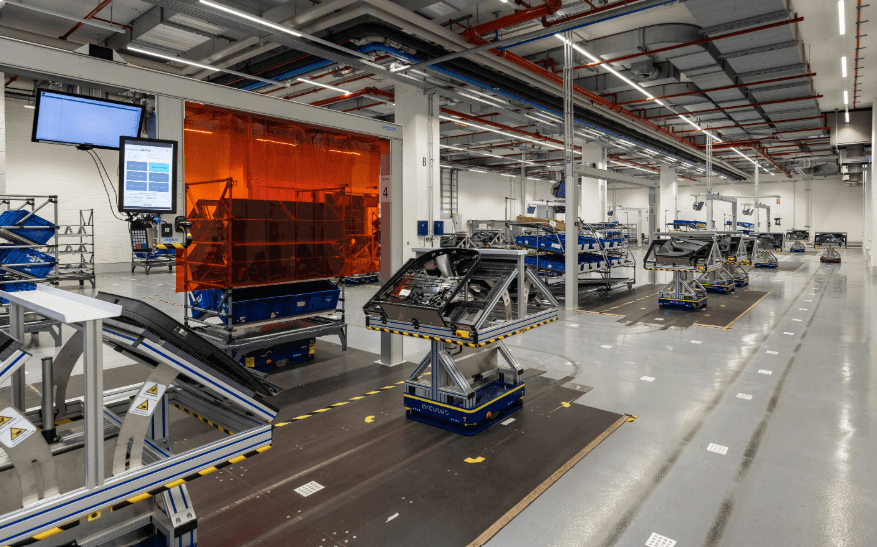
Modular Assembly Line (Credit: Audi Media Center)

Types of Assembly Lines table (Generated by artificial intelligence.)
Assembly line types exhibit significant differences in terms of production speed, efficiency, and flexibility. Moving assembly lines are ideal for high-volume production, while fixed assembly lines enable the manufacture of large-scale products. Modular assembly lines offer a structure better suited to customized and variable product demands.
In today’s industry, assembly lines are becoming smarter, more efficient, and more flexible alongside lean manufacturing, automation, and Industry 4.0 approaches. Technologies such as robotics, artificial intelligence-supported production management, and the Internet of Things (IoT) will be the most important factors shaping the future of assembly lines.
Assembly line design encompasses engineering efforts aimed at ensuring the production process operates efficiently, fast, and without errors. A well-designed assembly line reduces production costs and improves quality by optimizing labor, machinery, material flow, and production processes.
When designing an assembly line, the following key elements must be considered:
The assembly line design process includes the steps of analysis, planning, simulation, testing, and implementation.
One of the most important optimization techniques in assembly line design is line balancing.
The following optimization techniques can be applied to create an efficient assembly line:
Assembly line efficiency must be optimized to ensure production processes operate faster, at lower cost, and without errors. Increasing efficiency raises production speed while minimizing labor, material, and time waste.
Lean manufacturing is a production philosophy focused on reducing waste and optimizing processes. Some important lean manufacturing techniques applied on assembly lines are:
The 5S method is a technique used to improve organization and efficiency in the workplace:

5S Method (Credit: Esat Demirel)
Kaizen (Credit: Mehmet Dalbudak)
To prevent bottlenecks by evenly distributing workloads across assembly line work stations, line balancing techniques must be applied.
Automation systems are used to accelerate production processes and reduce human errors.
The training and motivation of workers on the assembly line directly affect efficiency.
Assembly lines are widely used across various industries to accelerate production, reduce costs, and improve quality. They play a critical role in many sectors including automotive, electronics, aerospace, defense, white goods, food, and pharmaceutical industries.
The automotive industry is one of the fields where assembly line systems originated and are most intensively used. Henry Ford’s development of the moving assembly line in 1913 revolutionized automobile production.
Electronics manufacturing is one of the sectors requiring precise assembly. In electronics assembly lines, robotic systems, automated soldering machines, and human labor work together.
In aerospace and space industries, assembly lines enable the integration of complex components requiring high precision and quality.
Military vehicles, weapon systems, and unmanned aerial vehicles produced in the defense industry require precise engineering and high security standards.
White goods manufacturing is one of the most common areas for mass production assembly lines.
Food production is an industry requiring hygienic and rapid assembly lines.
Medical products and pharmaceutical manufacturing involve assembly lines requiring precise and sterile environments.
Britannica Money. "Assembly Line."
Croci, F., M. Perona, and A. Pozzetti. “Work Force Management in Automated Assembly Systems.” *International Journal of Production Economics*. March 1, 2000.Accessed Adresi.
Ford. "The Moving Assembly Line and The Five-Dollar Workday".
Humphreys, J. (2024). "Manufacturing assembly line: Understanding it from start to finish."Accessed Adresi.
Inc. (2020). "Assembly Line Methods."Accessed Adresi.
Karaca, M. "Montaj Hatları." Faculty of Economic and Administrative Sciences, Süleyman Demirel University.
LTC Roll Blog. (2018). "The Different Types of Assembly Lines in Manufacturing."Accessed Adresi.
Safety Culture. (2023). "A Short Introduction to Assembly Lines".Accessed Adresi.

Types of Assembly Lines
Fixed Position Assembly Line
Moving Assembly Line
Modular Assembly Line
Assembly Line Design
Factors to Consider in Assembly Line Design
1- Product Characteristics
2- Production Volume and Speed
3- Labor and Automation Level
4- Material Flow and Logistics
5- Ergonomics and Safety
Assembly Line Design Process
1- Analysis and Planning
2- Line Balancing
3- Simulation and Testing Process
4- Implementation and Commissioning
Assembly Line Optimization
1- Lean Manufacturing
2- Use of Automation and Robotics
3- Data Analytics and Industry 4.0 Integration
Methods to Increase Efficiency on Assembly Lines
Lean Manufacturing Techniques
1- 5S Method (Organization and Discipline)
2- Kaizen (Continuous Improvement)
3- JIT (Just-In-Time) – On-Time Production
Line Balancing Methods
1- Time Study and Workflow Analysis
2- Bottleneck Identification and Resolution
Use of Automation and Robotics
1- Use of Industrial Robots
2- IoT and Smart Sensor Systems
Workforce Efficiency and Employee Training
1- Employee Training and Skill Enhancement
2- Ergonomic Working Conditions
Application Areas of Assembly Lines
Assembly Lines in the Automotive Industry
Electronics Industry Assembly Lines
Aerospace and Space Industry Assembly Lines
Defense Industry Assembly Lines
White Goods and Durable Consumer Goods Assembly Lines
Food and Beverage Industry Assembly Lines
Pharmaceutical and Medical Device Manufacturing Assembly Lines