


This article was automatically translated from the original Turkish version.
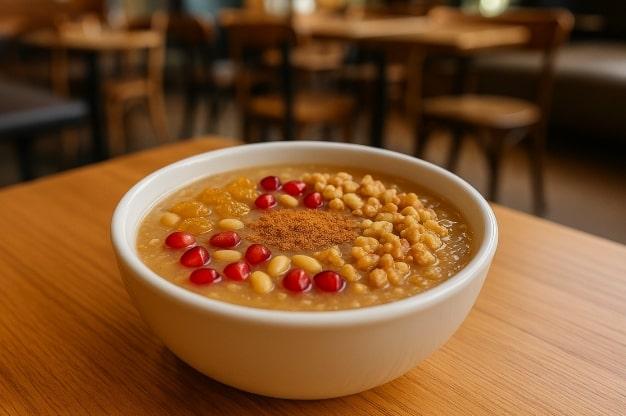
Ashura
Category | Sweet / Traditional dish | ||||||||
|---|---|---|---|---|---|---|---|---|---|
Cultural Origin | Middle East, Anatolia | ||||||||
Date Consumed | The 10th day of Muharram (Ashura Day) | ||||||||
Main Ingredient | Chickpeas Walnut Dried fruits Dried beans Wheat Sugar | ||||||||
Aşure is regarded as an important traditional dessert across Türkiye, as well as in the Middle East and Balkans. This dessert carries both religious and social significance and is prepared particularly on the tenth day of the Islamic lunar month of Muharrem, then distributed among the community as an act of shared generosity. For centuries, Aşure has endured as a multilayered cultural symbol shaped by literature and belief systems.
The sacredness attributed to the day of Aşure extends back to pre-Islamic times and has been interpreted in various ways across different belief systems. In Jewish tradition, this day is associated with Yom Kippur (Day of Atonement) and observed as a day of fasting; in Christian culture, it has been linked to pre-Easter fasting rituals. One of the most widespread narratives holds that on the day Noah Prophet’s ark came to rest on Mount Judi after the flood, the remaining ingredients aboard were combined to create the dessert known as Aşure.
In Islamic communities, however, this day acquired a tragic meaning through its association with the Kerbelâ event and came to be observed as a day of mourning. Ottoman times saw Aşure spread across a broad social practice, from the palace to the tekke, from the mansion to the household, acquiring both religious and social significance.
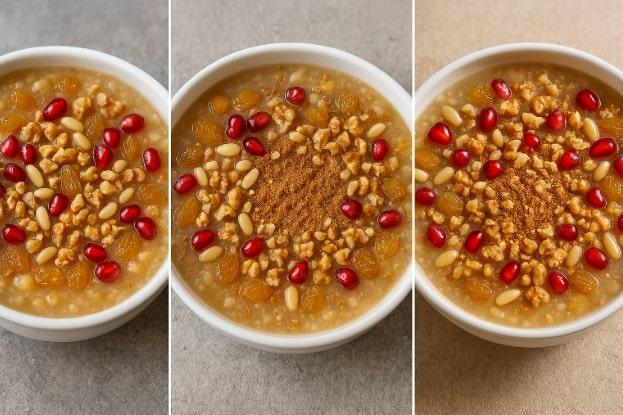
Aşure. Generated by artificial intelligence.
Aşure is a dessert rich in diverse components, possessing both symbolic and nutritional value. Its preparation requires care and time. Below is a description of a classic Aşure recipe:
Aşure is more than just a dessert of culinary tradition; it carries symbolic meanings at religious, sectarian, and sociocultural levels.
In the Ottoman palace, Mevlevi and Bektashi tekkes, and various regions of Anatolia, the tradition of preparing Aşure was performed with distinct rituals and seen as part of both personal devotion and communal solidarity. Prayers and remembrances performed around the Aşure pot, along with the ritual transfer of the serving spoon from hand to hand accompanied by specific recitations, are among the indicators of this cultural context.
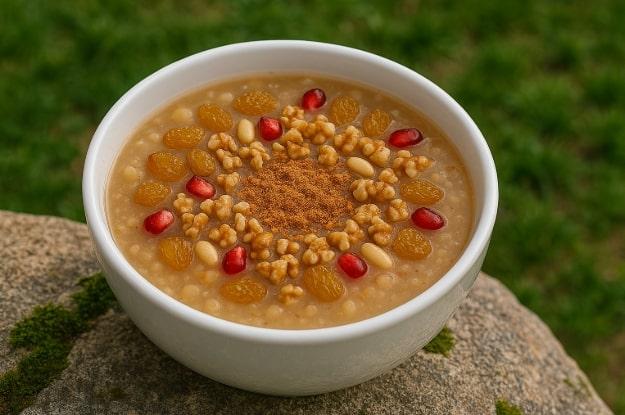
Aşure. Generated by artificial intelligence.
In the Ottoman palace, Aşure was prepared under the supervision of the chief confectioner and distributed to the public in special ceramic jars. In Mevlevi and Bektashi tekkes, this tradition was carried out with prayers and elegies, sometimes integrated into zikir gatherings. In different regions of Anatolia, ingredient preferences varied according to local tastes.
For example, in Eastern Anatolia, grape molasses is used instead of sugar; in the Aegean region, the quantity of legumes is reduced while the proportion of dried fruit is increased. In some areas, aromatic elements such as rose water or clove are added, and the first bowl is kept at home as a sign of blessing.
Aşure is a dessert prepared on the tenth day of Muharrem in the Islamic world and has become a symbol of sharing. In the Ottoman Empire, Aşure was recognized as an important ritual especially during the month of Muharrem and religious holidays. In the Ottoman palace, the tradition of cooking Aşure was practiced as part of the sultan’s connection with the people and as an act of charity. Sultans and palace officials distributed the Aşure prepared on the tenth day of Muharrem to the public and to the poor, reinforcing social solidarity.
During the Republic of Türkiye period, the Aşure tradition continued as a cultural legacy inherited from the Ottoman era. Even in the Republican period, Aşure continued to be prepared and distributed to neighbors and those in need, particularly during Muharrem and certain regional religious holidays. In Türkiye, Aşure is recognized not only as a religious ritual but also as a symbol of cultural sharing. Today in Türkiye, Aşure is not only prepared during Muharrem but also by some families during religious holidays and offered to guests. Particularly in some regions, the offering of Aşure during Eid al-Adha and Ramadan holidays is maintained as a sign of hospitality and festive joy.
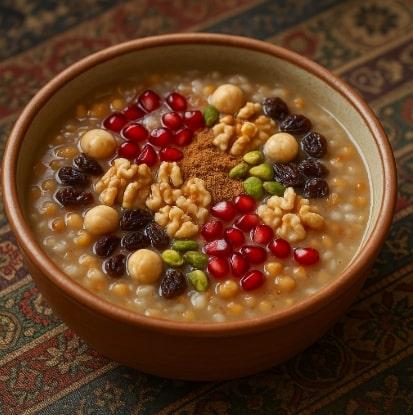
A regional Aşure served in a ceramic bowl, garnished with pomegranate seeds, hazelnuts, walnuts, raisins, and cinnamon.
BBC Türkçe. "Aşurenin Tarihi: Her Kepçede Binlerce Yılın Hikâyesi." July 28, 2023.
Başan, Ghillie. "Turkish Noah’s Ark Pudding – Aşure." The Spruce Eats. Accessed March 27, 2025.
Kültür ve Turizm Bakanlığı. "Aşure." Kültür Portalı. Accessed March 27, 2025.
Polat, Kadim. "Aşure Geleneğinin Tarihsel Arka Planı ve Osmanlı Kültür Dünyasına Yansımaları." *Akademik Dil ve Edebiyat Dergisi* 3, no. 4 (2019): 457–474.https://doi.org/10.34083/akaded.627055.

Ashura
Category | Sweet / Traditional dish | ||||||||
|---|---|---|---|---|---|---|---|---|---|
Cultural Origin | Middle East, Anatolia | ||||||||
Date Consumed | The 10th day of Muharram (Ashura Day) | ||||||||
Main Ingredient | Chickpeas Walnut Dried fruits Dried beans Wheat Sugar | ||||||||
History and Origins
Preparation and Ingredients
Ingredients (serves 20–25):
Preparation:
Cultural Significance
Regional Variations and Ottoman Tradition
Aşure in Ottoman and Contemporary Türkiye During Festivals