


This article was automatically translated from the original Turkish version.
Art therapy is a mental health practice that integrates creative processes with psychotherapy, enabling individuals to express thoughts, emotions, and internal conflicts through art. At its core, art therapy is based on the idea that artistic creation makes unconscious processes visible, facilitates emotional catharsis, and fosters self-awareness and insight. This approach developed in the mid-20th century under the influence of psychodynamic theories, particularly through the psychoanalytic view of art as a reflective space.
Historically, even before the emergence of modern psychotherapy, cave paintings, ritual objects, and symbolic artistic production demonstrate the use of art as a tool. In the 20th century, the convergence of clinical psychology and art gave rise to art therapy as a systematic field. From the 1940s onward, it became institutionalized and recognized as a therapeutic intervention. The power of art to reveal, structure, and transform psychological processes has been integrated into therapeutic practice, establishing it as an effective tool in mental health care.
The philosophical dimension of art therapy is intertwined with concepts of aesthetics, ethics, being, and knowledge. Art serves as a means of understanding the inner world and achieving self-realization. Aristotle’s concept of catharsis argues for emotional purification through art. Plato posited beauty as a path to truth, while Plotinus emphasized that intrinsic aesthetic experience enables spiritual development.
Art therapy is not merely a therapeutic tool but also a multilayered structure encompassing aesthetic, ethical, and existential inquiries. The images, drawings, and aesthetic objects used in therapy help individuals reflect upon and interpret their psychological reality through form and symbolism.
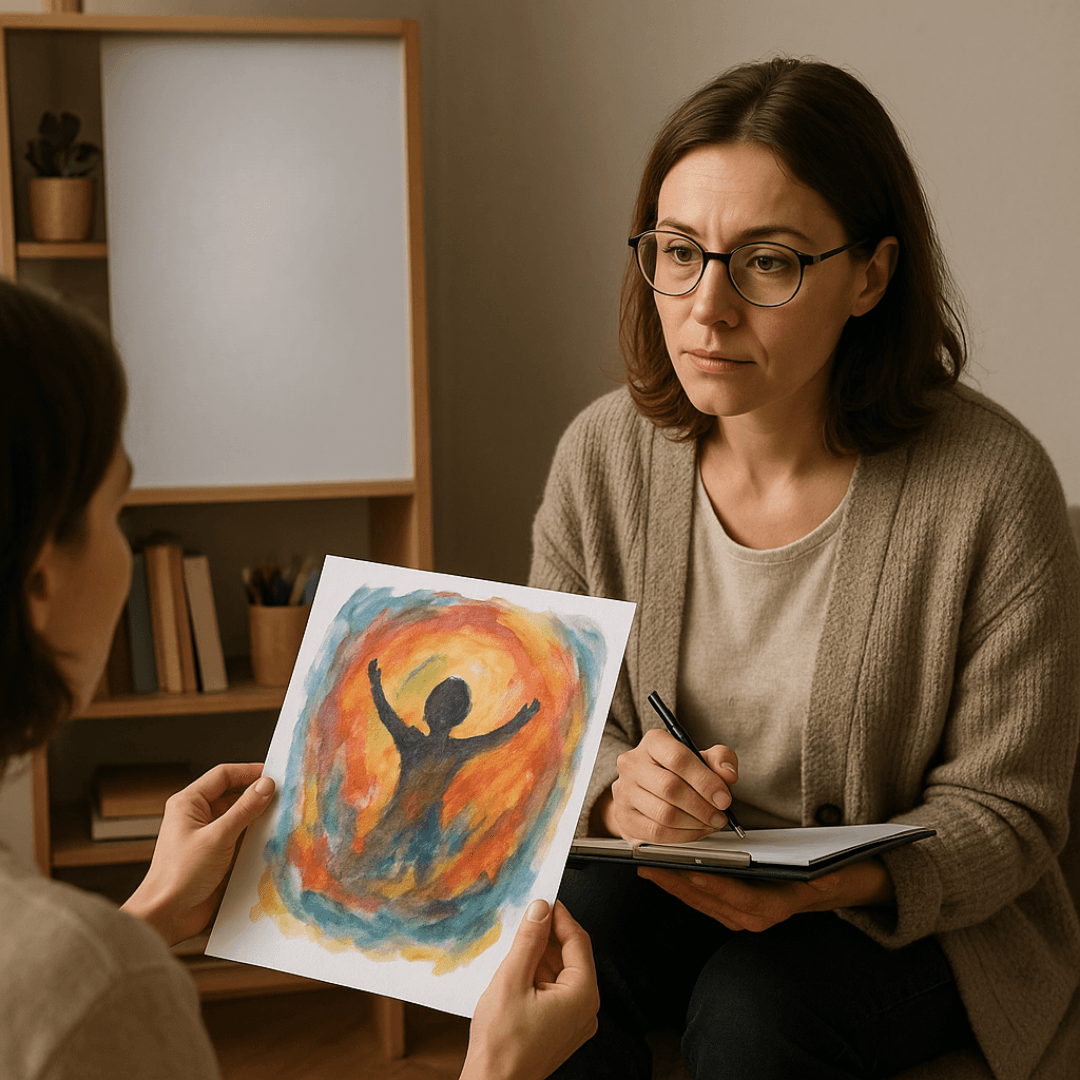
Sanat terapisini temsil eden bir görsel. (Yapay zeka ile oluşturulmuştur.)
In addition to its philosophical underpinnings, the theoretical framework of art therapy encompasses a multidimensional structure extending from psychoanalytic theory to humanistic psychology, and from cognitive-behavioral models to phenomenology and existential approaches. Freud’s theories on unconscious processes and his techniques of free association and dream analysis transformed art’s symbolic expressive power into a therapeutic instrument. Carl Jung’s theories of the collective unconscious and archetypes suggest that art can access an individual’s deep psychological structures through universal imagery. Carl Rogers’ person-centered approach highlights the importance of empathy, unconditional positive regard, and genuineness in the therapeutic environment, creating a foundation for art therapy as a safe space for expression.
Art therapy also allows individuals to externalize their subjective experiences and existential questions through artistic means. Approaches such as Gestalt therapy support the insight-generating function of the artistic process by focusing on the individual’s “here and now” experience. In particular, expressive art therapy regards the spontaneous and symbolic expression of internal conflicts as the primary healing mechanism.
Art therapy is a flexible psychotherapeutic method suitable for individuals across different age groups. It can be applied in both individual and group sessions with children, adolescents, adults, and older adults. It functions as an alternative communication tool for individuals who struggle with verbal expression. In this sense, art therapy facilitates nonverbal expression of emotions and thoughts.
Art therapy is used as a supportive intervention for various mental health conditions, including post-traumatic stress disorder, depression, anxiety disorders, behavioral problems, developmental disorders, and psychotic disorders. Research has also demonstrated its effectiveness in enhancing psychosocial support for individuals living with chronic physical illnesses.
This therapeutic approach is not limited to individual sessions and can be implemented in diverse institutional settings. Art therapy programs are integrated into educational institutions, rehabilitation centers, hospitals, correctional facilities, and refugee and migrant camps across social and health care domains. Group activities in these settings promote interpersonal interaction and contribute to healing processes.
A wide range of creative art disciplines are employed in art therapy applications, including drawing, collage, clay work, mask-making, creative writing, movement, dance, and music. These mediums enable individuals to enhance personal awareness and develop social communication skills.
In art therapy applications with children, emotional regulation skills are supported through drawing and play-based activities. Simultaneously, self-development and enhanced self-confidence are targeted. As a result, positive effects on children’s emotional, cognitive, and social development can be observed.
Art therapy is a psychotherapeutic method that employs artistic expression to support psychological well-being. The primary goal in this approach is not to produce an aesthetic product but to enable the individual to express their inner world. During the art therapy process, the therapist assumes the role of a guide who respects the individual’s self-process and facilitates rather than directs or interprets.
The functions of art therapy are multifaceted. The main functions include:
In addition, art therapy supports individuals in better understanding themselves, evaluating interpersonal relationships, and assigning new meanings to life events.
Empirical and qualitative research on art therapy reveals its multidimensional effects. Studies have shown that expressive art therapy interventions lead to significant reductions in various psychopathological indicators such as depression, anxiety, interpersonal sensitivity, obsessive thoughts, and psychotic symptoms. Positive effects have also been observed on automatic thoughts, levels of hopelessness, and dysfunctional cognitive structures.
Art therapy is also effective in areas such as emotional regulation, cognitive integration, and self-development. These effects are evident not only in clinical populations but also in general population samples. Participants report that they can express emotions more freely through art, gain a better understanding of themselves, and form empathetic connections within the group.
Warning: The content in this article is provided solely for general encyclopedic information. The information presented here should not be used for diagnosis, treatment, or medical guidance. Before making any decisions regarding health, you must consult a physician or qualified healthcare professional. The author of this article and the KÜRE Encyclopedia assume no responsibility for any consequences arising from the use of this information for diagnostic or therapeutic purposes.
Akaroğlu, Emine Gülriz, Koç, Aysel, Tekbaş, Ulya, Şen, Hümeyra Nur, and Erdoğan, Şeyda Nur. “Dışavurumcu Sanat Terapi Yönteminin Korku Duygusu Üzerine Etkisi.” *The Journal of Academic Social Science* 142, no. 142 (2024): 357–383. Accessed May 21, 2025.https://asosjournal.com/index.jsp?mod=makale_ing_ozet&makale_id=69549
Demir, Volkan, and Yıldırım, Burcu. “Sanatla Terapi Programının Üniversite Sınavına Hazırlanan Öğrencilerin Depresyon, Anksiyete ve Stres Belirti Düzeylerine Etkililiği.” *Ege Eğitim Dergisi* 18, no. 1 (2017): 311–344. Accessed May 21, 2025.https://doi.org/10.12984/egeefd.280267
Demir, Volkan. “Dışavurumcu Sanat Terapisinin Psikolojik Belirtiler ile Bilişsel İşlevlere Etkisi.” *Uluslararası Toplum Araştırmaları Dergisi* 7, no. 13 (2017): 575–598. Accessed May 21, 2025.https://doi.org/10.26466/opus.337250
Filiz, Şahin. “Sanat Terapisinin Felsefi Boyutları.” *Mediterranean Journal of Humanities* 6, no. 1 (2016): 169–183. Accessed May 21, 2025.https://doi.org/10.13114/MJH.2016119297
Tanrıverdi, Yasemin. “Sanat Eyleminin Terapötik Yönü ve Kavramsal Sanata Yansımaları.” *Görünüm Dergisi*, no. 14 (2023): 123–138. Accessed May 21, 2025.https://dergipark.org.tr/en/pub/gorunum/issue/78330/1319660.
Yılmaz, Tuğba. “Klinik Psikolojide Sanat ve Sanat Uygulamaları.” *Tyche Sanat ve Tasarım Dergisi* 2, no. 2 (2017): 32–43. Accessed May 21, 2025.https://dergipark.org.tr/en/pub/tykhe/issue/55444/759915
Çakmak, Özlem, Biçer, İsmail, and Demir, Demir. “Sağlıkta Sanat Terapisi Kullanımı: Literatür Taraması.” *Sanat ve Araştırma Dergisi* 2, no. 2 (2020): 12–21. Accessed May 21, 2025.https://dergipark.org.tr/en/pub/sarad/issue/55492/739122
Öz Çelikbaş, Eda. “Dışavurumcu Sanat Terapisi.” *Sakarya Üniversitesi Türk Akademi Dergisi* 2, no. 1 (2019): 20–37. Accessed May 21, 2025.https://dergipark.org.tr/tr/pub/saktad/issue/44928/539173
History
Theoretical Foundations
Application Areas
Functions of Art Therapy