This article was automatically translated from the original Turkish version.
+2 More
Other Name | Potassium Soap Soft Soap | ||||||||
|---|---|---|---|---|---|---|---|---|---|
Basic Components | Vegetable Fatty Acids Potassium Hydroxide | ||||||||
Structure | Paste, Gel, Thick Liquid | ||||||||
Arap sabunu is a type of soap produced primarily by saponification of vegetable oils with potassium hydroxide. In its traditional form, it has a soft, paste-like or gel-like consistency and is known worldwide as "soft soap" (soft soap). 【1】 This product is used in various fields, including household and environmental cleaning as well as agricultural pest control. While traditional Arap sabunu has a very simple composition, commercial products labeled as Arap sabunu may contain added perfume, preservatives, colorants, and other auxiliary substances.
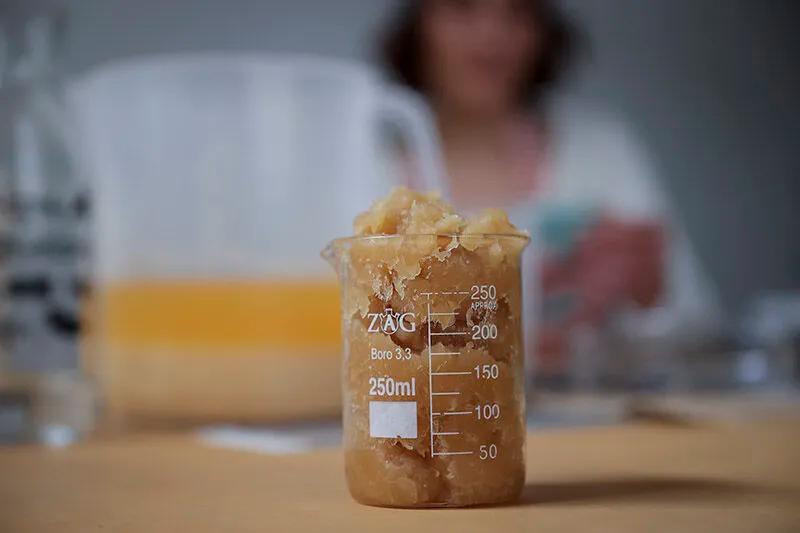
Soaps in general consist of fatty acid salts. The key feature distinguishing Arap sabunu from many solid soaps is the use of potassium hydroxide as the alkali agent in its production. 【2】 The saponification of natural vegetable fatty acids with potassium hydroxide yields a softer product compared to solid soaps. As a result, traditional Arap sabunu may have a paste, gel, or thick liquid consistency. Its color may range from yellowish to light orange depending on the characteristics of the oil used in production.
During saponification, the primary process in production, oily substances react chemically with alkali components to form soap. The molecular structure of soap also underpins its cleaning function: one part of the molecule interacts with grease and dirt, while the other part facilitates their dispersion in water. Additionally, soap reduces the surface tension of water, enabling surfaces to wet more easily, allowing greasy dirt to disperse and be removed more effectively.
In the production of Arap sabunu, new vegetable oils as well as waste vegetable oils can be utilized. Used frying oils can be converted into Arap sabunu through appropriate formulations. However, because different oils have varying properties, a single production formula may not be suitable for all types of oil. 【3】
The basic composition of traditional Arap sabunu consists of vegetable oils or fatty acids derived from them, combined with potassium hydroxide. However, the composition of commercial products labeled as Arap sabunu may differ from this basic formula.
A study examining approximately ten commercial Arap sabunu samples found that vegetable fatty acids, potassium hydroxide, and perfume were common to all products. Additional ingredients such as limonene, EDTA, citral, methylisothiazolinone, dyes, and essences were detected in some products. Some commercial products also contained sodium hydroxide-based soap components alongside potassium hydroxide-based ones. 【4】
The primary use of Arap sabunu is cleaning. Due to its soft consistency, it can be applied directly, or diluted with water to create cleaning solutions of varying concentrations.
Arap sabunu is used for cleaning floors and wooden surfaces, polishing wood, washing carpets, cleaning bathrooms and sinks, and cleaning furniture such as chairs, sofas, tables, and similar items.
Arap sabunu is also used in agricultural plant protection as potassium soap. It has found application in organic farming and alternative pest management practices due to its contact activity against certain soft-bodied pests. 【5】
Arap sabunu can be applied against aphids, thrips, and various leaf and stem pests on fruit trees and vegetables. Mixtures combining Arap sabunu with vegetable oils are also used. Such mixtures are effective against spider mites, aphids, and various insects. However, because they may cause leaf tip burn on some sensitive plants, testing on a limited number of plants is recommended before widespread use. 【6】
Waste vegetable oils can be converted into Arap sabunu as a means of recycling. This prevents direct disposal of waste oils into the environment and instead repurposes them as raw materials for a new cleaning product. However, since some commercial products may contain perfume, preservatives, dyes, EDTA, and various fragrance components, not all Arap sabunu products have identical environmental impacts.
Anadolu Ajansı. "Atık yağları 'çevreci arap sabunu'na dönüştürüyor." Accessed July 19, 2026.https://www.aa.com.tr/tr/yesilhat/cevre-hikayeleri/atik-yaglari-cevreci-arap-sabununa-donusturuyor/1819014
Mehmet Ali Yetgin. *Organik Tarımda Bitki Koruma Yöntemleri.* T.C. Samsun Valiliği İl Tarım Müdürlüğü, 2010. Accessed July 19, 2026.https://samsun.tarimorman.gov.tr/BelgelerArsiv/Yayinlar/Kitaplarimiz/organik_tarimda_bitki_koruma_yontemleri.pdf
Sultan Çobanoğlu and Saied Alzoubi. "Effects of Soft Soap and Abamectin on the Two SpottedSpider MiteTetranychus Tetranychus urticae Koch (Acari: Tetranychidae) and Predatory MitePhytoseiulus Persimilis A-H (Acari: Phytoseiidae) under Laboratory Conditions." *Türkiye Entomoloji Dergisi* 37, no. 1 (2013): 31-38. Accessed July 19, 2026.https://dergipark.org.tr/en/download/article-file/65205
Şen, Azmi Kaan. *Hijyen Kimyasallarının İş Sağlığı ve Güvenliği Açısından Değerlendirilmesi.* Master's thesis, İnönü Üniversitesi Fen Bilimleri Enstitüsü, 2022. Accessed July 19, 2026.https://tez.yok.gov.tr/UlusalTezMerkezi/tezSorguSonucYeni.jsp
[1]
Azmi Kaan Şen, Hijyen Kimyasallarının İş Sağlığı ve Güvenliği Açısından Değerlendirilmesi, Yüksek Lisans Tezi, İnönü Üniversitesi Fen Bilimleri Enstitüsü, 2022, s. 17, Erişim Tarihi: 19 Temmuz 2026, https://tez.yok.gov.tr/UlusalTezMerkezi/tezSorguSonucYeni.jsp
[2]
Azmi Kaan Şen, s. 15.
[3]
Anadolu Ajansı, "Atık yağları "çevreci arap sabunu"na dönüştürüyor," Anadolu Ajansı, Erişim Tarihi: 19 Temmuz 2026, https://www.aa.com.tr/tr/yesilhat/cevre-hikayeleri/atik-yaglari-cevreci-arap-sabununa-donusturuyor/1819014
[4]
Azmi Kaan Şen, s. 18 ve s. 47.
[5]
Sultan Çobanoğlu ve Saied Alzoubi, "Effects of Soft Soap and Abamectin on the Two Spotted Spider MiteTetranychus Urticae Koch (Acari: Tetranychidae) and Predatory Mite Phytoseiulus Persimilis A-H (Acari: Phytoseiidae) under Laboratory Conditions," Türkiye Entomoloji Dergisi 37 (1), (2013): s. 32, Erişim Tarihi: 19 Temmuz 2026, https://dergipark.org.tr/en/download/article-file/65205
[6]
Mehmet Ali Yetgin, Organik Tarımda Bitki Koruma Yöntemleri, T.C. Samsun Valiliği İl Tarım Müdürlüğü, 2010, s. 16, Erişim Tarihi: 19 Temmuz 2026, https://samsun.tarimorman.gov.tr/BelgelerArsiv/Yayinlar/Kitaplarimiz/organik_tarimda_bitki_koruma_yontemleri.pdf

Other Name | Potassium Soap Soft Soap | ||||||||
|---|---|---|---|---|---|---|---|---|---|
Basic Components | Vegetable Fatty Acids Potassium Hydroxide | ||||||||
Structure | Paste, Gel, Thick Liquid | ||||||||
Structure and Production
Ingredients
Use for Cleaning and Hygiene
Use in Agriculture
Environmental Aspect and Utilization of Waste Oils