This article was automatically translated from the original Turkish version.
+1 More
Region of Origin | Siberia Altay Turkestan | ||||||||
|---|---|---|---|---|---|---|---|---|---|
Origin | 7th century BCE | ||||||||
Period | Andronovo culture Karasuk culture Tagar culture Mayemir culture | ||||||||
Representatives | Göktürks Huns Scythians | ||||||||
Area of Spread | Ural Mountains North Black Sea North-South Caucasus Eastern Europe Kazakhstan Mongolia | ||||||||
Animal style is the general term for animal motifs used in the artistic works of Turkic communities that adopted a nomadic lifestyle and formed the steppe culture. Through the intermediary of Scythians, Huns, Göktürks and other steppe groups, this style spread from Turkistan westward into Europe and eastward into China, featuring animal figures crafted using metal, wood, bone, leather, textile, and stone techniques.
Animal style is based on the stylized or naturalistic depiction of animals in artistic works. These figures were not used merely as decorative elements but were also connected to the religious beliefs, mythological concepts, and symbolic values of these societies.
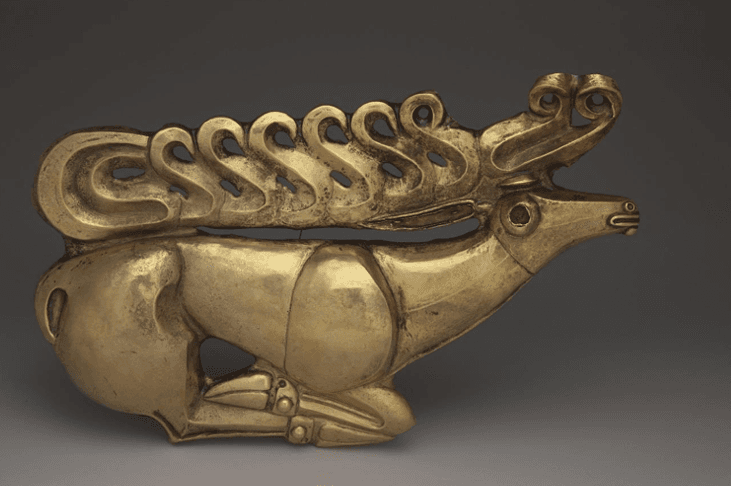
Golden Deer Figure, Northwest Caucasus, 7th Century BCE (Elvin Huseynov)
The earliest traces of animal style appear in the Andronovo culture of Turkistan during the second millennium BCE. Concrete representations of animals emerged during the Karasuk culture period of the first millennium BCE. These depictions were systematized in the Tagar and Mayemir cultures, acquiring a distinct stylistic character, particularly in the regions around the Yenisey and Altai. The mature phase of animal style began in the 7th century BCE. The animal figures from these early cultural periods were later transmitted to Scythian art.
Scythians developed animal style systematically and regularly from the 8th century BCE onward, transforming it into a classical form of expression through figures rendered in goldwork. The style evolved into a systematic artistic approach through the Huns, Göktürks and Uyghurs.
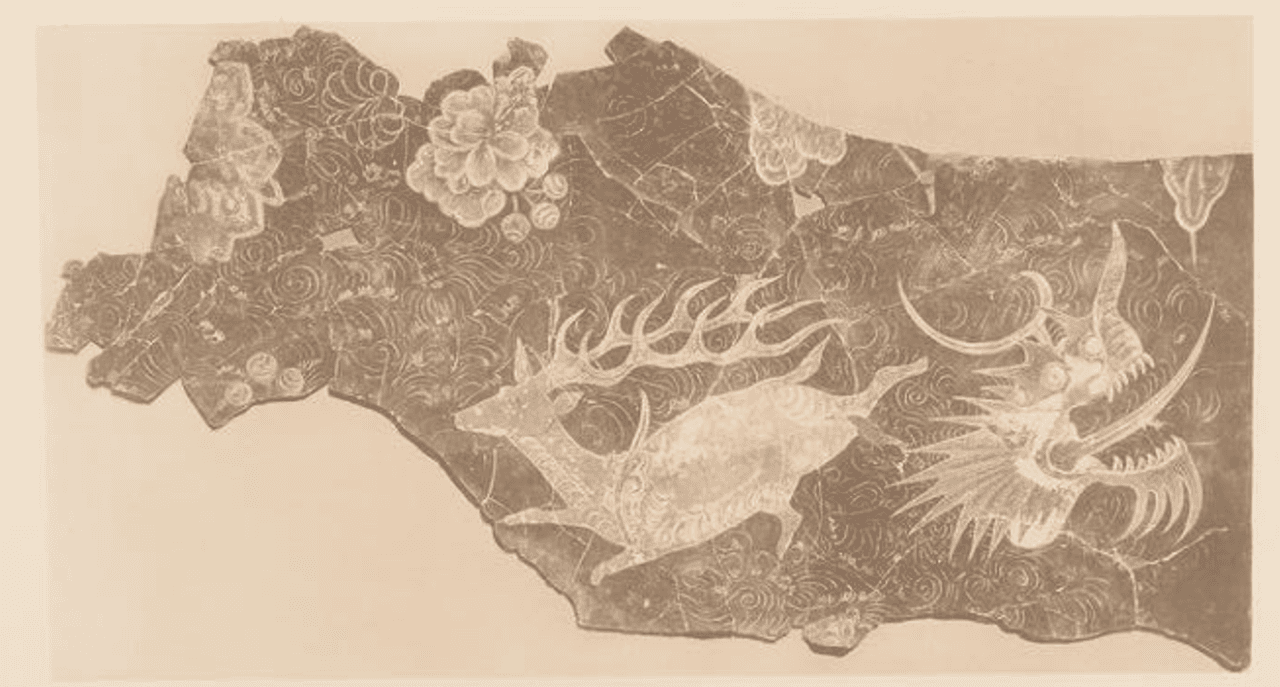
Deer Fresco from the Koco Temple of the Uyghurs (Açelya Dursun)
Thanks to the mobility of steppe peoples, animal style spread across a vast geographical area. Archaeological findings indicate that its origins lie in the Turkistan, Altai and Siberia regions, and that it expanded westward through migrations.
From the 8th century BCE onward, Scythians settled in the steppe regions north of the Caspian Sea, along the Volga, Don, Dnieper, Bug and Dniester rivers, in the North Pontic and North Caucasus steppes, bringing animal style with them. Thanks to the rich metalwork of the Scythians, known as “the jewelers of the steppe,” this artistic tradition that began in Asia extended from the northern shores of the Black Sea into Eastern Europe.
The style advanced eastward as far as the region around the Great Wall of China through the Scythians and Huns. In the north, the Siberian and Yenisey regions are among the richest centers of animal style finds in kurgans. In the south, the influence of animal style reached Iranian and Near Eastern art through the Tagar and Scythian cultures. In later periods, the style was carried into Western Eurasia by the Göktürks. During the Göktürk period, animal depictions became prominent on rock paintings, bone carvings, and metal ornaments.
The origin of animal style is the Turkistan–Altai–Siberia region; its area of diffusion includes the North Pontic, North Caucasus, Eastern Europe, Siberia, Kazakhstan, Mongolia, Ural Mountains and South Caucasus.
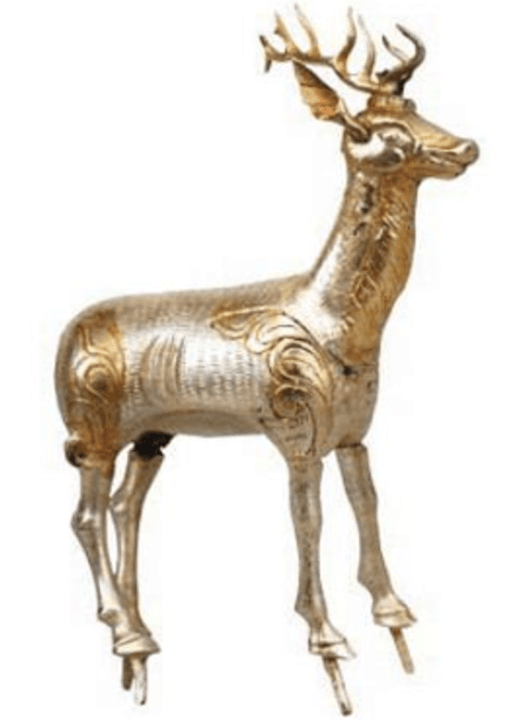
Deer Statuette from the Bilge Kağan Külliyesi, 8th Century (Açelya Dursun)
Artifacts found in kurgans exhibit animal style. Metal ornaments, carpets, wooden carvings, and clothing accessories recovered from pre-Hun kurgans such as Pazyryk, Shibe and Esik provide concrete examples of this artistic tradition.
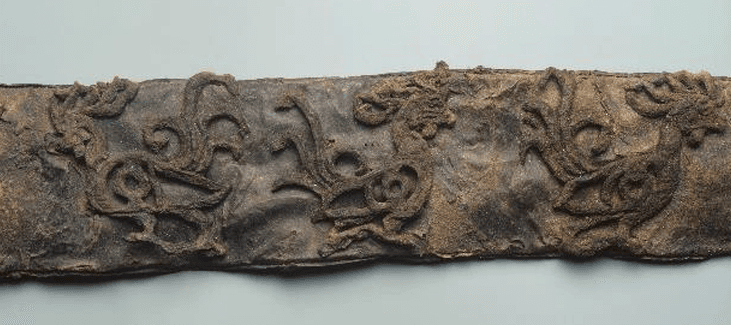
Leather Belt with Rooster Figure from Pazyryk II Kurgan, 5th Century BCE (Figen Bali)
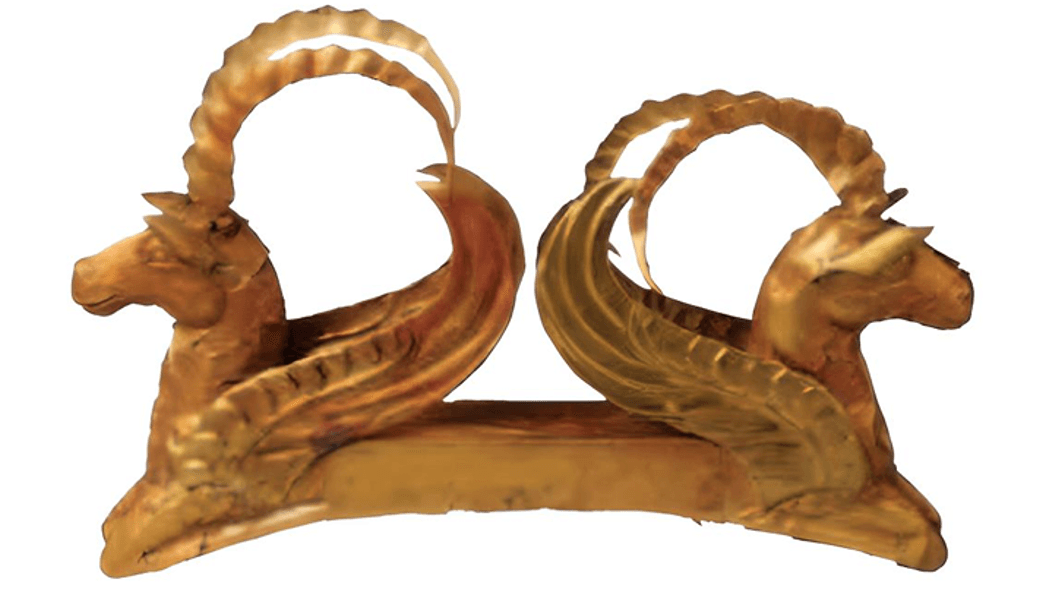
Plaque from the Hat of the Man in the Golden Robe, 5th–4th Century BCE (Elvin Huseynov)
The first artifacts emerged in the last quarter of the 17th century. During this period, treasure hunters conducted clandestine excavations and looted kurgans in Siberia. Tsar Peter I became aware of these activities and in 1718 ordered all recovered artifacts to be sent to St. Petersburg. The first official expedition to Siberia took place in 1763, during which some kurgans were opened. In subsequent years, numerous excavations were carried out by archaeologists and anthropologists in the region.
The shared aesthetic qualities of the artifacts recovered from these excavations attracted attention; in 1929, Russian archaeologist Rostovtzeff first referred to this common style as “animal style.” Today, the findings from these excavations are displayed in the “Siberian Collection” section of the Hermitage Museum.
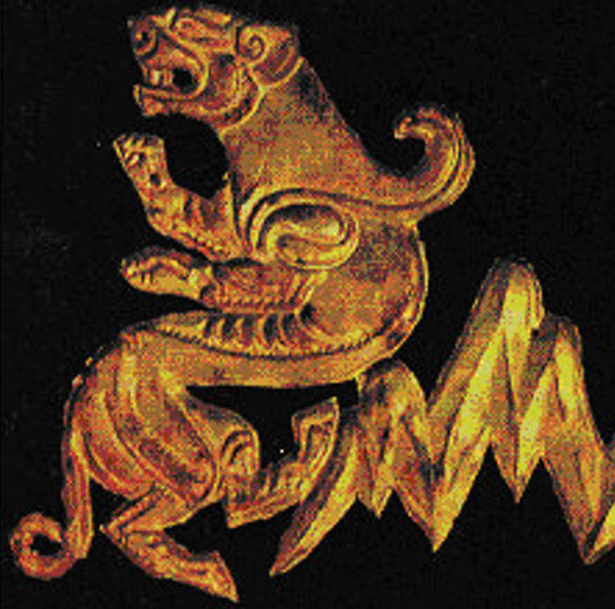
In animal style, high stylization emphasizes the movement of animals. Animals are depicted both realistically and abstractly. One of the most distinctive features of animal style is the depiction of animal combat scenes. In these scenes, predator and prey are rendered in intertwined, curvilinear forms, creating a dynamic impression as if the figures are suspended in mid-air.
Techniques such as casting, inlay, carving, and relief were employed, using materials including gold, bronze, bone, felt, wool, leather, horn, ivory, and wood.
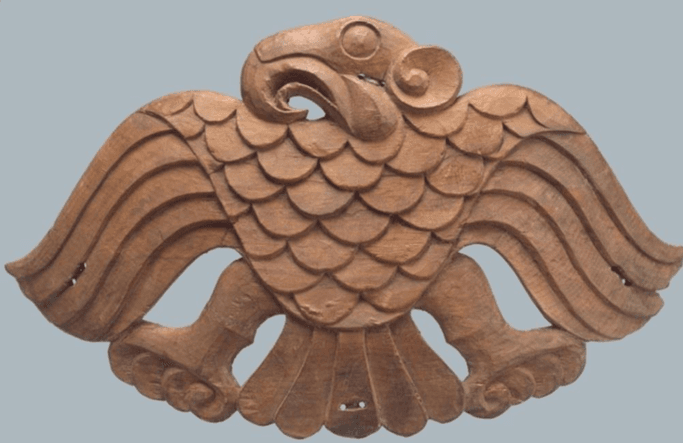
Wooden Eagle Plaque from a Saddle, Central Altai, 6th Century BCE (Elvin Huseynov)
Nomadic steppe communities lived in close interaction with nature and animals; horses, sheep, deer, wolves, and eagles played central roles in their lives, both economically and spiritually. The sacredness attributed to animals and the strong bond with nature within the shamanistic belief system formed the foundation of this style. Animal style is directly linked to the rituals, totemic beliefs, and shamanic practices of steppe communities, reflecting their social order and cosmological understanding.
Animal style serves as a cultural indicator of the belief systems, perceptions of nature, and social identities of nomadic steppe societies. Thanks to these characteristics, it continued to influence Turkish art after the adoption of Islam, being reinterpreted in Seljuk and Ottoman periods through stone, ceramic, and miniature art.
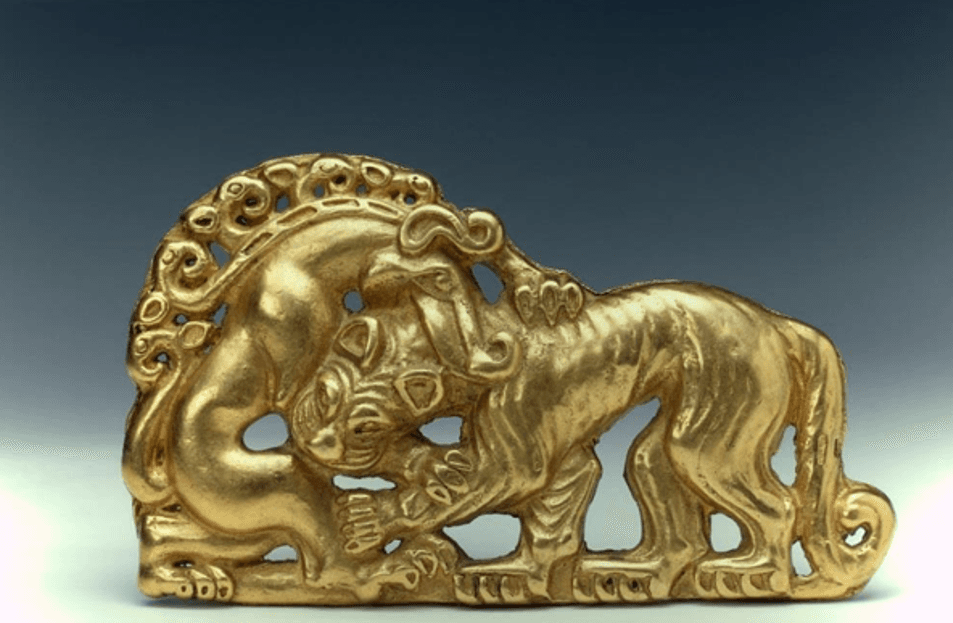
Animal Combat Scene on a Belt Plaque, Siberia, 6th Century BCE (Elvin Huseynov)
Animal motifs first appear in rock paintings. Early nomadic and semi-nomadic communities of the Eurasian steppes, due to their mobile way of life, focused on portable objects and extensively decorated them with animal figures. Animal style was used to produce sword hilts, spears, knives, horse harnesses, saddle cloths, pendant belt buckles, drinking vessels, felt and woven textiles.
Golden deer plaques, panther-decorated scabbards, and eagle-shaped belt buckles are made of metal; wooden and bone items include pole tops, horse harnesses, and animal-masked headgear; carpets, saddle cloths, and felt birds and deer figures belong to textile and feltwork traditions. Additionally, tattooed examples of animal motifs have been found in Scythian kurgans.
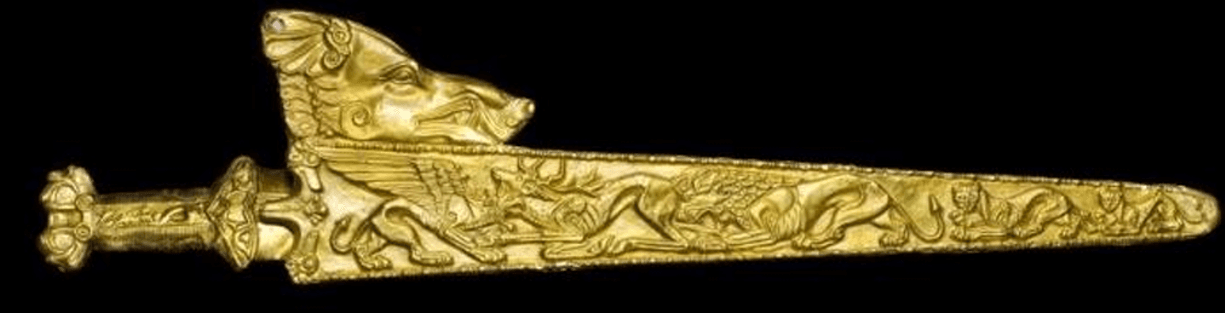
Griffin-Motif Scabbard, Late 4th Century BCE (Figen Bali)
Artworks employing animal style vary by region. In kurgans from the north of the Black Sea, motifs include male and female lions, leopards, deer, rams, goats, rabbits, birds, and fish. In kurgans from the Altai, motifs include tigers, deer, horses, mountain goats, roosters, fish, swans, cranes, and storks. In kurgans from northern China, motifs include tigers, deer, wolves, eagles, turtles, yak deer, badgers, and fish. Some kurgans also feature mythical creatures such as winged wolves, griffins, sphinxes, dragons, and kilins.
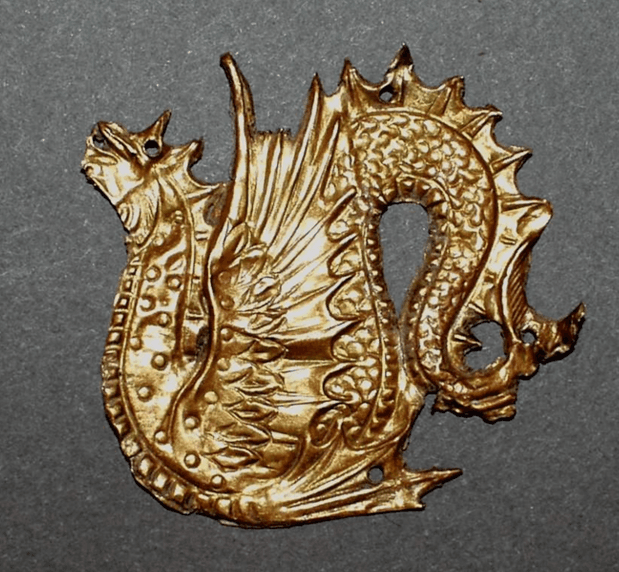
Sea Dragon Motif from the Kul-Oba Kurgan in Eastern Crimea, 5th Century BCE (Elvin Huseynov)
The representation of animals in artworks was achieved through the depiction of various scenes. Over time, the characteristic movements and emotional qualities of these animals became more pronounced. The animals used also indicated the individual’s tribal affiliation or social rank.
Animal style is an aesthetic form that reflects both the mythological world and the realities of steppe life in pre-Islamic Turkish art. The dynamism of the warrior steppe culture, the sacred bond with nature, and the symbols of nomadic existence were transmitted into artistic works through this style. It stands as one of the earliest indicators of proto-Turkic cultural identity.
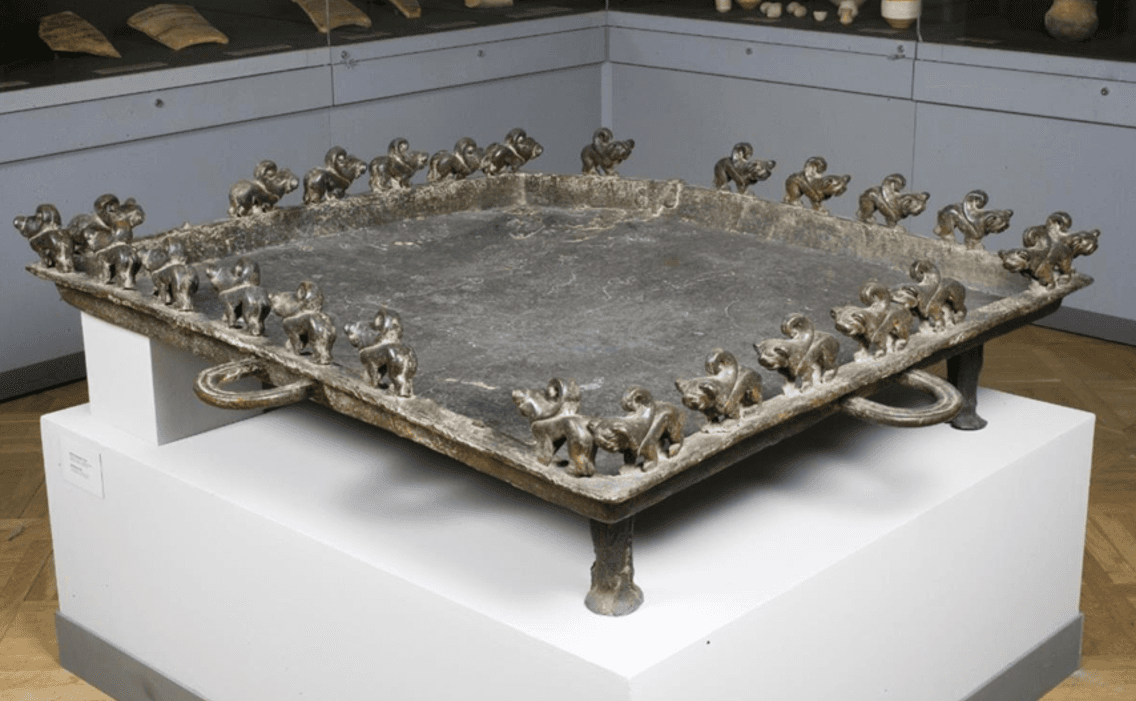
Altar Featuring Leopard Motifs, Yedisu Region, 5th–3rd Century BCE (Elvin Huseynov)
Arık, Murat. *Esik Kurganı, Buluntuları ve Kültür Tarihi Açısından Değerlendirilmesi.* Master's thesis, Gazi Üniversitesi Sosyal Bilimler Enstitüsü, 2008. Accessed August 25, 2025.https://tez.yok.gov.tr/UlusalTezMerkezi/TezGoster?key=wBmNpkQC9Nhi90NLW7E7-Q6ekaSRx9oUIPliryr4SdyecvaxaATLW9-xGkUI7Kns
Bali, Figen. *Türk Göçebe Sanatında İkonografi.* Master's thesis, İstanbul Üniversitesi, 2019. Accessed August 25, 2025.https://tez.yok.gov.tr/UlusalTezMerkezi/TezGoster?key=Mir2lXQK1dkmQ9Ige3PZbggAG0V1k9C3xhD8_5IkRv_ftQU9KXg0AehalvY0Ld_u
Bilici, Kenan. "Anadolu Taş Tezyinatında Hayvan Üslubu (Erken Devir Kaynakları Üzerine Bir Deneme)." *Sanat Tarihi Dergisi* 2, no. 2 (1983): 19–27. Accessed August 25, 2025.https://dergipark.org.tr/tr/pub/std/issue/16505/172335
Dalkıran, Ahmet. “Türk Kültür ve Sanatındaki Horoz/Tavuk Sembolizminin Çağdaş Resim Sanatındaki Yansımaları.” *Selçuk Üniversitesi Sosyal Bilimler Enstitüsü Dergisi*, 37 (2017): 336–348. Accessed August 25, 2025.https://dergipark.org.tr/tr/pub/susbed/issue/61817/924936
Dursun, Açelya. *Orta Asya’dan Doğu Avrupa’ya Erken Devir Türk Sanatında Geyik Figürleri*. Master's thesis, Mimar Sinan Güzel Sanatlar Üniversitesi, 2022. Accessed August 25, 2025.https://tez.yok.gov.tr/UlusalTezMerkezi/TezGoster?key=5XiSE4yCP_gmnukpMEp65aaD432jnqHmhqkxBBYf84dDGTwHRVngP0I7cc2EU3B7
Esin, Emel. Türklerde Maddi Kültürün Oluşumu. İstanbul: Kabalcı Yayınevi, 2006.
Eycil, Ahmet, and Ünzile Us. "İslamiyet Öncesi Türk Tarihinde Sanatı Etkileyen Unsurlar." *Asia Minor Studies* 7, no. 1 (2019): Accessed August 25, 2025.https://dergipark.org.tr/tr/pub/asm/issue/42798/498779
Huseynov, Elvin. *İskit Sanatında Hayvan Üslubu.* Master's thesis, Çanakkale Onsekiz Mart Üniversitesi, 2024. Accessed August 25, 2025.https://tez.yok.gov.tr/UlusalTezMerkezi/TezGoster?key=usXiZIM9Lp0wk-YzRoaT-4zMlHXOdocQighE6KoBv1suW1Vbk4VHSdBwtCLzP3N2
Kahraman Çinar, Aslı. *Bozkır Kavimlerinin Kültür ve Mitolojilerinde Geyik, Kurt ve Kartal (Başlangıcından Göktürk Dönemi Sonuna Kadar).* PhD thesis, Gazi Üniversitesi, 2016. Accessed August 25, 2025.https://tez.yok.gov.tr/UlusalTezMerkezi/TezGoster?key=OykDDeWBWTL9-Wm52sZBrB8ba4FsreivpfA8RUY4agfNkOSt_vqYdkn70HyJRxxW
Koçak, Kürşat. “Kuzey Kafkasya ve Kuzey Karadeniz’deki İskit Kurganlarının Ortaya Çıkışı.” *Karadeniz Uluslararası Bilimsel Dergi* 1, no. 25 (2015): 66–78. Accessed August 25, 2025.https://dergipark.org.tr/tr/pub/kdeniz/issue/16876/175681
Kurtulan, Mahir. *Orta ve Batı Asya Sanatında Mürekkep Resmi Geleneği ve Hayvan Mücadele Sahneleri.* Master's thesis, Marmara Üniversitesi, 2019. Accessed August 25, 2025.https://tez.yok.gov.tr/UlusalTezMerkezi/TezGoster?key=npGs9H39x7G6401x51yqpFmWdvNcT7qmWhUzTWFdtlcxB0Nn1RGfphuALp6UdKMl
Tural, Suat. "İskitler ve Madencilik Sanatındaki Yerleri." Uluslararası Toplumsal Bilimler Dergisi, 4:1 (2020): 69–90. Accessed August 25, 2025.https://dergipark.org.tr/tr/pub/toplumsalbilimler/issue/54426/749051
Umurca, Saliha Beyza. *Doğu Avrasya Bozkırlarının Göçebe Sanatı' Sergisinden Seçilmiş Kemer Toka Tasarımları (Metropolitan Sanat Müzesi).* Master's thesis, Marmara Üniversitesi, 2024. Accessed August 25, 2025.https://tez.yok.gov.tr/UlusalTezMerkezi/TezGoster?key=cr4SkWLaRMhkDRBjqthpsTSJMQNWp3ZV5P5jFNDBmot10kdt0c0HujB0_HQCAygj
Çoruhlu, Yaşar. "Hun Sanatı" in Türkler, edited by Hasan Celal Güzel, 4:54-76. Ankara: Yeni Türkiye Yayınları, 2002.
Ögel, Bahaeddin. İslamiyetten Önce Türk Kültür Tarihi. Ankara: Türk Tarih Kurumu Basımevi, 1984.

Region of Origin | Siberia Altay Turkestan | ||||||||
|---|---|---|---|---|---|---|---|---|---|
Origin | 7th century BCE | ||||||||
Period | Andronovo culture Karasuk culture Tagar culture Mayemir culture | ||||||||
Representatives | Göktürks Huns Scythians | ||||||||
Area of Spread | Ural Mountains North Black Sea North-South Caucasus Eastern Europe Kazakhstan Mongolia | ||||||||
History and Origins
Emergence
Geographical Spread of Animal Style
Kurgans
Discovery of Artifacts and Origin of the Term
Artistic Features
Cultural and Mythological Foundations
Artworks and Objects Featuring Animal Style
Animal Motifs and Symbolic Meanings