


This article was automatically translated from the original Turkish version.
In Anatolian traditional architecture, door knockers are more than mere functional elements; they serve as carriers of aesthetic taste, privacy, social rituals, and cultural symbolism. These elements, passed down from the Ottoman era to the present, have materialized social codes, religious affiliations, and traditional belief systems through their forms, tonal qualities, and the motifs engraved upon them.
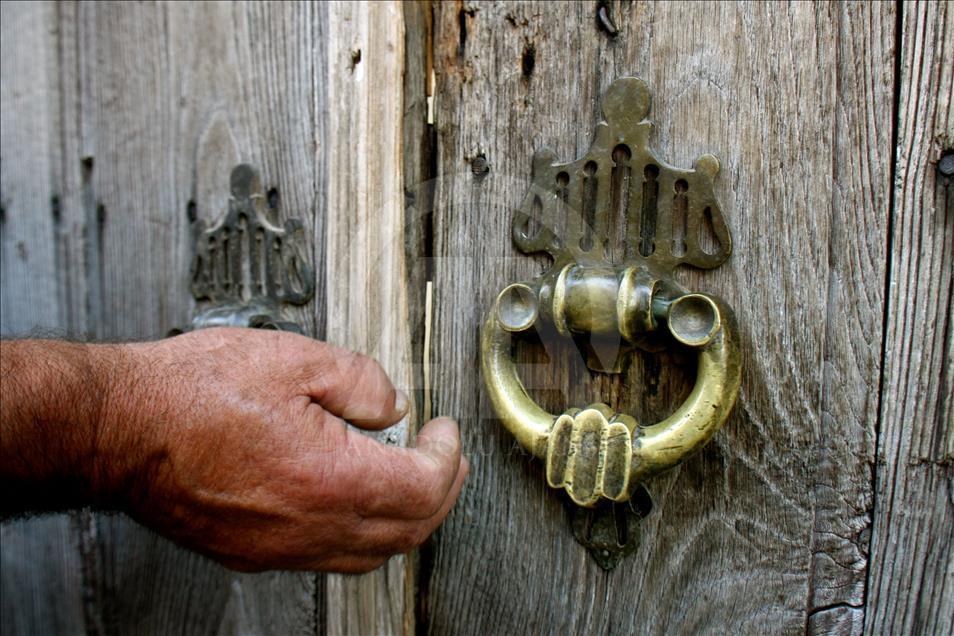
Door Knocker (AA)
The history of Anatolian door knockers is deeply rooted and bears traces of multiple civilizations. One of the earliest known examples is the dragon-shaped door knocker from the 14th-century Cizre Ulu Camii. Some claims trace the origins of door knockers found near Van back to the Urartians. Lion-headed knockers from the Late Roman and Byzantine periods are housed in the Istanbul and Konya Archaeology Museums. 【1】
With migrations from Central Asia, Asian-origin motifs such as the dragon were incorporated into Anatolian door knockers. During the Ottoman period, simple iron ring knockers of the 15th century gave way in the 16th century to designs filled with rumi and palmette patterns, and from the 18th century onward, stylistic diversity increased. Today, Western-style door knockers can also be found in cities such as Antakya, Antalya, Istanbul, İzmir, Tokat, Sivas, and Mardin. 【2】
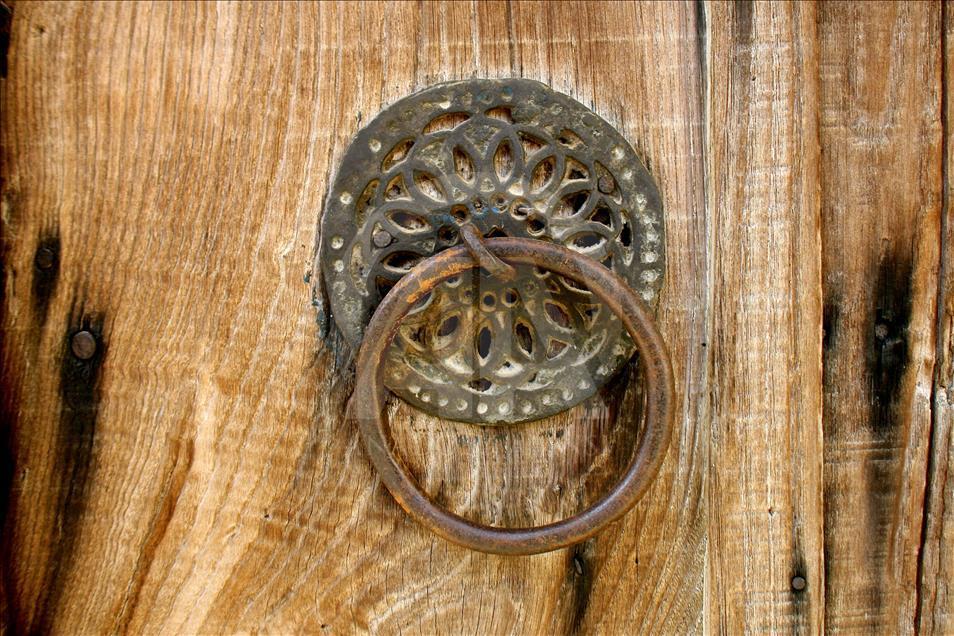
Door Knocker (AA)
Door knockers are defined by three primary components:
The material used in the construction of door knockers typically reflects the social and economic status of the household. Thick, heavy, and ornate knockers made of brass signify wealth and social standing, while thinner, simpler, iron knockers in ring form adorned the doors of more modest households.
Door knockers functioned as symbolic communication tools and the initial point of contact between host and guest. Central to this communication was the use of gender-specific knockers:
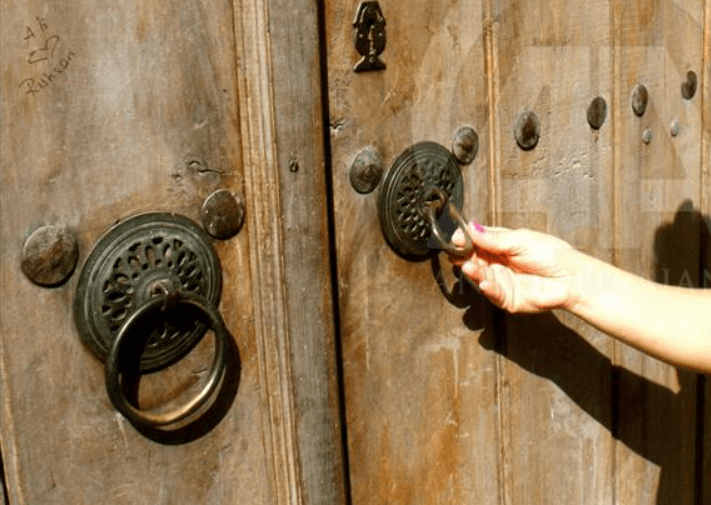
Gender-Specific Door Knockers (AA)
This practice enabled the regulation of social interaction without physical visibility. Household members could identify the guest’s gender by the sound of the knocker and adjust clothing and spatial arrangements accordingly. Thus, knockers were not merely aesthetic or functional but also sustained the socio-religious order. Binding the two door rings together with a string or ribbon indicated that no one was home.
Knockers and rings were generally produced using two main techniques:
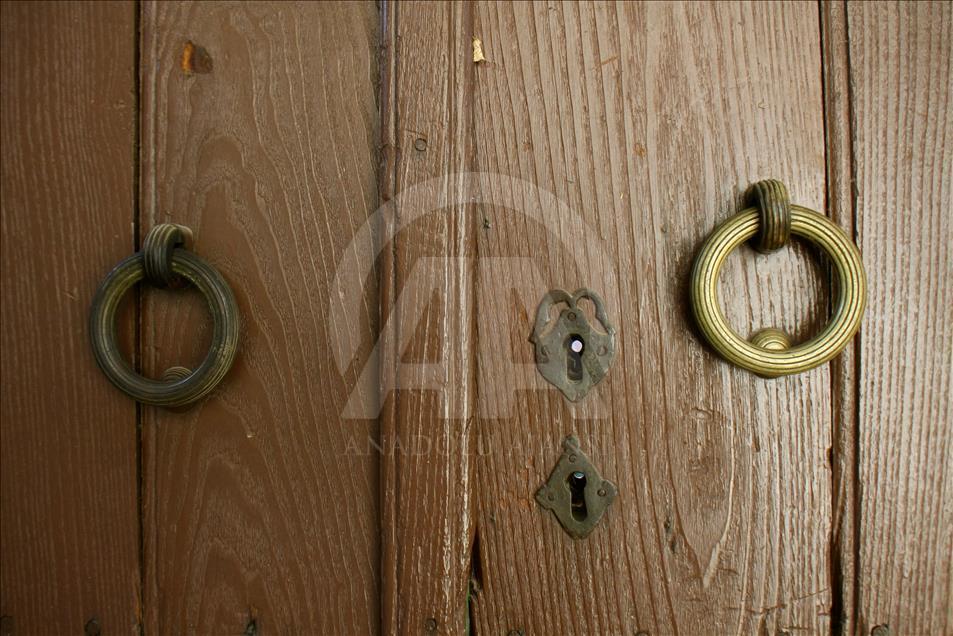
Door Rings (AA)
Found in many parts of Anatolia, these knockers contain a rounded surface within the palm to produce sound. Designs vary with or without bracelets and with or without rings. The ring motif on these hand-shaped knockers signifies the household owner’s marital status.
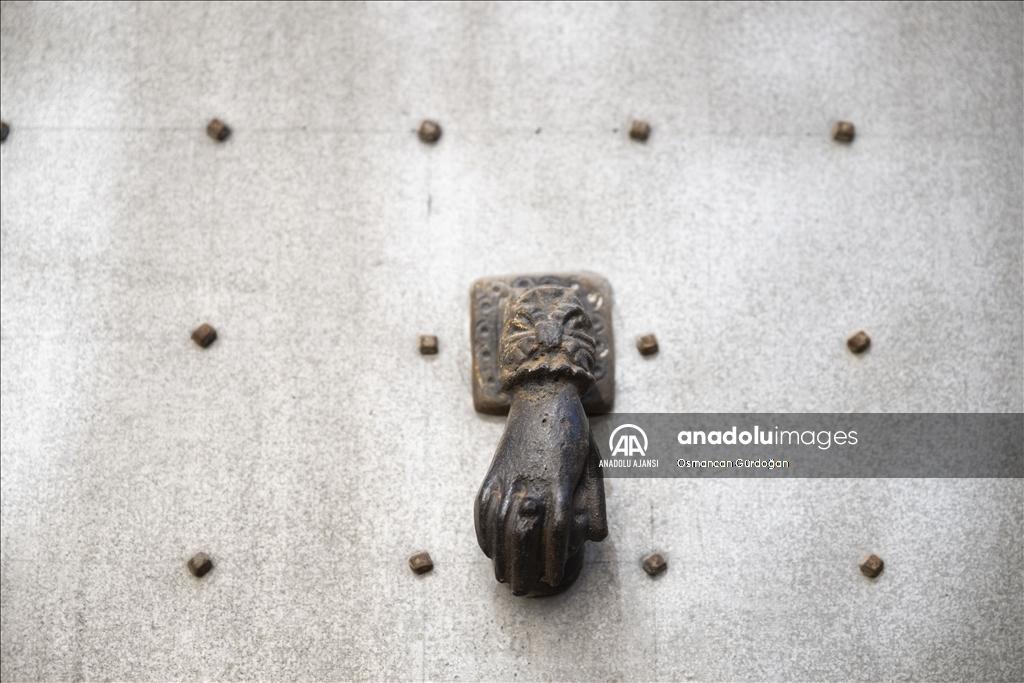
Hand-Shaped Knocker (AA)
Natural forms such as oak leaves and palmettes are used. Most of these are of European origin and produced using casting techniques.
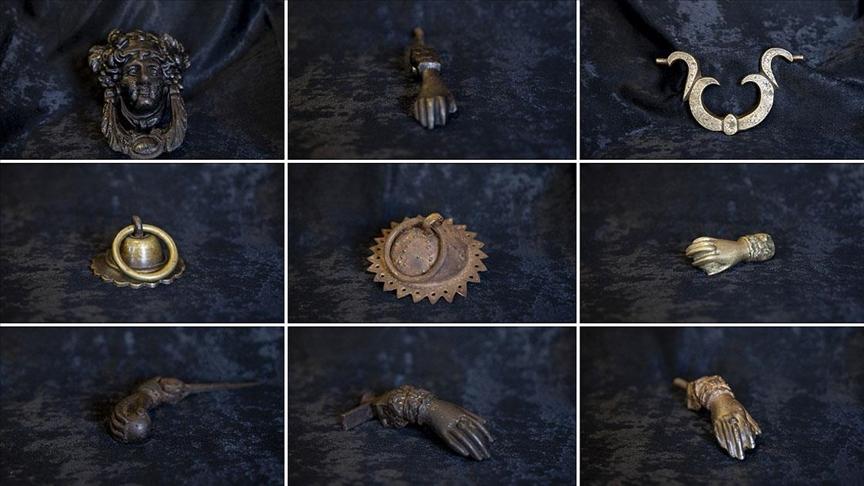
Various Knocker Types
Made of hammered iron in square or rectangular bar forms, these are classified into four main types based on the number of bends in the shaft:
Shaped like a pear, narrow at the top and broad at the bottom. Made of hammered iron or sheet metal. The pointed upper end is attached to the door nail ring.
Resemble two joined circles, produced by casting. A rounded protrusion at the center bottom produces the sound.
Cast brass knockers often feature religious phrases such as “ya fettah” or “la ilahe illallah” in decorative calligraphic form.
Technological advancements, the proliferation of mass communication, globalization, and urbanization have transformed the Turkish way of life. This has led to a shift in which the traditional functions of doors and the boundary between private and public space have been blurred or even erased.
Documentary on Door Knockers (TRT Archive)
Açık, Deniz. “7 Asırlık Osmanlı Köyünün Kapı Tokmakları Geçmişe Götürüyor.” Anadolu Ajansı. Accessed July 12, 2025.https://www.aa.com.tr/tr/pg/foto-galeri/7-asirlik-osmanli-koyunun-kapi-tokmaklari-gecmise-goturuyor/13.
Gürdoğan, Osmancan. “Şahinbey İlçesindeki Tarihi Kapı Tokmakları.” Anadolu Ajansı. Accessed July 12, 2025.https://www.aa.com.tr/tr/pg/foto-galeri/sahinbey-ilcesindeki-tarihi-kapi-tokmaklari.
Karahan, Onur, and Vedia Dökmeci. “Kapı Tokmakları.” *Mimar.ist* 35 (Istanbul, 2010). Accessed July 12, 2025.https://www.academia.edu/41908881/Kap%C4%B1_Tokmaklar%C4%B1
TRT Arşiv. “Kapı Tokmakları.” YouTube. Accessed July 12, 2025.
Çal, Halit. “Osmanlı Kapı Halkaları ve Kapı Tokmakları.” *Osmanlı Kültür ve Sanat* 11 (Ankara, 1999). Accessed July 12, 2025.https://www.academia.edu/29642287/Osmanl%C4%B1_Kap%C4%B1_Halkalar%C4%B1_ve_Kap%C4%B1_Tokmaklar%C4%B1_pdf
Çelikkol, Zeynep. “Ege’nin Tarihi Kenti Tire’de Asırlık Kapı Tokmakları Müzede Sergileniyor.” Anadolu Ajansı. Accessed July 12, 2025.https://www.aa.com.tr/tr/kultur-sanat/egenin-tarihi-kenti-tirede-asirlik-kapi-tokmaklari-muzede-sergileniyor/2219003.
Özcan, Seyyit, and Yüksel Göğebakan. “Geleneksel Anadolu Mimarisine Ait Kapı Yüzeylerinde Kullanılan Simge ve Semboller.” *İnönü Üniversitesi Kültür ve Sanat Dergisi (IJCA)* 11, no. 1 (2025): 182–97. Accessed July 12, 2025.https://dergipark.org.tr/en/download/article-file/4961801
İhlas Haber Ajansı. "Geçmişin Yok Olan Mirası: Kapı Tokmakları." İhlas Haber Ajansı. Accessed July 12, 2025.https://www.iha.com.tr/erzincan-haberleri/gecmisin-yok-olan-mirasi-kapi-tokmaklari-35487527.
[1]
Onur Karahan ve Vedia Dökmeci, “Kapı Tokmakları,” Mimar.ist 10, no. 35 (İstanbul, Bahar 2010), 22, https://www.academia.edu/41908881/Kap%C4%B1_Tokmaklar%C4%B1.
[2]
Onur Karahan ve Vedia Dökmeci, “Kapı Tokmakları,” Mimar.ist 10, no. 35 (İstanbul, Bahar 2010), 23, https://www.academia.edu/41908881/Kap%C4%B1_Tokmaklar%C4%B1.

No Discussion Added Yet
Start discussion for "Anatolian Door Knockers" article
Historical Development and Origins
Technical Structural Features
Materials and Social Indicators
The Concept of the Door and Privacy
Materials and Techniques
Door Rings
Door Knocker Forms and Symbolic Meanings
Female Hand-Shaped Door Knockers
Animal-Motif Door Knockers
Botanical-Form Door Knockers
Geometric Door Knockers
Shaped Door Knockers
Pear-Shaped Door Knockers
“8”-Shaped Door Knockers
Inscribed Knockers
Current Status