


This article was automatically translated from the original Turkish version.
+1 More
Alternating current (AC or its English abbreviation) is, in its most fundamental definition, an electric current whose direction and magnitude change periodically over time. This periodic variation typically occurs in a sinusoidal waveform, although other forms such as triangular or square waves may be used in different applications. This fundamental characteristic distinguishes alternating current from direct current (DC). In direct current, electric charges flow in a constant direction, typically from high potential to low potential.
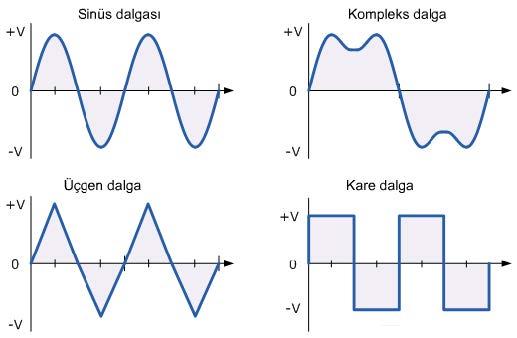
Alternating Current Waveforms (megep.meb)
In the early years of electrical power, direct current was adopted as the standard in the United States through systems developed by Thomas Edison. However, the inability to easily change the voltage level of direct current posed a significant obstacle to the efficient transmission of energy over long distances. Alternating current, by contrast, provided a solution to this problem through the ability to easily step up or step down voltage levels using transformers. This technical advantage enabled AC to become the dominant global standard for electricity generation, transmission, and distribution.
The following table summarizes the key differences between alternating current and direct current:
(see: Direct Current)
To understand the behavior and applications of alternating current, it is necessary to know its fundamental characteristics. These properties determine how AC is measured, defined, and analyzed.
The widespread use of alternating current (AC) in power systems is primarily due to the efficiency of its generation mechanism and its transmission capability.
AC generation is performed using alternators (AC generators), which operate based on Faraday’s Law of Electromagnetic Induction. This law states that an electromotive force (EMF or voltage) is induced in a closed conductor when the magnetic flux passing through it changes.
In alternators, this principle is applied as follows:
This rotational motion causes the magnetic flux through the coil to change periodically, inducing a sinusoidal AC voltage.
This mechanism forms the fundamental operating principle of AC in electrical energy production.
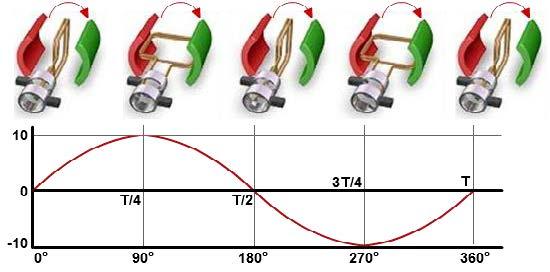
Conductor moving in a magnetic field (megep.meb)
One of the fundamental characteristics of alternating current (AC) systems is the ability to efficiently change voltage levels using transformers. Transformers are static electromagnetic devices that operate based on the principle of electromagnetic induction.
Transformers are used in electrical systems for the following purposes:
This feature provides a significant advantage to AC systems in energy transmission and distribution.
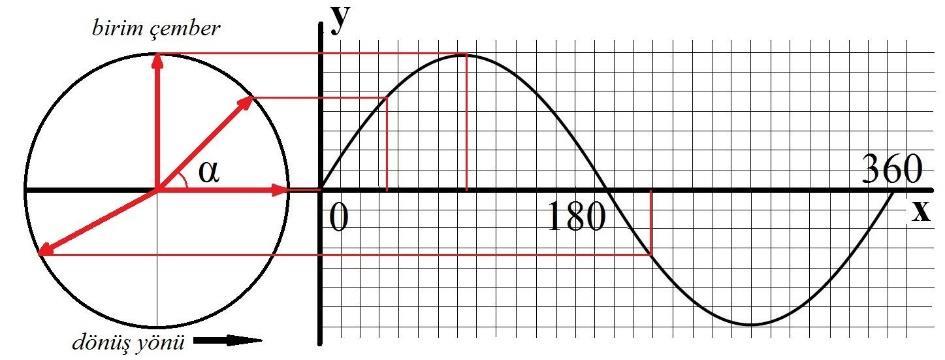
Sinusoidal wave (megep.meb)
The primary reason alternating current (AC) is preferred for long-distance energy transmission is the ability to efficiently change voltage levels using transformers. Power loss (Ploss) in transmission lines, according to Ohm’s Law, is proportional to the line resistance (R) and the square of the current (I2):
The transmitted power (P) is equal to the product of voltage (V) and current (I):
These equations show that for a given power level, losses can be significantly reduced by transmitting at high voltage and low current. Accordingly, AC voltage generated at power plants is stepped up by transformers to hundreds of thousands of volts (kV) for efficient long-distance transmission with minimal losses. At consumption points, the voltage is stepped back down by transformers to safe levels (e.g., 220 V).
This advantage of AC systems relies on the existence of transformers, which operate in accordance with the principle of electromagnetic induction. The ability of AC to produce time-varying magnetic fields provides a technical superiority over DC systems.
The last quarter of the 19th century was a period when the foundations of electrical systems were laid and a competition emerged to establish the standard between direct current (DC) and alternating current (AC) systems. The main figures in this technical rivalry were Thomas Alva Edison, the pioneer of DC systems, and Nikola Tesla, who developed polyphase AC technology, along with industrialist George Westinghouse, who commercialized it.
Thomas Edison gained an early advantage in the electrical industry by inventing the incandescent lamp and establishing a DC distribution system. However, the fundamental limitation of the DC system was its operation at low voltage levels (typically 110 V) and its inability to transmit power efficiently beyond about one mile (approximately 1.6 kilometers). This required separate DC power stations for every neighborhood and settlement, significantly increasing infrastructure costs.
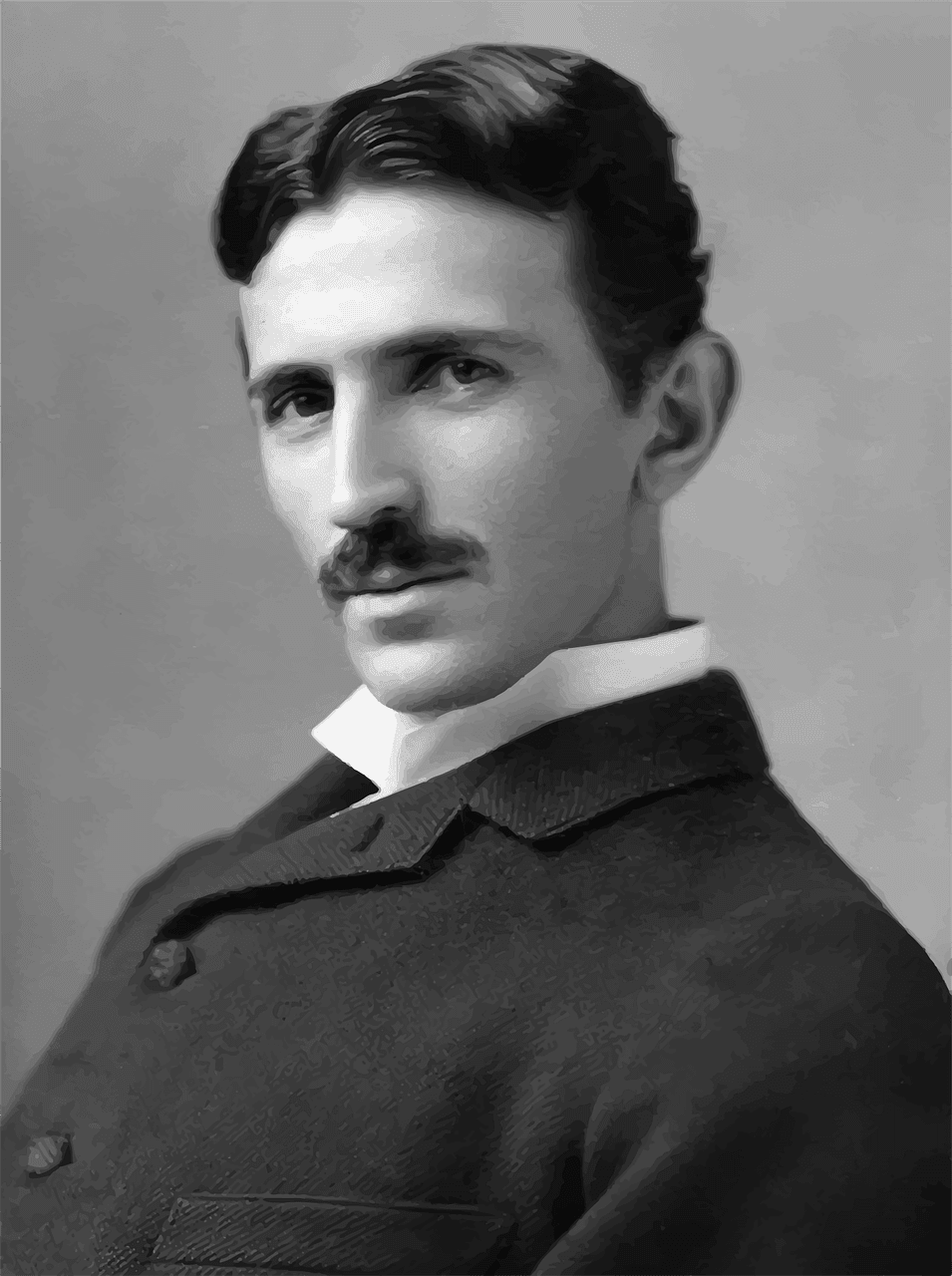
Nikola Tesla (Loc)
In contrast, Nikola Tesla’s polyphase (particularly three-phase) AC systems and induction motor, developed in the 1880s, enabled energy to be transmitted over long distances at high voltages of hundreds of thousands of volts with minimal losses, thanks to transformer technology. The ability to easily change voltage levels in AC systems made it possible to distribute energy from centralized power plants across vast geographic areas.
To protect its market share and significant patent revenues, Edison launched a comprehensive smear campaign against AC technology.
As part of this campaign, public animal electrocution demonstrations were held to emphasize the dangers of AC’s high voltage. More significantly, the state of New York was encouraged to adopt AC for its electric chair execution method. These strategic moves led to AC being branded in the public mind as the “death current.”
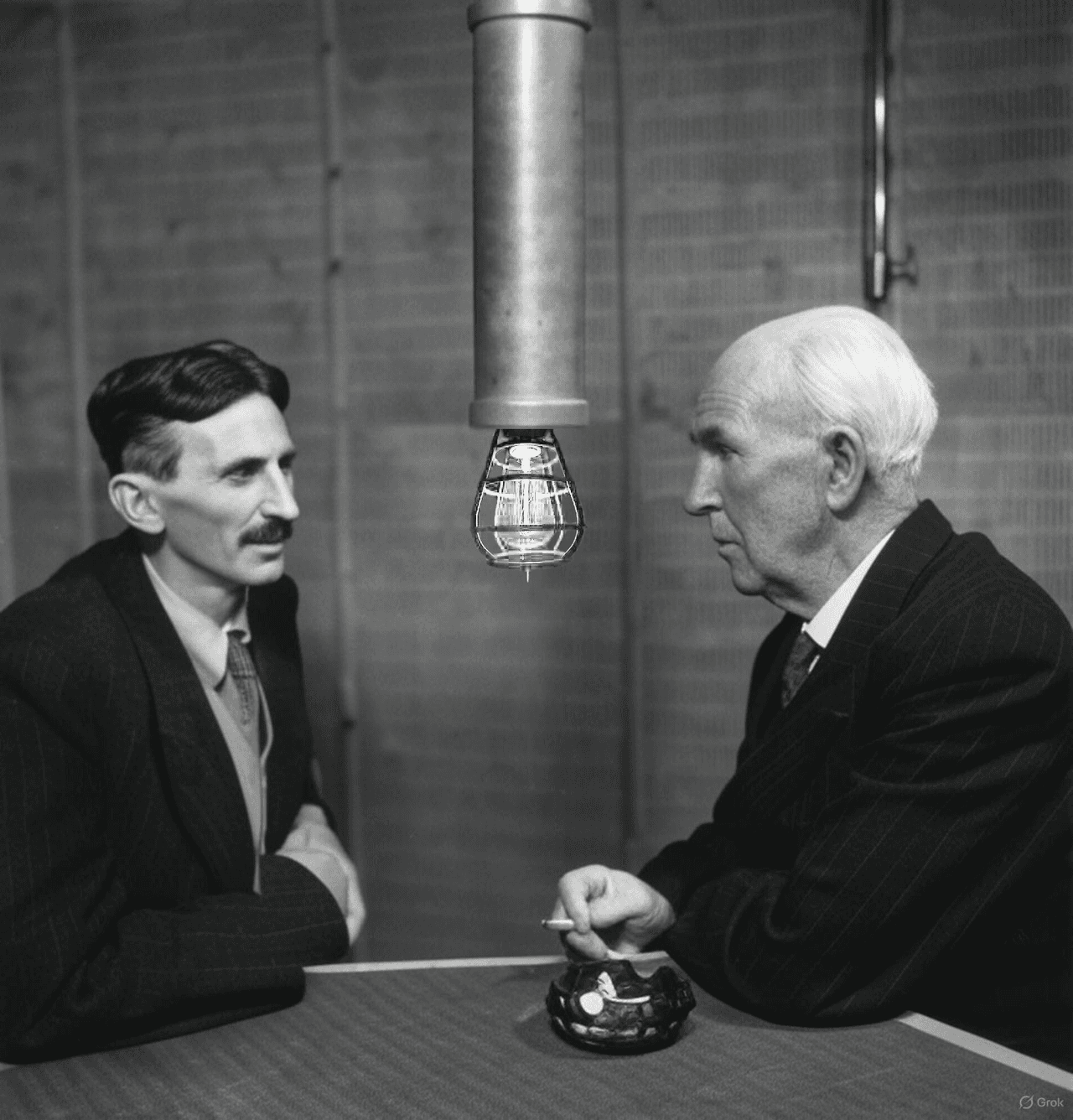
Nikola Tesla and Thomas Edison (generated by artificial intelligence.)
However, the technical advantages of AC technology became increasingly evident over time. In 1893, the Westinghouse Company illuminated the World’s Columbian Exposition in Chicago using AC, demonstrating the reliability and potential of the technology to a broad audience. More importantly, in 1896, the successful transmission of AC power from the hydroelectric plant at Niagara Falls to the city of Buffalo conclusively proved AC’s technical superiority. These landmark developments enabled AC to rapidly become the fundamental global standard for electrical grids.
Alternating current today forms the foundation of modern energy systems and has a vast range of applications:
Allen.in. "Allen.in." Accessed April 25, 2025.https://allen.in
BYJU’S. "BYJU’S: Learn Chemistry, Biology, Physics, Maths & More." Accessed April 25, 2025.https://byjus.com
CEDengineering.com. "Basic Concepts of Alternating Current." Accessed April 25, 2025.https://www.cedengineering.com/userfiles/E03-003%20-%20Basic%20Concepts%20of%20Alternating%20Current%20-%20US.pdf
CircuitBread. "AC Sources: Introduction to Electricity, Magnetism, and Circuits." Accessed April 25, 2025.
Edison Papers Project, Thomas A. “The Current Wars.” Rutgers University. Accessed April 25, 2025.https://edison.rutgers.edu/life-of-edison/essaying-edison/essay/the-current-wars
Energy Education. "Alternating Current." University of Calgary. Accessed April 25, 2025.
Florida Academy. "AC vs. DC Power: A Beginner’s Guide." Accessed April 25, 2025.https://florida-academy.edu
Karayel, Murat. “Alternatif Akım Devre Analizi.” Karatekin Üniversitesi. Accessed April 25, 2025.http://websitem.karatekin.edu.tr/user_files/mkarayel/files/alternatifakimdevreanalizi.pdf
Keysight Technologies. "AC Power Supplies: Simulate International Electric Grids." Accessed April 25, 2025.https://keysight.com
Library of Congress. "Nikola Tesla." Photograph, ca. 1890. Accessed May 3, 2025.https://www.loc.gov/item/2014684845/
Lumen Learning. "Physics: Electric Generators." Accessed April 25, 2025.https://courses.lumenlearning.com/suny-physics/chapter/23-5-electric-generators/
Milli Eğitim Bakanlığı (MEB), Mesleki ve Teknik Eğitim Genel Müdürlüğü (MEGEP). "Alternatif Akım Esasları." Accessed April 25, 2025. https://meslek.meb.gov.tr/materyal.
Ministry of National Education (MEB), General Directorate of Vocational and Technical Education (MEGEP). "Alternatif Akım Esasları." Accessed April 25, 2025. https://megep.meb.gov.tr/mte_program_modul/moduller/Alternatif%20Ak%C4%B1m%20Esaslar%C4%B1.pdf.
Monolithic Power Systems. "Basic Concepts of AC Power and Its Importance." Accessed April 25, 2025.https://monolithicpower.com
Mouser Electronics. "Tesla, Edison and the War of Currents." Accessed April 25, 2025.https://www.mouser.com/applications/tesla-edison-war-of-currents/
Nişantaşı Üniversitesi. "Ders Öğretim Planı – Nişantaşı Üniversitesi Bilgi Paketi / Ders Kataloğu." Accessed April 25, 2025.https://ebp.nisantasi.edu.tr
RoyMech.org. "Alternating Current Notes." Accessed April 25, 2025.
Testbook.com. "AC Circuit: Definition, Formulas, Terms, Types and Applications." Accessed April 25, 2025.https://testbook.com
TutorChase. "What’s the Relationship between Power and Voltage in Transmission?" Accessed April 25, 2025.
U.S. Department of Energy. “The War of the Currents: AC vs. DC Power.” U.S. Department of Energy. November 18, 2014. Accessed April 25, 2025.https://www.energy.gov/articles/war-currents-ac-vs-dc-power
University of Vermont. “War of the Currents: Edison vs. Tesla.” Accessed April 25, 2025.https://uvm.edu
VAIA. "VAIA." Accessed April 25, 2025.https://vaia.com

No Discussion Added Yet
Start discussion for "Alternating Current" article
Fundamental Characteristics of Alternating Current
AC Generation and Efficient Transmission
AC Generation Mechanism
Basic Components of an Alternator
Principle of Transformer Operation:
Difference Between AC and DC Systems:
Primary Functions of Transformers:
Voltage Transformation and Energy Transmission Efficiency
Historical Development: The War of Currents
Applications of AC