


This article was automatically translated from the original Turkish version.
+1 More
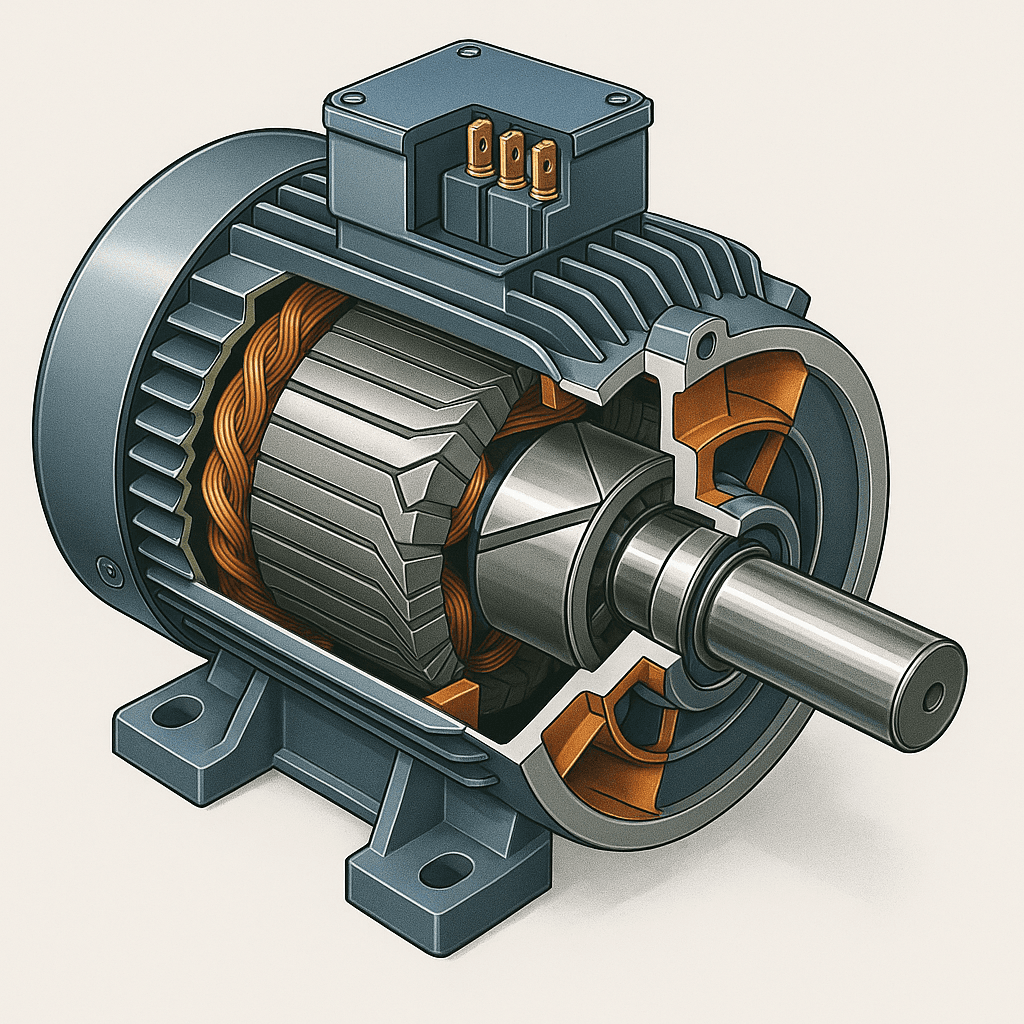
Electric Motor Structure
Inventor | Michael Faraday | ||||||||
|---|---|---|---|---|---|---|---|---|---|
History of Invention | 1821-09-03 | ||||||||
Fields of Use | Very diverse | ||||||||
Application | Energy conversion | ||||||||
Components | Rotor, stator, air gap, windings, magnet, commutator, shaft, bearing, brush (if present), cooling fins | ||||||||
Standard | IEEE NEMA IEC ISO | ||||||||
Patents | William Sturgeon (1832), Zénobe Gramme (1873), Nikola Tesla (1888) | ||||||||
Electric motors are electromechanical devices that convert electrical energy into mechanical energy. These devices have become one of the fundamental building blocks of modern industry transportation and daily life with applications ranging from household appliances and the automotive industry to industrial automation systems and robotic technologies. Fundamentally these machines convert electrical energy into rotational mechanical energy based on physical and engineering principles such as electromagnetic induction Lorentz force electrical commutation and control theory.
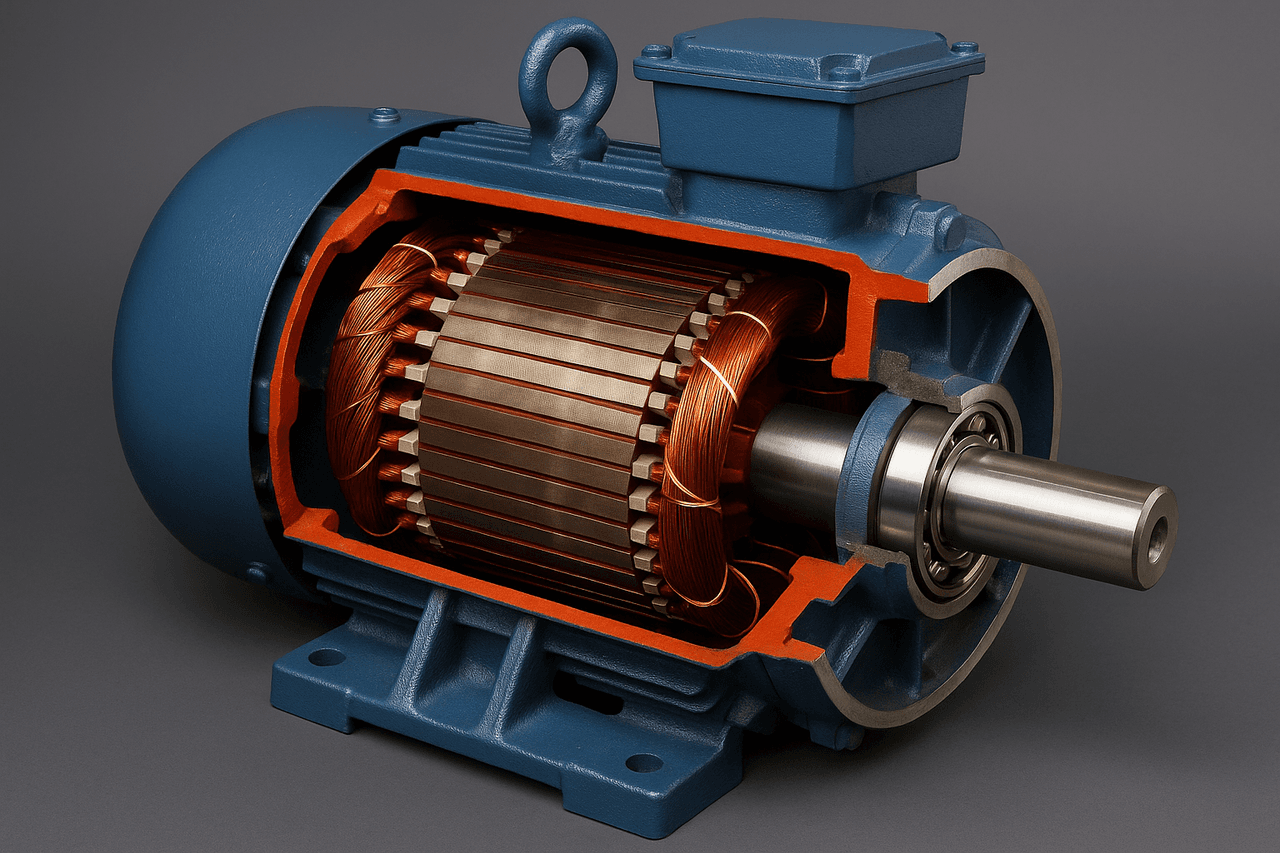
Endüstriyel tasarım ve soğutma yüzeyleri görünen Bir elektrik motorunun iç-dış gövde yapısının birleşimi. (Yapay Zeka)
The history of electric motors has progressed in parallel with the development of electromagnetic theory. In 1821 Michael Faraday laid the foundations by demonstrating that an electric current interacting with a magnetic field could produce rotational motion. In 1832 William Sturgeon developed the first practical DC motor while in 1873 Zénobe Gramme introduced the first commercially viable rotary electric motor. In the early 20th century Nikola Tesla’s motors based on AC systems began to gain widespread industrial use. Over time these motors were equipped with more advanced and efficient versions incorporating electronic drives control circuits and artificial intelligence based control systems.
The operation of electric motors is based on the Lorentz force generated when an electric current flowing through a conductor interacts with a magnetic field. This force creates torque causing the motor’s rotor to rotate. In DC motors the direction of current is reversed via a commutator and brushes while in AC motors sinusoidal excitation and a rotating magnetic field are used. Brushless motors and modern synchronous motors apply this principle electronically.
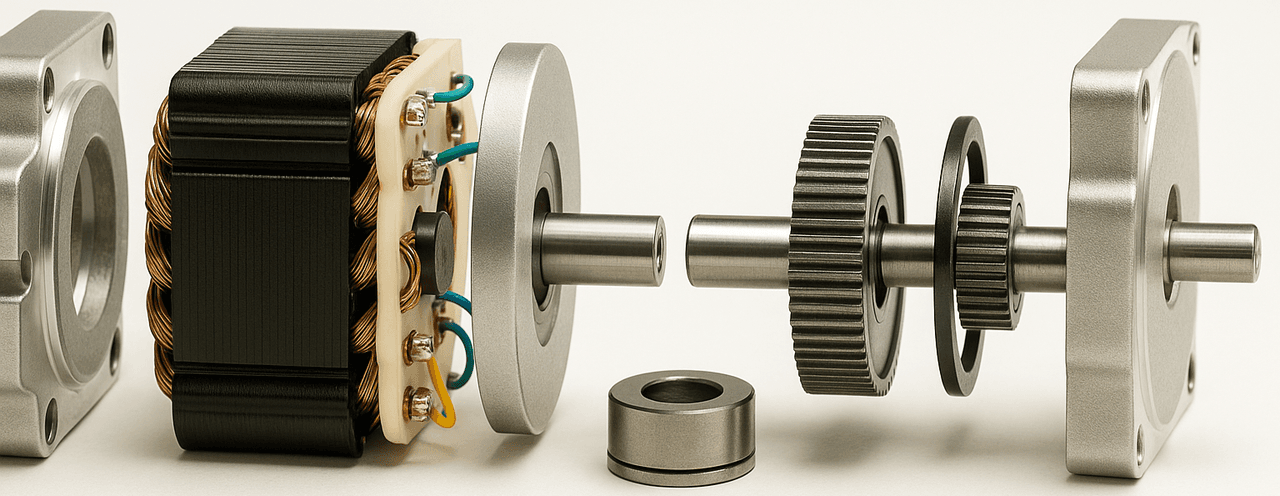
Step Motor. Rotor, stator, mıknatıslar, sargılar ve yataklar gibi bileşenlerin düzenli şekilde ayrılması, motorun iç dinamiğini anlamayı kolaylaştırır. (Yapay Zeka)
Electric motors fundamentally consist of the following components:
DC motors operate on direct current. Their main types include:
Applications: Automotive systems computer fans portable devices robotics.
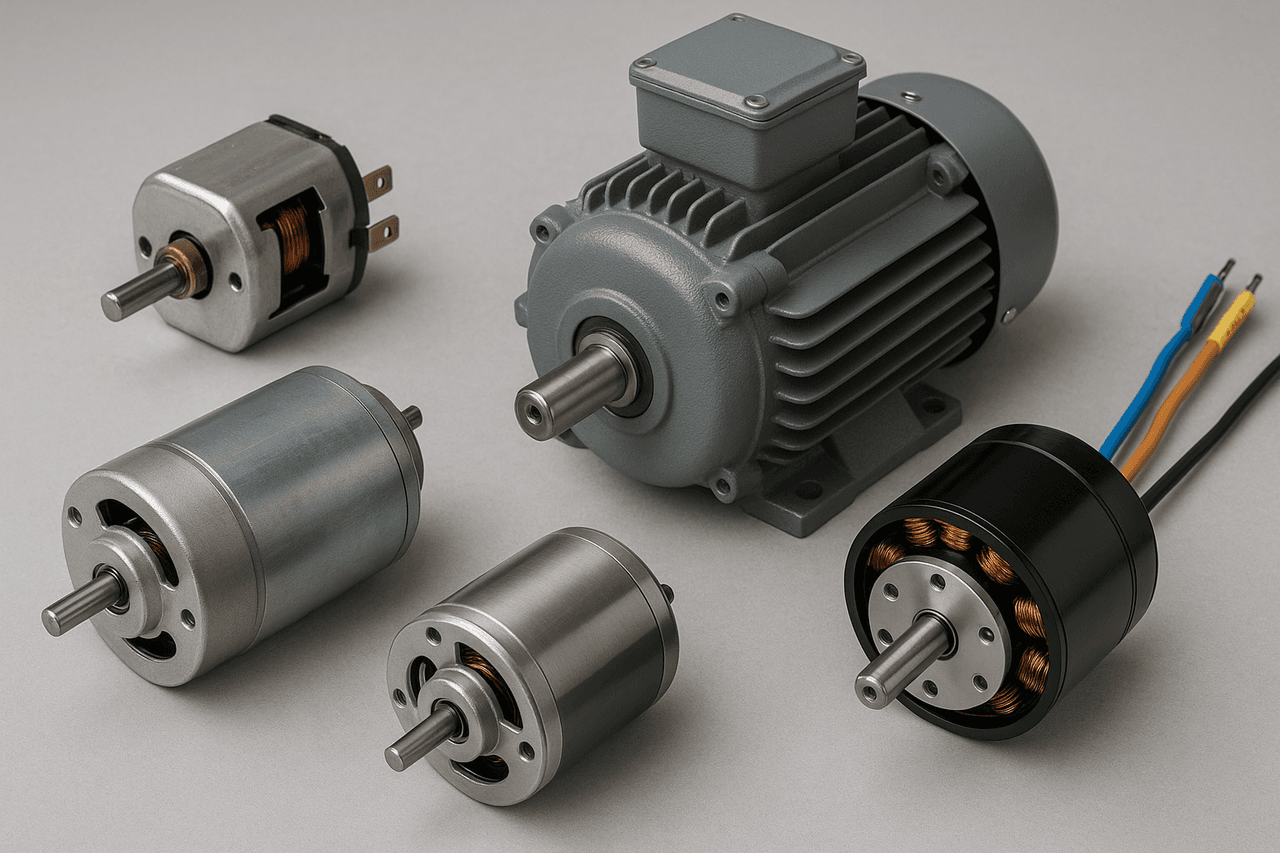
Farklı elektronik ve mekatronik uygulamalarda kullanılan çeşitli motorlar (Yapay Zeka)
AC motors operate on alternating current and are divided into two main categories:
In addition:
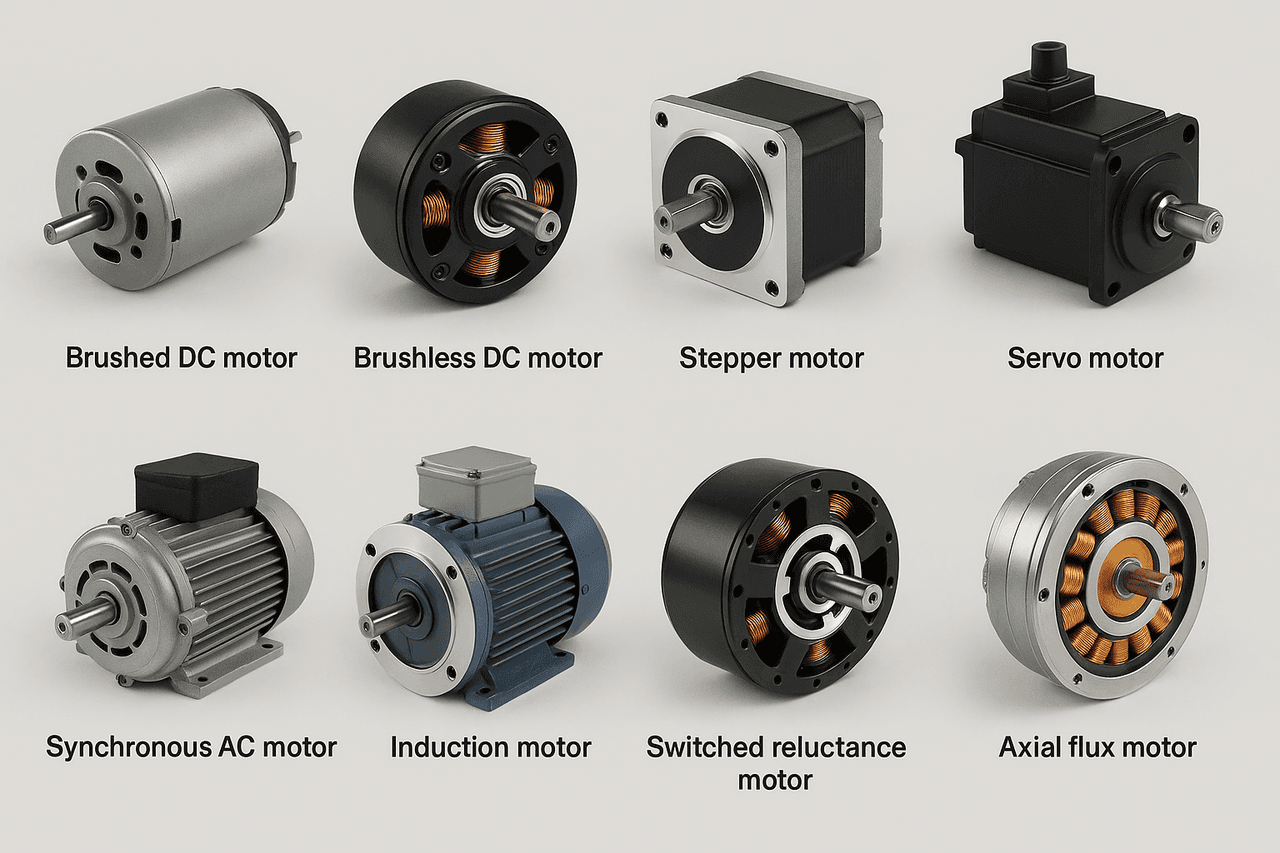
Step motor, servo motor, fırçalı DC motor ve fırçasız (BLDC) motor gibi çeşitli motor türlerinin görselleri (Yapay Zeka)
Drive circuits are required to control motors. In DC motors the Pulse Width Modulation (PWM) method is used while in AC motors advanced techniques such as voltage/frequency control (V/f) vector control (FOC) or direct torque control (DTC) are applied. Next generation motor drives are supported by microcontrollers FPGAs or DSPs. Features such as energy recovery integration with smart grids and artificial intelligence based predictive maintenance have become standard.
The main losses affecting the efficiency of electric motors are:
IE2 IE3 and IE4 efficiency classifications are defined by international standards. In the European Union and Türkiye the use of IE3 motors became mandatory as of 2021. High efficiency motors provide both energy savings and reduced carbon emissions.
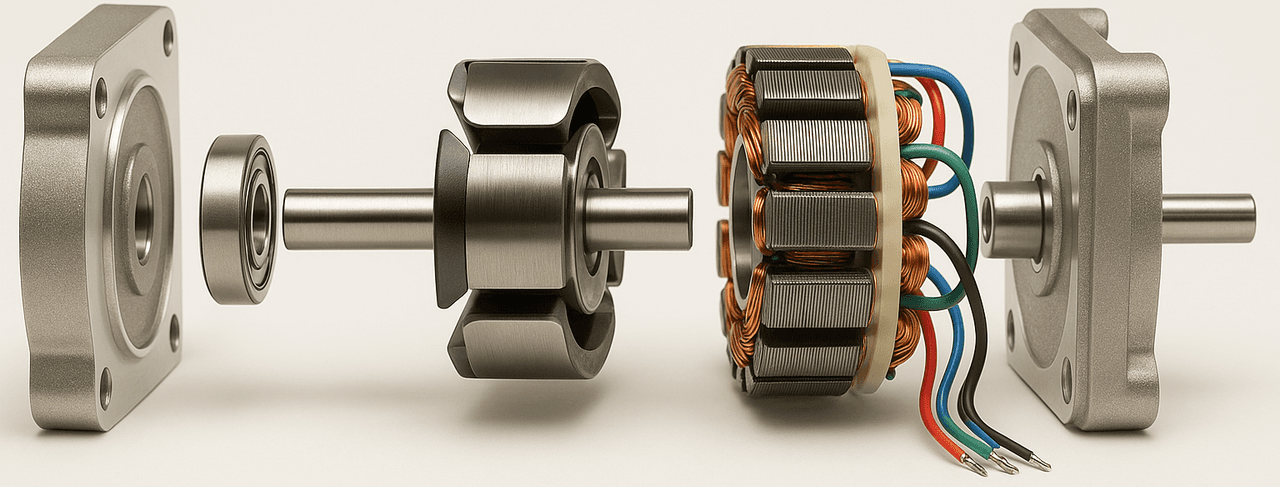
Rotor, stator, mıknatıslar, sargılar ve yataklar gibi bileşenlerin düzenli şekilde ayrılması, motorun iç dinamiğini anlamayı kolaylaştırır. (Yapay Zeka)
Electric motors are versatile technologies that meet modern society’s needs for energy efficiency sustainability and automation. Thanks to evolving engineering approaches these motors are becoming more powerful quieter smarter and more environmentally friendly.
Arabacı, Hayri. *Sincap Kafesli Asenkron Motorlarda Kafes Arızalarının Motor Performansına Etkileri.* PhD thesis, Selçuk Üniversitesi, 2011. AccessedUlusal Tez Merkezi.
Bodur, Fatih. "Yüksek Verimli Elektrik Motoru Tasarımı." *Elektrik Mühendisleri Odası Yayını*, 2019. AccessedEMO.
Bose, Bimal K. *Power Electronics and Motor Drives: Advances and Trends.* 2nd ed., Academic Press, 2020. ISBN: 978-0-12-821360-5. AccessedElsevier Shop.
Guarnieri, Massimo. "Revolving and Evolving—Early DC Machines." *IEEE Industrial Electronics Magazine*, vol. 12, no. 1, 2018, pp. 6–17. DOI: 10.1109/MIE.2017.2751478. AccessedIEEE Xplore.
Guarnieri, Massimo. "The Development of AC Rotary Machines." *IEEE Industrial Electronics Magazine*, vol. 13, no. 3, 2019, pp. 6–17. DOI: 10.1109/MIE.2019.2921352. AccessedIEEE Xplore.
Hughes, Austin, and Bill Drury. *Electric Motors and Drives: Fundamentals, Types and Applications.* 5th ed., Newnes, 2019. ISBN: 978-0-08-102615-1. AccessedElsevier.
Keleşoğlu, Alper, et al. "Elektrik Motorlarında Enerji Sınıfları Arası Tüketim Farklılıkları ve Verimlilik Artırıcı Metotlar." *Sürdürülebilir Mühendislik ve Yenilikçi Teknolojiler Dergisi*, vol. 3, no. 2, 2023, pp. 100–110. DOI: 10.47118/somatbd.1238976. AccessedDergiPark.
Krishnan, R. *Permanent Magnet Synchronous and Brushless DC Motor Drives.* CRC Press, 2010. ISBN: 978-1-4398-0050-0. Accessed:Google Books.
Ministry of National Education of the Republic of Türkiye. *Elektrikli Ev Aletlerinde DC Motorlar.* Ankara, 2011. AccessedMEGEP.
Ruşen, Selmin Ener. "Elektrik Motorlarının Verimlilik ve CO₂ Emisyon Analizi; Bir Gıda Fabrikası Örneği." *Elektrik Mühendisliği Dergisi*, vol. 59, no. 1, 2020, pp. 45–52. AccessedDergiPark.
T.C. Millî Eğitim Bakanlığı. *Elektrik Motor Bağlantıları.* Ankara, 2011. AccessedMEGEP.
T.C. Millî Eğitim Bakanlığı. *Elektrikli Ev Aletlerinde AC Motorlar.* Ankara, 2011. AccessedMEGEP.
TÜBİTAK Bilim Genç. "Farklı Bir Elektrik Motoru Tasarımı." AccessedBilim Genç.
Tümbek, Mustafa. *Elektrikli Araçlar İçin Dış Rotorlu Doğrudan Yol Vermeli Senkron Motor Tasarımı, Analizi ve Sürülmesi.* PhD thesis, Pamukkale Üniversitesi, 2019. AccessedAçık Bilim.
Xia, Chang-liang. Permanent Magnet Brushless DC Motor Drives and Controls. John Wiley & Sons, 2012. ISBN: 978-1-119-94466-7. Accessed.
Çarkıt, Sümeyye. *Elektrikli Araç Tahrik Sistemleri İçin Akı Anahtarlamalı Motor Tasarımı.* Master's thesis, Erciyes Üniversitesi, 2020. AccessedUlusal Tez Merkezi.
Özdemir, Ali. *Elektrik Motorları ve Sürücüleri.* Birsen Yayınevi, 2019. ISBN: 978-605-168-377-2. AccessedBirsen Yayınevi.

Electric Motor Structure
Inventor | Michael Faraday | ||||||||
|---|---|---|---|---|---|---|---|---|---|
History of Invention | 1821-09-03 | ||||||||
Fields of Use | Very diverse | ||||||||
Application | Energy conversion | ||||||||
Components | Rotor, stator, air gap, windings, magnet, commutator, shaft, bearing, brush (if present), cooling fins | ||||||||
Standard | IEEE NEMA IEC ISO | ||||||||
Patents | William Sturgeon (1832), Zénobe Gramme (1873), Nikola Tesla (1888) | ||||||||
Historical Development
Principle of Operation
Basic Motor Components
Types of Electric Motors
DC Motors
AC Motors
Special Motor Types
Motor Drives and Control Systems
Efficiency and Losses
Applications
Current Developments and Research