This article was automatically translated from the original Turkish version.
In today’s world, we are caught in a strange, endless, and inwardly exhausting race—a frantic rush to learn without pause—as if, for even a moment, we were to stop, leave a book unfinished, or skip the latest popular course, we would be left behind and erased by the times. The fear of falling behind, heavily fueled by social media, drives us to chase after useless knowledge that serves no purpose in our lives and is utterly alien to our nature. Too often, we turn our minds into dumping grounds of information solely to impress others, driven by the thought: “I must have it too,” or “I must be able to say I know this in social settings.” This pathological perfectionism and the illusion of needing to know everything drag us into an endless, exhausting, and deeply unsatisfying state.
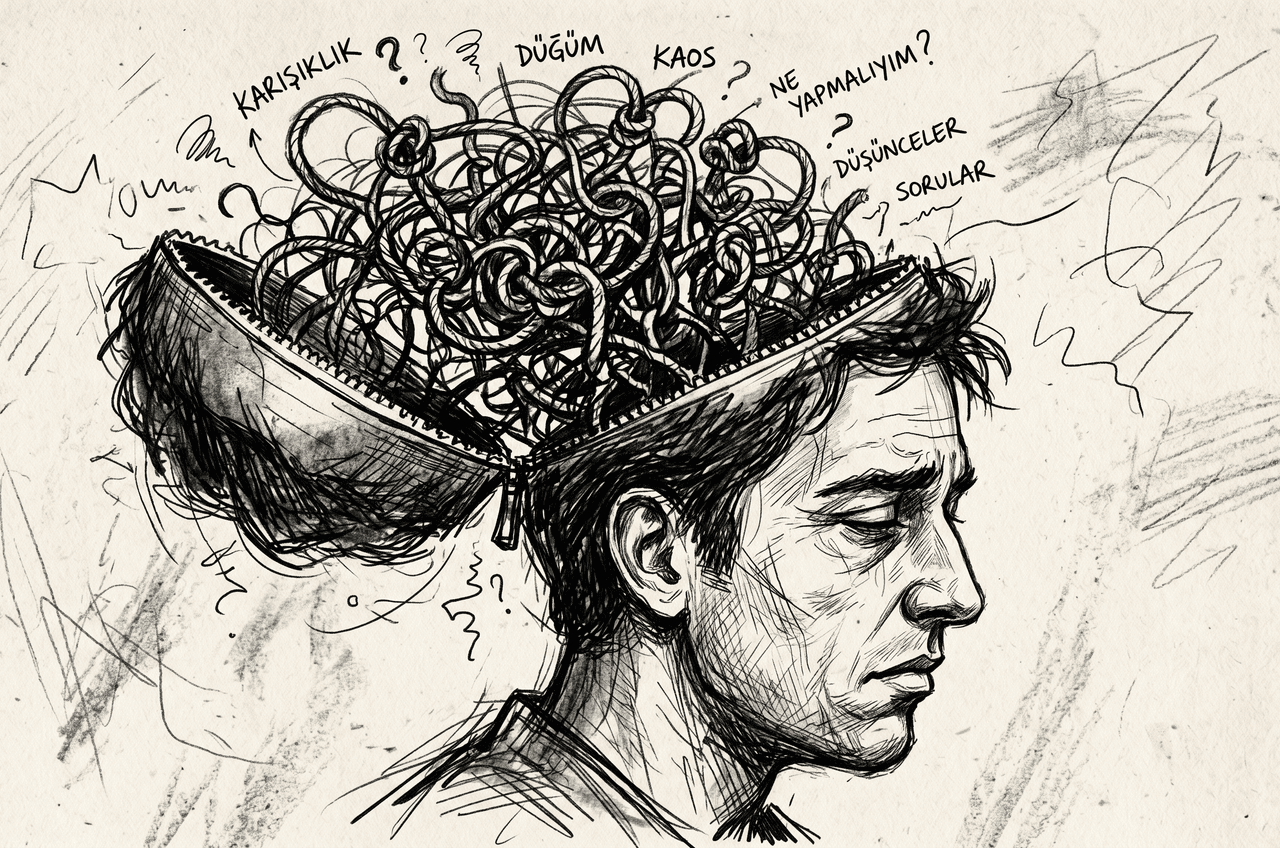
The Confused Human (Image Generated by Artificial Intelligence)
As someone who has spent years immersed in words, writing, and the crowded chaos of the communication world, I watch with deep sorrow how people brutalize themselves in this obsession with information. People squander their energy learning countless things that do not touch their hearts or nourish their souls, simply to avoid appearing deficient. Unfortunately, this energy is not directed toward meaningful transmission; instead, it plunges these individuals deeper into cycles of burnout. The false or performative belief that everyone must know everything in its most perfect form actually alienates us from our essence, leaving us ignorant of the most fundamental and human concerns. The more we learn, the more blind we become; the more we fill our minds, the more we drift away from our true selves and our pure, unblemished existence.
The most painful aspect is that this toxic perfectionism and the desire to master everything do not remain confined to worldly matters or career goals—they quietly seep into our spiritual lives and belief systems. You see someone with no formal religious education, who has devoted their life to no such path, boldly diving into matters far beyond their depth, driven by the arrogance of wanting to know the deepest truths. They recklessly enter theological debates that even seasoned theologians approach with humility and caution, attempting to swallow advanced jurisprudential knowledge. Yet how great a mistake this is… Or consider how people comfortably speak on topics that even those who have dedicated their lives to physics, chemistry, medicine, and other sciences hesitate to address. Our true and primary duty is not to drown in endless debates or to display intellectual superiority, but first and foremost to possess a pure, clear, and unblemished heart. Progress in spirituality, knowledge, and science does not mean constantly piling complex information into the mind.
The true purpose of human life is not to vanish among lines of text and inflate the mind, but to find what resides in the heart. What we truly need is to pursue what illuminates our inner world, frees us from arrogance, and benefits both ourselves and humanity. Our responsibility is to know our limits and keep our hearts as clear and untainted as a mirror. If all this exhaustion, all this reading, all this memorization does not reveal to us our own limitations, then what use is this knowledge? What good is knowledge that we do not comprehend and that does not reflect upon our condition, other than to act as mere laborers for it?
I wholeheartedly reject the cruel modern myth imposed upon us—that we must “work relentlessly,” “constantly produce and learn.” Working hard and filling the mind to bursting with constant activity is not, in itself, a virtue. It never has been. Human beings have a profound need to rest, to pause and slow down, to think, and to listen to the rhythm of their own heart in the silence. We are not insensitive machines processing data; we are human beings who require stillness, reflection, and contemplation. Our souls breathe only in peace; our hearts come alive only in silence. Resting is as much a requirement of faith and humane living as working is—it is the true art of balance.
True virtue is not hidden in the number of sleepless nights or the quantity of thick books consumed. Virtue is directly tied to the heart. The greatest knowledge a person can attain is to discover the deep stillness within themselves, to know where to stop, and to understand what they must know—and what they must not know.
Learning is indeed a noble act—but only so long as it does not become poison or arrogance. We are not required to know everything; swallowing the entire complexity of the world’s knowledge will not make us better human beings. What will save us is tending to our hearts with humility and pure intention, becoming a quiet drop in the ocean of true wisdom, and being of service to humanity. When we give rest and inward reflection their due, the exhausting voices in our minds will finally fall silent, and we will begin to feel far more deeply the secrets that truth whispers to our hearts.