


This article was automatically translated from the original Turkish version.
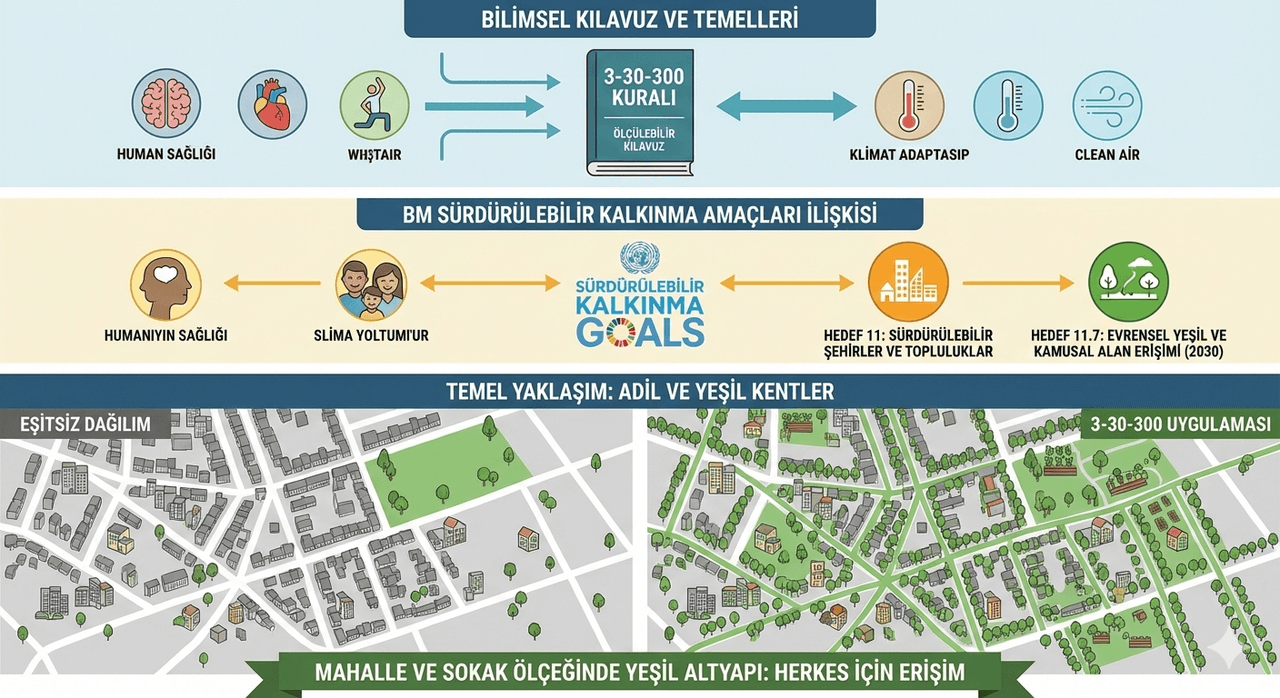
The 3-30-300 Rule (generated with Artificial Intelligence.)
Developer | Cecil Konijnendijk | ||||||||
|---|---|---|---|---|---|---|---|---|---|
Primary Objective | Mental health Climate change adaptation Urban well-being | ||||||||
Criterion 1 (3) | At least three mature trees must be visible from each home's window | ||||||||
Criterion 2 (30) | Each neighborhood must have at least 30% tree canopy coverage | ||||||||
Criterion 3 (300) | Each dwelling should be no more than 300 meters from a park | ||||||||
Application Examples from Around the World | Spain, Canada, Switzerland, Sweden | ||||||||
The 3-30-300 rule is a measurable and actionable urban green infrastructure guideline grounded in scientific evidence on the impacts of high-quality urban green spaces on human health, well-being, and climate resilience. This rule is directly linked to the seventh target of the United Nations Sustainable Development Goals, which aims for universal access to safe, inclusive, and accessible green and public spaces for all by 2030, within the framework of the 11th target. 【1】 Rising urbanization rates and the fact that a large share of the world’s population now live in cities have made urban greening a strategic priority in the context of health, equity, and environmental sustainability.【2】 In this context, the 3-30-300 rule, proposed by Cecil Konijnendijk in 2021, is defined as a set of objective criteria designed to create healthy, green, and equitable cities.
The primary aim of the rule is to ensure that urban forests and other green spaces permeate all aspects of life, work, and learning environments, and that the benefits derived from them are experienced by the entire urban population. In this framework, the unequal distribution of urban trees and green spaces is highlighted; it is emphasized that developing only large, symbolic parks is insufficient, and that green infrastructure must be integrated into streets, neighborhoods, and residential surroundings.
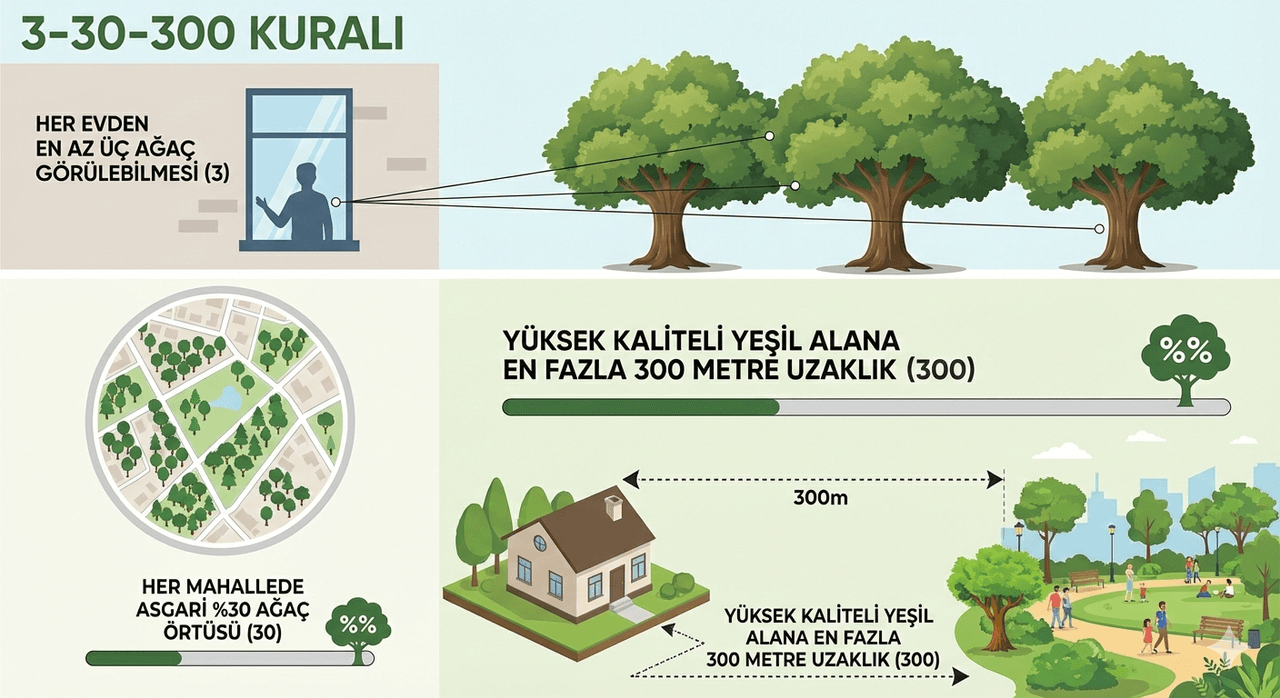
The 3-30-300 Rule Core Components (Generated by Artificial Intelligence)
The 3-30-300 rule consists of three core components established to ensure that urban residents have adequate access to nature. These components collectively address the concepts of visual greenery, residential greenery, and access to outdoor recreation. The rule aims for everyone to be able to see at least three mature trees from their home, workplace, or place of learning; for at least 30 percent of their neighborhood to be covered by tree canopy; and for everyone to live no more than 300 meters from a high-quality public green space of at least 0.5 hectares. The core components of the rule are as follows:
The first component of the rule requires that every individual be able to see at least three mature trees from their home. It is widely accepted that green elements visible in the immediate vicinity, especially from windows, contribute to individuals’ daily connection with nature. Trees visible from homes are considered a fundamental element that facilitates bonding with nature amid the intensity of urban life; this visibility aims to ensure continuity of urban green infrastructure even at the smallest scale.
The second component requires that every neighborhood have at least 30 percent tree canopy cover. This value is associated with the impacts of urban tree cover on microclimate, environmental comfort, and quality of life. Ensuring sufficient tree canopy at the neighborhood level seeks to prevent urban green spaces from being concentrated only in city centers or specific areas. Indeed, this approach aims for the balanced distribution of urban forestry at the neighborhood level and the creation of sustainable green networks at the local scale. In areas where tree growth is difficult, the same proportion is applied to overall vegetation cover.
The third component requires that every individual live no more than 300 meters from the nearest high-quality public park or other green space. This distance is defined as a threshold enabling pedestrian access to green spaces in daily life. Parks and green spaces located nearby are regarded as spaces that encourage recreational use and function as integral parts of public life. This principle acknowledges that the importance of parks lies not only in their size but also in their accessibility and ease of use; it also includes linear green spaces, green boulevards, and similar public space types within its scope.
The 3-30-300 rule has attracted attention from urban foresters, environmental experts, city planners, architects, policymakers, and the media. Many cities including Malmö, Zurich, St. Petersburg (Florida), Haarlem, Saanich, and Viladecans have formally or informally adopted the rule as part of their urban forestry or greening programs.【3】 Additionally, international organizations such as the United Nations Economic Commission for Europe and the Nordic Council of Ministers recommend the implementation of the 3-30-300 rule.【4】
Methods such as surveys, high-resolution land cover mapping, GIS (Geographic Information Systems) analysis, and network analysis are used to monitor the rule. The rule’s clear and numerical criteria enable comparisons between cities and regular tracking of progress. At the same time, its simplicity allows local governments, decision-makers, and residents to easily understand it, aiming to raise awareness and build support for urban greening policies.
This rule treats urban forestry not merely as an aesthetic or environmental element but as a fundamental component of urban life. Trees and green spaces are evaluated within a system extending from the residential scale to the neighborhood and citywide levels. The 3-30-300 rule is defined as a framework designed to ensure the continuity of urban green infrastructure, promote equity in access to green spaces, and enable cities to become more livable, resilient, and integrated with nature.
Browning, M.H.E.M.; Locke, D.H.; Konijnendijk, C.; Labib, S.M.; Rigolon, A.; Yeager, R.; Bardhan, M.; Berland, A.; Dadvand, P.; Helbich, M.; Li, F.; Li, H.; James, P.; Klompmaker, J.; Reuben, A.; Roman, L.A.; Tsai, W.-L.; Patwary, M.; O'Neil-Dunne, J.; Ossola, A.; Wang, R.; Yang, B.; Yi, L.; Zhang, J.; Nieuwenhuijsen, M. "Measuring the 3-30-300 rule to help cities meet nature access thresholds". *Science of The Total Environment.* 907: 167739. Accessed December 22, 2025.https://research.fs.usda.gov/treesearch/67230#:~:text=Abstract,a%20high%2Dquality%20green%20space.
Konijnendijk, Cecil. “The 3-30-300 Rule for Urban Forestry and Greener Cities.” BIOPHILIC CITIES JOURNAL / RESEARCH, vol:4, no:2. Accessed December 22, 2025.https://www.researchgate.net/publication/353571108_The_3-30-300_Rule_for_Urban_Forestry_and_Greener_Cities
Nature Based Solutions Institute. “The 3+30+300 Rule for Healthier and Greener Cities.” NBSI. Accessed December 22, 2025.https://nbsi.eu/the-3-30-300-rule/
Nieuwenhuijsen, Mark J., Payam Dadvand, Sandra Márquez, Xavier Bartoll, Evelise Pereira Barboza, Marta Cirach, Carme Borrell, and Wilma L. Zijlema. “The Evaluation of the 3-30-300 Green Space Rule and Mental Health.” Environmental Research (Çevre Araştırmaları) 215, no. 2 (December 2022): 114387. ScienceDirect. Accessed December 22, 2025.https://www.sciencedirect.com/science/article/pii/S0013935122017145
[1]
M.H.E.M Browning; Locke, D.H.; Konijnendijk, C.; Labib, S.M.; Rigolon, A.; Yeager, R.; Bardhan, M.; Berland, A.; Dadvand, P.; Helbich, M.; Li, F.; Li, H.; James, P.; Klompmaker, J.; Reuben, A.; Roman, L.A.; Tsai, W.-L.; Patwary, M.; O'Neil-Dunne, J.; Ossola, A.; Wang, R.; Yang, B.; Yi, L.; Zhang, J.; Nieuwenhuijsen, M. "Measuring the 3-30-300 rule to help cities meet nature access thresholds, Science of The Total Environment. 907: 167739, sayfa 3, erişim 22 Aralık 2025, https://research.fs.usda.gov/treesearch/67230#:~:text=Abstract,a%20high%2Dquality%20green%20space.
[2]
M.H.E.M Browning; Locke, D.H.; Konijnendijk, C.; Labib, S.M.; Rigolon, A.; Yeager, R.; Bardhan, M.; Berland, A.; Dadvand, P.; Helbich, M.; Li, F.; Li, H.; James, P.; Klompmaker, J.; Reuben, A.; Roman, L.A.; Tsai, W.-L.; Patwary, M.; O'Neil-Dunne, J.; Ossola, A.; Wang, R.; Yang, B.; Yi, L.; Zhang, J.; Nieuwenhuijsen, M. "Measuring the 3-30-300 rule to help cities meet nature access thresholds, Science of The Total Environment. 907: 167739, sayfa 3, erişim 22 Aralık 2025,
[3]
M.H.E.M Browning; Locke, D.H.; Konijnendijk, C.; Labib, S.M.; Rigolon, A.; Yeager, R.; Bardhan, M.; Berland, A.; Dadvand, P.; Helbich, M.; Li, F.; Li, H.; James, P.; Klompmaker, J.; Reuben, A.; Roman, L.A.; Tsai, W.-L.; Patwary, M.; O'Neil-Dunne, J.; Ossola, A.; Wang, R.; Yang, B.; Yi, L.; Zhang, J.; Nieuwenhuijsen, M. "Measuring the 3-30-300 rule to help cities meet nature access thresholds, Science of The Total Environment. 907: 167739, sayfa 3, erişim 22 Aralık 2025,
[4]
M.H.E.M Browning; Locke, D.H.; Konijnendijk, C.; Labib, S.M.; Rigolon, A.; Yeager, R.; Bardhan, M.; Berland, A.; Dadvand, P.; Helbich, M.; Li, F.; Li, H.; James, P.; Klompmaker, J.; Reuben, A.; Roman, L.A.; Tsai, W.-L.; Patwary, M.; O'Neil-Dunne, J.; Ossola, A.; Wang, R.; Yang, B.; Yi, L.; Zhang, J.; Nieuwenhuijsen, M. "Measuring the 3-30-300 rule to help cities meet nature access thresholds, Science of The Total Environment. 907: 167739, sayfa 3, erişim 22 Aralık 2025,

The 3-30-300 Rule (generated with Artificial Intelligence.)
Developer | Cecil Konijnendijk | ||||||||
|---|---|---|---|---|---|---|---|---|---|
Primary Objective | Mental health Climate change adaptation Urban well-being | ||||||||
Criterion 1 (3) | At least three mature trees must be visible from each home's window | ||||||||
Criterion 2 (30) | Each neighborhood must have at least 30% tree canopy coverage | ||||||||
Criterion 3 (300) | Each dwelling should be no more than 300 meters from a park | ||||||||
Application Examples from Around the World | Spain, Canada, Switzerland, Sweden | ||||||||
Objective and Core Approach
Core Components
At Least Three Trees Visible from Every Home (3)
Minimum 30 Percent Tree Canopy in Every Neighborhood (30)
Maximum 300 Meters to a High-Quality Green Space (300)
Implementation, Monitoring, and Global Adoption
Its Place Within Urban Green Infrastructure