


This article was automatically translated from the original Turkish version.
YOLO is an object detection algorithm that simultaneously predicts the location and class of all objects in an image through a single pass of a neural network. YOLO, which has become a significant method in the fields of artificial intelligence and deep learning, is particularly preferred in video processing and autonomous systems due to its real-time analysis capability. YOLO’s most prominent feature is its ability to detect objects in a single step, delivering efficient results in terms of both speed and accuracy.
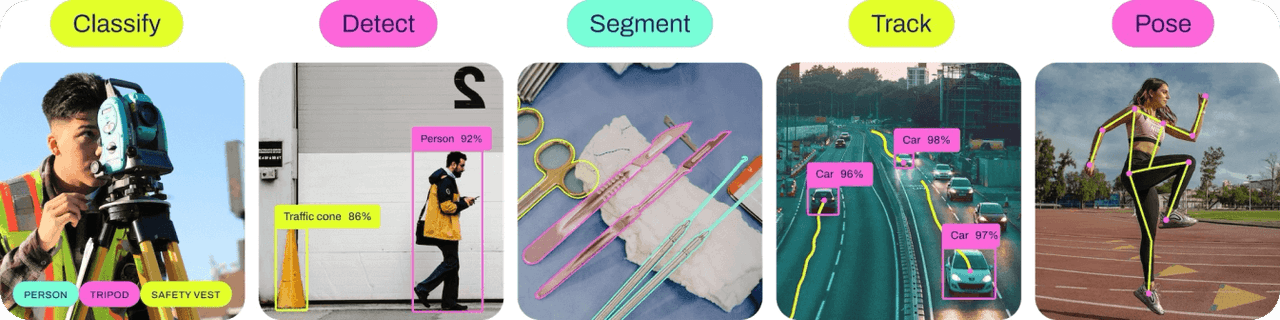
Computer Vision Tasks Supported by YOLO11. (Ultralytics/Figure 3)
The YOLO algorithm was first developed in 2016 by Joseph Redmon and Ali Farhadi. Unlike traditional region-based approaches, this algorithm aims to detect objects by processing the entire image through a single convolutional neural network (CNN).
Subsequent versions have improved the balance between accuracy and speed:
YOLO divides the input image into an S×S grid. Each cell determines whether an object is present and, if so, predicts the object’s class and location coordinates. Each prediction includes the class probability, x and y coordinates of the bounding box center, and width and height values. The results are evaluated using the IoU (Intersection over Union) metric to determine accurate bounding boxes.
Thanks to this structure, YOLO generates high-accuracy results with significantly fewer computations than traditional methods. This makes it especially suitable for applications requiring real-time performance, such as video streams.
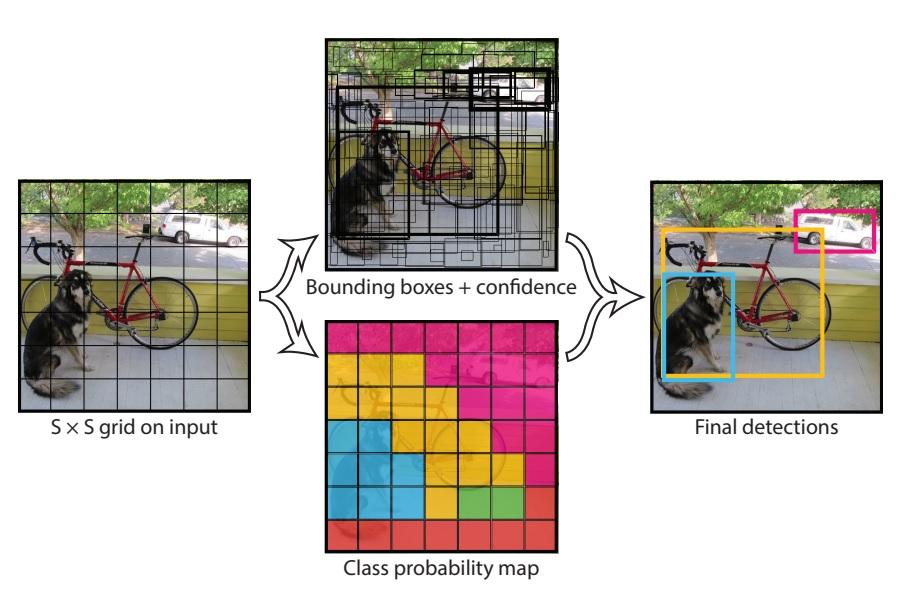
The YOLO algorithm divides the image into grid cells and predicts whether an object is present in each cell. (Redmon et al. 2016)
The YOLO algorithm is effectively used across a wide range of industries:
Cameras mounted on vehicles detect traffic signs, pedestrians, and other vehicles in real time to enhance driving safety.
In closed-circuit television systems, YOLO enables real-time human detection, behavior analysis, and threat identification during live monitoring.
It is used in production lines for quality control, product classification, and sorting systems in manufacturing.
In imaging systems, YOLO can be applied to medical tasks such as detecting abnormal regions in lung X-rays for diagnostic support.
Kaya and Akgül conducted a comparative study evaluating YOLOv2, YOLOv3, and YOLOv4 algorithms on a traffic sign dataset. The following table summarizes the performance of these algorithms:
Redmon, J., Divvala, S., Girshick, R., and Farhadi, A. (2016). *You Only Look Once: Unified, Real-Time Object Detection*. CVPR.https://arxiv.org/abs/1506.02640(Accessed July 2, 2025). Redmon, J., and Farhadi, A. (2017). *YOLO9000: Better, Faster, Stronger*. CVPR.https://arxiv.org/abs/1612.08242(Accessed July 2, 2025). Redmon, J., and Farhadi, A. (2018). *YOLOv3: An Incremental Improvement*. arXiv:1804.02767.https://arxiv.org/abs/1804.02767(Accessed July 2, 2025). Bochkovskiy, A., Wang, C.-Y., and Liao, H.-Y. M. (2020). *YOLOv4: Optimal Speed and Accuracy of Object Detection*. arXiv:2004.10934.https://arxiv.org/abs/2004.10934(Accessed July 2, 2025). Kaya, V., and Akgül, İ. (2022). *Object Detection with Artificial Intelligence: YOLO Application*. Erzincan Binali Yıldırım Üniversitesi.https://www.researchgate.net/publication/366658382(Accessed July 2, 2025). Zeadally, S., Adi, E., Baig, Z., and Khan, I. A. (2020). *Harnessing Artificial Intelligence Capabilities to Improve Cybersecurity*. IEEE Access.https://ieeexplore.ieee.org/document/8963952(Accessed July 2, 2025). Bardou, D., Zhang, K., and Ahmad, S. M. (2018). *Lung Sounds Classification Using Convolutional Neural Networks*. Artificial Intelligence in Medicine.https://pubmed.ncbi.nlm.nih.gov/29724435(Accessed July 2, 2025). Li, L., Lin, Y. L., Zheng, N. N., et al. (2018). *Artificial Intelligence Test: A Case Study of Intelligent Vehicles*. Artificial Intelligence Review.https://www.researchgate.net/publication/324484533_Artificial_intelligence_test_a_case_study_of_intelligent_vehicles(Accessed July 2, 2025).

Development History
Working Principle
Application Areas
Autonomous Vehicles
Security Systems
Industrial Automation
Healthcare Technologies
Academic Application Example