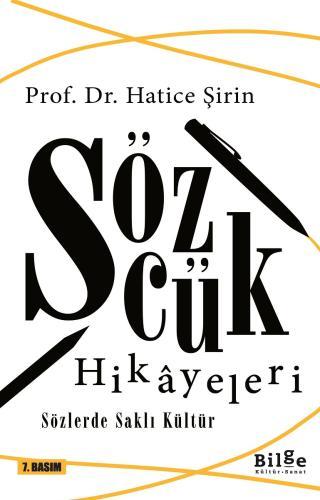
Written by Prof. Hatice Şirin, a member of the Science Council of the Turkish Language Association, the work titled Word Stories (Culture Hidden in Words) was published in 2019. The book comprehensively examines the etymological origins of 134 words along with their historical shifts in meaning and cultural reflections.
Objective and Scope of the Work
In this work, etymology or what is termed “word story” is presented as a journey parallel to human history, tracing where words come from and where they end up. Drawing on articles she published on social media about word origins and essays she wrote for the Turkish Language Association’s periodicals, Hatice Şirin reveals the cultural and literary reflections of words that entered Turkish from other cultures or originated in Turkish.
Examined Words and Thematic Categories
The 134 words in the book are categorized under diverse thematic headings such as animals, plants, geographical place names, clothing and accessories, tools and equipment, war and weapons, gender concepts, metals and minerals, illness and medicine, mathematical terms, colors, organs, social order and opponents, emotions, virtues, national identity and actions. Thus, each word’s origin, evolution of meaning, place in folk culture, and usage in literature are evaluated from a comprehensive perspective.
Hatice Şirin compares the words under study with domestic and foreign dictionaries, academic publications, examples from folk culture, literary works, newspaper articles, novels, songs and folk ballads, as well as with definitions from the Turkish Language Association’s Current Turkish Dictionary (CTD). This interdisciplinary approach enables a deep understanding of words both as linguistic and cultural phenomena.
Contributions of the Work
The book has offered various contributions to the Turkish Language Association’s Current Turkish Dictionary. For instance, it proposed removing outdated parts of the definition for the word “flamingo,” adding local equivalents such as “allı turna,” correctly categorizing idioms, including certain foreign-origin words in the Turkish dictionary, and reflecting current semantic developments. The book also includes observations on the modern usage of the word “lümpen.”
Geographical and Cultural Scope
The analyses in the book encompass a broad geographical area where Turkish culture has interacted, spanning from China and Japan to distant corners of Europe. These investigations reveal the cultural as well as linguistic journey of Turkish words.