


This article was automatically translated from the original Turkish version.
+1 More
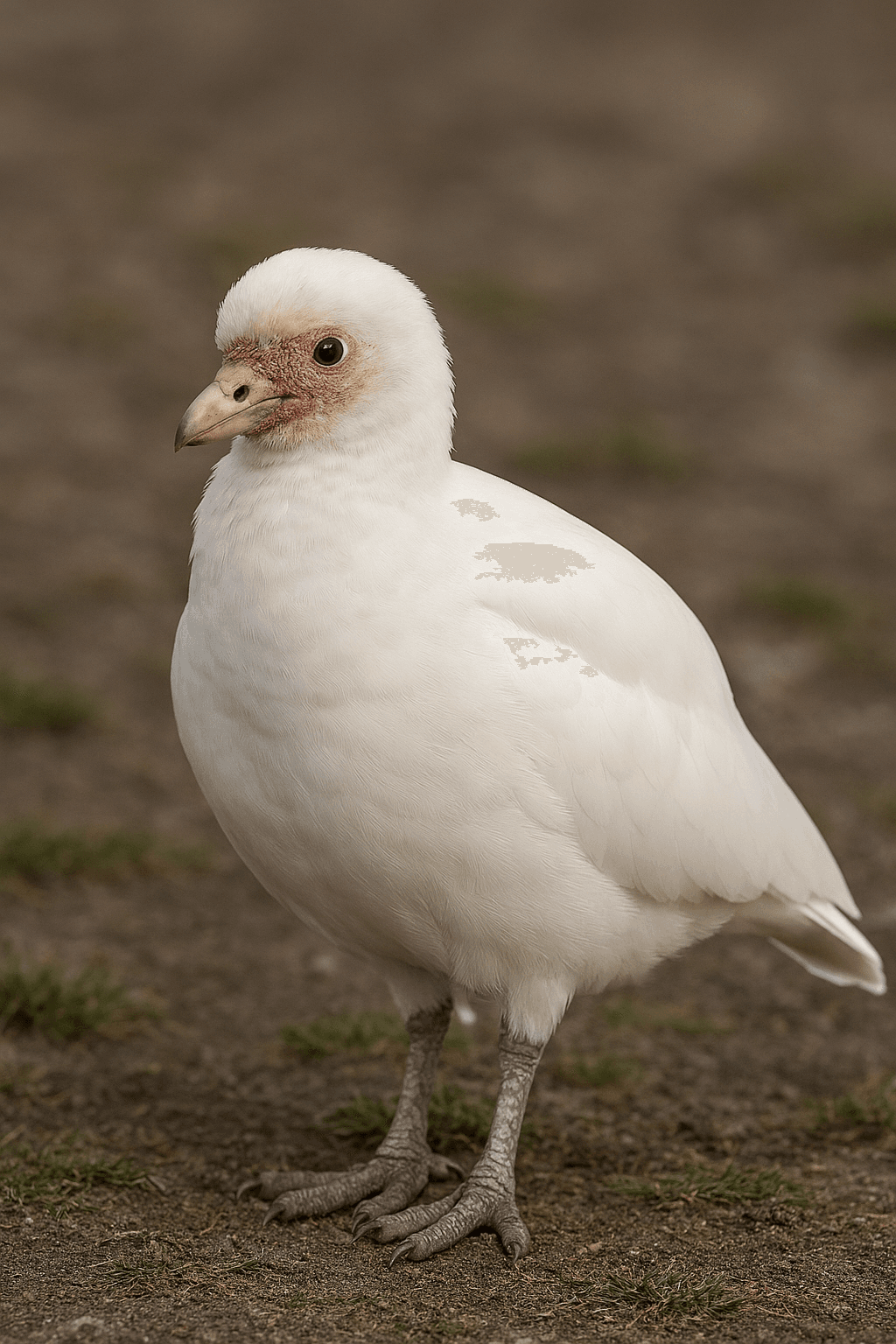
Ak Kıngaga (Chionis Albus) (generated by artificial intelligence.)
Team(s) | Charadriiformes | ||||||||
|---|---|---|---|---|---|---|---|---|---|
Family | Chionididae | ||||||||
Type(s) | Chionis Albus | ||||||||
Size(s) | 38–40 cm | ||||||||
Weight(s) | 560–810 g | ||||||||
Wingspan | 76-84 cm | ||||||||
Distribution Area | South Orkney Islands South Shetland Antarctic Peninsula | ||||||||
Conservation Status | Least Concern | ||||||||
The Snow Petrel (Chionis albus) is a species found among land-based birds in the Antarctic ecosystem. Despite having limited flight capability, this species exhibits high adaptability to harsh environmental conditions and can form symbiotic interactions with seabirds. This article presents a systematic evaluation of C. albus based solely on four original sources, covering its taxonomic position, morphological characteristics, habitat preferences, behavioral repertoire, feeding strategies, and conservation status.
Chionis albus belongs to the order Charadriiformes and the family Chionididae. The Chionididae family is a small group consisting of only two species, and C. albus is the white-plumaged representative endemic to Antarctica. The species was scientifically described by Johann Friedrich Gmelin in 1789.
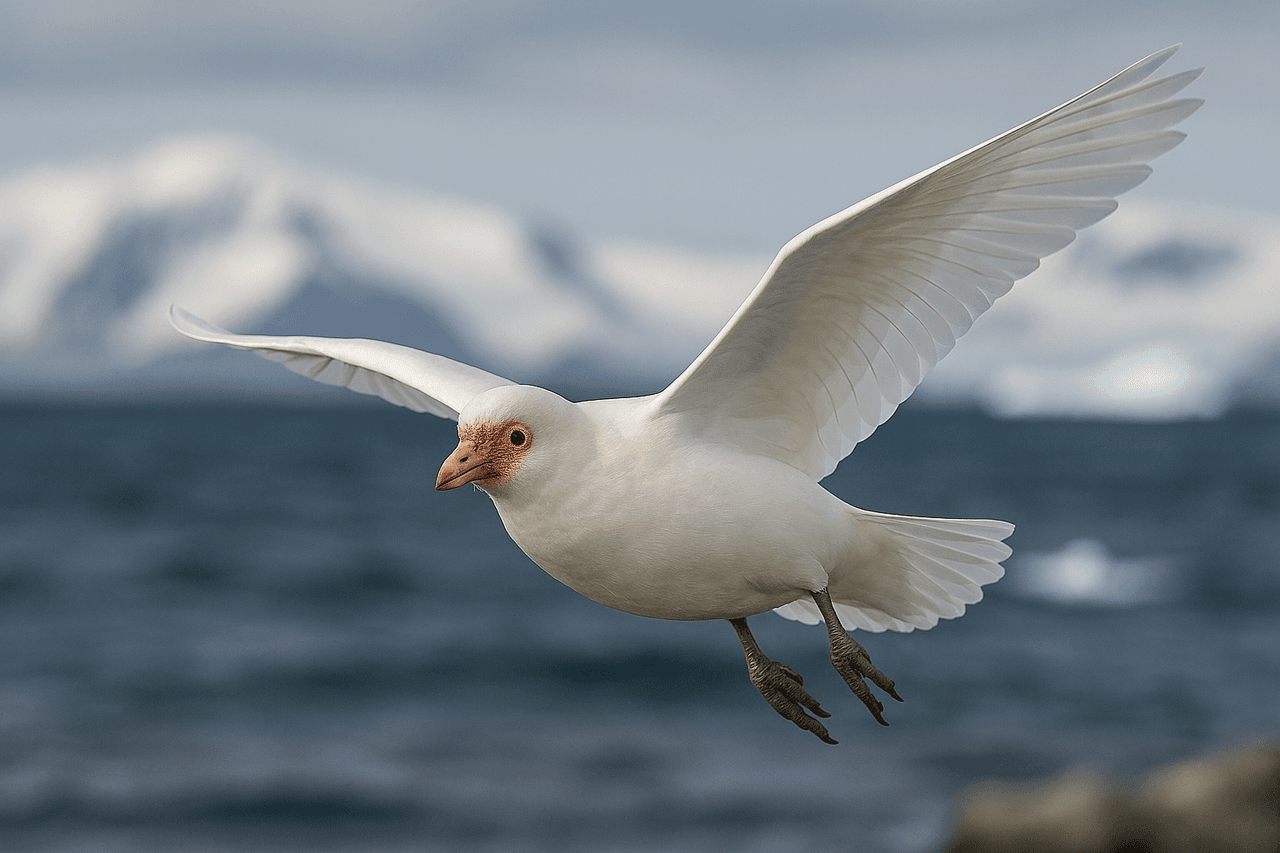
Snow Petrel (Chionis albus) (generated by artificial intelligence.)
The Snow Petrel is distinguished by its entirely white plumage and short, robust bill. The keratinized sheath structure at the base of the bill gives rise to its English name “sheathbill.” Its unwebbed feet and strong legs confer high terrestrial locomotion ability. Flight capability is limited, and the bird primarily moves by walking. These traits enable efficient movement across Antarctica’s icy and rocky terrain.
Chionis albus breeds in colonies along the Antarctic Peninsula and surrounding South Shetland and South Orkney Islands. Outside the breeding season, it may migrate as far south as the southern coasts of South America. Breeding and feeding behaviors are concentrated particularly in ice-free coastal zones and areas associated with penguin colonies.
The Snow Petrel is known for its omnivorous feeding strategy. Its food sources include the eggs, chicks, and feces of seabirds, carcasses of dead animals, and organic waste left behind by human settlements. It is frequently observed near penguin colonies, where it exhibits opportunistic feeding behavior. The species contributes to the organic matter cycle by fulfilling a scavenger role within the ecosystem.
As a social species, Chionis albus moves in pairs or small groups and communicates through visual and auditory signals. Ground-based foraging, interactions with other bird species, and food-seeking behaviors form the core elements of its behavioral repertoire.
The breeding season typically occurs between November and January. The female lays two to three eggs in a simple nest constructed from stones and bone fragments. Incubation lasts approximately 30 days, and the chicks are fed by their parents in the nest. The young become independent after about seven weeks. Breeding sites are usually located near penguin colonies.
According to BirdLife International, Chionis albus is classified as “Least Concern.” Its population size is stable and it is not currently under significant threat. However, the long-term impacts of climate change and human activities on Antarctic ecosystems may indirectly affect the species’ habitat.
The Snow Petrel plays a scavenger role in the Antarctic ecosystem by contributing to the recycling of organic waste. Its frequent presence at human settlements and research stations demonstrates its adaptability to anthropogenic sources. In this regard, it is among the rare Antarctic birds capable of thriving in both natural and semi-artificial environments.
BirdLife International. “Snowy Sheathbill Chionis albus.” BirdLife Data Zone. Accessed August 23, 2025. https://datazone.birdlife.org/species/factsheet/snowy-sheathbill-chionis-albus.
Fang, Emerson D. “Snowy Sheathbill (Chionis albus).” Birds of the World. Cornell Lab of Ornithology. Accessed August 23, 2025. https://birdsoftheworld.org/bow/species/snoshe2/cur/introduction.
Petry, Maria V. “Record of Ship-Assisted Displacement of Chionis albus (Gmelin, 1789) (Aves: Chionidae) from Antarctica to South America.” Academia. Accessed August 23, 2025. https://www.academia.edu/115681591/RECORD_OF_SHIP_ASSISTED_DISPLACEMENT_OF_Chionis_albus_GMELIN_1789_AVES_CHIONIDAE_FROM_ANTARCTICA_TO_SOUTH_AMERICA.
Özkan, Korhan. “Ak Kıngaga.” *TÜBİTAK Kutup Araştırmaları Ansiklopedisi*. Accessed August 23, 2025. https://ansiklopedi.tubitak.gov.tr/kutup/ansiklopedi/ak-kingaga.

Ak Kıngaga (Chionis Albus) (generated by artificial intelligence.)
Team(s) | Charadriiformes | ||||||||
|---|---|---|---|---|---|---|---|---|---|
Family | Chionididae | ||||||||
Type(s) | Chionis Albus | ||||||||
Size(s) | 38–40 cm | ||||||||
Weight(s) | 560–810 g | ||||||||
Wingspan | 76-84 cm | ||||||||
Distribution Area | South Orkney Islands South Shetland Antarctic Peninsula | ||||||||
Conservation Status | Least Concern | ||||||||
No Discussion Added Yet
Start discussion for "White Gull (Chionis albus)" article
Taxonomy and Systematic Position
Morphological Characteristics
Habitat and Geographic Distribution
Feeding Strategies
Behavioral Traits
Reproductive Biology
Conservation Status
Ecological Role and Human Interaction