


This article was automatically translated from the original Turkish version.
+1 More
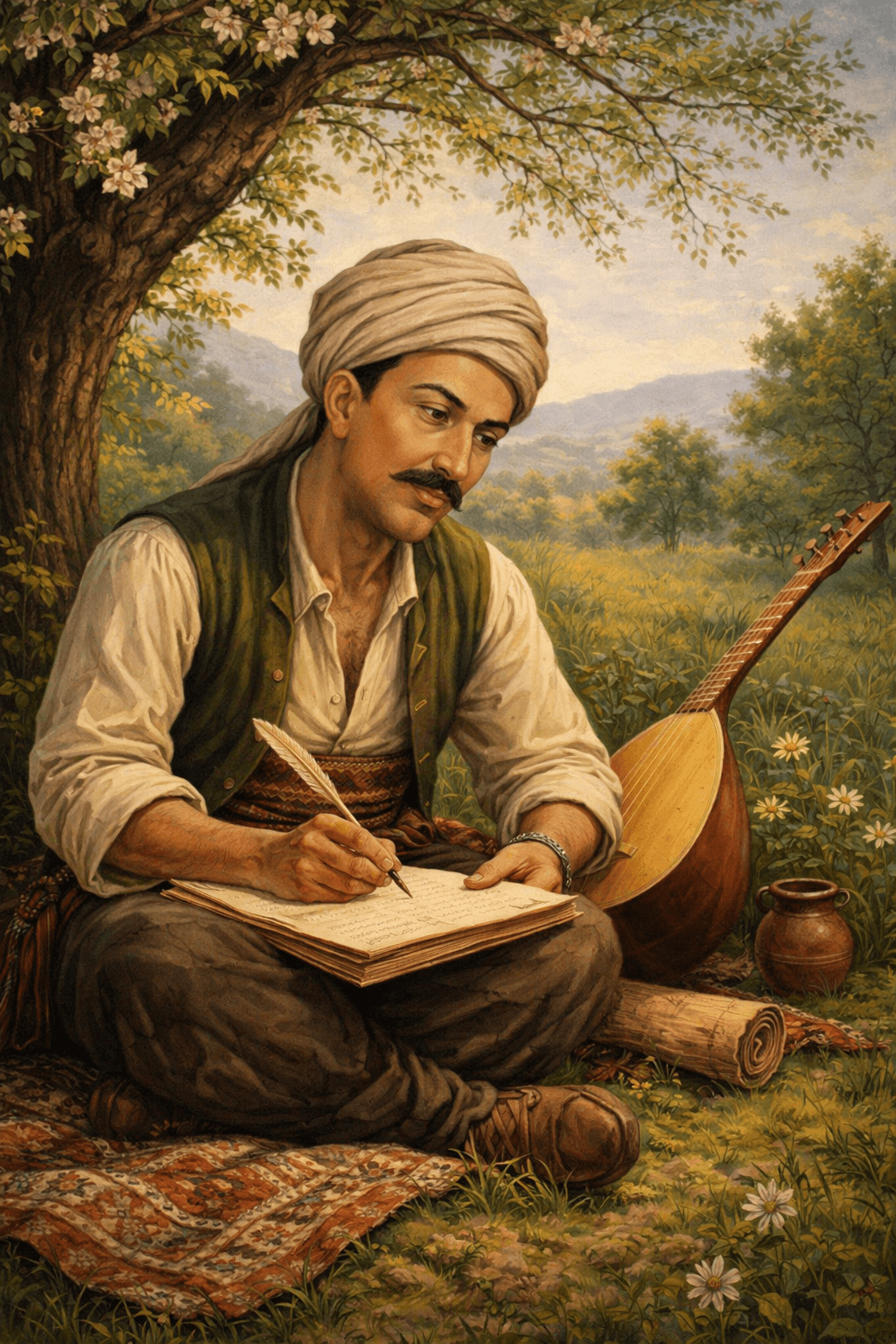
Karacaoğlan (Generated by Artificial Intelligence)
When Spring Turns to Summer Months (Poem)
Author(s) | Karacaoğlan | ||||||||
|---|---|---|---|---|---|---|---|---|---|
Genre | Folk Poetry / Aşık Poetry / Koşma | ||||||||
Region of Compilation or Knowledge | Anatolia, Taurus Mountains, Çukurova | ||||||||
Publication Venues | Academic studies and research; digital poetry compilation platforms | ||||||||
Period of Writing | 17th Century | ||||||||
When Spring and Summer Months Begin is a lyrical poem attributed to Karacaoğlan, one of the prominent representatives of Turkish folk literature. The poem addresses the transformations in nature brought about by the arrival of spring. Shaped within the tradition of âşık literature, it draws attention through its nature-based narrative, simple language, and lyrical structure. The relationship between nature and human emotion, a recurring theme in Karacaoğlan’s poetry, is prominently featured here, with seasonal change intertwined with the emotional world of the lover.
The poem titled When Spring and Summer Months Begin has circulated within the oral folk literature tradition and appears in various collections with multiple variants. Its opening quatrain reflecting the theme of spring reads:
When spring and summer months begin
The streams flow muddy and unclear
Have you then turned cold and distant from me
The wounds in my heart now meet eye to eye
Do not weep, my beloved, I shall return
Among the beauties I shall find you again
This sorrow cannot be healed, I shall die
Let the lord of beauties ride the dark lands
My heart is mad for you, my love
Owls glide through the silent, deserted valleys
No shroud shall be fate for the beautiful one
They shall wrap me in the morning’s dew
Karacaoğlan says, with my quatrains and ballads
My leaves have fallen, one by one
We still have one matter left with the beauties
Only my Lord may resolve our dispute
Karacaoğlan
In these lines, the natural changes accompanying spring are linked to the emotional unraveling of the lover. As is common in Karacaoğlan’s poetry, elements of nature serve as mirrors of the human soul. The poem exhibits the characteristics of the koşma verse form and is regarded as a representative example of Karacaoğlan’s nature-centered lyricism.
The poem belongs to the koşma genre, widely used in Turkish folk literature. Composed in syllabic meter and structured in quatrains, its rhyme scheme and delivery align with the traditional structure of âşık literature. The language is simple, clear, and closely resembles folk speech.
The poem is evaluated within the context of the 17th century, the period traditionally associated with Karacaoğlan’s life. This era saw the widespread popularity of Anatolian âşık-style folk poetry and the vigorous continuation of oral culture. The exact date of the poem’s composition remains unknown.
There is no definitive information regarding the region where the poem was first collected. However, considering the elements of highland pastures, mountains, and nomadic life present in Karacaoğlan’s poetry, the work is commonly associated with the Taurus Mountains and Çukurova regions. It is known that the poem has spread widely across various parts of Anatolia through oral tradition.
The poem is attributed to Karacaoğlan, one of the most renowned âşıks in Turkish folk literature. Details of his life are limited; his birthplace and date are not definitively known. Based on his poems and scholarly studies, he is generally regarded as a wandering âşık who traveled across various regions of Anatolia. Nature, love, separation, and human relationships dominate his themes. His language is simple, his expression direct, and his style closely aligned with folk speech. Due to its transmission through oral tradition, multiple variants of the text exist. Nevertheless, the overall style, thematic structure, and linguistic features align closely with other poems attributed to Karacaoğlan.
The central subject of the poem is the renewal observed in nature with the arrival of spring. The theme, conveyed through this renewal, encompasses rebirth, love, the vitality of life, and emotional turbulence. Spring functions in the poem both as a natural season and as a symbol of inner transformation within the human soul.
In the poem, natural elements serve as reflections of human emotion. Flowers, wind, animals, and highland pastures represent the liveliness brought by spring, and this vitality is directly connected to the emotional movement within the human heart. In this regard, the poem reflects Karacaoğlan’s poetic approach, which goes beyond mere description of nature to interpret its deeper meaning.
No direct historical document or narrative exists regarding the origin of the poem “When Spring and Summer Months Begin.” However, it is well established that Karacaoğlan composed his poems based largely on his immediate surroundings, direct observations, and seasonal changes. Accordingly, the poem is understood as an expression of the renewal in nature during spring and the corresponding emotional stirrings it evokes in the human soul. The content of the poem presents a narrative framework that reflects the âşık’s observations of nature and the emotional responses these observations inspire.
Albayrak, Nurettin. “Karacaoğlan.” *TDV İslâm Ansiklopedisi*. İstanbul: Türkiye Diyanet Vakfı, 2001. Accessed April 30, 2026. https://islamansiklopedisi.org.tr/karacaoglan
Emeksiz, Abdulkadir. “Karacaoğlan Kimliği.” *Uluslararası Asya ve Kuzey Afrika Çalışmaları Kongresi Bildirileri* (2007): 635–646. Accessed April 30, 2026. https://www.ayk.gov.tr/wp-content/uploads/2015/01/EMEKS%C4%B0Z-Abdulkadir-KARACAO%C4%9ELAN-K%C4%B0ML%C4%B0%C4%9E%C4%B0.pdf
Oğuz, M. Öcal. “Karacaoğlan Sorunsalı İçinde Rumelili Karacaoğlan.” *Gazi Türkiyat* 12 (Spring 2013): 1–8. Accessed April 30, 2026. https://dergipark.org.tr/tr/download/article-file/76806
Sakaoğlu, Saim. “Karacaoğlan.” *Türk Edebiyatı İsimler Sözlüğü*. Date Published February 10, 2015. Updated December 8, 2020. Accessed April 30, 2026. https://teis.yesevi.edu.tr/madde-detay/karaca-oglan

Karacaoğlan (Generated by Artificial Intelligence)
When Spring Turns to Summer Months (Poem)
Author(s) | Karacaoğlan | ||||||||
|---|---|---|---|---|---|---|---|---|---|
Genre | Folk Poetry / Aşık Poetry / Koşma | ||||||||
Region of Compilation or Knowledge | Anatolia, Taurus Mountains, Çukurova | ||||||||
Publication Venues | Academic studies and research; digital poetry compilation platforms | ||||||||
Period of Writing | 17th Century | ||||||||
No Discussion Added Yet
Start discussion for "When Spring Turns to Summer Months (Poem)" article
Genre and Formal Features
Historical Context
Region of Collection and Dissemination
The Poet
Subject and Theme
Contextual and Semantic Evaluation
Origin Story