KURE Kids Header Line
badge icon

This content was originally written in Turkish for children and is automatically translated into English using artificial intelligence.

article-image

What is the Stratosphere?

Last Updated: 12/01/2025

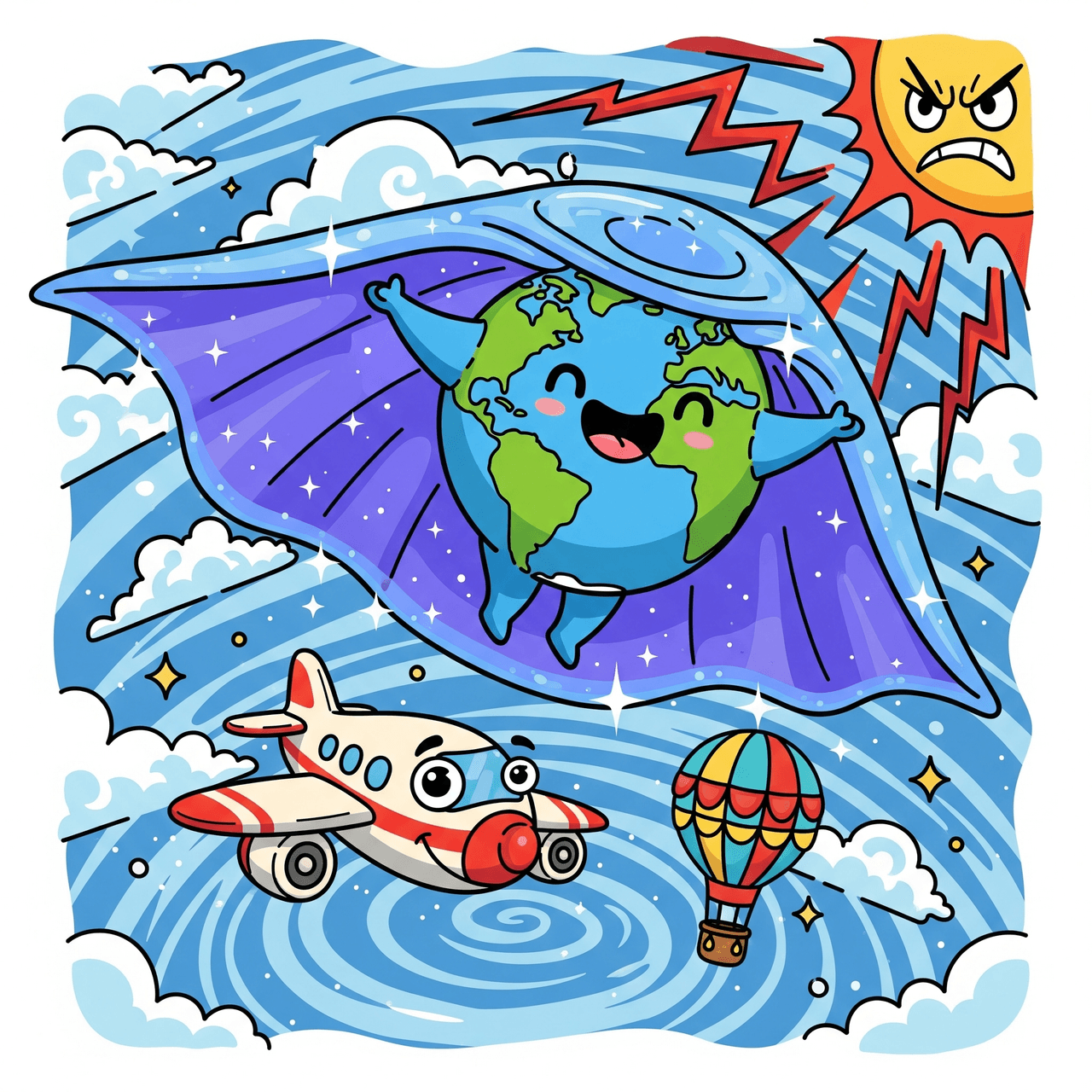
Our planet’s silent atmospheric layer. The stratosphere is a layer within Earth’s atmosphere, located directly above the troposphere. Aircraft typically fly within this layer, where the air is much calmer and windless. Additionally, the ozone layer, which blocks harmful rays from the Sun, is found within the stratosphere.


(Generated by Artificial Intelligence.)

Where Is the Stratosphere Located?

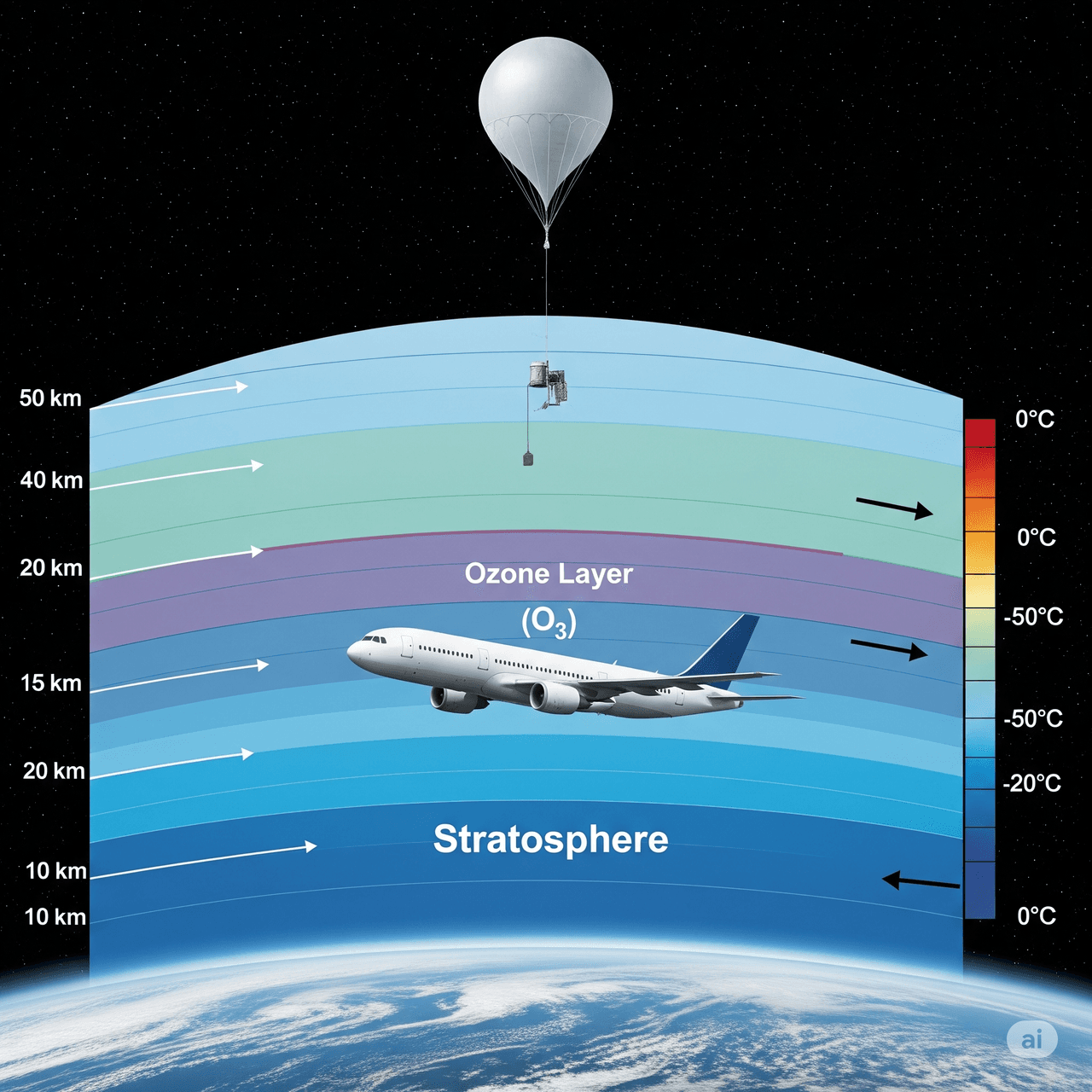
The air surrounding Earth is composed of layers. The stratosphere is the second of these layers. It begins at approximately 10 kilometers above sea level and extends up to 50 kilometers. Thus, it is far from the surface but has not yet reached outer space. Most aircraft fly in the troposphere below, but some specialized aircraft can reach the stratosphere.

What Are the Characteristics of the Stratosphere?

The stratosphere is one of the layers that make up Earth’s atmosphere. It lies directly above the troposphere, the lowest layer of the atmosphere, and extends from about 10 kilometers to 50 kilometers in altitude.


Because the stratosphere contains less air, breathing is not possible here. Clouds form very rarely, as the air is dry and stable. The most important feature of the stratosphere is the ozone layer it contains. This layer protects humans, animals and plants by blocking harmful solar radiation.

(Generated by Artificial Intelligence.)


In the stratosphere, air generally moves horizontally, and temperature increases with altitude. This is the opposite of what occurs in the troposphere below. Scientists study the regular patterns of winds and their effects on climate in this layer to better understand weather phenomena.

What Is the Purpose of the Stratosphere?

- Provides protection: The ozone layer prevents harmful radiation from reaching Earth.

- Influences climate: Changes in the stratosphere can affect weather patterns and climate on the Earth’s surface.

- Important for scientific research: Space research, weather modeling and climate change studies require an understanding of the stratosphere.


(Generated by Artificial Intelligence.)

What Are Scientists Doing?

Researchers use specialized instruments and satellites to study changes in the stratosphere. By examining phenomena such as aerosols, winds and temperature variations, they gather information about the future of the climate.

Don't Forget to Look at These!
Science and Technology
cat img
History and Culture
cat img
Art and Literature
cat img
image
Most Read
Thomas Edison
arrow
image
Last Added
Pardus
arrow
ilham-notu-bg
INSPIRATION NOTE FOR CURIOUS KIDS!

The stratosphere, the silent guardian of the sky, makes Earth habitable by protecting you every day from the Sun’s harmful rays, even though it is invisible.

KURE Kids Kure Card Pin Icon
KURE Kids Kure Card Book Icon
1000009826.jpg

What is the Stratosphere?

Height(s)(Text)

It is found at an altitude of approximately 10 km to 50 km.

Why is İt İmportant?

Scientists study it to understand climate and weather phenomena.

What is İt Used for?

It protects Earth by blocking harmful rays from the Sun.

What is İt?

It is the second layer of the atmosphere, located immediately above the troposphere.

Feature(s)

The air is dry

temperature increases with altitude. The ozone layer is located in this layer.

with very few clouds

Who Wrote?
Kids Writing
Authorİbrahim FilizDecember 1, 2025
bottom-bg-effect-bottom
bottom-bg-effect-top

The stratosphere is an atmospheric layer located approximately 10 to 50 kilometers above the Earth's surface. The ozone layer is situated here and blocks harmful rays from the Sun. The air is dry and calm, with few clouds. Temperature increases with altitude. Scientists study the stratosphere to better understand climate and weather phenomena.

Bibliographies


Añel, Juan A. 2015. “The Stratosphere: History and Future a Century after Its Discovery: A Review of The Physics of the Stratosphere, by Goody.” *Contemporary Physics* 57 (2): 230–33. Accessed May 26, 2025. https://doi.org/10.1080/00107514.2015.1029521

Baldwin, M. P., L. J. Gray, T. J. Dunkerton, K. Hamilton, P. H. Haynes, W. J. Randel, J. R. Holton, et al. "The Quasi-Biennial Oscillation." *Reviews of Geophysics* 39, no. 2 (2001): 179–229. Accessed May 26, 2025. https://doi.org/10.1029/1999rg000073

Gettelman, A., M. L. Salby, and F. Sassi. "Distribution and Influence of Convection in the Tropical Tropopause Region." *Journal of Geophysical Research: Atmospheres* 107, no. D10 (2002): ACL 6-1–ACL 6-15. Accessed May 26, 2025. https://doi.org/10.1029/2001jd001048

MGM. "Sıkça Sorulan Sorular." Meteoroloji Genel Müdürlüğü. Accessed May 26, 2025. https://www.mgm.gov.tr/genel/sss.aspx?s=atmosfer

Rempel, Matthias, and Rolf Schlichenmaier. "Sunspot Modeling: From Simplified Models to Radiative MHD Simulations." *Living Reviews in Solar Physics* 8, no. 3 (2011). Accessed May 26, 2025. https://doi.org/10.12942/lrsp-2011-3

World Meteorological Organization (WMO). *Scientific Assessment of Ozone Depletion: 2018*. Global Ozone Research and Monitoring Project—Report No. 58. Geneva: World Meteorological Organization, 2018. Accessed May 26, 2025. https://ozone.unep.org/sites/default/files/2019-05/SAP-2018-Assessment-report.pdf

ilham-notu-bg
ilham-notu-bg
ilham-notu-bg
HEYY!
Did You Know?
These?
Lamb
Lamb
Ask to Küre