

`atmosphere` Related Article Results
 At
AtAtmospheric Acceleration and Deceleration
Atmospheric acceleration and deceleration are fundamental concepts in atmospheric science. The tendency of air masses to accelerate arises from variations in pressure, temperature, and humidity distributions within the atmosphere. These motions are essential components of the general atmospheric circulation and influence local regional and global weather systems. Acceleration refers to the introduction of a new direction or rate of motion to an air mass as a result of changes in the force balanc
EN
Ahmet Burak Taner

Mesosphere
Mesosphere is the layer of Earth’s atmosphere located approximately between 50 and 85 kilometers above the surface, situated between the stratosphere and the thermosphere. This region is the coldest part of the atmosphere, with temperature decreasing with altitude and reaching as low as approximately -90°C at its upper boundary, known as the mesopause. The mesosphere is a region where dynamic processes such as gravity waves, atmospheric tides, and planetary waves are active. Additionally, it ser
EN
Okan Kanpolat
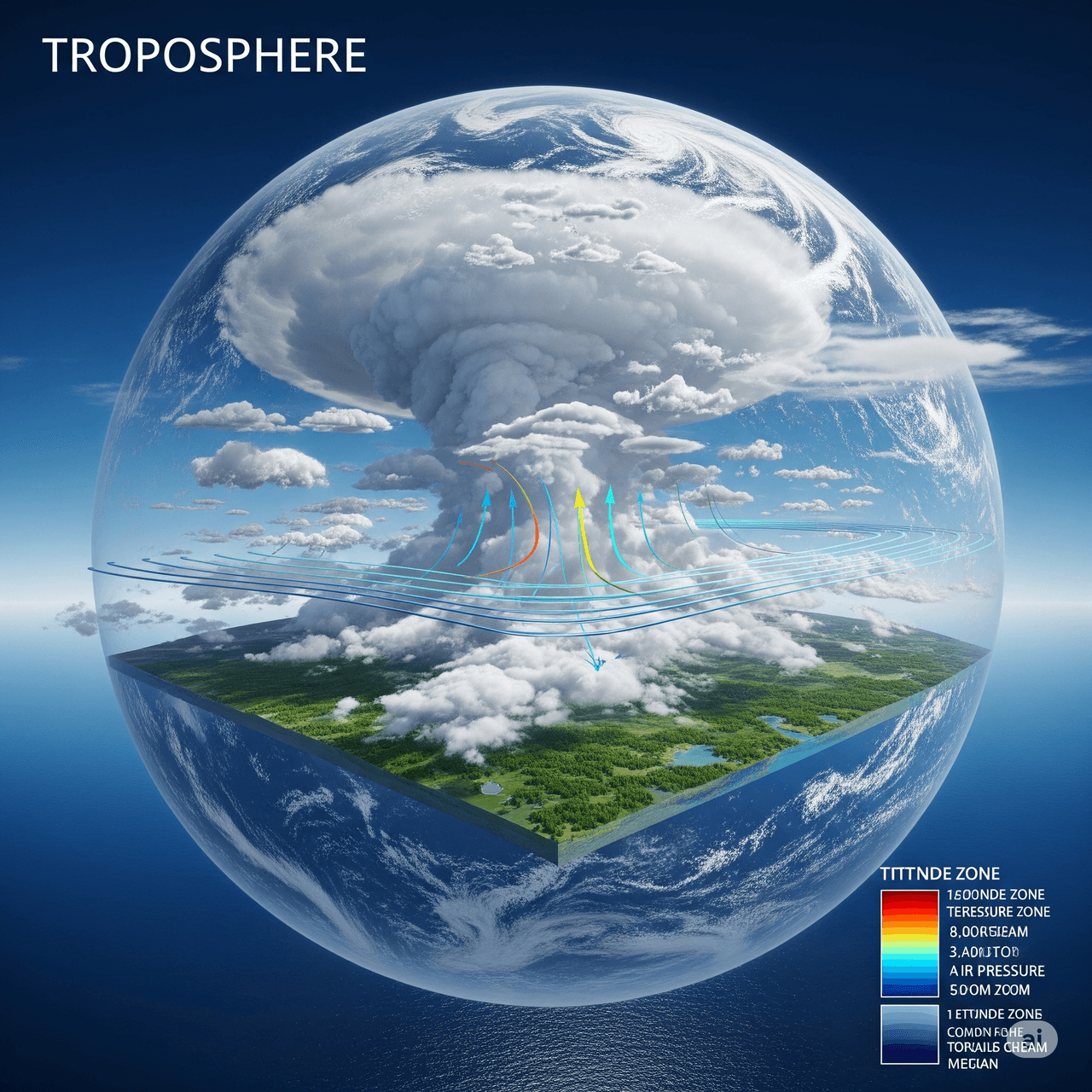
Troposphere
The troposphere is the layer of Earth’s atmosphere closest to the surface, and nearly all meteorological phenomena occur within this region. Approximately 75 to 80 percent of the atmosphere’s total mass is concentrated here. The surface, warmed by absorption of solar radiation, triggers vertical convection within the troposphere. These vertical motions form the basis of processes such as cloud formation, precipitation systems, and the transport of heat and moisture. The thermodynamic structure a
ENOkan Kanpolat
ThThermal Convection Process
Thermal convection is one of the fundamental mechanisms of heat transfer in the atmosphere. This process is based on the principle that warmed air rises and cooled air sinks. When the Earth’s surface is heated by incoming shortwave solar radiation, the air layer in direct contact with the surface also warms and rises due to decreased density. Cooler, denser air then descends to replace it, initiating convective motion. Convection can be observed not only in the atmosphere but also in liquids and
EN
Ahmet Burak Taner

Meteorology
Meteorology is the scientific study of atmospheric phenomena. Derived from the Greek word "meteorologia," it means the study of celestial phenomena. This science encompasses a much broader field than just daily weather forecasting, including climate change, global warming, storms, wind patterns, and precipitation systems. Meteorology investigates the physical and chemical properties of the atmosphere, makes predictions about the future based on past data, and seeks to understand the scientific b
EN
Gülsüm Yıldırım
HyHydrometeorology
Weather phenomena refer to short-term physical conditions observed in the atmosphere at a specific time and location. These phenomena are typically defined by the observation of meteorological variables such as temperature, wind, humidity, pressure, cloud cover, and types of precipitation. Phenomena such as rain, snow, hail, fog, lightning, and storms are among the most commonly encountered weather events. These events not only reflect the state of the atmosphere but also directly impact land, s
EN
Aslı Öncan
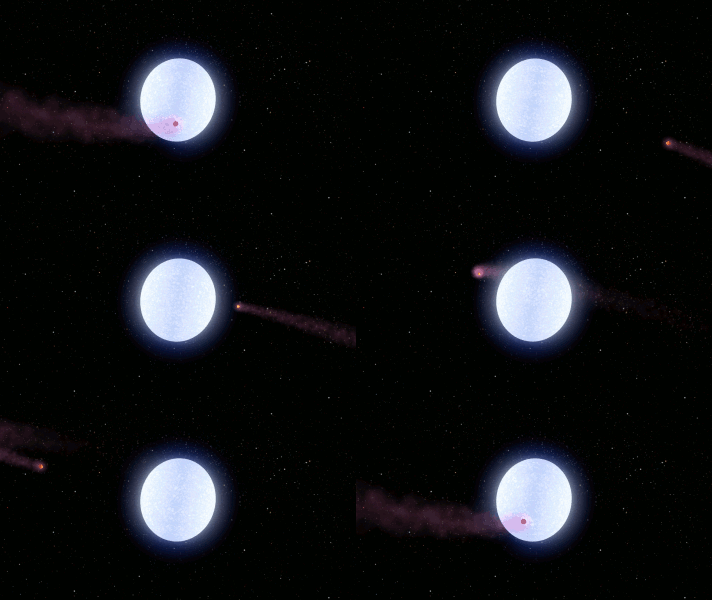
KELT-9b
KELT-9b is a gas giant exoplanet that stands out among extrasolar planets due to its physical and atmospheric properties. Discovered in 2016, it has become a significant subject in scientific research as one of the planets with the highest surface temperatures ever detected. Discovery Information KELT-9b was discovered in 2016 as part of the KELT (Kilodegree Extremely Little Telescope) project. This discovery was made during a sky survey led by Ohio State University in the United States. The fin
EN
Osman Özbay
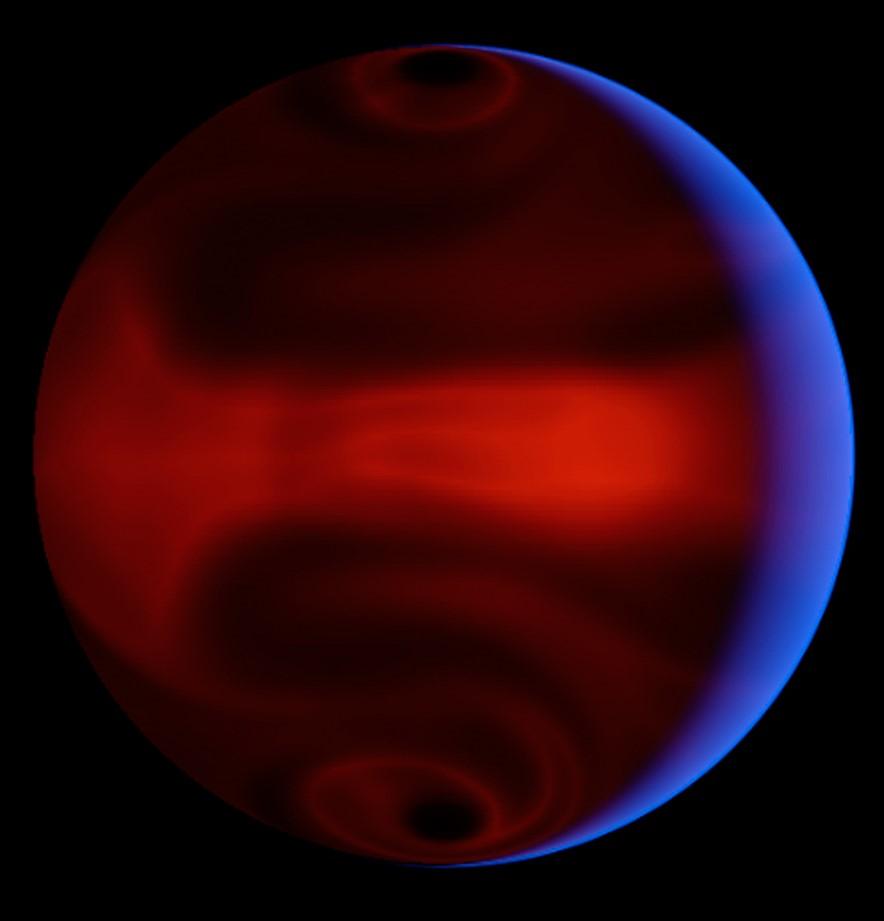
HD 80606b
HD 80606b is a gas giant with remarkable physical and orbital characteristics among exoplanets outside the Solar System. It orbits HD 80606, a G5V-type main-sequence star similar to the Sun, located in the Pegasus constellation approximately 190 light-years from Earth. This planet is particularly notable for its highly eccentric orbit and the abrupt temperature fluctuations this causes. HD 80606b was first discovered in 2001 using the radial velocity method. Physical and Orbital Characteristics
ENOsman Özbay

Pink Northern Lights
Pink Northern Lights are a rare natural phenomenon observed in the sky. They occur when charged particles from the Sun reach Earth’s atmosphere and produce light. Typically appearing at an altitude of 100 km, they emit vibrant colors. They are especially visible during winter months in polar regions.
EN
Oksana Gülünay
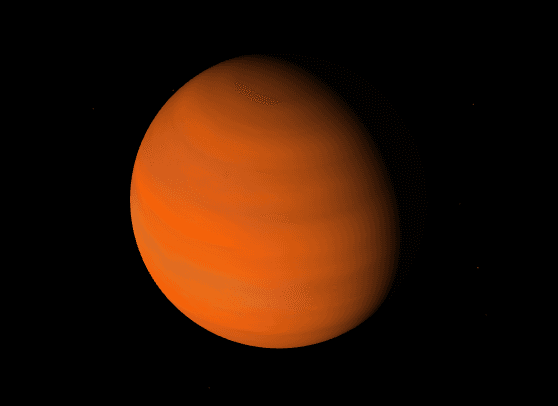
WASP-96b
WASP-96b is a gas giant exoplanet of the “hot Saturn” type, located approximately 1,150 light years from the Solar System in the direction of the Phoenix constellation. It orbits very close to its host star, WASP-96. The planet gained worldwide recognition for being among the first scientific datasets released after the activation of the James Webb Space Telescope (JWST), which included its atmospheric spectrum. Observations have provided definitive evidence of water vapor as well as haze and cl
EN
Erhan Şencan