


This article was automatically translated from the original Turkish version.

Being an UI/UX designer is sometimes like walking through a museum.
As you navigate an interface, you might think, "This feels familiar… from somewhere."
Could that familiarity come from Monet’s misty mornings or the clarity of Bauhaus?
Art does not live only on walls—it lives on our screens too.
If you’re ready, let’s brush through several art movements using the color palette of user experience.
Classical art venerates the beauty of order and proportion. Think of the symmetry in Michelangelo’s sculptures.
Now close your eyes and imagine Apple’s website. Everything is measured. Even the empty spaces breathe.
Impressionists sought to capture the play of light and the emotion of a fleeting instant.
Today’s user experience stands out not only through functionality but also through what it evokes.
Micro-animations, warm transitions, and emotional color palettes…
In design, there is no room for excess. No unnecessary ornamentation, no superfluous detail… Bauhaus venerates functional simplicity. Minimal yet powerful.
The curl of a flower, the grace of a branch… Art Nouveau does not imitate nature—it dances with it.
Today, some interfaces mirror this style: fluid, artistic, and delicately detailed.
Less is not the goal—rawness is. In the brutalist approach, it is not aesthetics but reality that takes center stage.
Fonts are bold, colors are contrasting, rules are stretched or entirely ignored. To some it is bold; to others, the beauty of ugliness.
Art is not merely an aesthetic concern. It is a reflection of a feeling, a thought, an era.
Just as interfaces are.
UI is not just about how it looks—it is about how it feels, how it tells a story.
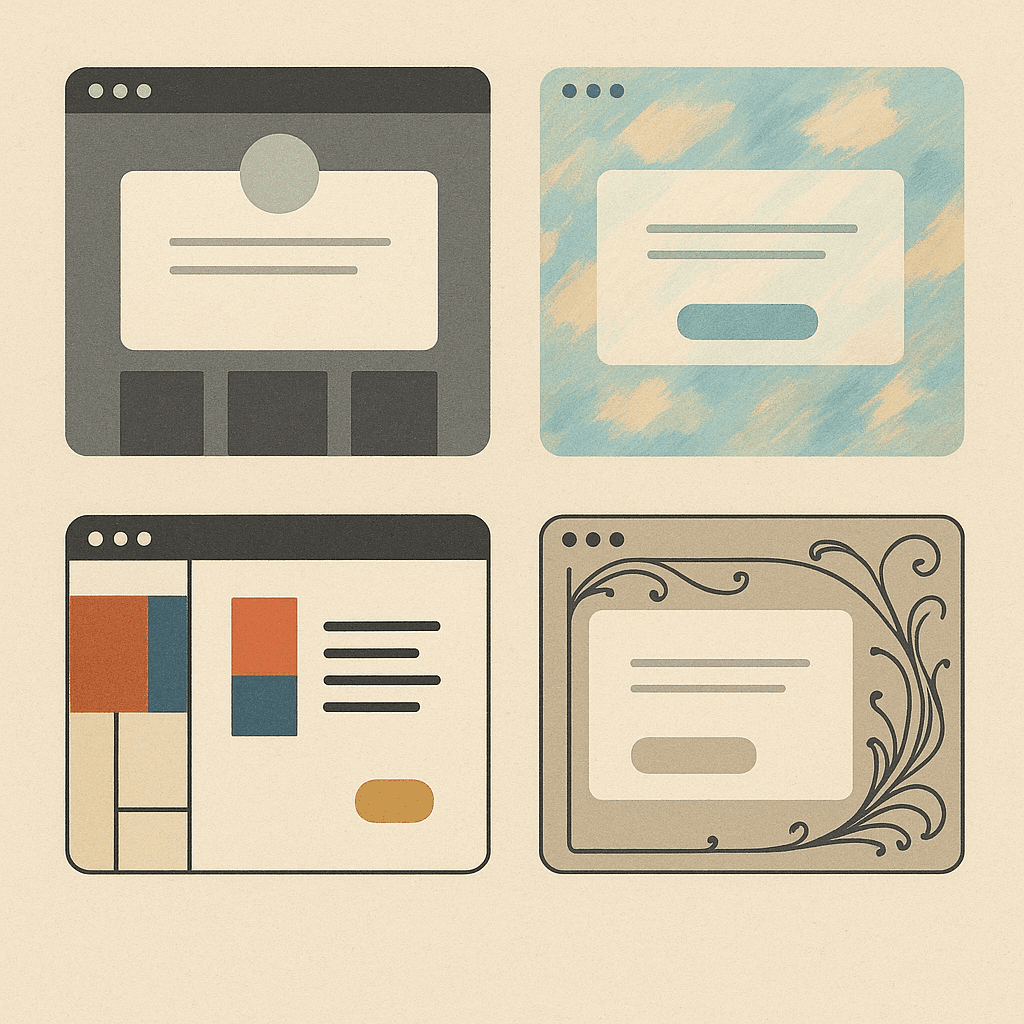
A representative image illustrating the influence of art on interfaces. (Generated by artificial intelligence.)
Lidwell, William, Kritina Holden, and Jill Butler. Universal Principles of Design. Rockport Publishers, 2010. Meggs, Philip B., and Alston W. Purvis. Megg’s History of Graphic Design. John Wiley & Sons, 2016. Papanek, Victor. Design for the Real World. Thames and Hudson, 1985. Interaction Design Foundation. "UX Design Resources." Accessed May 15, 2025. https://www.interaction-design.org/ Nielsen Norman Group. "The Aesthetic-Usability Effect." Accessed May 15, 2025. https://www.nngroup.com/articles/aesthetic-usability-effect/ Smashing Magazine. "UX Design." Accessed May 15, 2025. https://www.smashingmagazine.com/category/uxdesign/ Tate Modern. "Art Movements Glossary." Accessed May 15, 2025. https://www.tate.org.uk/art/art-terms UX Collective. "The Golden Ratio in UI Design." Accessed May 15, 2025. https://uxdesign.cc/the-golden-ratio-in-ui-design-75e8c35eaac3
Classicism: "Perfection lies within repetition."
Its echo in UI/UX:
Impressionism: "Can an interface capture a moment?"
Its echo in UI/UX:
Bauhaus: "Form follows function."
Its echo in UI/UX:
Art Nouveau: "Wrap the user in fluid lines."
Its echo in UI/UX:
Brutalism: "Show the code as it is."
Its echo in UI/UX:
Why Does This Matter So Much?
Bonus: 3 Suggestions to Inspire Your Designs