


This article was automatically translated from the original Turkish version.
+2 More
Vilayet (province) is the largest administrative unit, governed by a vali, and encompasses subordinate units such as sancak/liva, kaza, nahiye, and village, following the 1864 Vilayet Nizamnamesi. 【1】 The everyday and dictionary meaning of the term is defined as "the largest administrative division under a vali, a province"; it also refers to "the building where the vali performs his duties, the vali’s office." In earlier usages, it also carried meanings such as "region, country, homeland, and the right to exercise control over something." 【2】

Administrative Map of the Ottoman Vilayets in 1899 (Library of Congress)
During the classical Ottoman period, the basic unit of provincial administration was the sancak. Several sancaks combined to form larger administrative regions known as beylerbeylik or eyalet. The eyalet was headed by a beylerbeyi or vali, while the sancaks were administered by sancak beys. This structure emerged from military and fiscal needs. The term “vilayet” was used more broadly and flexibly in early periods, sometimes referring to any administrative region or territory, whereas “eyalet” gradually became the more distinct term for the highest provincial unit. 【3】 Before the Tanzimat, provincial administration featured various authority figures such as valis, mutasarrıfs, mütesellims, voyvodas, and muhassıls. The decline of the timar system, the rise of iltizam and malikane practices, and the strengthening of local notables and ayan weakened central control over the provinces. Consequently, during the Tanzimat period, the reorganization of provincial administration was viewed not merely as an administrative reform but as a matter of fiscal centralization and political control. 【4】
Following the Tanzimat Fermanı of 1839, the state initiated new administrative experiments to establish more orderly tax collection, ensure security, and strengthen central authority in the provinces. The first phase involved establishing the muhassıllık system; subsequently, in 1842, the muhassıllık system was abolished and a new structure based on eyalet, sancak, and kaza was introduced. During this period, the kaza ceased to be merely a judicial unit and acquired administrative status. 【5】 The 1849 reforms further clarified the roles of eyalet and sancak councils and redefined the duties of the vali, defterdar, kaymakam, and kaza directors. 【6】
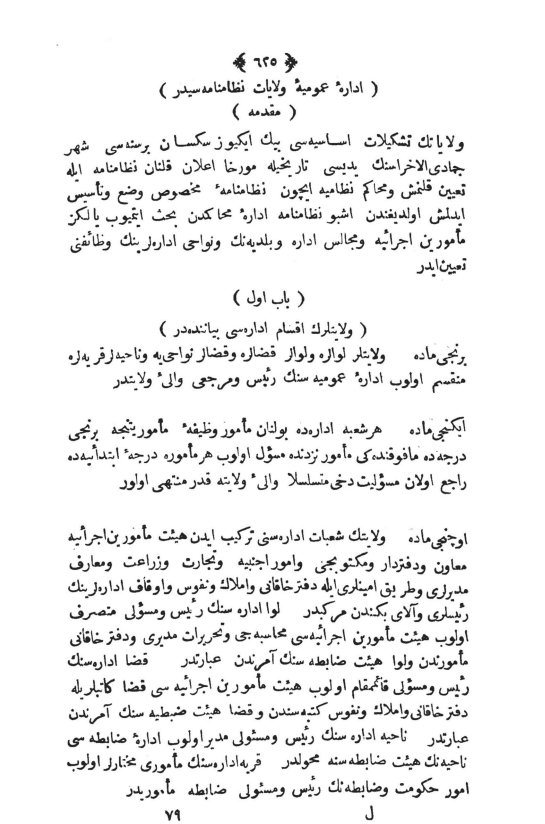
Text of the 1871 İdare-i Umumiye-i Vilâyet Nizamnamesi: Introduction and First Articles (TBMM Library)
The institutional meaning of the term “vilayet” in Ottoman provincial administration became clearly defined with the 1864 Tuna Vilayeti Nizamnâmesi. This reform was first implemented in the newly formed Tuna Vilayet, created by merging the eyalets of Niş, Vidin, and Silistre. Although the Nizamname was designed for the entire empire, it was initially applied as a pilot project. Midhat Pasha’s implementation in the Tuna region played a decisive role in the rapid expansion of the new system. 【7】
1867 Vilayet-i Umumiye Nizamnamesi was proclaimed, extending the application of the 1864 Vilayet Nizamnamesi. This reform did not introduce a new text but rather expanded the vilayet system, initiated in the Tuna Vilayet, to other regions of the empire. The Nizamname formalized the replacement of the term “eyalet” with “vilayet” and generalized the new vilayet administrative structure. As a result, new vilayets were established in Anatolia and Rumelia; Ankara, Kastamonu, Sivas, Hüdavendigar, İzmir, Konya, Trabzon, Diyarbakır, Cezayir-i Bahr-i Sefid, Selanik, Yanya, and Prizren were organized as vilayets during this period. The overall administrative structure of the 1871 reform remained largely unchanged from the 1864 model; changes primarily concerned the broader application of the system and adjustments to local conditions in certain vilayets.
1871 İdare-i Umumiye-i Vilayet Nizamnamesi elaborated on the structure established in 1864. This reform clearly defined the administrative hierarchy of vilayet, sancak, kaza, nahiye, and village. The civil bureaucracy’s role in the provinces was expanded under the 1871 reform; administrative councils, general councils, and municipal organizations gained more prominent positions within the vilayet system. 【8】
The 1864 Vilayet Nizamnamesi established a new administrative hierarchy in Ottoman provincial governance based on the vilayet. Under this reform, the vilayet became the largest provincial unit. Vilayets consisted of liva or sancaks, which in turn comprised kazas, and kazas consisted of karye or villages. Although nahiye was included in a limited capacity under the 1864 system, it became a more distinct administrative level between kaza and village under the 1871 Vilayet Nizamnamesi. Thus, provincial administration was organized into the following hierarchy: vilayet, liva/sancak, kaza, nahiye, and village. 【9】
The vali, at the head of the vilayet, was the highest civil authority in the province. The vali was assisted by a defterdar, mektupçu, and other provincial officials. The liva or sancak was administered by a mutasarrıf, who was accountable to the vali of the parent vilayet. The kaza was headed by a kaymakam, and administrative affairs of the subordinate nahiyes and villages were supervised through this level. The nahiye director maintained administrative links between the villages within the nahiye and the kaza center. In villages, the muhtar and the ihtiyar meclisi served as the primary local officials. 【10】
Efe, Ayla. “Tanzimat’ın Eyalet Reformları 1840-64: Silistre Örneği.” *Karadeniz Araştırmaları* 6, no. 22 (2009): 87–113. Accessed June 15, 2026. https://izlik.org/JA27SS79FN
Gençoğlu, Mustafa. “1864 ve 1871 Vilâyet Nizamnamelerine Göre Osmanlı Taşra İdaresinde Yeniden Yapılanma.” *Çankırı Karatekin Üniversitesi Sosyal Bilimler Enstitüsü Dergisi* 2, no. 1 (2011): 29–50. Accessed June 15, 2026. https://izlik.org/JA36NP64FR
Huber, R. *Empire Ottoman: Division Administrative*. Map. [S.l.: s.n.], 1899. Library of Congress, Geography and Map Division. Accessed June 15, 2026. https://www.loc.gov/item/2007633930
Kılıç, Selda Kaya. “1864 Vilayet Nizamnamesinin Tuna Vilayetinde Uygulanması ve Mithat Paşa.” *Tarih Araştırmaları Dergisi* 24, no. 37 (2005): 99–111. Accessed June 15, 2026. https://dergipark.org.tr/tr/pub/tariharastirmalari/article/603852
Ortaylı, İlber. Tanzimat Devrinde Osmanlı Mahalli İdareleri (1840-1880). Ankara: Türk Tarih Kurumu, 2020.
Torun, Sadık Fatih. “Vilâyet kanunlarına göre sancak (Livâ) idare meclisleri”. Tarih Araştırmaları Dergisi 35, no. 60 (2016): 157–174. Accessed June 15, 2026. https://doi.org/10.1501/Tarar_0000000647
Çadırcı, Musa. “Türkiye’de Kaza Yönetimi (1840-1876).” *Belleten* 53, no. 206 (1989): 237–258. Accessed June 15, 2026. https://dergipark.org.tr/tr/pub/ttkbelleten/article/958002
Çoban, Mehmet Salih. “1864 Tuna Vilayet Nizamnamesi.” *KÜRE*. July 19, 2025. Accessed June 15, 2026. https://kureansiklopedi.com/tr/detay/1864-tuna-vilayet-nizamnamesi-a010e
Çoban, Mehmet Salih. “Vilayet (Sözlük).” *KÜRE*. January 6, 2025. Accessed June 15, 2026. https://kureansiklopedi.com/tr/detay/vilayet-sozluk
“İdare-i Umumiye-i Vilâyet Nizamnamesi.” *Düstur*, Tertib 1, Volume 1, Issue 1289, 625. Accessed June 15, 2026. https://acikerisim.tbmm.gov.tr/items/943870e6-d252-4eeb-a24d-eddaad616be8
[1]
Mehmet Salih Çoban, "1864 Tuna Vilayet Nizamnamesi," KÜRE 19 July 2025, Access: 15 June 2026, https://kureansiklopedi.com/tr/detay/1864-tuna-vilayet-nizamnamesi-a010e.
[2]
Mehmet Salih Çoban, “Vilayet (Dictionary),” KÜRE, 6 January 2025, access 15 June 2026, https://kureansiklopedi.com/tr/detay/vilayet-sozluk.
[3]
Ayla Efe, “Tanzimat’s Eyalet Reforms 1840-64: The Silistre Example,” Karadeniz Araştırmaları 6, no. 22 (2009): 87-88, Access: 15 June 2026, https://izlik.org/JA27SS79FN. Sadık Fatih Torun, “Sancak (Liva) Administrative Councils According to the Vilayet Laws,” Tarih Araştırmaları Dergisi 35, no. 60 (2016): 158, Access: 15 June 2026, https://doi.org/10.1501/Tarar_0000000647.
[4]
Efe, “Tanzimat’ın Eyalet Reformları,” p. 88; Mustafa Gençoğlu, “Reorganization of Ottoman Provincial Administration According to the 1864 and 1871 Vilayet Nizamnameleri,” Çankırı Karatekin Üniversitesi Sosyal Bilimler Enstitüsü Dergisi 2/1 (2021): 30-31, Access: 15 June 2026, https://izlik.org/JA36NP64FR.
[5]
Musa Çadırcı, “Kaza Administration in Turkey (1840-1876),” BELLETEN 53/206 (1989): 237-238, Access: 15 June 2026, https://dergipark.org.tr/tr/pub/ttkbelleten/article/958002.
[6]
Selda Kaya Kılıç, “Implementation of the 1864 Vilayet Nizamnamesi in the Tuna Vilayet and Midhat Pasha,” Tarih Araştırmaları Dergisi 24, no. 37 (2005): 100, Access: 15 June 2026, https://dergipark.org.tr/tr/pub/tariharastirmalari/article/603852.
[7]
Gençoğlu, “1864 ve 1871 Vilâyet Nizamnameleri,” p. 35.
[8]
Gençoğlu, “1864 ve 1871 Vilâyet Nizamnameleri,” 35-36; Ortaylı, Tanzimat Devrinde Osmanlı Mahalli İdareleri, 64-65.
[9]
Çoban, "1864 Tuna Vilayet Nizamnamesi".
[10]
İlber Ortaylı, Tanzimat Devrinde Osmanlı Mahalli İdareleri (1840-1880), (Ankara: Türk Tarih Kurumu, 2020), 71-79.


Transition to the Vilayet System During the Tanzimat
Administrative Hierarchy and Officials