


This article was automatically translated from the original Turkish version.
Official Name | Tuvalu | ||||||||
|---|---|---|---|---|---|---|---|---|---|
Location | Located north of Fiji and northeast of Australia. South Pacific Ocean | ||||||||
Area | 26 km² | ||||||||
Population | Approximately 11,000 people | ||||||||
Official Language | English Tuvaluan | ||||||||
Form of Government | Constitutional Monarchy and Parliamentary Democracy | ||||||||
Currency | Australian Dollar (AUD) | ||||||||
Religion | Protestantism | ||||||||
Tuvalu is a small island nation located in the Pacific Ocean. With a total area of 26 km², Tuvalu is the second smallest country in the world and consists of nine islands. These islands are bordered by Kiribati to the north, Fiji to the west, and New Zealand to the east. The capital, Funafuti, is renowned for its tropical climate and white sandy beaches. Due to its low elevation, Tuvalu faces significant risks from climate change and rising sea levels. Its economy relies on agriculture, fishing, and foreign aid. The national currency is the Australian Dollar, and the main sources of livelihood include coconut, copra, and fishing. Tuvalu became a member of the United Nations in 2000, a significant step that strengthened its international representation. Ethnically, the majority of the population consists of Polynesian Tuvaluans.
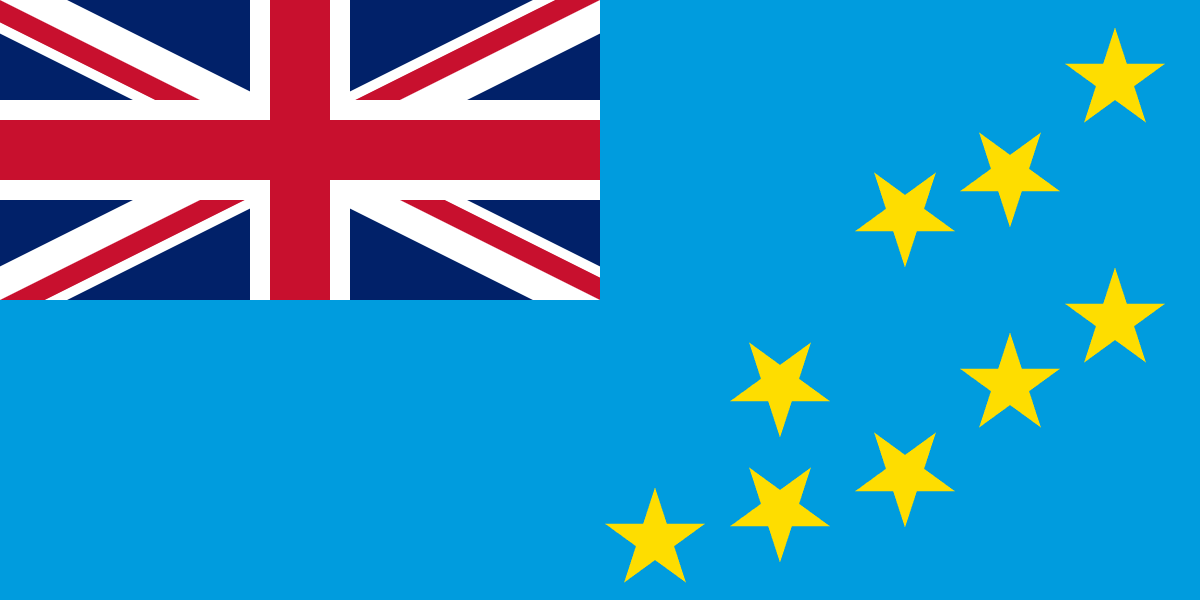
Flag of Tuvalu
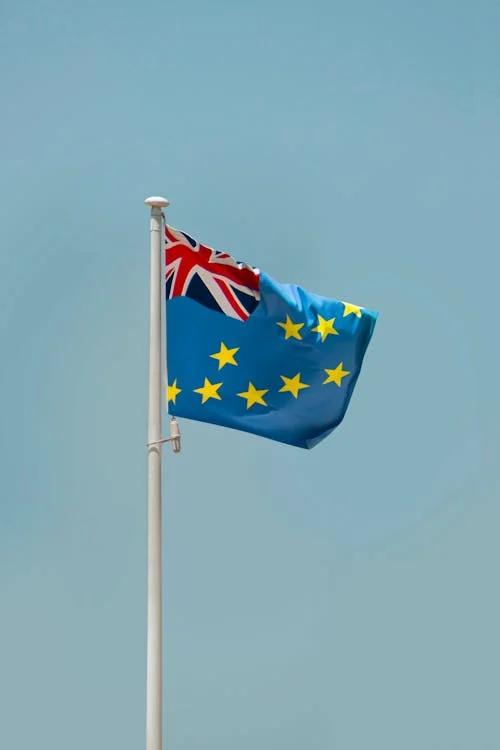
The flag of Tuvalu was adopted in 1978 following the country’s independence. The flag features a blue field with a small version of the United Kingdom’s Royal Standard, reflecting Tuvalu’s history as a former British colony. The Union Jack in the upper left corner symbolizes historical ties, while the eight stars at the bottom represent Tuvalu’s eight islands. Each star symbolizes one of the country’s islands and highlights its natural beauty and close connection to the ocean. The flag reflects Tuvalu’s struggle for independence and its national identity.
Name: Tuvalu mo te Atua - "Tuvalu to God"
Adopted: 1978
"Tuvalu mo te Atua" is the national anthem of Tuvalu, adopted in 1978 after independence. It expresses the people’s love for their homeland, their struggle for freedom, and their devotion to God. The anthem establishes a strong bond with Tuvalu’s cultural values and natural beauty. As an island nation, Tuvalu has a deep relationship with the ocean, and this anthem symbolizes the people’s connection to it. Adopted as the official national anthem alongside independence in 1978, "Tuvalu mo te Atua" represents a pivotal moment in the country’s history and the people’s respect for their liberty.
The first inhabitants of Tuvalu were seafarers from Polynesia who arrived approximately 3,000 years ago. These navigators crossed vast oceanic distances to settle on the islands and developed their own distinct cultures. On Nui Island, influences from Micronesian migrants are evident.
In 1568, Spanish explorer Álvaro de Mendaña became the first European to discover the Tuvalu islands. However, the islands attracted little European interest for a long time. It was not until the 19th century that missionaries and traders began arriving.
In 1892, Tuvalu came under British protection and became part of the Gilbert and Ellice Islands Colony.
In 1974, due to ethnic differences, the Ellice Islands (present-day Tuvalu) and the Gilbert Islands (present-day Kiribati) voted to separate. In 1978, Tuvalu declared independence and joined the British Commonwealth.
Tuvalu is a small island nation located in the Pacific Ocean south of the equator. With a total area of 26 km², Tuvalu is the second smallest country in the world. It consists of nine islands and has an average elevation of only three meters, making it one of the lowest-lying countries on Earth and one of the most vulnerable to climate change and rising sea levels.
Tuvalu has no land borders as it is composed entirely of islands in the Pacific Ocean. Its nearest neighbors are Kiribati, Fiji, and New Zealand. The country consists of islands and atoll groups connected by ocean routes.
Tuvalu is surrounded on all sides by the Pacific Ocean. Its coastline is lined with coral reefs, reflecting its close relationship with the ocean. The proximity of the sea makes maritime transport vital for Tuvalu. The ocean plays a fundamental role in the country’s livelihood through fishing. Moreover, this ocean sustains Tuvalu’s natural environment and holds a central place in the daily lives of its people, deeply influencing its culture.
Tuvalu consists of nine islands: Funafuti, Nanumea, Nanumaga, Niutao, Nukufetau, Vaitupu, Nukulaelae, Niulakita, and Motulalo. Funafuti, the capital, is the largest and most populous island. The other islands have smaller populations and contribute to the economy through natural resources such as agriculture and fishing.
Tuvalu is a tropical island nation characterized by warm and humid conditions. Located in the Pacific Ocean, Tuvalu experiences consistently warm and moist weather throughout the year. Its low elevation and flat topography make it particularly vulnerable to environmental risks such as tropical storms and sea level changes.
Tuvalu’s climate results in nearly constant temperatures throughout the year. The annual average temperature is around 28°C. There is no significant difference between winter and summer temperatures. Temperatures range between 25°C and 32°C year-round, but humidity levels are very high, making the heat feel more oppressive.
Rainfall occurs regularly throughout the year, and the region has adopted a generally humid climate. The wettest period is the summer season from November to March. During this time, Tuvalu is susceptible to tropical storms and cyclones. The country receives approximately 3,000 mm of rainfall annually, which can intensify due to tropical storms.
Tuvalu lies within the Pacific Ocean’s tropical storm belt. As a result, the country frequently faces tropical storms and cyclones. Cyclones are most intense from November to April, posing serious threats to Tuvalu’s population and infrastructure. This condition makes Tuvalu’s climate more vulnerable compared to other regions.
Winds also play an important role in Tuvalu’s climate. Throughout the year, oceanic winds affect Tuvalu and can alter sea currents and air flow between islands. Winds can intensify significantly as tropical storms approach.
All of Tuvalu’s islands are relatively close to each other, and climatic differences between them are generally not pronounced. However, some islands may receive more rainfall than others and be exposed to different wind directions. Funafuti, as the capital and largest island, has a higher population density and consequently more developed infrastructure than the other islands.
Tuvalu’s low elevation makes its climate even more sensitive. As sea levels rise, Tuvalu’s land area is gradually shrinking, with parts of the islands becoming submerged. Climate change and rising sea levels constitute a serious threat to Tuvalu’s future.
Tuvalu is a small and isolated island nation in the Pacific Ocean and one of the countries with the lowest populations in the world. As of 2023, Tuvalu’s population is approximately 12,000. The population is shaped by the typical characteristics of island nations: low growth rates and high emigration rates. Due to limited resources, climate change, and the inherent challenges of island life, the population is not increasing rapidly.
The majority of Tuvalu’s population is concentrated in Funafuti, the capital. Funafuti serves as the country’s economic, cultural, and administrative center and is also its largest settlement. While the remainder of the population is distributed across the other islands, migration from coastal areas to inland regions has declined. The high population density in Funafuti, combined with the island’s limited land area and infrastructure, creates pressure on housing and natural resources.
Tuvalu’s urbanization rate remains relatively low, encompassing only 42% of the total population. Many island residents live in rural or coastal areas, and strangely, the majority of the island population sustains itself through agriculture and fishing, leading to a life heavily dependent on external support.
Although Tuvalu is culturally diverse, it is ethnically homogeneous. The vast majority of the population consists of Polynesian Tuvaluans. Tuvalu’s ethnic structure is similar to that of other Pacific island nations, with the majority of the population identifying as ethnically Tuvaluan.
Although Tuvalu is officially a secular state, the majority of the population is Christian. Christianity is an integral part of Tuvalu’s social structure and the most widespread belief system. The majority of the island population belongs to the Evangelical Church of Tuvalu, a Protestant denomination.
Tuvalu has a well-developed education system with a very high literacy rate. The country’s education system focuses on promoting literacy and ensuring access to education from primary through higher levels.
Tuvalu’s education system is small and centralized. For higher education, students typically travel to nearby countries such as Australia, New Zealand, and Fiji.
Tuvalu is a small island nation situated in an isolated corner of the Pacific Ocean and plays a limited but significant role in international relations. Tuvalu’s foreign policy focuses primarily on environmental sustainability, climate change, sea level rise, and regional cooperation. Although its global influence is small, Tuvalu has successfully raised its voice on international issues such as climate change and rising sea levels.
Tuvalu maintains close and strong relations with Australia and New Zealand. These two countries are Tuvalu’s most important providers of aid and trade partners. Australia and New Zealand provide Tuvalu with its largest economic assistance and infrastructure projects. Relations with both countries focus particularly on Tuvalu’s environmental challenges. Australia and New Zealand offer various climate funds and projects to help Tuvalu address difficulties related to climate change and sea level rise.
Tuvalu also collaborates with these countries through regional organizations such as the Pacific Islands Forum. This forum is a platform aimed at developing solutions to environmental issues in the Pacific region.
Although China is not a major trade partner for Tuvalu, it provides assistance in areas such as combating climate change and infrastructure development. China has contributed to some infrastructure projects aimed at helping Tuvalu and other islands combat sea level rise. However, given China’s growing regional influence and Tuvalu’s relationships with Western allies, Tuvalu manages its relations with China carefully.
Tuvalu has established limited relations with the European Union (EU), but the EU is one of the main actors supporting Tuvalu’s environmental and climate-related projects. Tuvalu receives support for environmental improvements and sustainable development initiatives through EU funding and aid programs. The EU shares Tuvalu’s concerns regarding climate change and sea level rise and supports regional and global efforts on these issues.
As a small island state in the Pacific Ocean, Tuvalu does not maintain a large armed force for direct military defense. However, it has certain security units to ensure national security and strengthen regional cooperation. Tuvalu’s defense policy focuses primarily on combating environmental threats, maritime security, international collaboration, and humanitarian aid operations. Additionally, Tuvalu’s military capacity is limited by its geographic location, low military spending, and international relations framework.
Tuvalu is a small island state in the Pacific Ocean whose economy is largely based on marine resources, international aid, and regional cooperation. Highly dependent on external factors, Tuvalu struggles to cope with threats such as global environmental changes, sea level rise, and other climatic factors. The country’s economy is also shaped by foreign aid and regional support.
Tuvalu’s economic structure faces numerous challenges due to limited natural resources, a small domestic market, and weak infrastructure. However, the country is attempting to promote sustainable tourism and international cooperation to mitigate the effects of global warming.
Tuvalu’s economy is small and externally dependent, primarily relying on external factors such as international trade, foreign aid, and fishing. The country also cooperates with the international community on regional climate change policies and environmental sustainability.
Tuvalu’s foreign trade is largely based on imports. Due to its limited domestic production capacity, the country imports a significant amount of consumer goods and infrastructure needs. Major import items include food products, fuel, construction materials, and machinery.
Tuvalu’s export potential is limited. Fishing is the main export activity, with marine products such as tuna contributing to the country’s economic growth. Most of its foreign trade is conducted with Australia, New Zealand, and other countries in the Asia-Pacific region.
Although Tuvalu is not an attractive market for foreign investors, it attracts some international investment in environmentally friendly and sustainable development projects. The country is particularly seeking support in areas such as combating climate change and rising sea levels. However, its small domestic market, weak infrastructure, and limited natural resources hinder the growth of direct foreign investment.
Tuvalu meets most of its energy needs through imports. The country has limited local energy production capacity, but renewable energy sources such as solar power hold significant potential for future energy infrastructure. Transportation infrastructure is also highly limited. Tuvalu’s island structure makes land transport difficult, and most trade is conducted by sea.
CIA The World Factbook. "Tuvalu." CIA, Accessed April 12, 2025.https://www.cia.gov/the-world-factbook/countries/tuvalu/.
T.C. Ministry of Foreign Affairs. "Tuvalu." Accessed April 12, 2025.https://www.mfa.gov.tr/sub.tr.mfa?dfa328a5-7c2c-8c1a-9c5a-b5bcc40589ca.
“Tuvalu.” *The Commonwealth*. Accessed April 12, 2025.https://thecommonwealth.org/our-member-countries/tuvalu.

Official Name | Tuvalu | ||||||||
|---|---|---|---|---|---|---|---|---|---|
Location | Located north of Fiji and northeast of Australia. South Pacific Ocean | ||||||||
Area | 26 km² | ||||||||
Population | Approximately 11,000 people | ||||||||
Official Language | English Tuvaluan | ||||||||
Form of Government | Constitutional Monarchy and Parliamentary Democracy | ||||||||
Currency | Australian Dollar (AUD) | ||||||||
Religion | Protestantism | ||||||||
Flag of Tuvalu
National Anthem of Tuvalu
History
Early Period
European Discovery and Colonial Era
Independence
Geography
Borders and Neighbors
Island Groups and Islands
Climate
Sea Level
Demographics
Key Demographic Indicators for 2024
Population Distribution and Urbanization
Largest Islands (Approximate 2023 Populations)
Ethnic Composition
Ethnic Distribution (2021 Data)
Religious Distribution
Religious Distribution (2021 Data)
Literacy Rate
Education Levels
International Relations
Relations with Australia and New Zealand
Relations with China
Relations with the European Union
Armed Forces
Economy
Foreign Trade and Economic Partners
Foreign Investment and Business Environment
Energy and Transportation Infrastructure