


This article was automatically translated from the original Turkish version.
+1 More
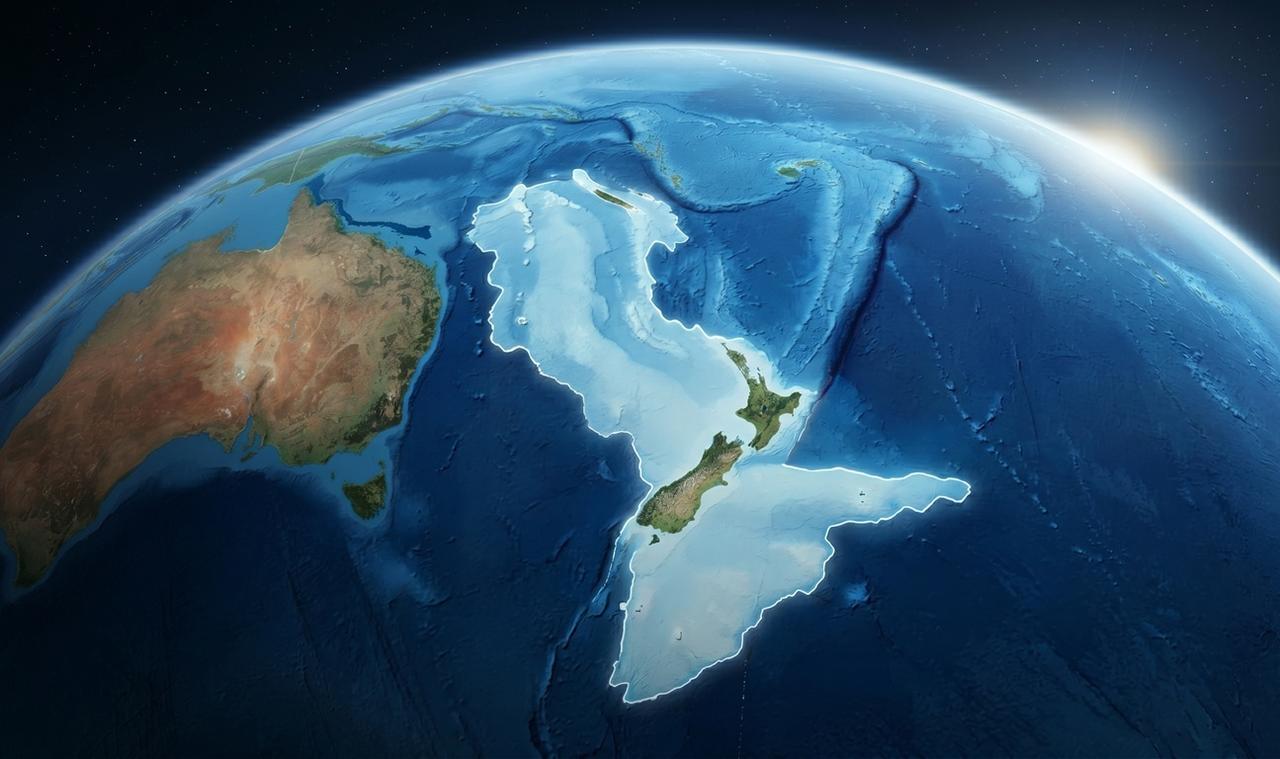
Created by Visual Artificial Intelligence
New Zealand
Age Range | The oldest known surface rocks are about 500 million years old (Paleozoic); however, Archean traces extending up to 3.5 billion years are found in the deep crust. | ||||||||
|---|---|---|---|---|---|---|---|---|---|
Geological Origin | It separated and became independent from the Gondwana supercontinent approximately 80-105 million years ago. | ||||||||
Surface Area | 4.9 - 5.37 million km² | ||||||||
Depth(s) | 94-95% of the continental mass lies below sea level its average modal depth is -1100 meters. | ||||||||
Definition(s) | A largely submerged geologically confirmed eighth continent in the southwestern Pacific Ocean. | ||||||||
Zealandia is a submerged continent with a vast surface area of 4.9 to 5.37 million square kilometers located in the southwest Pacific Ocean, encompassing the islands of New Zealand and New Caledonia. Approximately 94–95 percent of the continental mass lies below sea level. Recognized as the eighth continent, Zealandia was situated along the southern edge of the Gondwana supercontinent during earlier geological periods and later detached from the Australia-Antarctica margin to become an independent continent.【1】
Although the presence of continental crust in this region has been known for many years, the term “Zealandia” was first used in 1995 by Luyendyk to collectively describe New Zealand and surrounding submarine plateaus. The Māori-Pasifika-derived name “Te Riu-a-Māui,” proposed by academic Manuka Henare, refers to the legendary explorer Māui and evokes the image of a canoe’s hull (riu) alongside its valleys and plains.【2】
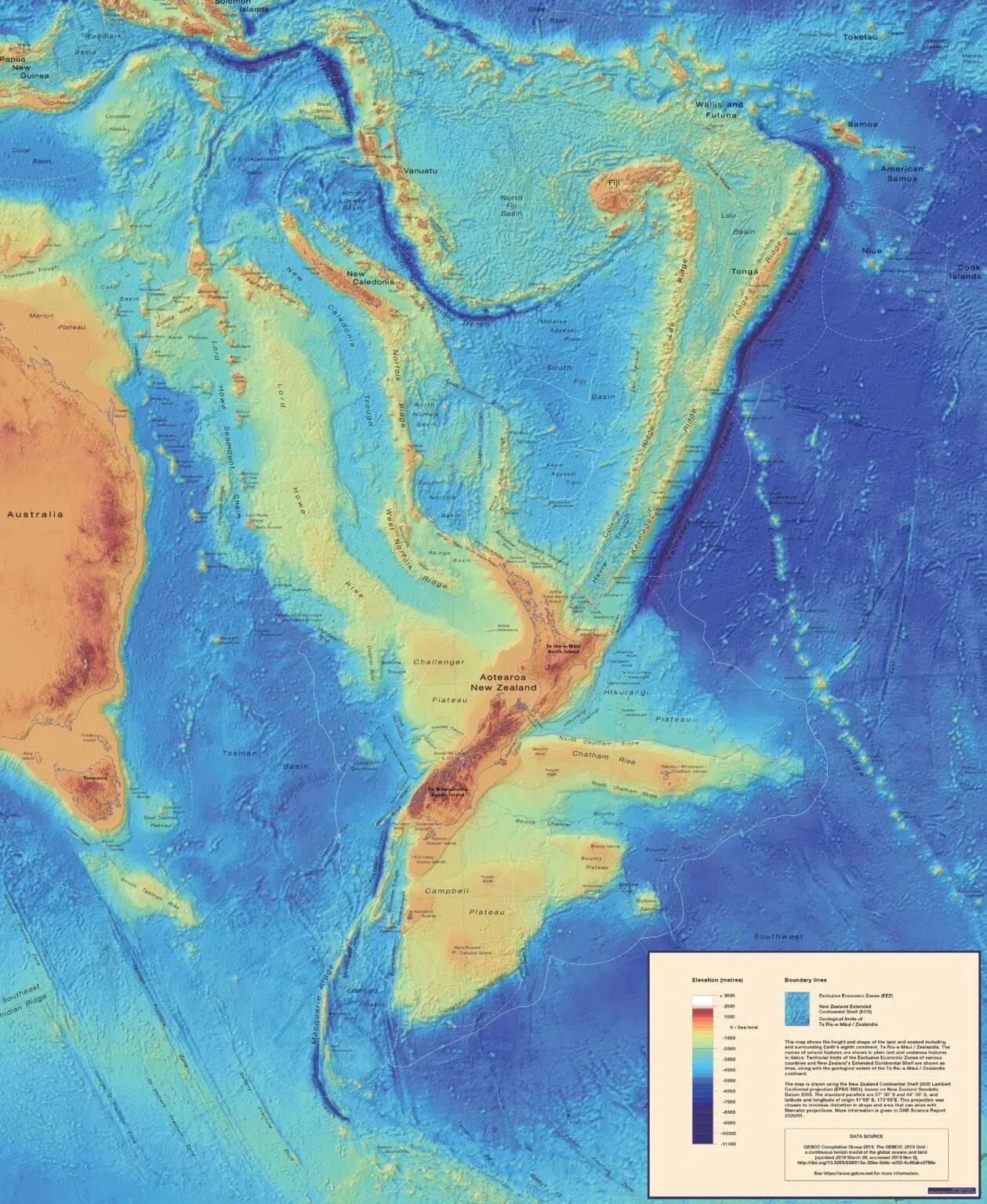
Bathymetric Map of Zealandia (mapasmilhaud.com)
Before Zealandia’s existence was confirmed, in 1977 Nur and Ben-Avraham, followed by Kamp in 1980, proposed the hypothetical continent “Pacifica,” which was thought to have fragmented and laterally dispersed across the Pacific Ocean. Data collected during the 1980s revealed that the Pacific Ocean ridges consisted not of continental crust but of thickened oceanic crust, leading to the abandonment of the Pacifica hypothesis.【3】
Zealandia possesses all the principal characteristics required for a landmass to be classified as a continent. These criteria include a distinct elevation above surrounding oceanic crust, a wide variety of silicic continental rocks, a thick and low-seismic-velocity crust compared to oceanic basins, and well-defined physical boundaries exceeding one million square kilometers.【4】
The average modal elevation of the submerged portion of the continent is approximately −1100 meters. The highest peak of Zealandia is Aoraki/Mount Cook, rising 3724 meters above sea level. The continental crust ranges in thickness from 10 to 30 kilometers, typically 20–25 kilometers, but exceeds 40 kilometers beneath certain regions such as the South Island. Seismic velocity data indicate P-wave velocities generally below 7.0 km/s.【5】
The oldest exposed portions of Zealandia’s crust date back approximately 500 million years. However, studies of lithospheric mantle xenoliths and detrital zircons have revealed materials from the Precambrian era ranging in age from 1200 to 3526 million years.
The basement rocks formed through episodic subduction and accretion processes along the Gondwana margin during the Phanerozoic. Approximately 105 million years ago, the collision of the Hikurangi oceanic plateau with the Gondwana continental margin, and its failure to subduct, terminated prolonged subduction and initiated extensional tectonics. Zealandia gradually rifted away from Gondwana between 80 and 60 million years ago and became fully separated around 55 million years ago.【6】
In the current tectonic configuration, the continental lithosphere is bounded by the Pacific and Australian plates. To the north, the Hikurangi subduction zone marks the westward subduction of the Pacific plate, while in the south, the Australian plate subducts eastward beneath Fiordland to form the Puysegur subduction zone. The Alpine Fault, connecting these two subduction zones, exhibits an oblique continental-continental collision with a right-lateral strike-slip motion of 28 mm per year, resulting in the vertical uplift of the Southern Alps at a rate of 6–9 mm per year.【7】
The surface geology of Zealandia is divided into two main structural groups: a folded crystalline basement formed between 540 and 105 million years ago, and overlying stratified units of the Zealandia Megasequence, deposited unconformably between 105 and 0 million years ago.【8】
The crystalline basement units are divided into three broad regions from west to east:
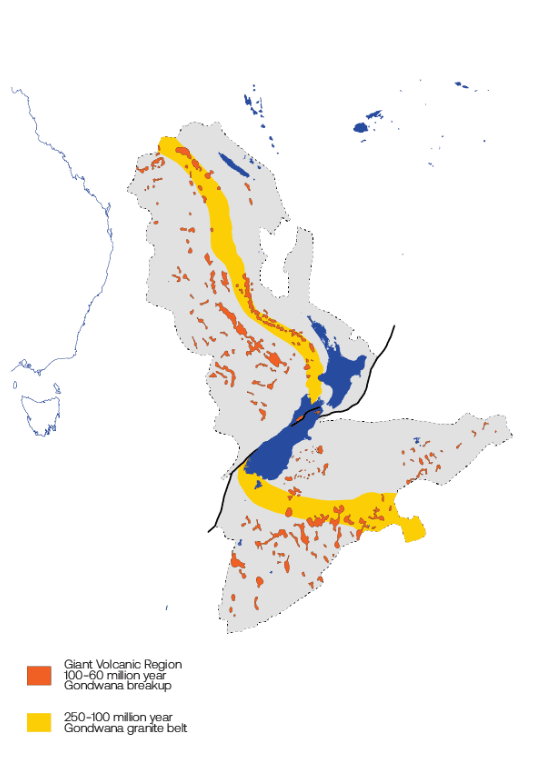
Mapped Zealandia Continent (GNS Science)
Post-Cretaceous cover units are classified into five main supergroups:
The “depth to base of magnetic sources” (DBMS) method is widely used to investigate the thermal structure of the continent. Analytical DBMS depth indicates the Curie temperature at which rocks within the crust lose their magnetism, corresponding generally to the reference value for magnetite (580°C).
Spectral mapping results over Zealandia show that magnetic base depths vary between 8.9 and 28.5 kilometers across the region. In the deeper regions beneath the South Island, this boundary reaches 28.5 kilometers, while in magnetically quieter areas it is found at depths of 26–28 kilometers. In the Taupo Volcanic Zone (TVZ), where magmatic rifting and a thin crust dominate, the thermal gradient is significantly higher, and DBMS depths shallower to between 8.9 and 12 kilometers. Discrepancies between heat flow analysis data and geothermal borehole measurements in areas dominated by plutonic rocks suggest that the titanomagnetite chemistry within plutons lowers the Curie decomposition temperature to approximately 500°C, below the assumed value.【9】
"Bathymetric map of Zealandia (2020)." Milhaud Maps. October 27, 2023. Accessed April 26, 2026. https://mapasmilhaud.com/en/geographical-maps/bathymetric-map-of-zealandia-2020/
"Zealandia just became the first continent to be completely mapped." GNS Science. October 9, 2023. Accessed April 26, 2026. https://www.gns.cri.nz/news/zealandia-just-became-the-first-ever-continent-to-be-completely-mapped/
Hodder, Peter. "The Zealandia continent: a worthy replacement for Pacifica?" *New Zealand Science Review* 74, no. 3: 59–65. Accessed April 26, 2026. https://ojs.victoria.ac.nz/nzsr/article/view/8491
Miller, C. A., A. Kirkby, N. Mortimer, F. Aden, J. Barretto, J. Black, et al. "The thermal structure of central Te Riu a Maui/Zealandia continent as determined from the depth to base of magnetic sources." *Journal of Geophysical Research: Solid Earth* 128 (2023): e2023JB027557. Accessed April 26, 2026. https://agupubs.onlinelibrary.wiley.com/doi/full/10.1029/2023JB027557
Mortimer, Nick, Hamish J. Campbell, Andy J. Tulloch, Peter R. King, Vaughan M. Stagpoole, Ray A. Wood, Mark S. Rattenbury et al. "Zealandia: Earth's Hidden Continent." Accessed April 26, 2026. https://archimer.ifremer.fr/doc/00489/60035/63303.pdf
Mortimer, Nick. "Tectonics, geology and origins of Te Riu-a-Māui / Zealandia." *New Zealand Journal of Geology and Geophysics* 68, no. 4 (2025): 531-567. Accessed April 26, 2026. https://www.tandfonline.com/doi/full/10.1080/00288306.2025.2500394
Scott, J. M., J. Liu, D. G. Pearson, G. A. Harris, T. A. Czertowicz, S. J. Woodland, A. J. V. Riches, and R. W. Luth. "Continent stabilisation by lateral accretion of subduction zone-processed depleted mantle residues; insights from Zealandia." *Earth and Planetary Science Letters* 507 (2019): 175-185. Accessed April 26, 2026. https://www.sciencedirect.com/science/article/pii/S0012821X18306988
[1]
J. M. Scott vd., "Continent stabilisation by lateral accretion of subduction zone-processed depleted mantle residues; insights from Zealandia," Earth and Planetary Science Letters 507 (2019): 1, erişim 26 Nisan 2026.https://www.sciencedirect.com/science/article/pii/S0012821X18306988
Nick Mortimer, "Tectonics, geology and origins of Te Riu-a-Māui / Zealandia," New Zealand Journal of Geology and Geophysics 68, sy. 4 (2025): 2,5, erişim 26 Nisan 2026.https://www.tandfonline.com/doi/full/10.1080/00288306.2025.2500394
Nick Mortimer vd., "Zealandia: Earth's Hidden Continent," 1, erişim 26 Nisan 2026.https://archimer.ifremer.fr/doc/00489/60035/63303.pdf
[2]
Nick Mortimer, "Tectonics, geology and origins of Te Riu-a-Māui / Zealandia," New Zealand Journal of Geology and Geophysics 68, sy. 4 (2025): 2, erişim 26 Nisan 2026.https://www.tandfonline.com/doi/full/10.1080/00288306.2025.2500394
[3]
Peter Hodder, "The Zealandia continent: a worthy replacement for Pacifica?," New Zealand Science Review 74, sy. 3: 1, erişim 26 Nisan 2026.https://ojs.victoria.ac.nz/nzsr/article/view/8491
[4]
Nick Mortimer vd., "Zealandia: Earth's Hidden Continent," 1,4, erişim 26 Nisan 2026.https://archimer.ifremer.fr/doc/00489/60035/63303.pdf
[5]
Nick Mortimer, "Tectonics, geology and origins of Te Riu-a-Māui / Zealandia," New Zealand Journal of Geology and Geophysics 68, sy. 4 (2025): 4, erişim 26 Nisan 2026.https://www.tandfonline.com/doi/full/10.1080/00288306.2025.2500394
Nick Mortimer vd., "Zealandia: Earth's Hidden Continent," 3,4, erişim 26 Nisan 2026.https://archimer.ifremer.fr/doc/00489/60035/63303.pdf
[6]
Nick Mortimer, "Tectonics, geology and origins of Te Riu-a-Māui / Zealandia," New Zealand Journal of Geology and Geophysics 68, sy. 4 (2025): 2,5,6,15, erişim 26 Nisan 2026.https://www.tandfonline.com/doi/full/10.1080/00288306.2025.2500394
J. M. Scott vd., "Continent stabilisation by lateral accretion of subduction zone-processed depleted mantle residues; insights from Zealandia," Earth and Planetary Science Letters 507 (2019): 1,2, erişim 26 Nisan 2026.https://www.sciencedirect.com/science/article/pii/S0012821X18306988
[7]
Nick Mortimer, "Tectonics, geology and origins of Te Riu-a-Māui / Zealandia," New Zealand Journal of Geology and Geophysics 68, sy. 4 (2025): 2,6,7, erişim 26 Nisan 2026.https://www.tandfonline.com/doi/full/10.1080/00288306.2025.2500394
[8]
Nick Mortimer, "Tectonics, geology and origins of Te Riu-a-Māui / Zealandia," New Zealand Journal of Geology and Geophysics 68, sy. 4 (2025): 9,1,11,12,13,15,16, erişim 26 Nisan 2026.https://www.tandfonline.com/doi/full/10.1080/00288306.2025.2500394
[9]
C. A. Miller vd., "The thermal structure of central Te Riu a Maui/Zealandia continent as determined from the depth to base of magnetic sources," Journal of Geophysical Research: Solid Earth 128 (2023): e2023JB027557, 1,4,10,12, erişim 26 Nisan 2026.https://agupubs.onlinelibrary.wiley.com/doi/full/10.1029/2023JB027557


Created by Visual Artificial Intelligence
New Zealand
Age Range | The oldest known surface rocks are about 500 million years old (Paleozoic); however, Archean traces extending up to 3.5 billion years are found in the deep crust. | ||||||||
|---|---|---|---|---|---|---|---|---|---|
Geological Origin | It separated and became independent from the Gondwana supercontinent approximately 80-105 million years ago. | ||||||||
Surface Area | 4.9 - 5.37 million km² | ||||||||
Depth(s) | 94-95% of the continental mass lies below sea level its average modal depth is -1100 meters. | ||||||||
Definition(s) | A largely submerged geologically confirmed eighth continent in the southwestern Pacific Ocean. | ||||||||
Naming and Conceptual Development
Continental Characteristics and Physical Structure
Geological History and Tectonic Evolution
Stratigraphy and Rock Structure
Basement Rocks
Zealandia Megasequence
Magnetic and Thermal Structure