This article was automatically translated from the original Turkish version.
Project Start | 2014 | ||||||||
|---|---|---|---|---|---|---|---|---|---|
Launch Date | 9 Temmuz 2024 | ||||||||
Orbital Position | 42° East | ||||||||
Total Mass | 4.220 kg | ||||||||
Design Life | 22.5 years | ||||||||
Mission Control Software | TStar-Go | ||||||||
Manufacturing Organizations | Ctech Aselsan TusAŞ Tübitak Uzay | ||||||||
International Cooperation | Freesat Lanka (Sri Lanka) | ||||||||
Launch Vehicle | Falcon 9 | ||||||||
Governing Institution | Türksat A.Ş. | ||||||||
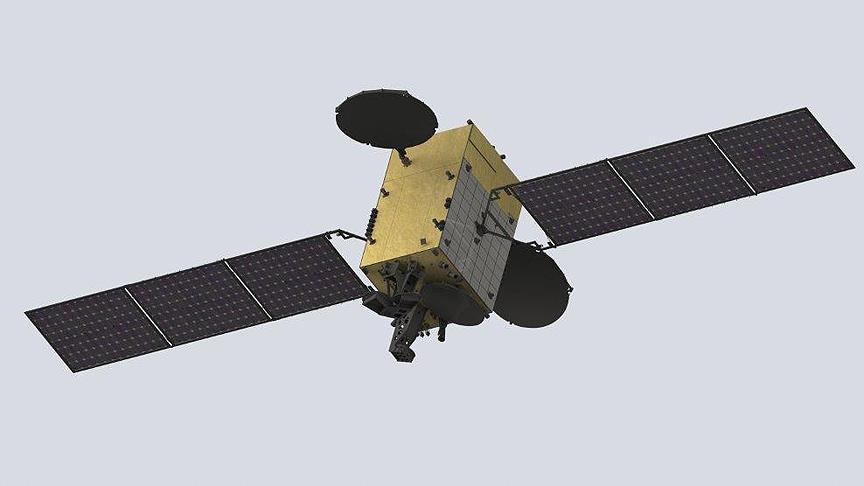
TÜRKSAT 6A is Türkiye’s first fully domestic and national communication satellite. It was developed through a collaboration between TUSAŞ, ASELSAN, and CTech under the project management of TÜBİTAK UZAY. With a launch mass of approximately 4.2 tons and a 16-year operational lifespan, the satellite operates in a geostationary orbit at 42° East. TÜRKSAT 6A provides communication and broadcasting services covering large parts of Türkiye, Europe, Asia, and Africa, featuring more than 20 transponders across multiple frequency bands. The project was launched into space on 9 July 2024 aboard a SpaceX Falcon 9 rocket and was commissioned into service in April 2025. All operational processes are conducted via the domestic mission control software platform TStar-GO developed by TÜBİTAK UZAY.
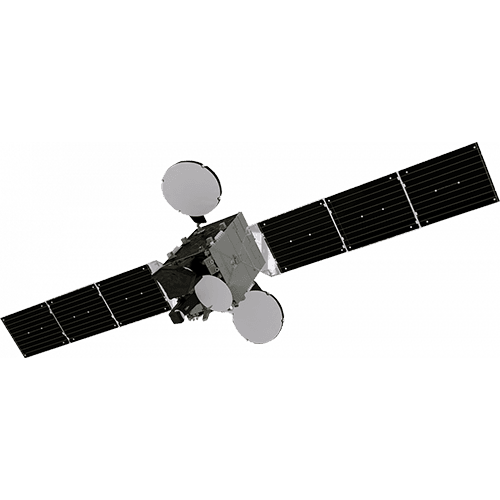
TÜRKSAT 6A National Communication Satellite (Tübitak Uzay)
The TÜRKSAT 6A project was initiated in 2014 with the goal of developing Türkiye’s first fully domestic communication satellite. The “TÜRKSAT-6A National Communication Satellite Project Agreement and Additional Protocol” was signed in the same year by the Ministry of Transport and Infrastructure, TÜBİTAK, and TÜRKSAT. By 2017, design and engineering work had reached completion, and production of qualification test models of the satellite had begun.
Between 2018 and 2022, the engineering model, thermal-structural qualification model, electrical-electronic model, and flight model were developed, and system-level tests were successfully conducted. In 2023, the integration process was completed, and launch preparations were planned to be carried out using SpaceX’s Falcon 9 rocket.
TÜRKSAT 6A was launched into space on 9 July 2024 from Cape Canaveral Space Force Station in Florida, United States, and conducted its first test broadcast on 17 February 2025. Following the completion of all system tests, it was officially commissioned on 21 April 2025 in a ceremony attended by President Recep Tayyip Erdoğan.
The TÜRKSAT 6A project was executed under TÜBİTAK’s 1007 Public Institution Research and Development Projects Support Program. It was funded by the Ministry of Transport and Infrastructure and TÜBİTAK, with TÜRKSAT A.Ş. serving as the end-user institution. The satellite was developed through collaboration between TÜBİTAK UZAY, TUSAŞ, ASELSAN, and CTech.
After the design phase was completed, the satellite’s engineering model (EM), thermal-structural qualification model (TSQM), electrical-electronic satellite model (EESM), and flight model (FM) were produced. System-level tests conducted on these models covered launch conditions and space environment simulations.
The majority of the software, hardware, and subsystems used in the development process were produced using domestic capabilities. The ground infrastructure was prepared to operate from the test and mission control centers established at the TÜRKSAT Gölbaşı Campus. Throughout the project, a workforce of engineers and a production infrastructure specialized in satellite technologies were developed.
TÜRKSAT 6A was launched into space on 9 July 2024 at 02:30 Türkiye time from Cape Canaveral Space Force Station in Florida, United States, aboard a SpaceX Falcon 9 rocket. The launch operation, delayed by approximately two hours due to weather conditions, was successfully completed.
Thirty-five minutes after launch, the satellite separated from the rocket, and its first signal was successfully received at the 65th minute, confirming communication with the ground control center. The first command was transmitted from the ground control center one hour after signal acquisition.
Following launch, TÜRKSAT 6A entered an elliptical temporary orbit with a perigee of 300 kilometers and an apogee of 70,000 kilometers. During this phase, the solar panels were deployed and power generation began. The satellite completed a four-stage maneuver using its chemical propulsion system to reach its final geostationary orbit at 42° East longitude.
Throughout the orbit insertion process, orbit determination, burn parameter calculation, burn command execution, and orbit control operations were conducted via the domestic mission control software TStar-GO. After all tests were completed, TÜRKSAT 6A was officially commissioned on 21 April 2025.
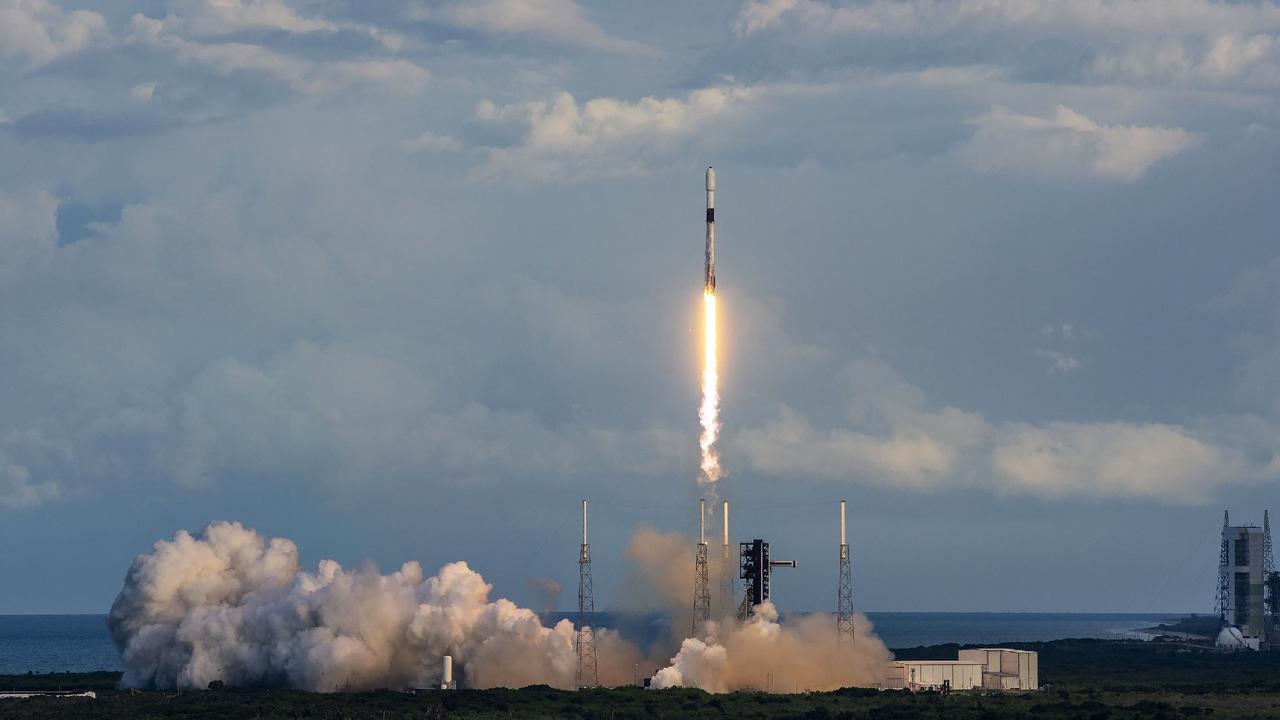
Launch of TÜRKSAT 6A aboard SpaceX Falcon 9 rocket from Cape Canaveral, Florida on 9 July 2024 (Tübitak Uzay)
TÜRKSAT 6A is designed to provide long-term communication services with a 16-year operational lifespan and a design lifespan exceeding 22.5 years. The satellite was launched on 9 July 2024, conducted its first test broadcast on 17 February 2025, and was officially commissioned on 21 April 2025.
Orbit insertion, testing phases, and commissioning procedures were completed according to the planned schedule. All these processes were conducted via the domestic mission control software TStar-GO developed by TÜBİTAK UZAY.
Among TÜRKSAT 6A’s achievements are the successful deployment of Türkiye’s first fully domestically produced communication satellite, thereby placing Türkiye among the 11 countries capable of launching their own communication satellites. Additionally, the domestic subsystems and equipment developed under the project have reduced Türkiye’s dependence on foreign technologies in satellite systems and established a reusable infrastructure for future space projects.
The mission control activities of TÜRKSAT 6A are conducted entirely through the fully domestic TStar-GO mission control software developed by TÜBİTAK UZAY. From launch through orbit insertion, testing, and commissioning, all operations were executed via this platform.
The mission control system performs functions including satellite system management, orbit maneuver planning, and mission operation monitoring. Communication, command transmission, and data reception between the satellite and ground control centers are also conducted through the same infrastructure.
System operations are managed from control centers located at the TÜRKSAT Gölbaşı Campus. All software, hardware, and monitoring systems used in operational processes are domestically produced. This structure constitutes one of the key components reducing external dependency in satellite mission planning and execution.
TÜRKSAT 6A provides services across a wide geographic area encompassing Türkiye’s Western and Eastern coverage regions. The satellite expands the coverage of existing TÜRKSAT communication satellites to include countries such as India, Thailand, Malaysia, and Indonesia.
Through more than 20 transponders operating in different frequency bands, the satellite delivers television broadcasting, communication services, and data transmission. This coverage structure is designed to serve a population of approximately 5 billion people.
The satellite’s high power capacity and wide bandwidth capabilities enable uninterrupted television and radio broadcasting, as well as efficient implementation of data communications and broadband applications. Following its commissioning, TÜRKSAT 6A began providing infrastructure for the broadcast of 50 television channels via Sri Lanka’s Freesat Lanka platform.
The TÜRKSAT 6A project was executed internationally while maintaining Türkiye’s priority for domestic production. The satellite was launched into space from Cape Canaveral Space Force Station in the United States aboard a SpaceX Falcon 9 rocket. The launch process was monitored simultaneously by Turkish engineering teams at both U.S. and Turkish mission control centers.
Following its commissioning, a capacity agreement was signed between TÜRKSAT and Sri Lanka’s Freesat Lanka broadcasting platform. Under this agreement, 50 television channels are now broadcasting via TÜRKSAT 6A, aiming to transform Türkiye’s satellite capacity into an international service export.
These collaborations represent the first international commercial steps taken to provide communication and broadcasting services within TÜRKSAT 6A’s coverage area.
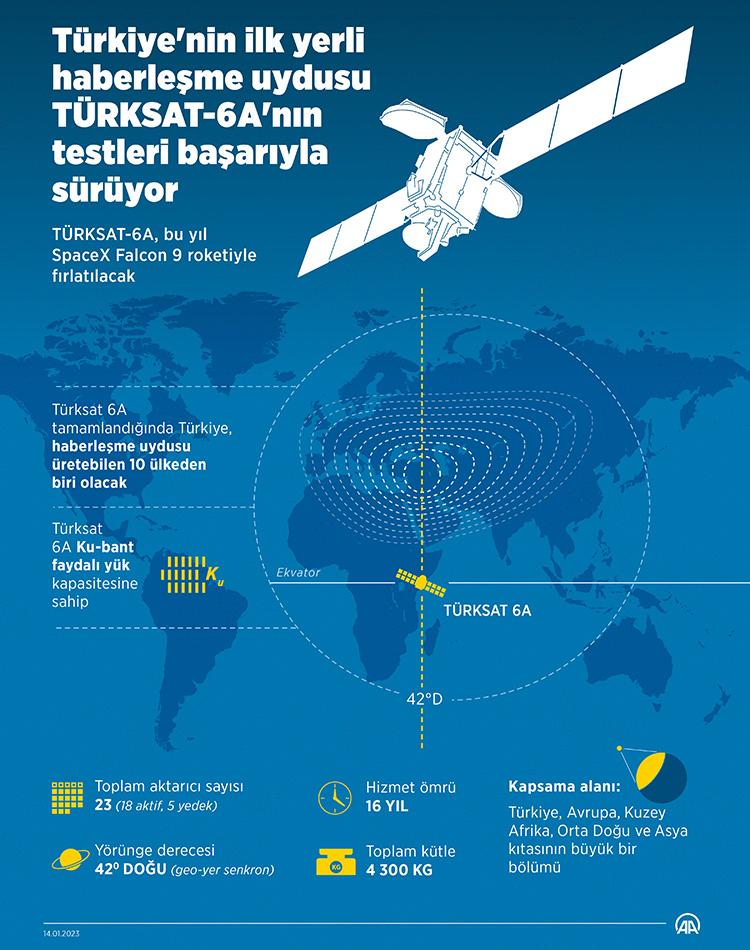
General Information on TÜRKSAT 6A National Communication Satellite (AA)
TÜRKSAT 6A is the first project enabling Türkiye to achieve full independent production capacity in satellite communications. Developed using domestic engineering expertise and national technologies, it has significantly reduced external dependency.
The hardware, software, and subsystems developed under the project have established a reusable infrastructure for future satellite and space missions. TÜRKSAT 6A has positioned Türkiye among the 11 countries capable of developing satellites using their own resources, marking a significant achievement in national space competency.
Additionally, the project has fostered new production and research capacities within Türkiye’s space ecosystem through collaboration between domestic industrial entities and universities. This has created a sustainable system in terms of both engineering infrastructure and human resources.
TÜRKSAT 6A is directly aligned with the objectives of Türkiye’s National Space Program. The engineering experience and technical knowledge gained during the project have laid the foundation for future space missions, including the Lunar Exploration Mission.
According to information provided by the Ministry of Industry and Technology, the knowledge accumulated during the development of TÜRKSAT 6A is being applied to the design and integration of systems required for the lunar mission. The project, carried out through collaboration between TÜBİTAK UZAY, TUSAŞ, ASELSAN, and CTech, is recognized as a major milestone in Türkiye’s transition to becoming a producer nation in space technologies.
In this regard, TÜRKSAT 6A serves as an engineering bridge enabling Türkiye to transfer its experience in communication satellites to deep space missions.
The TÜRKSAT 6A project was executed through collaboration among public institutions and defense industry organizations. The primary executor of the project was TÜBİTAK Space Technologies Research Institute (TÜBİTAK UZAY). Financial support was provided by the Ministry of Transport and Infrastructure and TÜBİTAK, while TÜRKSAT A.Ş. served as the end-user institution.
During the production and integration phases of the satellite systems, Turkish Aerospace Industries Inc. (TUSAŞ), ASELSAN, and CTech were responsible for development. These organizations were tasked with developing the satellite platform, communication systems, power management, control subsystems, and software components.
Additionally, various subsystems, test infrastructures, and engineering support were provided by domestic industrial organizations and universities under the project. This collaborative structure enabled a significant increase in the national production rate during the development of TÜRKSAT 6A.
The TÜRKSAT 6A project has expanded Türkiye’s domestic production capacity in communication and space technologies and established infrastructure for high-tech exports. The majority of equipment, software, and components used in the satellite and ground systems were developed using domestic capabilities.
The project enhanced the expertise of engineering personnel involved in satellite manufacturing and testing, contributing to the formation of a skilled workforce in this field. Furthermore, the GEO satellite development infrastructure established for TÜRKSAT 6A enables Türkiye to domestically design future communication and observation satellites.
With the commissioning of TÜRKSAT 6A, Türkiye’s external dependency in satellite communications has decreased, and technologies developed using national resources have been converted into economic value. The technical knowledge and production expertise gained during this process have directly contributed to Türkiye’s space and defense industry projects.
Anadolu Ajansı. "TÜRKSAT 6A uydusu Cumhuriyet’in 100. yılında uzayda olacak." Accessed November 10, 2025.https://www.aa.com.tr/tr/teknofest/turksat-6a-uydusu-cumhuriyetin-100-yilinda-uzayda-olacak/2676444
Anadolu Ajansı. "TÜRKSAT 6A uydusunda üretim aşamasına geçildi." Accessed November 10, 2025.https://www.aa.com.tr/tr/bilim-teknoloji/turksat-6a-uydusunda-uretim-asamasina-gecildi/884605
Anadolu Ajansı. "TÜRKSAT 6A üzerinden Sri Lanka’da yayın yapılması için kapasite sözleşmesi imzalandı." Accessed November 10, 2025.https://www.aa.com.tr/tr/gundem/turksat-6a-uzerinden-sri-lankada-yayin-yapilmasi-icin-kapasite-sozlesmesi-imzalandi/3733059
Anadolu Ajansı. "Türkiye’nin ilk yerli haberleşme uydusu TÜRKSAT 6A’nın testleri başarıyla sürüyor." Accessed November 10, 2025.https://www.aa.com.tr/tr/bilim-teknoloji/turkiyenin-ilk-yerli-haberlesme-uydusu-turksat-6anin-testleri-basariyla-suruyor/2787507
Anadolu Ajansı. “Dışa bağımlılığı azaltan Türksat 6A haberleşme uydusuyla Türkiye ilk 11’de.” Accessed November 10, 2025.https://www.aa.com.tr/tr/analiz/disa-bagimliligi-azaltan-turksat-6a-haberlesme-uydusuyla-turkiye-ilk-11de/3269454
TÜBİTAK Uzay Resmî Kanalı. "TÜRKSAT 6A Tanıtım Videosu." YouTube, Accessed November 10, 2025.https://www.youtube.com/watch?v=s3LxKRoqNXI.
TÜBİTAK Uzay Technologies Research Institute. "TÜRKSAT 6A devreye alındı." Accessed November 10, 2025.https://uzay.tubitak.gov.tr/turksat-6a-devreye-alindi/
TÜBİTAK Uzay Technologies Research Institute. "TÜRKSAT 6A." Accessed November 10, 2025.https://uzay.tubitak.gov.tr/turksat-6a/
TÜBİTAK Uzay Technologies Research Institute. "Türkiye’nin ilk millî haberleşme uydusu TÜRKSAT 6A uzaya başarıyla fırlatıldı." Accessed November 10, 2025.
Türksat A.Ş. "TÜRKSAT 6A." Accessed November 10, 2025.https://uydu.turksat.com.tr/tr/uydu-filosu/turksat-6a
İletişim Başkanlığı. "TÜRKSAT 6A uydusu bu gece uzaya fırlatılıyor." Accessed November 10, 2025.https://www.iletisim.gov.tr/turkce/haberler/detay/turksat-6a-uydusu-bu-gece-uzaya-firlatiliyor.

Project Start | 2014 | ||||||||
|---|---|---|---|---|---|---|---|---|---|
Launch Date | 9 Temmuz 2024 | ||||||||
Orbital Position | 42° East | ||||||||
Total Mass | 4.220 kg | ||||||||
Design Life | 22.5 years | ||||||||
Mission Control Software | TStar-Go | ||||||||
Manufacturing Organizations | Ctech Aselsan TusAŞ Tübitak Uzay | ||||||||
International Cooperation | Freesat Lanka (Sri Lanka) | ||||||||
Launch Vehicle | Falcon 9 | ||||||||
Governing Institution | Türksat A.Ş. | ||||||||
History
Development Process
Technical Specifications
Launch and Orbit
Operational Duration and Achievements
Mission Control System
Coverage Area and Services
International Cooperation
Strategic Importance
Place in Türkiye’s Space Program
Project Stakeholders
Economic and Technological Contributions