


This article was automatically translated from the original Turkish version.
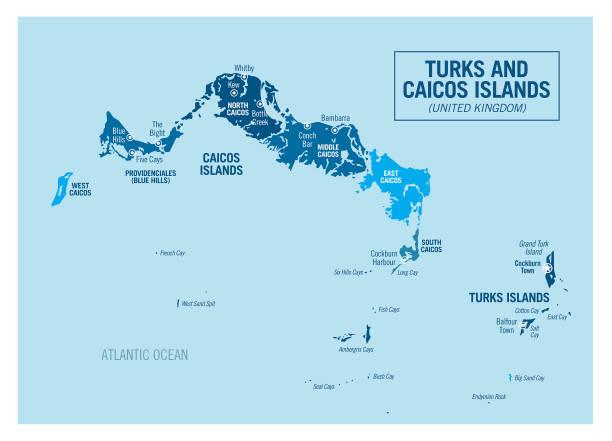
Turks and Caicos Islands
Number of Islands | 40 | ||||||||
|---|---|---|---|---|---|---|---|---|---|
Official Language | English | ||||||||
Official Currency | US Dollar (USD) is used | ||||||||
Turks and Caicos Islands are an overseas territory of the United Kingdom located in the western Atlantic Ocean, within the Caribbean region. They lie southeast of the Bahamas and north of the island of Hispaniola (Haiti and the Dominican Republic). The islands' economy is driven by sectors such as tourism and finance.
The Turks and Caicos Islands are divided into two main groups:
The total land area is approximately 948 square kilometers. The coastline extends for about 389 kilometers. The islands are of coral origin and generally low and flat. The highest point is the Blue Hills summit on Providenciales, at approximately 49 meters above sea level.
The Turks and Caicos Islands are surrounded by one of the world’s three largest continuous coral reef systems. Freshwater resources are limited, and drinking water needs are met through rainwater collection or seawater desalination.
A tropical climate prevails on the islands. The annual average temperature is approximately 27°C. The climate is divided into two main seasons:
The period from June to November is subject to the Atlantic hurricane season.
Although the exact origin of the name is not fully known, the term “Turks” is derived from the Turk’s Cap Cactus (Melocactus intortus), a plant native to the region. This cactus species resembles the Ottoman fez due to its red, dome-shaped top.
The word “Caicos” originates from the indigenous Lucayan language and is believed to come from the phrase “Caya Hico,” meaning “string of islands.”
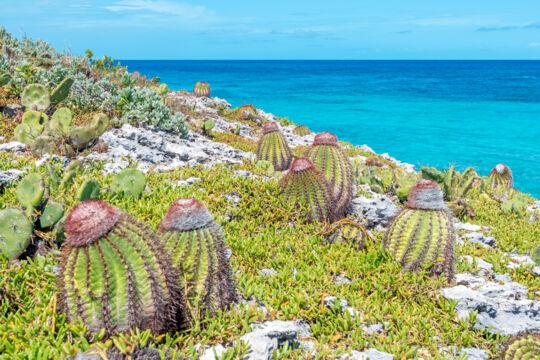
Examples of Turk’s Cap Cactus (Source: Visittci)
The earliest known inhabitants of the Turks and Caicos Islands were the Lucayan people, who migrated from South America.
The islands are a British overseas territory. Governance is carried out by a Governor appointed by the United Kingdom and a Prime Minister elected by the local population. The main economic activities are tourism, offshore financial services, and real estate. The majority of the population resides on Providenciales Island.
National Oceanic and Atmospheric Administration (NOAA). Climate Data for Turks and Caicos, 2024.
Sadler, Nigel. Turks and Caicos Islands: A History. Macmillan Caribbean, 1997.
Turks and Caicos Government. *Official Site*. Accessed April 22, 2025.https://www.gov.tc.
U.S. Central Intelligence Agency. The World Factbook - Turks and Caicos Islands, 2025.
UK Foreign, Commonwealth & Development Office. Turks and Caicos Islands Profile. Accessed April 22, 2025.

Turks and Caicos Islands
Number of Islands | 40 | ||||||||
|---|---|---|---|---|---|---|---|---|---|
Official Language | English | ||||||||
Official Currency | US Dollar (USD) is used | ||||||||
No Discussion Added Yet
Start discussion for "Turks and Caicos Islands" article
Geographical Location and Natural Features
Climate
Origin of the Name
Historical Background
Turks and Caicos Islands Today