This article was automatically translated from the original Turkish version.
+3 More
Program Name | National Space Program | ||||||||
|---|---|---|---|---|---|---|---|---|---|
First Astronaut | Alper Gezeravcı | ||||||||
Mission Name | Turkish Space Traveler and Science Mission (part of the Ax-3 Mission) | ||||||||
Mission Duration | Approximately 18 days (on the International Space Station) | ||||||||
Launch Date | 19 Ocak 2024 | ||||||||
Launch Site | Kennedy Space Center, Florida, USA | ||||||||
Institutions | Turkish Space Agency (TUA), TÜBİTAK | ||||||||
Number of Scientific Experiments | 13 | ||||||||
Space sciences encompass all disciplines that study the universe beyond Earth’s atmosphere, celestial bodies, and the properties of the space environment. This field includes disciplines such as astronomy, astrophysics, planetary science, and cosmology. Space missions are planned journeys conducted to carry out these scientific investigations, develop technology, and explore space. Türkiye has accelerated its activities in this field since the establishment of the Türkiye Space Agency (TUA) in 2018 and the subsequent announcement of the National Space Program. The program aims to enhance Türkiye’s competence in space technologies, reduce external dependencies, and secure a share in the global space economy.
The National Space Program, prepared by the Türkiye Space Agency, was designed to integrate Türkiye’s space policies, strategies, and projects into a cohesive framework. Its core objectives include developing the necessary infrastructure for space technologies, reducing external dependencies, and increasing Türkiye’s visibility on the international stage. The strategy document highlights the global space economy, which reached a value of 424 billion dollars by 2020 and is growing rapidly. In this context, the program seeks to position Türkiye in future domains such as space tourism, satellite constellations, space manufacturing, and space mining. Strategic goals outlined in the program include reaching the Moon, developing indigenous satellites, establishing a spaceport, and sending a Turkish citizen into space.
One of the most prominent objectives of the National Space Program, the manned space mission, has been realized through the “Turkish Space Traveler and Science Mission” project. Under this initiative, a Turkish citizen was planned to be sent to the International Space Station (ISS) to conduct scientific experiments. For this mission, Alper Gezeravcı, a former F-16 pilot in the Air Forces Command, was selected. Gezeravcı, along with Roketsan engineer Tuva Cihangir Atasever, was chosen from among candidates and completed their training in Houston, Texas, USA.
The Axiom Mission 3 (Ax-3) crew, which included Alper Gezeravcı, was launched on January 19, 2024 (Türkiye time) from NASA’s Kennedy Space Center in Florida, USA, aboard a SpaceX Falcon 9 rocket. The crew reached the International Space Station after a 36-hour journey aboard the SpaceX Dragon spacecraft. Alongside Gezeravcı, the mission crew consisted of mission commander Michael López-Alegría (USA/Spain), pilot Walter Villadei (Italy), and Marcus Wandt (Sweden/ESA). Gezeravcı became Türkiye’s first astronaut through this mission. The mission lasted 14 days aboard the ISS and was successfully completed when Gezeravcı returned to Earth on February 9, 2024.
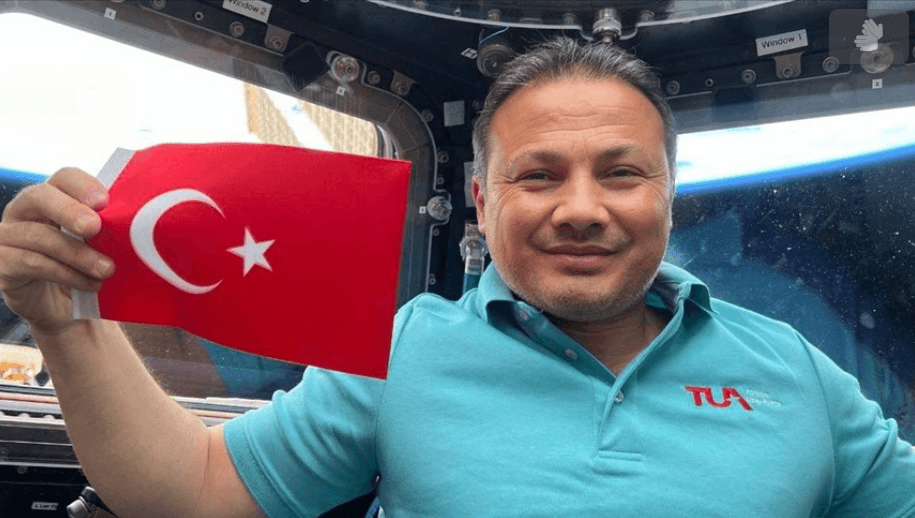
Photo of Alper Gezeravcı during Türkiye’s First Manned Space Mission (AA)
Alper Gezeravcı’s mission aboard the ISS was designed as a science mission. Under the coordination of the Ministry of Industry and Technology, the Türkiye Space Agency, and TÜBİTAK, thirteen distinct scientific experiments developed by Turkish scientists were carried out. These experiments aimed to investigate the effects of microgravity in various fields including biology, medicine, materials science, and genetics. The selected experiments are as follows:
UYNA: Developed by TÜBİTAK Marmara Research Center (MAM), this experiment aimed to produce high-temperature-resistant and high-strength alloys. The effects of microgravity on crystal growth and thermophysical properties were studied to enhance Türkiye’s capability to develop next-generation materials for its space, aerospace, and defense industries.
gMETAL: Also developed by TÜBİTAK MAM, this experiment investigated how gravity affects the formation of homogeneous mixtures between solid particles and fluid media. The findings are expected to improve the efficiency of spacecraft propulsion systems.
UzMAn: Developed by Boğaziçi University, this experiment tested the growth and resilience of microalgae species adapted to harsh conditions under microgravity, analyzed their metabolic changes, and evaluated their potential for life support systems.
EXTREMOPHYTE: Developed by Ege University, this experiment compared the physiological and molecular responses of plants (A. thaliana and S. parvula) exposed to salt stress when grown both in space and on Earth.
METABOLOM: Conducted by Ankara University, this research examined the effects of space conditions on human health. Changes in the astronaut’s gene expression and metabolism were analyzed to understand potential risk factors of space travel and to develop strategies to mitigate these effects.
MİYELOİD: Developed by Hacettepe University, this experiment measured the effects of space travel and cosmic radiation on the immune system at the level of myeloid-derived suppressor cells.
MESSAGE: Developed by Üsküdar University, this experiment aimed to identify genes affected by microgravity whose functions are not yet understood. Using CRISPR gene-editing techniques, researchers investigated which immune cells are directly influenced by gravity.
ALGALSPACE: Developed by Yıldız Technical University, this experiment compared the growth data of Antarctic and temperate-zone microalgae in space to assess the potential of polar algae for use in life support systems (oxygen production, supplemental food, water purification).
Other experiments included studies on the effects of propolis in microgravity and technological research such as electronic circuit board assembly.
Türkiye’s first manned space science mission did more than collect scientific data; it also served critical strategic and societal goals. The mission’s primary aims included providing Turkish scientists with opportunities to conduct research in space, enhancing Türkiye’s international visibility in space, inspiring the younger generation toward science and technology, and creating a source of national inspiration. Minister of Industry and Technology Mehmet Fatih Kacır noted that the mission was closely followed by the entire society, from children to the elderly, and marked a significant milestone on Türkiye’s path to becoming a science-based society. The mission has particularly empowered children and young people by enabling them to envision new dreams in space and science.
Türkiye’s first manned space mission is not the end of the National Space Program but rather its beginning. Future objectives include sending the second astronaut, Tuva Cihangir Atasever, on a suborbital flight to conduct scientific experiments. Additionally, the Moon Program, which aims to send an unmanned spacecraft to the Moon, is one of the program’s most ambitious projects. This mission plans to enable Türkiye to reach the Moon using a spacecraft designed and manufactured domestically. Other goals include establishing a space technology development zone in Ankara, developing launch vehicles, constructing an international spaceport through global partnerships, and creating a regional positioning and timing system. These steps reflect Türkiye’s vision of becoming an independent force in space technologies and securing a lasting place in the global space race.
Anadolu Ajansı. 2024. “Bakan Kacır: Gelecekte Yerli Uzay Aracımızla İnsansız Ay Misyonunu da Gerçekleştireceğiz.” *AA*, January 25, 2024.https://www.aa.com.tr/tr/bilim-teknoloji/bakan-kacir-gelecekte-yerli-uzay-aracimizla-insansiz-ay-misyonunu-da-gerceklestirecegiz/3112301.
TÜBİTAK Bilim Genç. 2024. “Alper Gezeravcı Uzayda Hangi Deneyleri Yapacak?” *Bilim Genç*, January 2024.https://bilimgenc.tubitak.gov.tr/makale/alper-gezeravci-uzayda-hangi-deneyleri-yapacak.
TÜRKSAM. 2024. “Milli Uzay Programı, İlk Türk Astronot ve Bilim Misyonu.” *Türksam.org*, 2024.https://www.turksam.org/detay-milli-uzay-programi-ilk-turk-astronot-ve-bilim-misyonu.
Türkiye Uzay Agency (TUA). 2021. “Milli Uzay Programı.” TUA Resmî Web Sitesi, 2021.https://tua.gov.tr/tr/milli-uzay-programi/milli-uzay-programi.
Türkiye Uzay Agency (TUA). 2023. “Türkiye’nin İnsanlı İlk Uzay Misyonu İçin PEncimiz Hazır.” *TUA Resmî Web Sitesi*, December 2023.https://tua.gov.tr/tr/haberler/turkiye-nin-insanli-ilk-uzay-misyonu-icin-pecimiz-hazir.
Türkiye Yüzyılı. 2024. “Proje: Türk Uzay Yolcusu ve Bilim Misyonu.” *Turkiyeyuzyili.com*, 2024.https://turkiyeyuzyili.com/proje-turk-uzay-yolcusu-ve-bilim-misyonu.

Program Name | National Space Program | ||||||||
|---|---|---|---|---|---|---|---|---|---|
First Astronaut | Alper Gezeravcı | ||||||||
Mission Name | Turkish Space Traveler and Science Mission (part of the Ax-3 Mission) | ||||||||
Mission Duration | Approximately 18 days (on the International Space Station) | ||||||||
Launch Date | 19 Ocak 2024 | ||||||||
Launch Site | Kennedy Space Center, Florida, USA | ||||||||
Institutions | Turkish Space Agency (TUA), TÜBİTAK | ||||||||
Number of Scientific Experiments | 13 | ||||||||
No Discussion Added Yet
Start discussion for "Türkiye's Space Sciences and Missions" article
National Space Program and Objectives
Türkiye’s First Manned Space Mission
Scientific Experiments Conducted on the International Space Station
Objectives and Societal Impact of the Mission
Future Vision and Projects