


This article was automatically translated from the original Turkish version.
+2 More
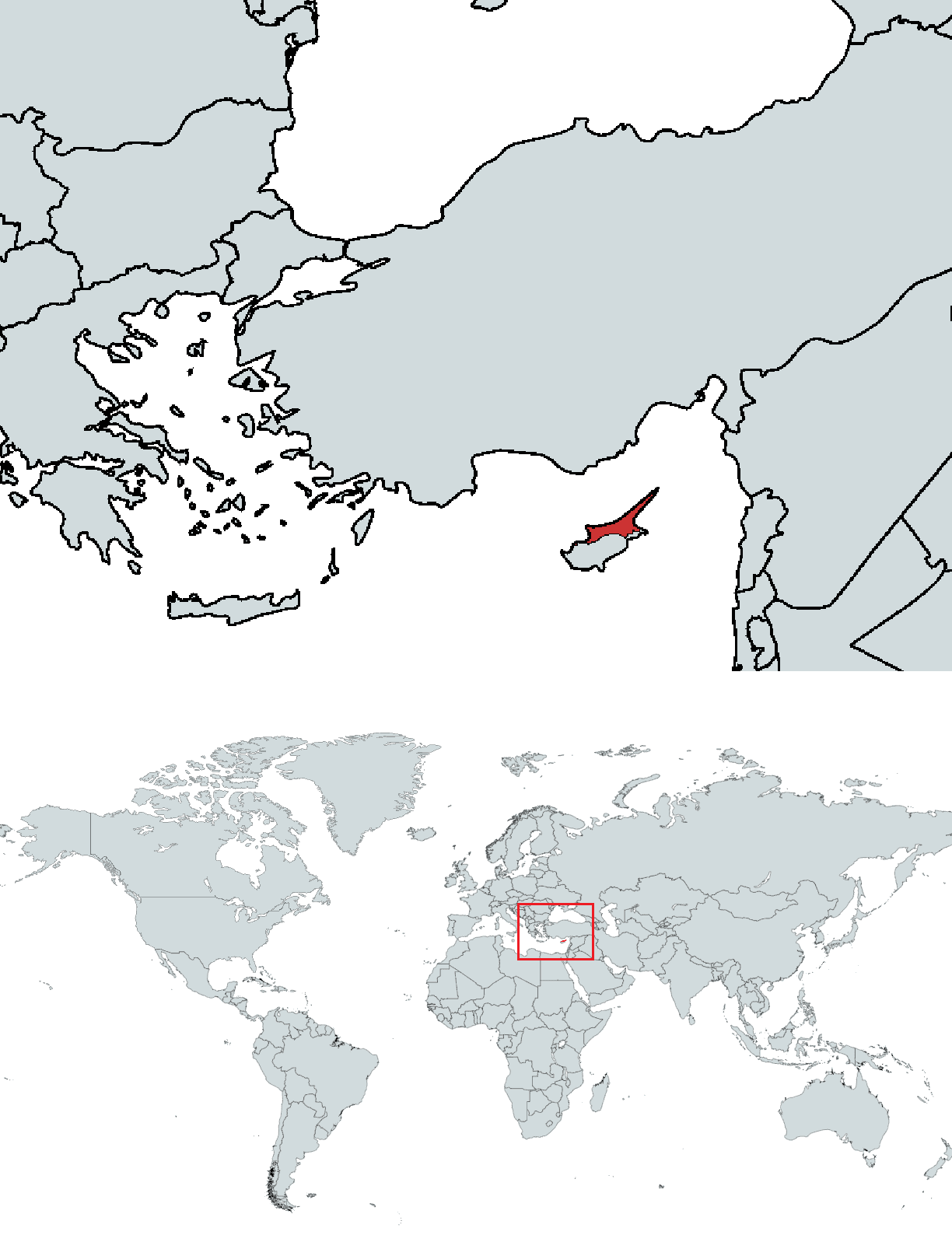
Turkish Republic of Northern Cyprus
Capital | Lefkoşa | ||||||||
|---|---|---|---|---|---|---|---|---|---|
Official Language | Turkish | ||||||||
Form of Government | Parliamentary System | ||||||||
President | Ersin Tatar | ||||||||
Prime Minister | Ünal Üstel | ||||||||
Independence | 15 November 1983 | ||||||||
Area | 3,248 km² | ||||||||
Population | 382,836 (2021) | ||||||||
Currency | Turkish Lira (TL) | ||||||||
Time Zone | GMT+03:00 | ||||||||
Telephone Code | +90 +392 | ||||||||
Climate | Mediterranean Climate | ||||||||
GDP | 132.3 Billion TL | ||||||||
GDP per Capita | 14,599 Dollars | ||||||||
The Turkish Republic of Northern Cyprus (TRNC) is one of the most notable formations in the Mediterranean region, distinguished by its geopolitical significance, multi-layered cultural structure, and social transformations throughout its historical process. The island came under the sovereignty of the Ottoman Empire in 1571 and was shaped over three centuries by Ottoman administrative, social, and architectural systems; it became acquainted with Western administrative and economic structures after Britain assumed control in 1878. Throughout the 20th century, rising ethnic tensions and the political and military activities of the Greek Cypriots pursuing the goal of Enosis (union with Greece) made it necessary for the Turkish Cypriot people to fight for their existence. The 1974 Cyprus Peace Operation established a secure zone in the northern part of the island, culminating in the declaration of the TRNC in 1983.
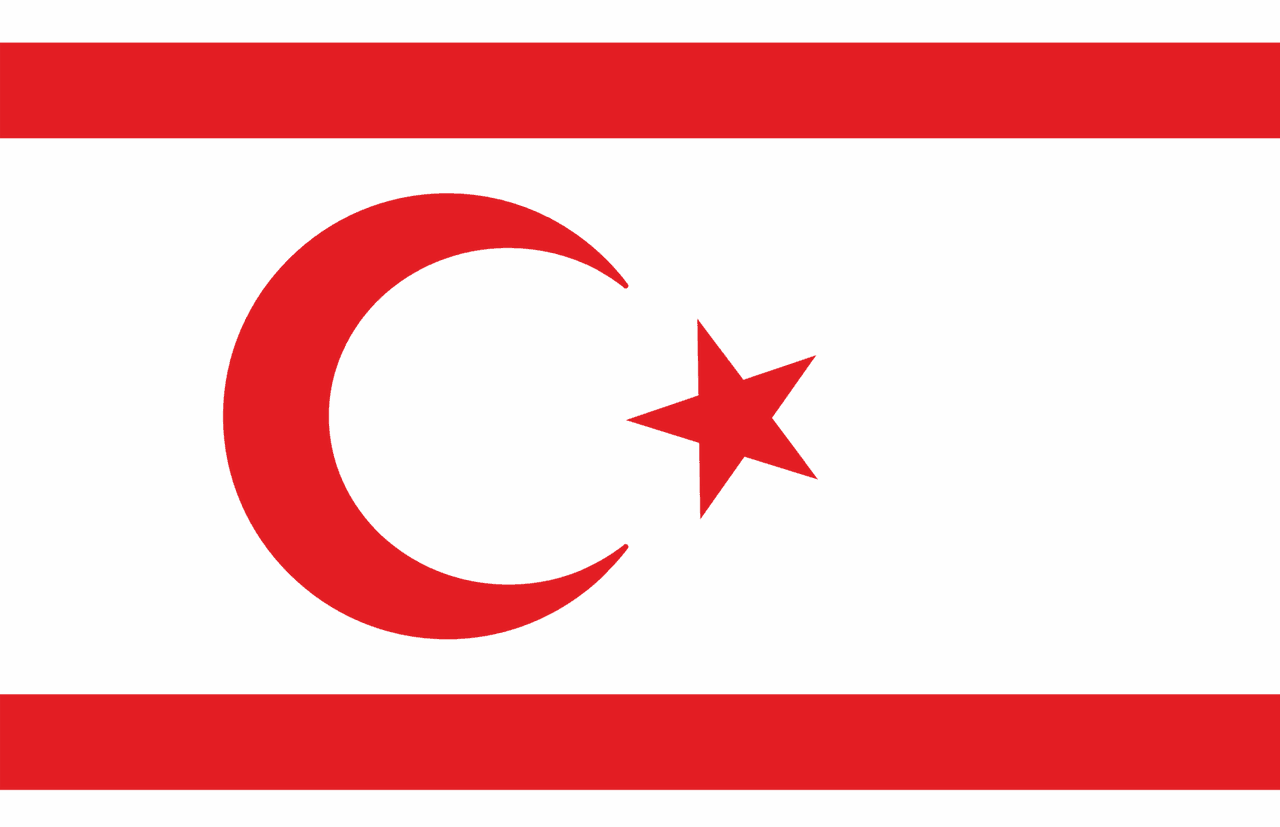
Flag of the Turkish Republic of Northern Cyprus
The island of Cyprus was conquered by the Ottoman Empire in 1571 and remained under Ottoman rule for approximately three centuries. During this period, Cyprus was administered as a sanjak within the classical Ottoman administrative system, and the diverse ethnic and religious communities living on the island continued to coexist with a degree of autonomy under the Ottoman “millet system,” governed by their own religious leaders and institutions. The Greek Orthodox population of Cyprus enjoyed significant social and economic privileges under Ottoman rule, while the Ottoman state sought to maintain demographic balance by supporting Turkish settlement in rural areas. By the second half of the 19th century, the weakening of the Ottoman Empire, alongside nationalist movements in the Balkans and the Aegean, fueled the spread of the “Enosis” idea among the Greek Cypriots—the desire for union with Greece.
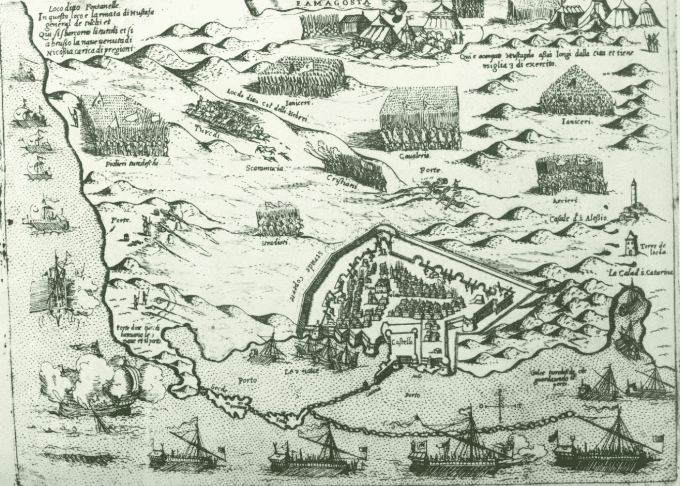
In the international context following the Russo-Turkish War of 1877–1878, Britain, seeking to counter the threat of Russian expansion into the Mediterranean, assumed administrative control of Cyprus through the Cyprus Convention of 4 June 1878. Under the agreement, Britain pledged to assist the Ottoman Empire if Russia attacked its territories, in return for the right to administer Cyprus. However, sovereignty remained with the Ottomans. Nevertheless, Britain exploited this arrangement to establish a permanent administrative structure on the island and systematically eliminated Ottoman influence. On 12 July 1878, the last Ottoman governor, Besim Pasha, transferred his authority to the British official Lord John Hay, and on the same day, the Turkish flag that had flown for three centuries was lowered and replaced by the British flag. This event was celebrated by the Greek Cypriots as the “first step toward Enosis.” Subsequently, in 1914, Britain unilaterally annexed the island, citing the Ottoman Empire’s entry into the war on Germany’s side. Turkey formally recognized this annexation through the Treaty of Lausanne of 1923.
【1】
Under British rule, Greek Cypriots rapidly gained economic and administrative power, while Turkish Cypriots were systematically marginalized. The British removed Turkish officials from public service and replaced them with Greek Cypriots. Turkish Cypriots faced economic pressure, and their lands, properties, and assets began to pass into Greek Cypriot hands. The Church supported this transfer of property, arguing that “the best way to remove the Turks from the island was to buy them out.” While Turkish Cypriots suffered economic decline, Greek Cypriots grew wealthier and became dominant in island politics. The Legislative Council established in 1882 granted the Greek Cypriots a majority based on population, and this structure was used as a tool for Enosis propaganda. During this period, Turkish Cypriots rapidly lost both their political representation and economic resources, and despite Britain’s claims of neutrality, its practices effectively supported the Greek Cypriots. This situation marked the beginning of a new struggle for the Turkish Cypriots.
The British administration adopted a more tolerant attitude toward the Greek Orthodox Church while undermining the political representation of the Turkish community by granting Greek Cypriots majorities in local councils. In this environment, the Greek Cypriots, led especially by the Church, began systematically promoting the ideal of Enosis—the union of the island with Greece. In 1931, Greek Cypriots launched a major uprising in pursuit of this goal. In response, the British suspended all political institutions, dissolved the legislature, and imposed strict controls on the press and education. Despite these pressures, Turkish Cypriots continued to maintain cultural ties with Turkey, embraced Atatürk’s reforms, and sought to build social unity through organizations such as the Federation of Turkish Cypriot Institutions.
In the 1940s, following World War II, demands for Enosis reemerged on the agenda. In 1950, a so-called plebiscite organized under the leadership of the Greek Orthodox Church claimed that 96% of the population supported Enosis; however, Turkish Cypriots did not participate. During the same period, Greece began international efforts to secure the annexation of Cyprus. In 1955, the Greek Cypriots established the terrorist organization EOKA and launched an armed struggle, aiming first to expel the British from the island and then to assimilate the Turkish Cypriots to achieve Enosis. This period initiated a phase in which the security of Turkish Cypriots was threatened, compelling the Turkish Cypriot community to organize for self-defense.
The Turkish Resistance Organization (TMT) was the most organized underground resistance movement established by the Turkish Cypriot community to defend itself against Greek Cypriot attacks. In response to EOKA, which was founded in 1955 and used violence against both the British and the Turks, initial defense units known as “Volkan” emerged but proved inadequate. In 1957, under the leadership of Rauf Denktaş, Dr. Fazıl Küçük, and Burhan Nalbantoğlu, the TMT was formally established. With Turkey’s support, the organization was secretly structured to organize in every village, aiming to ensure the security of Turkish Cypriots, raise community awareness, and, if necessary, conduct armed resistance. Members of the TMT swore oaths on the Quran, the flag, and weapons, and carried out secret activities in education, armament, and communication.
Turkish Resistance Organization (TRT News)
The organization became not only a military structure but also an institution that fostered social solidarity and strengthened moral unity. During the British administration, the TMT served as the moral backbone of the Turkish Cypriot community against both Greek Cypriot and British pressures, and after 1963, when Greek Cypriot attacks intensified, it effectively became a defensive line. It played a leading role in the 1964 Erenköy Resistance and actively participated in defending communities across many regions. The TMT also functioned as the local implementer of Turkey’s mechanisms for aid and intervention toward the Turkish Cypriot community, remaining the most fundamental pillar of the Turkish Cypriot people’s resistance and struggle for existence until the 1974 Peace Operation.
The Republic of Cyprus was established in 1960 under the guarantee of Turkey, Greece, and the United Kingdom. The president was the Greek Cypriot leader Makarios, and his vice president was the Turkish Cypriot leader Dr. Fazıl Küçük. The constitution sought to establish political balance between the Turkish and Greek Cypriot communities.
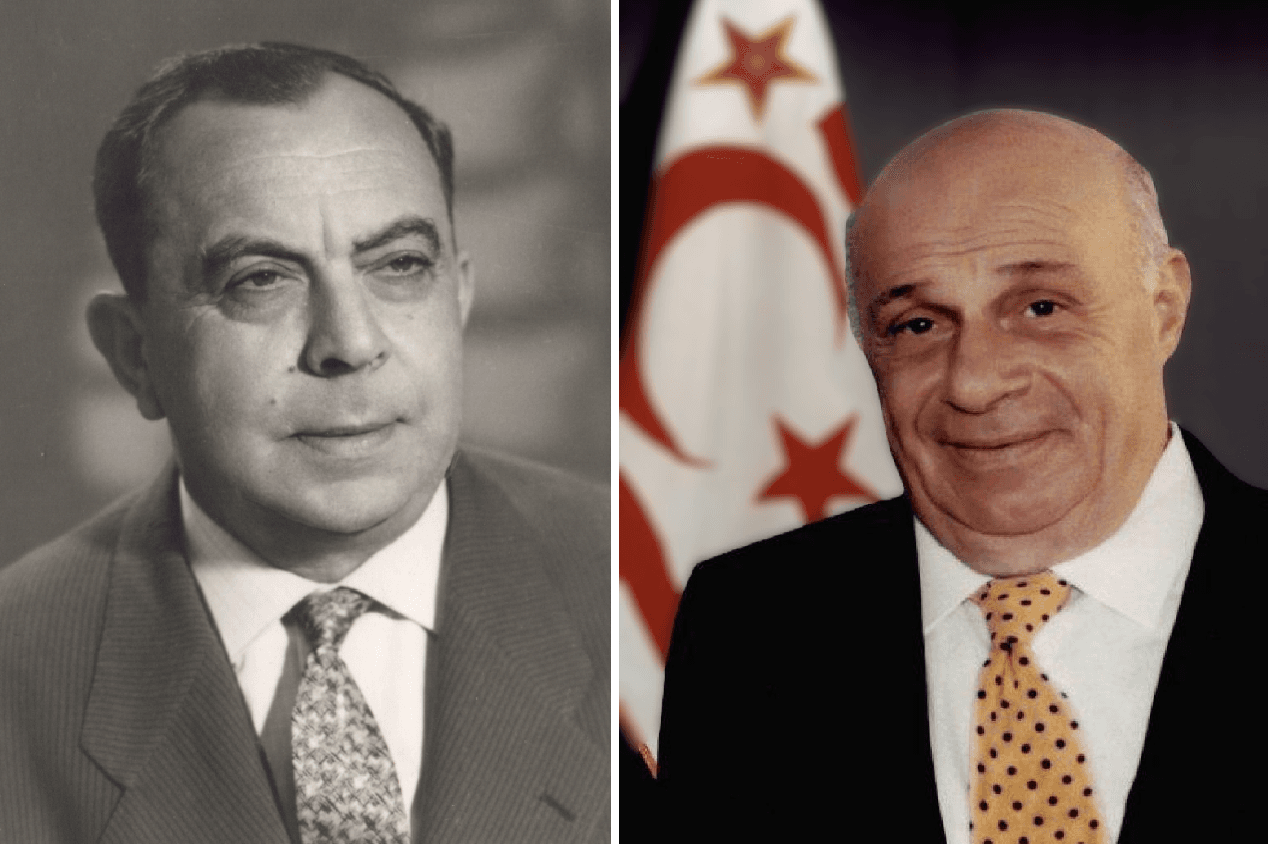
Dr. Fazıl Küçük and Rauf Denktaş (Dr. Fazıl Küçük Foundation - TRNC Presidency)
The period from 1963 to 1974 was a struggle for the Turkish Cypriot community marked by mass attacks, forced displacement, and threats of extermination. The crisis, initiated in 1963 by Greek Cypriot leader Makarios’s attempt to amend the constitution, culminated on 21 December 1963 in the “Bloody Christmas” massacres, during which hundreds of Turkish Cypriots were killed, thousands were forcibly displaced, and the community was confined to enclaves covering only 3% of the island. The 1964 Erenköy Resistance and the 1967 Geçitkale-Boğaziçi massacres demonstrated the continuity of Greek Cypriot aggression and the organized resistance of the Turkish Cypriots. Finally, on 15 July 1974, a Greek-backed coup revived the Enosis dream; Turkey, invoking the 1960 Treaty of Guarantee, launched the Cyprus Peace Operation on 20 July to secure the safety of the Turkish Cypriot community.
The Republic of Cyprus, established in 1960 under the guarantee of Turkey, Greece, and the United Kingdom, was based on political equality between the Turkish and Greek Cypriot communities. However, the Greek Cypriot administration, particularly President Archbishop Makarios, did not perceive this equality as sustainable in the long term. In 1963, Makarios proposed a package of thirteen constitutional amendments designed to eliminate the political rights of the Turkish Cypriots, aiming to marginalize them from the political system and eventually achieve Enosis. This proposal was rejected by the Turkish side, and the crisis between the two communities reached its peak.
On the night of 21 December 1963, attacks began in Nicosia and quickly spread across the entire island, marking a turning point for the Turkish Cypriot community. These events entered history as the “Bloody Christmas.” Greek Cypriot armed elements launched organized attacks on Turkish neighborhoods and villages, targeting civilians. Homes were burned, women and children were brutally killed, and hundreds lost their lives. Approximately 30,000 Turkish Cypriots were driven from their homes and forced to live in enclaves covering only 3% of the island. During this period, Nicosia was divided into two parts by a boundary line known as the “Green Line,” which marked the beginning of the island’s de facto division.
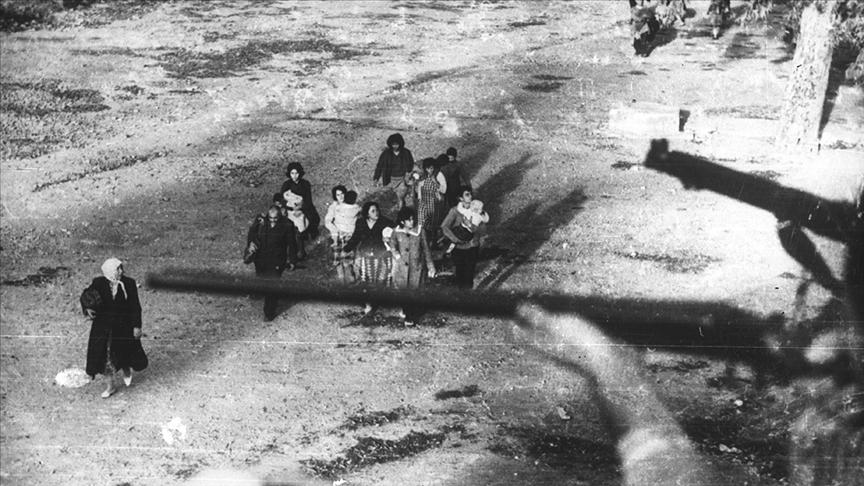
Turkish Cypriots Forced to Migrate (Anadolu Agency)
In 1964, Greek Cypriot attacks continued without abating. One of the most critical conflict points during this period was Erenköy. Erenköy was a geographically isolated Turkish settlement that came under siege by Greek and Greek Cypriot forces. The heroic resistance of Turkish fighters in the region, combined with Turkey’s limited air intervention in support of Erenköy, contributed to halting the Greek Cypriot aggression. However, this brought only temporary calm. The Erenköy Resistance became a symbol for the Turkish Cypriot community and is remembered in collective memory as the first example of organized defense.
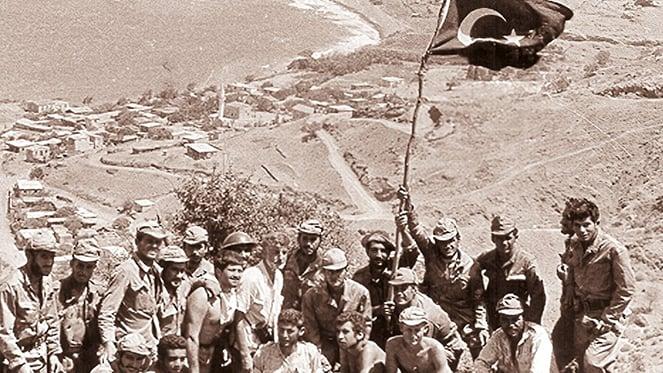
Erenköy Fighters (QHA)
1967 marked a period of renewed intensification of attacks. General Grivas, who returned to Cyprus, established a new organization called EOKA-B, a restructured version of EOKA, and resumed activities aimed at eliminating the Turkish Cypriot population. During this period, the massacres in the villages of Geçitkale and Boğaziçi once again revealed the brutality of Greek Cypriot aggression. Numerous Turkish civilians—women, children, and the elderly—were killed. Turkey reacted strongly to these events and threatened intervention. Grivas was removed from the island, and a brief period of stability was restored, but the Cyprus issue remained unresolved at its root.
1974 was one of the most critical turning points in the history of Cyprus. Although the Republic of Cyprus established in 1960 was based on the joint existence of the Greek and Turkish Cypriot communities, this structure quickly became unworkable due to the Greek Cypriot aspiration for Enosis (union with Greece). The Greek Cypriot attacks that began in 1963 resulted in the depopulation of Turkish villages, the killing of hundreds of civilians, and the confinement of the community to just 3% of the island. The events of 1964 and 1967 in Geçitkale, Boğaziçi, and Erenköy exposed the scale of violence endured by the Turkish Cypriot community. Although Turkey, as a guarantor power, occasionally issued diplomatic warnings during this period, it did not undertake direct military intervention. However, developments in 1974 made Turkey’s intervention unavoidable.
Documentary on the Cyprus Peace Operation, Episode 3 (Ministry of National Defense of the Republic of Turkey)
On 15 July 1974, a coup was carried out in Cyprus linked to the military junta in Greece. Planned by the Cypriot National Guard and EOKA-B elements, the coup overthrew President Archbishop Makarios and installed Nikolaos Sampson, an extreme Enosis supporter and former leader of EOKA-B. With Sampson’s appointment, the goal of Enosis was effectively declared. This coup was not merely a change in governance among Greek Cypriots; it represented an existential threat to the Turkish Cypriot community. Immediately after the coup, EOKA-B militants began attacking Turkish villages, carrying out massacres in many areas without distinction of age or gender. In response to these developments, Turkey invoked Article 4 of the 1960 Treaty of Guarantee and decided to intervene.
Turkey first summoned the other guarantor powers, Britain and Greece, to a meeting in Geneva for a diplomatic solution. However, as no outcome was achieved, on the morning of 20 July 1974 at 05:00, the Cyprus Peace Operation was launched. The Turkish Armed Forces conducted simultaneous amphibious landings on the coasts of Kyrenia using air, sea, and land forces. The operation was commanded by General Nurettin Ersin, Deputy Chief of the General Staff, with General Bedrettin Demirel commanding the Land Forces and General Ethem Ayan commanding the Air Forces. During the operation, members of the Turkish Resistance Organization (TMT), who were organized in areas inhabited by Turkish Cypriots, provided local guidance and logistical support to Turkish troops.
On 20 July, Turkish forces established a corridor along the Kyrenia-Nicosia line. However, as Greek and Greek Cypriot attacks continued, a second operation became inevitable. The Second Peace Operation, beginning on 14 August 1974, enabled Turkish forces to advance as far as Famagusta in the northeast and Lefke in the west. By the end of the operation, the Turkish side had gained control of approximately 37% of the island. A ceasefire was declared on 16 August. As a result of the operation, over 500 Turkish Cypriots were reported missing or killed, and thousands of Greek Cypriots were forced to migrate to the southern part of the island. Similarly, Turkish Cypriots moved northward. Thus, the island became de facto divided.
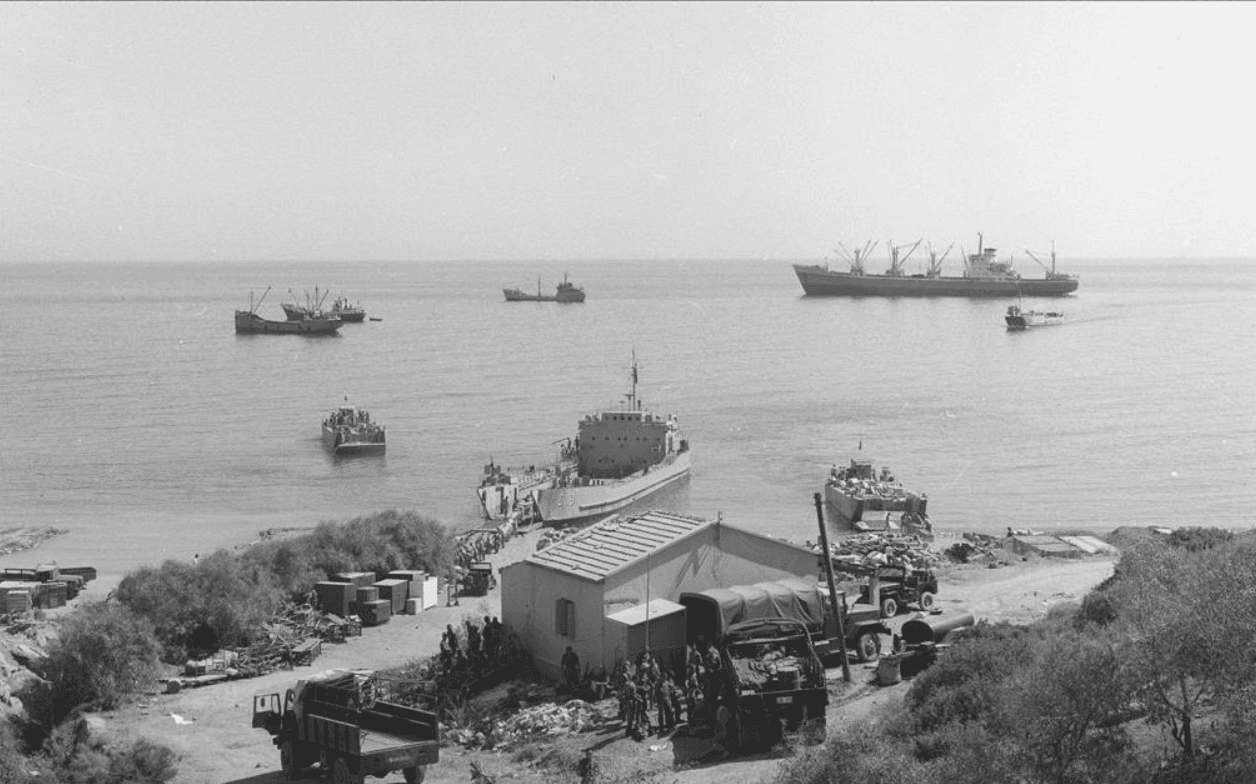
Cyprus Peace Operation (Anadolu Agency)
In the period following 1974, the Turkish Cypriot community began establishing its own administrative structure in this newly secured region. In 1975, the “Turkish Federated State of Cyprus” was declared, with Rauf Denktaş becoming its first president. However, this federal structure failed to become permanent due to the inability to reach a joint solution with the Greek Cypriot side. While negotiations under the auspices of the United Nations continued, the Turkish Cypriot community worked to develop its political, economic, and legal infrastructure. By 1983, the Turkish Cypriot community, having achieved institutional stability in terms of political stability, internal security, and administrative autonomy, declared the Turkish Republic of Northern Cyprus (TRNC) on 15 November 1983, based on the right to self-determination.
The declaration of the TRNC was not recognized by any country other than Turkey. The UN Security Council, through Resolutions 541 and 550, declared the declaration “invalid,” and no state other than Turkey has granted the TRNC diplomatic recognition. Nevertheless, Turkey, as the TRNC’s sole diplomatic and military ally, ensured the security of the Turkish presence on the island. The TRNC established its own constitution, multi-party political system, and institutions. Rauf Denktaş, who served as president for many years, became a symbolic figure in the political struggle of the Turkish Cypriot community.
Today, despite being recognized only by Turkey, the TRNC continues to exist as a de facto independent state. The Peace Operation was a historic turning point that saved the Turkish Cypriot community from genocide and secured for it safe living areas.
The Turkish Republic of Northern Cyprus (TRNC) is an independent state located in the northern part of the island of Cyprus in the eastern Mediterranean, with an area of approximately 3,355 km². Cyprus is the third-largest island in the Mediterranean after Sicily and Sardinia. The TRNC extends in an east-west strip, bounded to the north by the Pentadaktylos Mountains and extending southward along the Mesaoria Plain. It is approximately 70 kilometers from the Turkish coast, a proximity that forms the basis of its geographical, cultural, and strategic relations. The territory of the TRNC stretches from Güzelyurt in the west to Karpaz Point in the east, and is separated from the Greek Cypriot administration in the south by the United Nations-controlled boundary line known as the “Green Line.” Important port cities such as Kyrenia and Famagusta lie along the northern coastline facing the sea.
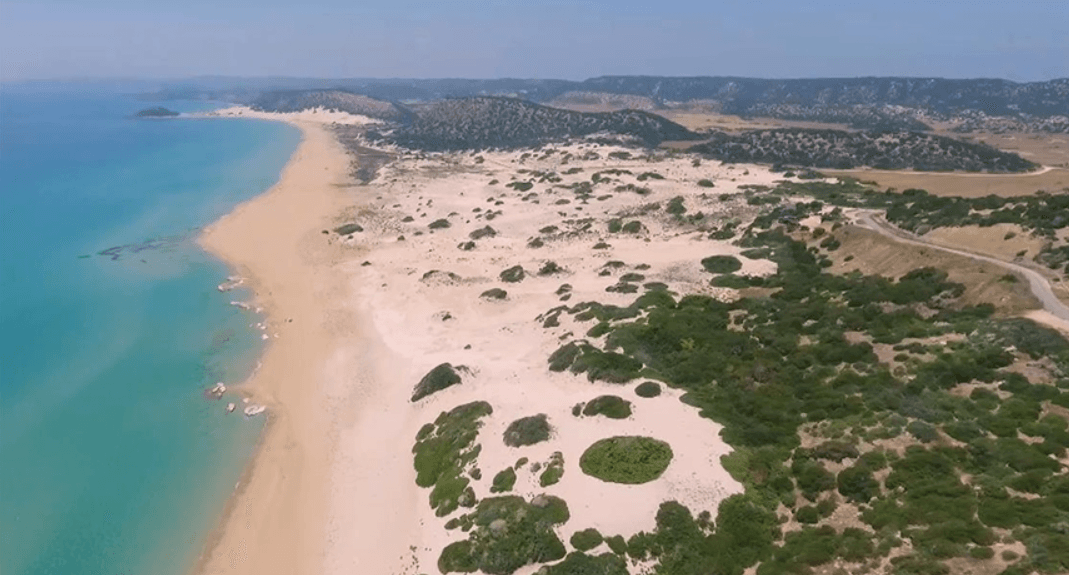
Turkish Republic of Northern Cyprus (Anadolu Agency)
The geological structure and morphological features of the TRNC are highly diverse. The Pentadaktylos Mountains, an extension of the Taurus Mountains, stretch in an east-west direction, shaping the island’s coastline. These mountains consist of limestone and crystalline rocks, rendering the region highly rugged from a geomorphological perspective. The highest point of the Pentadaktylos range is Selvili Tepe at 1,024 meters. To the south lies the Mesaoria Plain, the largest plain in Cyprus, situated between the Pentadaktylos Mountains and the Troodos Mountains to the south. Geologically a depression area, Mesaoria is a flat and fertile agricultural region with alluvial soils. To the east of the plain lies the Karpaz Peninsula. This region has largely preserved its natural character with steep cliffs, indented coastlines, and rural areas extending inland. Karpaz is also an ecologically protected area and home to a population of wild donkeys.
The TRNC lies within the Mediterranean climatic zone, characterized by hot, dry summers and mild, low-rainfall winters. The summer season typically begins in late April and lasts until mid-October. Temperatures can reach up to 40°C in July and August. Average winter temperatures range between 10–12°C. The annual average temperature is approximately 19°C. Rainfall is concentrated mainly in December, January, and February, accounting for 70% of the annual total. The northern slopes of the Pentadaktylos Mountains, facing the prevailing wind direction, receive more rainfall than the southern slopes, which are drier. The same pattern applies to the Troodos Mountains in the south. Annual average rainfall varies between 400 and 700 mm. These climatic conditions directly influence many human activities, from settlement patterns to agricultural practices.
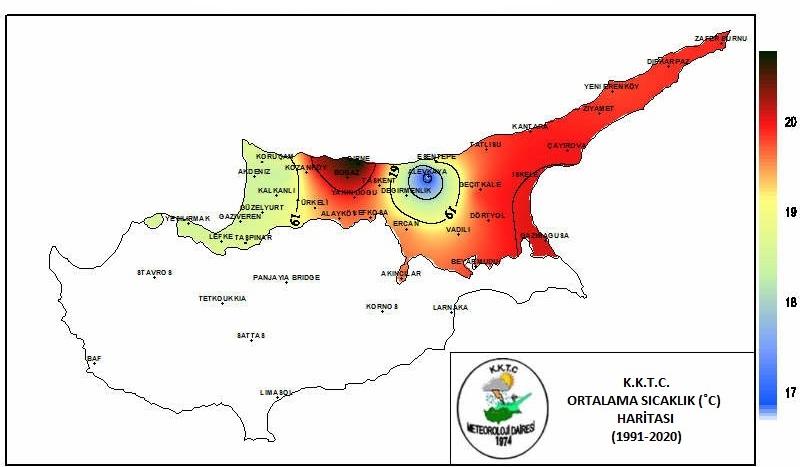
TRNC Average Temperature Map (TRNC Meteorology)
The TRNC has no permanent major river. Water resources consist of seasonal streams, small reservoirs, and groundwater. Rivers such as Kanlıdere and Ovgos, which flow through the Mesaoria Plain, dry up for much of the year. Therefore, drinking water needs are met by groundwater sources and water transported via pipeline from Turkey. This water, delivered through the “Asrın Project” initiated in 2015, reaches major settlements such as Güzelyurt and Nicosia. However, over-extraction of groundwater and unregulated drilling have led to problems such as salinization and depletion. In areas such as Güzelyurt, many wells that once provided abundant drinking and irrigation water are now non-functional, and the remaining wells have increased salinity levels. Consequently, water management remains both an environmental and economic priority in the TRNC.
Although various soil types are observed in the TRNC, the most common are terra rossa and alluvial soils. Terra rossa is found on the foothills and slopes of mountainous areas, while alluvial soils are concentrated in the Mesaoria Plain, Güzelyurt, and around Famagusta. Although the soils of Mesaoria contain rich organic matter, their productivity is limited due to insufficient irrigation and salinity. The Güzelyurt Plain, due to its alluvial structure, is the TRNC’s most important citrus production center. However, the sustainability of this potential is threatened by declining water resources. Dry farming is widespread in agriculture, with barley and wheat being the primary cereal crops. In regions such as Karpaz and İskele, orchards of olive and carob trees are common. Due to limited irrigation opportunities, modern agricultural practices are restricted, and agricultural production remains largely dependent on natural conditions.
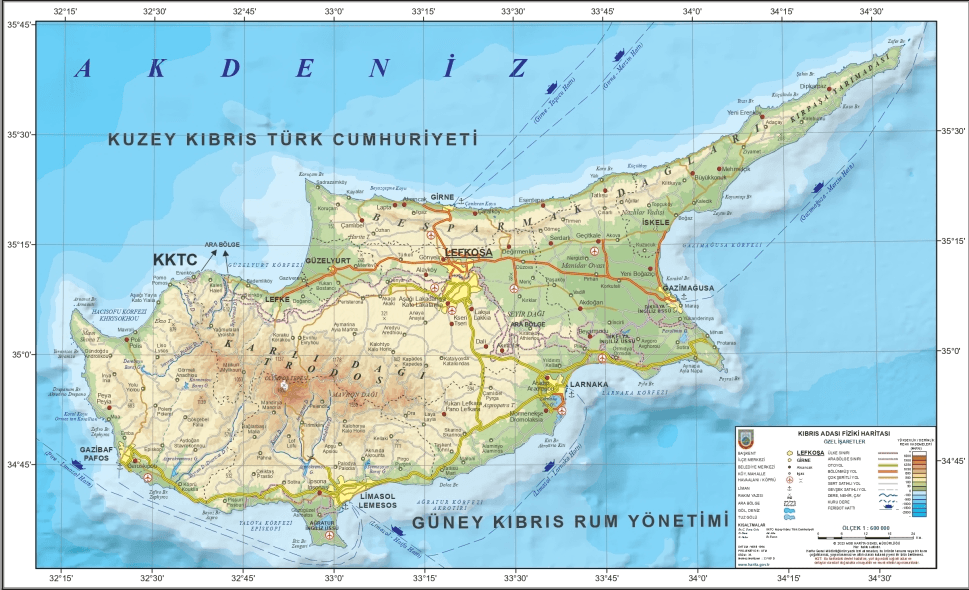
TRNC Physical Map (Turkish Armed Forces HGM)
The vegetation of the TRNC exhibits a typical Mediterranean flora. The northern slopes of the Pentadaktylos Mountains are forested, while the southern slopes feature sparse shrublands and maquis communities. At elevations of 900–1,000 meters, pine, juniper, and oak species are found, while at lower elevations, drought-resistant species such as olive, carob, mastic, and laurel are common. Steppe formations dominate arid areas such as the Mesaoria Plain. Grasses and flowers that green in spring dry up as summer temperatures rise. The Karpaz Peninsula is significant both for its floristic diversity and as a natural conservation area for the endangered Karpaz donkeys. Additionally, the coasts of the TRNC host nesting sites for sea turtles, particularly along the Alagadi and Tatlısu beaches.
Settlements in the TRNC are distributed according to geographical conditions. Dense settlements are found around the Mesaoria Plain and along the coastal strips, while settlement is sparse in mountainous and rocky areas. Nicosia is the capital and the most populous city. Famagusta, as a port city, holds importance for trade and tourism, while Kyrenia stands out for its tourist and cultural infrastructure. Güzelyurt is the center of agriculture. Rural settlement patterns are common in regions such as Karpaz and İskele. Population distribution is concentrated in urban centers, while rural areas experience population decline and aging. The migration of young rural populations to urban centers or to Turkey threatens the sustainability of agriculture. The most important factors shaping settlement patterns are transportation access, availability of water resources, topography, and security conditions.
The demographic development of the TRNC has been significantly shaped by the population exchange following the 1974 Cyprus Peace Operation and immigration from Turkey. In 1975, approximately 40,000 agricultural laborers were settled in the TRNC from Turkey, creating a permanent transformation in the demographic composition. The population, which was approximately 146,000 in 1978, rose to 286,257 according to the 2011 census and is projected to reach 390,745 by the end of 2021. However, this increase is primarily due to migration rather than natural birth rates.
The population structure of the TRNC shows a significant gender imbalance. In particular, among the active population aged 15–64, men outnumber women. In 2021, the sex ratio (number of men per 100 women) was measured at 119.2. This ratio stems from the migration of young adult men to the TRNC. In the 20–24 age group, this ratio exceeds 155. Conversely, among the population aged 65 and over, women outnumber men, a trend associated with women’s longer life expectancy.
In terms of age structure, the TRNC has entered a process of “demographic aging.” In 1978, 29.5% of the population was in the 0–14 age group; by 2021, this proportion had fallen to 13.7%. During the same period, the proportion of the active population aged 15–64 increased from 60.9% to 76.5%, while the elderly population aged 65 and over grew. Life expectancy is 83.1 years for women and 79.0 years for men, figures comparable to those of many developed countries. The fertility rate has been below the population replacement level (2.1) since 1998; as of 2021, the total fertility rate is 1.98.
Population growth has slowed, but migration continues to bring fresh labor and student inflows. In addition to migration from Turkey, significant immigration of university students and laborers from third countries contributes to the heterogenization of the population. On the other hand, the TRNC’s own young and educated population emigrates abroad, particularly to the United Kingdom, Turkey, and Australia. This phenomenon, known as “selective migration,” increases the proportion of elderly and dependent populations within the country.
78% of the TRNC’s population lives in urban centers. Cities such as Nicosia, Kyrenia, and Famagusta receive significant migration, while the rural population continues to decline. According to 2021 data, 13 villages have been completely abandoned. The elderly population is disproportionately high in rural areas; agricultural lands are being abandoned by the young, deepening the rural-urban imbalance.
Socioeconomically, approximately 75% of employment is concentrated in the service sector. Industry and agriculture account for 15% and 10% respectively. Women’s participation in the labor force is lower than that of men. A transformation is also occurring in family structures. The average age at marriage has increased; in 2021, it was 34.5 for men and 31.5 for women. Divorce rates have increased approximately fivefold since 1977.
The Turkish Republic of Northern Cyprus (TRNC) has an economic system based on free market principles and uses the Turkish Lira as its official currency. The state’s role in economic activities is defined as guiding, incentivizing, and regulating, while the private sector forms the fundamental dynamics of the economy. The TRNC’s economic structure reflects the typical characteristics of a small island economy with a limited domestic market and scarce natural resources. The service sector holds the largest share in the Gross Domestic Product (GDP), while agriculture and industry generally serve as supportive sectors.
The service sector forms the backbone of the TRNC economy. Within this sector, tourism and higher education are leading sub-sectors that generate a significant portion of national income. As of 2023, the number of foreign tourists visiting the country reached 1.9 million, and net tourism revenue exceeded one billion US dollars. The majority of tourists come from Turkey, with Russia and Iran also serving as important source markets.
The higher education sector, with approximately 100,000 students and 23 universities, generates significant foreign exchange and produces skilled human resources. In 2022, revenue from this sector reached approximately 950 million US dollars.
Universities in the Turkish Republic of Northern Cyprus:
The agricultural sector participates in foreign trade primarily through citrus fruits, potatoes, and dairy products derived from livestock, while also playing a strategic role in food security and rural employment. The availability of water from Turkey for agricultural irrigation has increased the sector’s productivity potential.
The industrial sector is largely limited to agro-based processing facilities and light manufacturing. However, due to low competitiveness and insufficient technology transfer, export potential remains limited.
The TRNC economy is highly dependent on imports. In 2023, imports reached 2.8 billion US dollars, while exports amounted to only 159 million US dollars. Eighty percent of exports are directed to Turkey, and 15% to Middle Eastern countries. Main export products include halloumi cheese, citrus fruits, potatoes, and scrap materials. The bulk of imports consists of petroleum products, vehicles, pharmaceuticals, and foodstuffs.
Under the Green Line Regulation established by the European Commission, exports to Southern Cyprus have increased in recent years, presenting a significant opportunity for expanding trade through the European Union.
The TRNC aims to offer an attractive environment for both local and foreign investors through its strategic geographical location and developing infrastructure. Investment incentives include VAT exemptions, customs duty reductions, investment deductions, and land and building provision. Priority sectors for development include tourism, higher education, agriculture, and energy.
The cultural structure of the TRNC is shaped by traditional crafts, folk music and dance, theater, literature, classical music, and performing arts. Cypriot crafts are particularly known for Lefkara lace and silk cocoon embroidery. These products are used as decorative items in homes, and traditional production methods such as basket weaving, wood carving, and chest making are also preserved.
The tourism sector of the TRNC has shown both quantitative and qualitative development since the 2000s. In 2002, approximately 470,000 tourists visited the TRNC; by 2011, visitor numbers exceeded one million. However, the sector experienced a severe decline due to the impact of the COVID-19 pandemic in 2020, when the number of visitors dropped by 77.7% to 388,837. In 2021, this figure rose to 552,312. The sector is heavily reliant on visitors from Turkey. According to 2021 data, 438,700 tourists came from Turkey, accounting for approximately 80% of the total. Other important source countries include Iran, Germany, the United Kingdom, and Pakistan.
The TRNC tourism sector is one of the most important revenue streams balancing the country’s foreign trade deficit. In 2019, tourism revenue reached $954.5 million, covering 63% of the TRNC’s foreign trade deficit. The same year, per capita tourism revenue was approximately $450. The direct contribution of tourism to GDP typically hovers around 3% at constant prices; however, when indirect effects on construction, transportation, and trade are included, the overall economic impact is significantly higher.
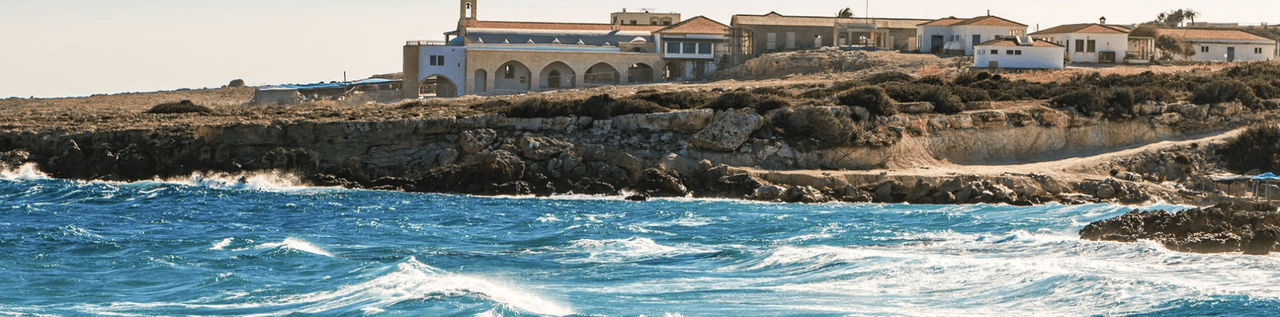
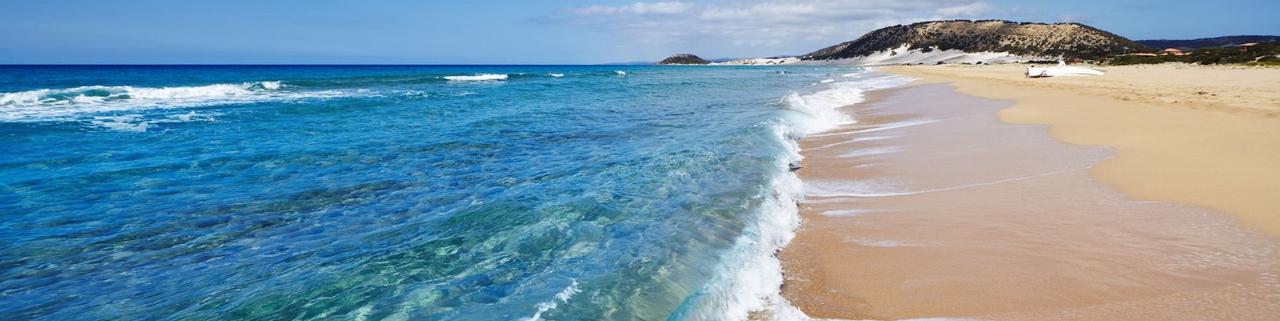
The Turkish Republic of Northern Cyprus, with its 396-kilometer coastline and Mediterranean climate, possesses significant potential for marine tourism. Climatic conditions allowing sea access from April to November increase tourist demand, particularly during summer months. Public and resort beaches in areas such as Kyrenia, Famagusta, and Dipkarpaz are the main centers of this type of tourism.
Notable beaches::
Apostolos Andreas Monastery (Northern Cyprus Guide)
Integrated with marine tourism, yacht tourism is supported by the TRNC’s natural harbors and specialized marina infrastructure.
Main harbors::
The TRNC’s advanced accommodation infrastructure and affordable high-service standards support congress and meeting tourism.
Congress venues::
Cypriot Turkish cuisine has enriched itself over centuries under the influence of multiple cultures. This cuisine, combined with the classic Mediterranean diet, highlights both meat dishes and traditional plant-based flavors.
Notable dishes::
The healthcare infrastructure in the TRNC has developed significantly in recent years.
Main areas::
The natural structure and biological diversity of the TRNC support nature-based tourism.
Regional richnesses::
Climatic conditions and geography make the TRNC suitable for various sports.
Sports activities::
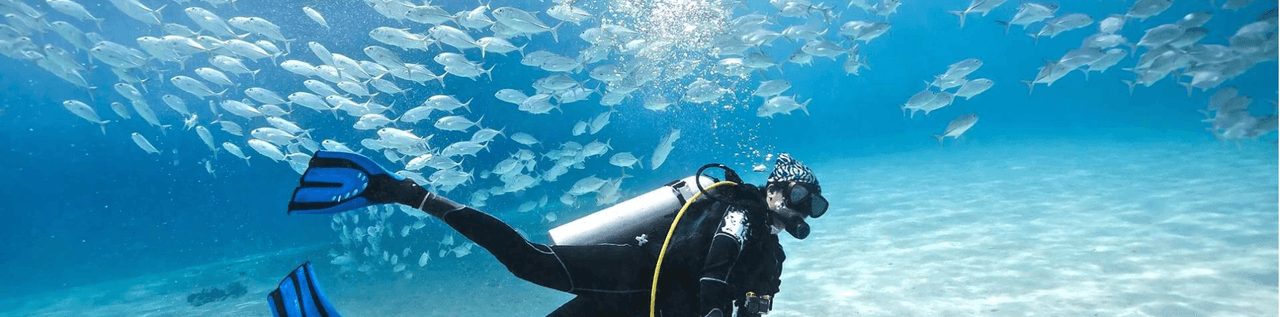
Dipkarpaz Altınkum Beach (Northern Cyprus Guide)
Cyprus, with numerous religious structures, is a suitable destination for faith tourism.
Sites of visit::
Recent political events and wars have also made the TRNC a destination for sorrow tourism.
Memorial sites::
Festivals held throughout the year in the TRNC play an important role in promoting local products, traditions, and artistic and musical events.
Main festivals::
TEKNOFEST, as Turkey’s largest Aviation, Space, and Technology Festival, hosts technological and innovation competitions annually in various fields. In 2025, TEKNOFEST was held in the Turkish Republic of Northern Cyprus (TRNC). The event took place between 1–4 May at the former Ercan Airport in Nicosia.
TEKNOFEST TRNC included technology competitions across six main categories and 13 subcategories, offering participants the opportunity to showcase innovation, engineering, and technological skills. Additionally, air shows, exhibitions, and workshops were organized during the festival. A total of 225,000 visitors attended the event.

Scuba Diving in Northern Cyprus (Northern Cyprus Guide)
After the Ottoman Empire conquered the island of Cyprus in 1571, numerous Ottoman structures were built. These include mosques, caravanserais, baths, fountains, tombs, libraries, and tekkes, representing traditional Ottoman architecture. At the same time, Latin and Byzantine structures on the island have been largely preserved, with some churches converted into mosques and given new functions. This reflects the Ottoman administration’s approach to the island’s multicultural structure and religious tolerance. Today, numerous historical monuments from the Ottoman period still stand in the territory of the Turkish Republic of Northern Cyprus. Most of these monuments are concentrated in settlements such as Nicosia, Famagusta, Kyrenia, and Lefke.
The Selimiye Mosque, the largest place of worship in the Turkish Republic of Northern Cyprus, is located in the center of Nicosia and serves as both a religious and cultural center. Originally built in the Gothic style during the Lusignan period as the St. Sophia Cathedral, it was converted into a mosque after the Ottoman conquest of Nicosia in 1570.
Construction of the cathedral began in 1209 and took over a century to complete. Due to earthquakes and structural difficulties, the construction process was prolonged, and it was consecrated in 1326 as the Ayasofya Church while still incomplete. It served as one of the religious centers where coronation ceremonies of the Kingdom of Cyprus were held during the Middle Ages.
After the Ottoman conquest, the first Friday prayer was held with the participation of Lala Mustafa Pasha; two minarets were added, and the structure was converted into a mosque. During the Ottoman period, the mosque became an educational and commercial center surrounded by madrasas and bazaars.
Architecturally, the building retains clear Gothic features: a three-aisle longitudinal plan, pointed-arch windows, and delicate stonework. In 1874, a new entrance gate, known as the “Aziziye Gate,” was constructed.
In 1954, the mosque’s name was changed to Selimiye Mosque. Today, with a capacity of 2,500, the building remains active for worship and hosts both religious and tourist visits.
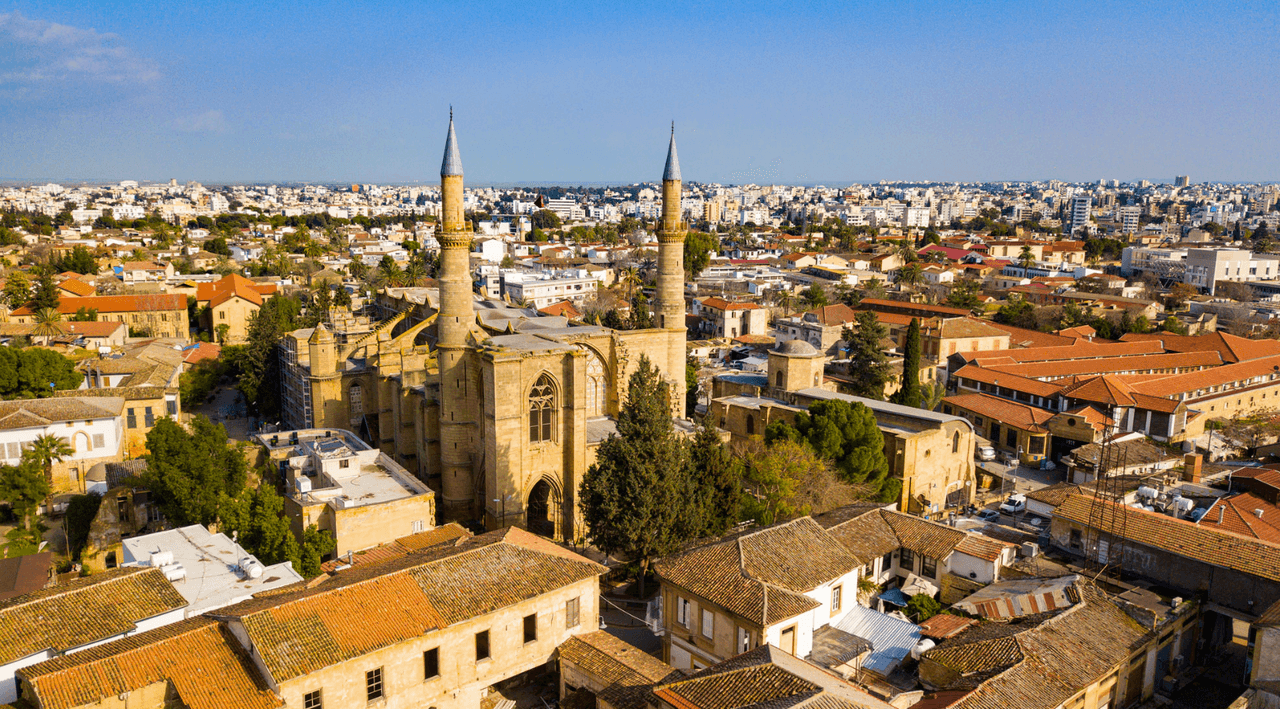
TEKNOFEST'25 TRNC (TEKNOFEST)
One of the most magnificent Gothic structures in Northern Cyprus, the Lala Mustafa Paşa Mosque was originally built as the St. Nicholas Cathedral between 1298 and 1312 and consecrated in 1328. During the Lusignan period, the Kings of Jerusalem were crowned here, making it both a religious and political center.
Built in the French Rayonnant Gothic style, the building is known as “the Reims of Northern Cyprus” due to its resemblance to Reims Cathedral. Constructed from honey-colored stone, it features rose windows, triple entrances, a cruciform roof, and delicate stone carvings. The interior is 50 meters long, three-aisled, and relatively simple.
After the Ottoman conquest of Famagusta in 1571, the building was converted into a mosque; frescoes were covered with plaster, and a mihrab, minbar, and minaret were added. In 1954, the mosque was named after Lala Mustafa Pasha, the Ottoman commander responsible for the conquest.
Unlike many Gothic structures in Europe, the mosque has been preserved without Baroque interventions. Inside, there are tombs from the Lusignan Kingdom and the Loggia Bembo section decorated with ruins from Salamis in the southwest corner. Today, it remains significant both as a place of worship and as a cultural heritage structure.
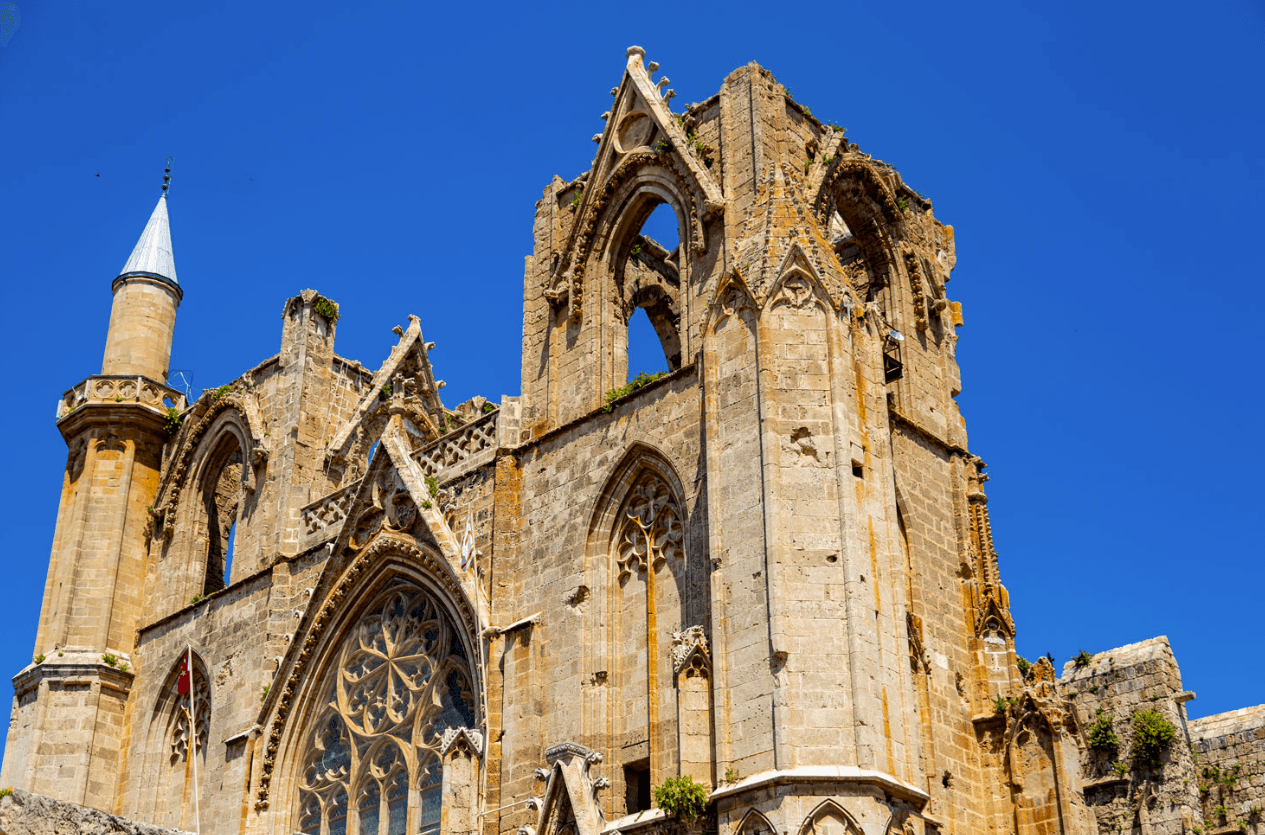
The Haydarpaşa Mosque, built in the 14th century during the Lusignan period as the St. Catherine Church in the Gothic style, became the second-largest church in Nicosia. Influenced by French Rayonnant Gothic architecture, it was converted into a mosque after the Ottoman conquest in 1570 and was also known as the “Ağalar Mosque.”
The building is notable for its three entrance doors, rose window, fine stonework, and Gothic details. The dragon and rose motif on the western door and the figurative reliefs on the northern door, along with Gothic arches and human-headed supports inside, are significant features.
The minaret added to the southwest corner collapsed in 1931 due to lightning and was replaced by a non-original minaret. The annex previously used as a nunnery acquired new functions during the Ottoman period.
Described by British official Sir Harry Charles Luke as “the most elegant Gothic structure in Cyprus,” the mosque remains significant today both as a place of worship and as an architectural heritage site.
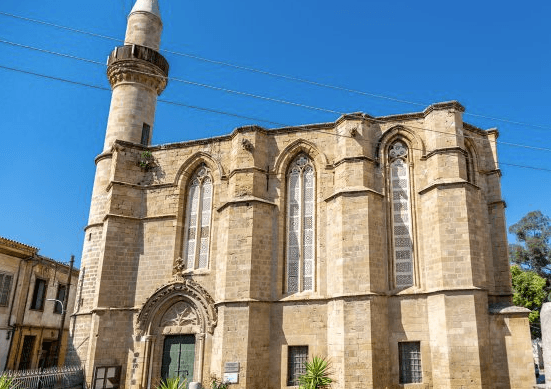
Selimiye Mosque (Northern Cyprus)
Built in the 14th century during the reign of Lusignan King Peter I and financed by the merchant Simon Nostrano, the Church of St. Peter and St. Paul is one of the original interpretations of Gothic architecture in the Eastern Mediterranean. After the Ottoman conquest of Famagusta in 1571, it was converted into a mosque and named after “Great Sinan Pasha,” and was also known for a time as the “Wheat Mosque.” During the British period, it was used as a warehouse.
The building exhibits earthquake-resistant Gothic engineering features such as thick walls and arched buttresses. The interior is notable for its delicate Gothic arches, cross vaults, and balanced column arrangement. Medieval statue fragments and sailor graffiti on the walls indicate that the structure served not only as a religious but also as a cultural center.
In the southern courtyard lies the tomb of Yirmisekiz Mehmet Çelebi, the French ambassador of the Ottoman Empire. Today, the building is closed for worship but remains an important architectural and historical heritage site from an academic and cultural perspective.
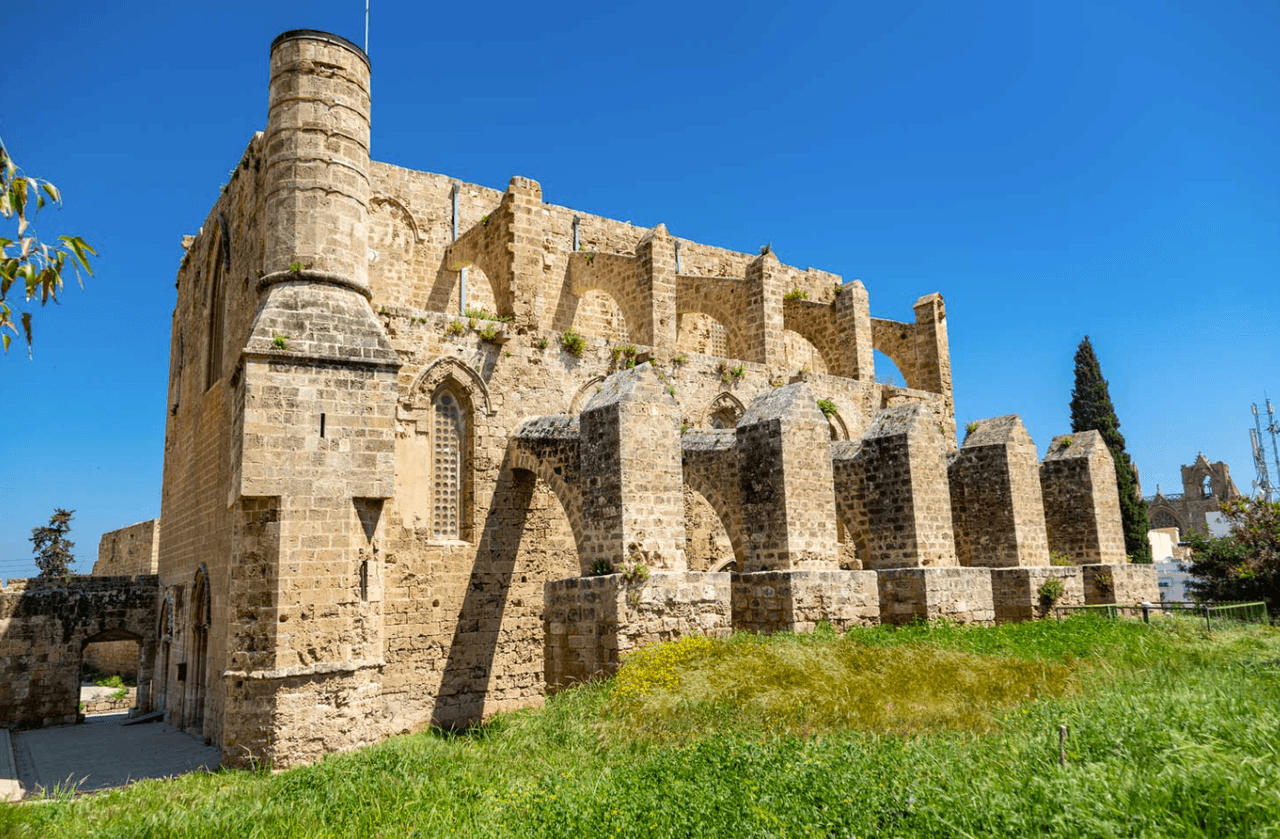
Lala Mustafa Paşa Mosque (Northern Cyprus)
The Büyük Han, constructed immediately after the Ottoman conquest of Cyprus in 1572, is the largest and best-preserved Ottoman caravanserai on the island. Located in the historic center of Nicosia within the city walls, it was commissioned by Muzaffer Pasha, the first Ottoman governor of Cyprus, modeled after the Koza Han in Bursa.
A two-story, square-plan building with 68 rooms, the lower floor was used for commercial purposes and the upper floor for accommodation. At the center of the courtyard stands a six-column mosque built on a stone fountain, forming the core of the structure. The tomb beside the mosque may belong to an important Ottoman official who used the han. The exterior, resembling a fortress, reflects defensive and security concepts.
During the Ottoman period, the building functioned as a commercial center; during the British period, it served as a prison; and in the 20th century, it provided shelter for impoverished families. After restoration in the 1990s, the han has been transformed into a functional cultural center housing art galleries, cafés, and craft workshops. Büyük Han holds an important place in Nicosia’s urban memory and attracts attention through both its architecture and layered history.
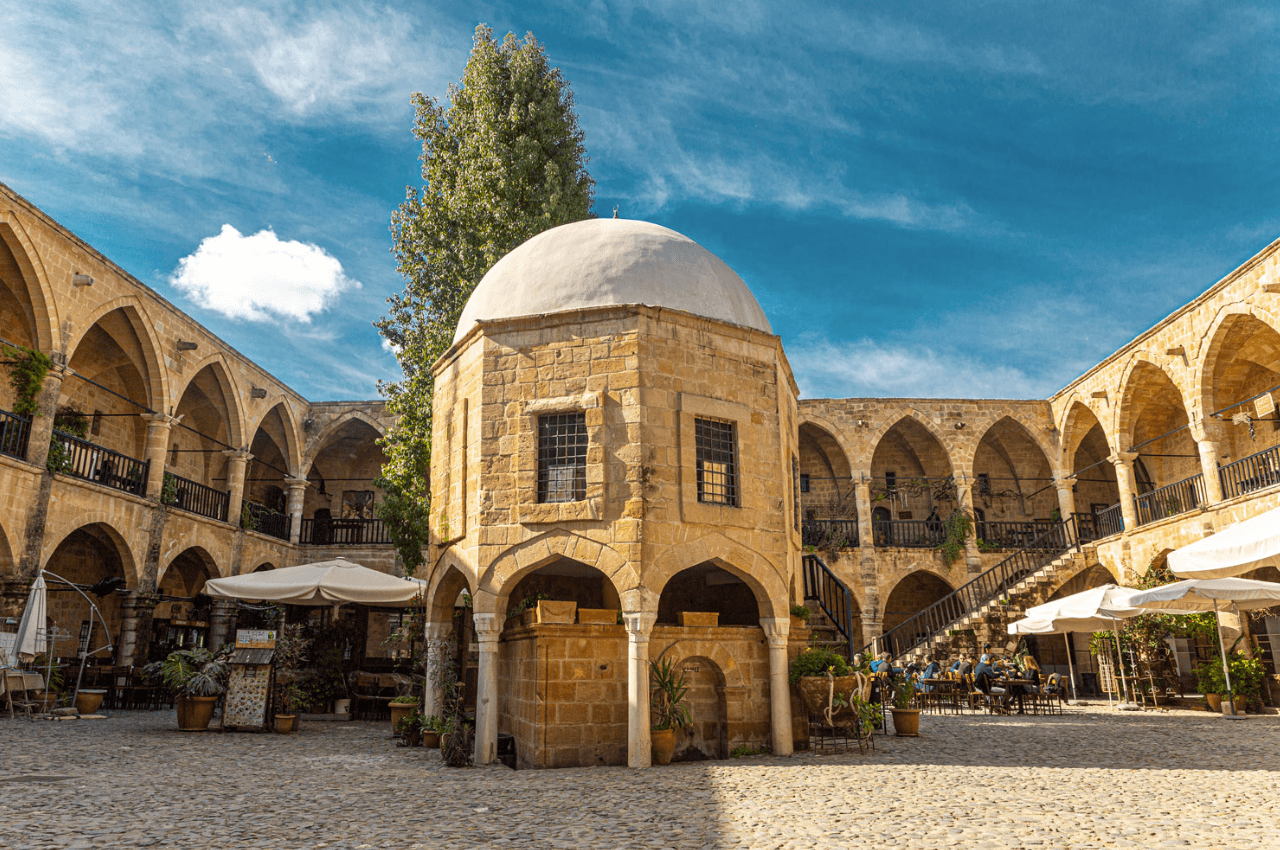
Haydarpaşa Mosque ( Northern Cyprus)
Located on a stone-paved slope leading to the harbor in the center of Kyrenia, the Ağa Cafer Paşa Mosque was built in 1580 by the Ottoman governor Ağa Cafer Paşa. As a typical example of simple Ottoman architecture, the mosque is notable both historically and for its location.
The rectangular building has a three-arched entrance on its north facade. The cross, coat of arms, and floral motifs on the central arch suggest that materials from an earlier structure were reused. The minaret, constructed of stone, is unadorned and harmonizes with the mosque’s simplicity.
Immediately southeast of the mosque stands the Hasan Kavizade Hüseyin Efendi Fountain, dated 1841. This fountain adds both historical and functional unity to the structure.
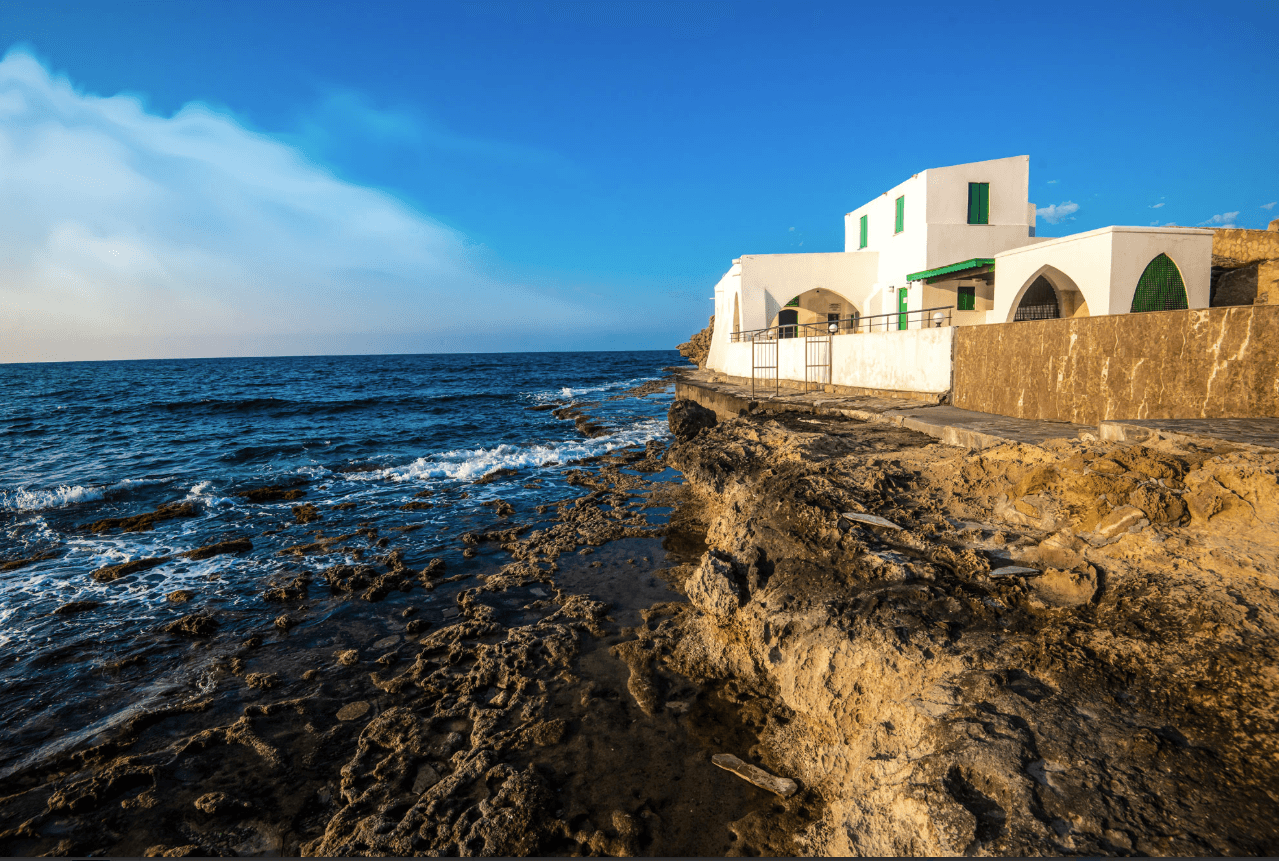
Located on the Çatalköy coast of Kyrenia, overlooking the Mediterranean at the foot of the Pentadaktylos Mountains, the Hz. Ömer Tomb is one of the most sacred Islamic sites in Northern Cyprus, both historically and spiritually. The tomb is believed to house the graves of Hz. Ömer and six warriors who were martyred during the 7th-century Arab raids.
The Ottomans, recognizing the sanctity of the site, built a small mosque and mausoleum here, and over time, the tomb became a revered pilgrimage site among Muslims. Although simple in design, its location harmonized with nature and the handwoven carpets inside create a spiritual atmosphere.
Sinan Paşa Mosque (Northern Cyprus)
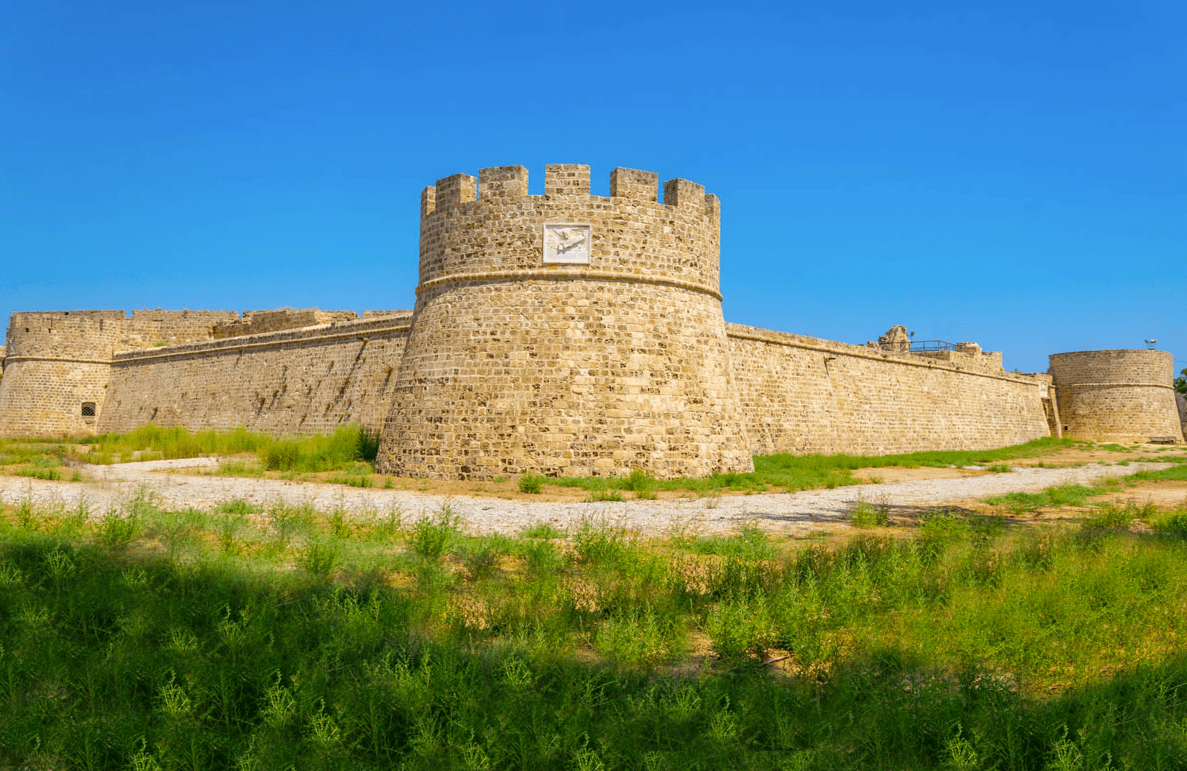
Othello Castle, a strong medieval fortress built in the 14th century by the Lusignans to protect the harbor of Famagusta and later redesigned during the Venetian period to accommodate cannon technology, derives its name from the protagonist of William Shakespeare’s tragedy Othello, who served in Cyprus.
In 1492, the Venetian lion (St. Mark) relief and the name of Captain Nicolao Foscareno were engraved on the castle. The structure is notable for its thick walls, round towers, bronze cannons, Gothic Great Hall, wooden doors, and remnants of the ancient iron chain that once stretched to the harbor. The rooms inside served as a dining hall, dormitory, and storage, while the towers and passages were designed for warfare, defense, and munitions.
After the Ottoman conquest in 1571, the castle continued to be used for military purposes and has preserved its original architecture due to the absence of Baroque interventions. The structure has become a literary symbol through its association with Shakespeare’s Othello.
Restored in 2014 and opened to visitors in 2015, the castle now hosts cultural events such as theater and concerts and serves as an important attraction that complements the historical fabric of Famagusta.
Büyük Han (Northern Cyprus)
Located on the summit of the Pentadaktylos Mountains north of Kyrenia, Saint Hilarion Castle is one of the most impressive medieval structures in Cyprus, notable for both its architecture and legends. Perched at 732 meters above sea level, the castle is part of the island’s triple defense system along with Buffavento and Kantara Castles and is the best-preserved of the three.
The castle takes its name from a hermit who came to Cyprus in the 4th century and withdrew to this area. First documented in 1191, it was initially established to monitor pirate attacks and later served as a royal summer palace during the Lusignan period. During the Venetian period, it lost its military importance and was largely abandoned.
The three-tiered structure of the castle includes::
Combining Gothic architectural elements with defensive functions, the castle is also breathtaking for its views. On clear days, the Turkish coast is even visible.
Saint Hilarion Castle has become a cultural symbol through the legend that it inspired Walt Disney’s Sleeping Beauty castle. Today, it attracts intense tourist interest as both a historical attraction and a visual route.
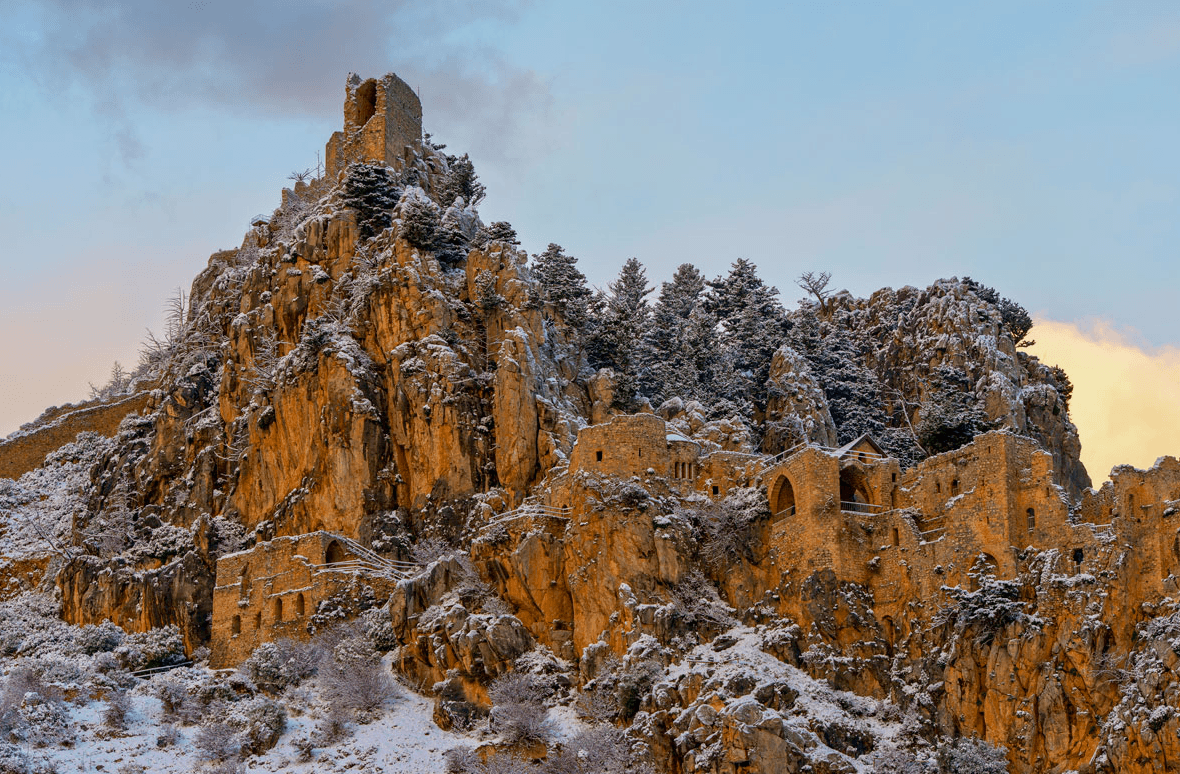
Hz. Ömer Tomb (Northern Cyprus)
Located on a hill 250 meters above sea level near Lefke, the Vouni Palace was constructed in the 5th century BCE by a pro-Persian king to oversee the city of Soli. Due to its strategic location, it served both political and defensive purposes and was later transformed into a royal palace. It was abandoned after a major fire in 380 BCE.
The palace has a three-terrace plan:
Architecturally, the palace consists of official areas (megaron), living quarters, and technical sections connected to cisterns. The most striking feature is a seven-step stone staircase 16 meters wide.
In an area lacking natural water sources, water was collected through cisterns carved into the rock. The large stone column used for water extraction has become the symbol of Vouni.
Excavations in the 1920s uncovered fire traces, Persian-style gold jewelry, sealed coins, bronze votive statues, and depictions of bulls and the Egyptian goddess Hathor. These rich findings confirm that Vouni was a unique ancient center influenced by both Eastern and Western cultures.
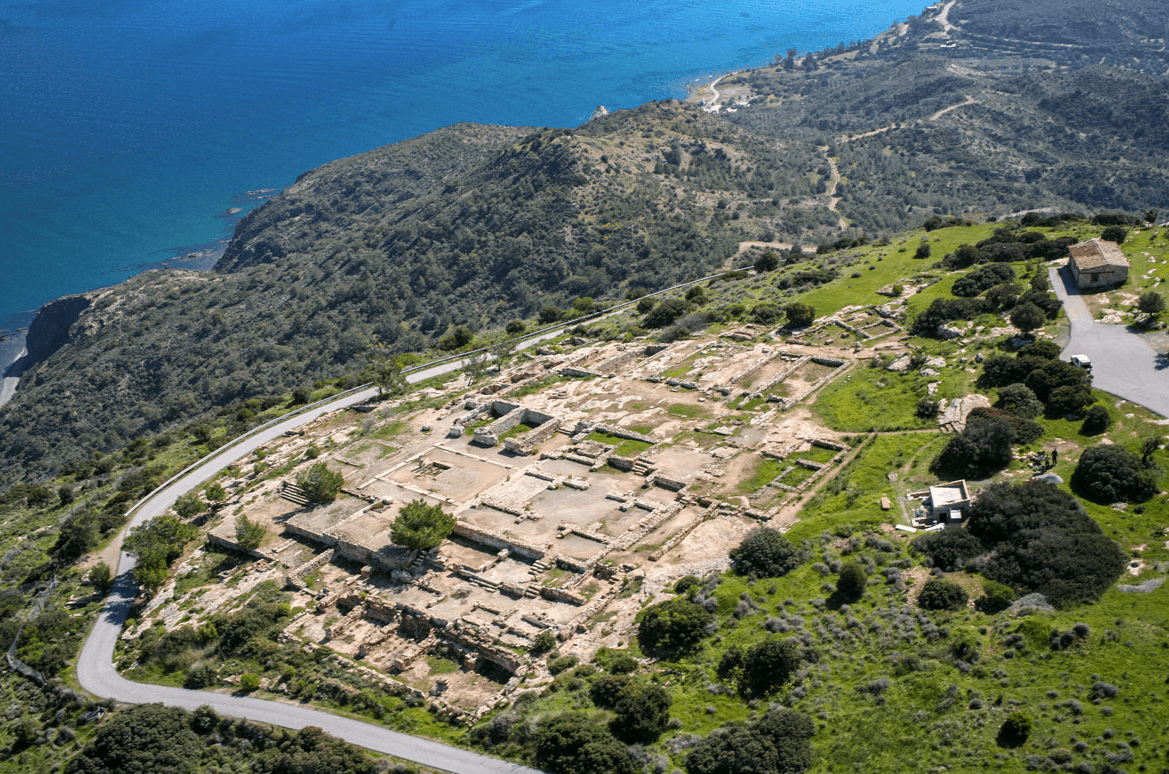
Othello Castle (Northern Cyprus)
Kyrenia Castle is a magnificent medieval structure on the northern coast of Northern Cyprus, built to protect the harbor. Originally constructed by the Byzantines in the 7th century to defend against Arab naval raids, it was strengthened over subsequent centuries by the Lusignans, Venetians, and Ottomans. In 1191, during the Third Crusade, King Richard captured the castle by defeating Isaac Comnenus; in 1571, it came under Ottoman control after the Ottoman conquest of the island.
Its current form dates to the 15th century under Venetian rule. Thickened walls, machicolated towers, a protected entrance system, and the St. George Church made it a significant military and religious center. Inside the castle are cisterns, dungeons, a church, and two museums. A walkway runs along the walls facing the harbor.
Shipwreck Museum is located within the castle and houses one of the oldest shipwreck examples in the world. This Greek merchant vessel, dated to 300 BCE, was accidentally discovered by divers in 1965 and scientifically excavated between 1967 and 1969 by Oxford and Pennsylvania Universities. It is believed to have sunk due to a pirate attack.
The 15-meter-long vessel, with its hull made of Aleppo pine, is displayed along with its cargo of amphorae, almonds, grain, and wine. This unique museum provides important insights into Mediterranean maritime history and is a must-see cultural stop in Kyrenia.
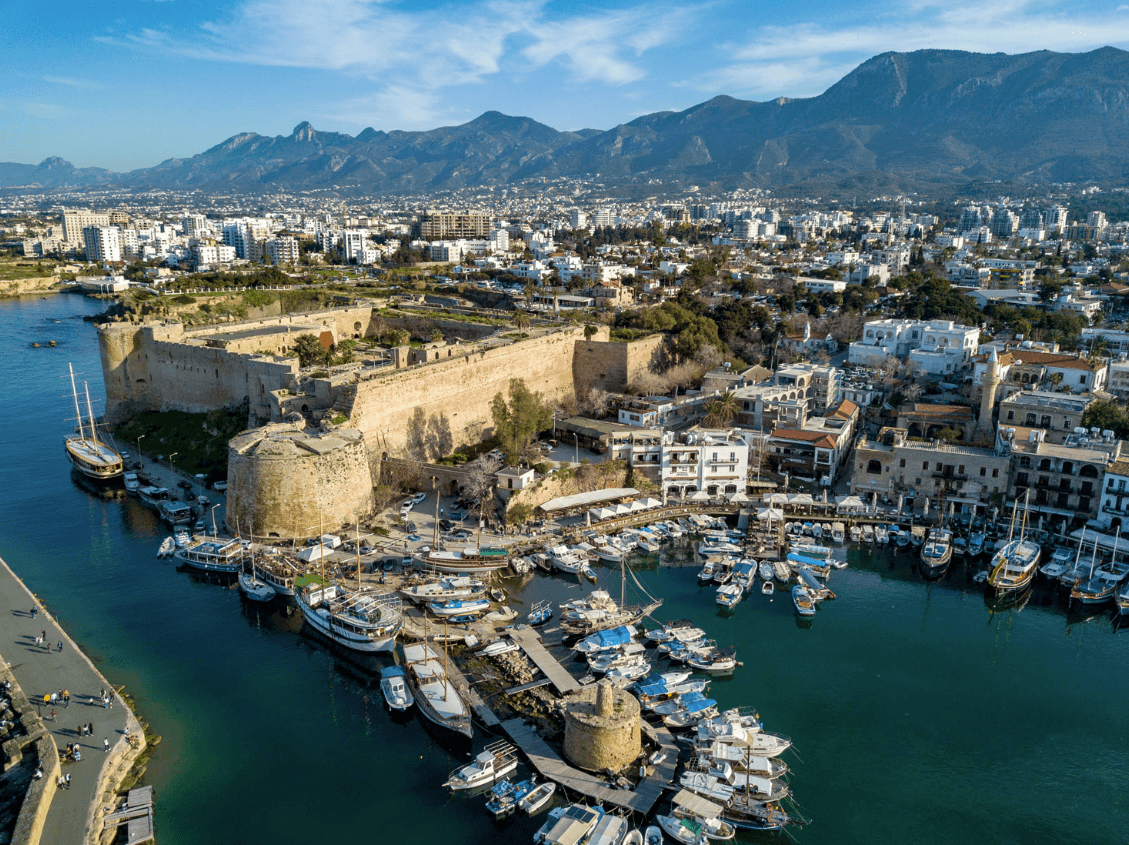
Saint Hilarion Castle (Northern Cyprus)
Located at the foot of the Pentadaktylos Mountains in the Kyrenia district of Northern Cyprus, the Bellapais Monastery is one of the most elegant examples of Gothic architecture on the island. Its name, derived from the French “belle paix” (beautiful peace), attracts attention for both its architectural and natural beauty.
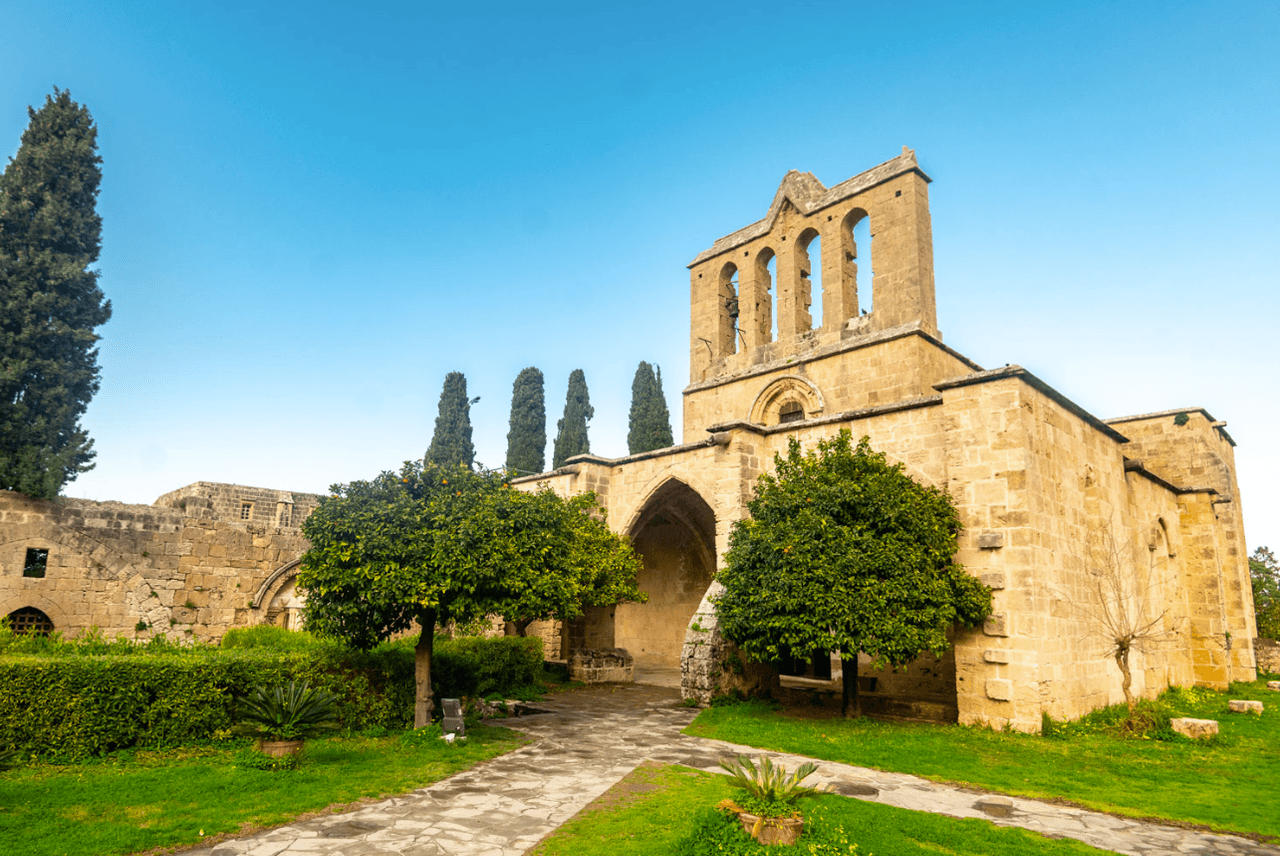
Vouni Palace (Northern Cyprus)
The monastery was founded between 1198 and 1205 by the Canons of the Holy Sepulchre who migrated from Jerusalem, and its main structures were completed during the reigns of Lusignan Kings Hugh III (1267–1284) and Hugh IV. The building stands out with its Gothic arches, stone carvings, and arched corridors, particularly its illuminated refectory (dining hall), along with the church, abbot’s chambers, courtyard, and cistern. Writer Lawrence Durrell lived in the village of Bellapais in the 1950s and described the monastery as “irresistibly attractive” in his work Bitter Lemons. Today, the monastery serves both as a historical structure and as a center for cultural events (concerts, theater, festivals), enchanting visitors with its unique Mediterranean views.
Gazioğlu, Ahmet C. “Kuzey Kıbrıs Türk Cumhuriyeti.” *TDV İslâm Ansiklopedisi*. Accessed April 29, 2025.https://islamansiklopedisi.org.tr/kuzey-kibris-turk-cumhuriyeti
Güler, Y. “Kuzey Kıbrıs Türk Cumhuriyeti’nin Kuruluşuna Kadar Kıbrıs Meselesi.” Ahi Evran Üniversitesi Kırşehir Eğitim Fakültesi Dergisi 5, no. 1 (2004): 101–112.https://dergipark.org.tr/tr/download/article-file/1337540
Kabakcı, Selahattin. “Kuzey Kıbrıs Türk Cumhuriyeti’ndeki Osmanlı Eserlerinin Kültür Turizmine Etkisi Üzerine Bir İnceleme.” *BENGİ Dünya Yörük-Türkmen Araştırmaları Dergisi* 2024, no. 3 (2024): 510–558.https://doi.org/10.58646/bengi.1512898.
Karabulut, Yalçın. *Kuzey Kıbrıs Türk Cumhuriyetinde Turizm*. Accessed April 28, 2025.https://dergipark.org.tr/tr/download/article-file/2152881.
Koday, Z. “Kuzey Kıbrıs Türk Cumhuriyeti Devleti'nin Coğrafi Özellikleri.” *Atatürk Üniversitesi Türkiyat Araştırmaları Enstitüsü Dergisi*, no. 2 (1995).https://dergipark.org.tr/tr/download/article-file/33339
Kıbrıs Türk Ticaret Odası. *Rakamlarla Kuzey Kıbrıs Türk Cumhuriyeti ve Yatırım Ortamı 2024*. Lefkoşa, 2024. Accessed April 29, 2025.https://www.ktto.net/wp-content/uploads/2024/05/Rakamlarla-Kuzey-Kibris-Turk-Cumhuriyeti-ve-Yatirim-Ortami-2024.pdf
T.C. Ministry of Foreign Affairs, TRNC Representation. "Economy." Public Information Office. Accessed April 29, 2025.https://pio.mfa.gov.ct.tr/ekonomi/.
TEKNOFEST. "TEKNOFEST KKTC Ziyaretçi Kayıtları Başladı." TEKNOFEST Resmî Web Sitesi, Accessed April 28, 2025.https://www.teknofest.org/tr/content/announcement/teknofest-kktc-ziyaretci-kayitlari-basladi/.
TRT Haber. "Türk Mukavemet Teşkilatı: TMT Nedir?" YouTube video, 5:33. Date Published September 9, 2022. Accessed April 29, 2025.http://youtube.com/watch?v=eXYx1kEmUqU
TÜRSAB. *Kuzey Kıbrıs Türk Cumhuriyeti Turizm Raporu*. İstanbul: Türkiye Seyahat Acentaları Birliği, March 2022.https://www.tursab.org.tr/assets/assets/uploads/ulke-raporlari/kktc-turizm-raporu-2022.pdf
VisitNCY. "Resim Galerisi." Visit North Cyprus – Resmî Turizm Portalı.https://www.visitncy.com/tr/media/resim-galerisi/
VisitNCY. “Tarih ve Din.” Visit North Cyprus – Resmî Turizm Portalı. Accessed April 28, 2025.https://www.visitncy.com/tr/discover-category/tarih-ve-din/.
Yüksel, Dilek Yiğit. “Kıbrıs Türk Milli Mücadelesi (1914–1958).” Çağdaş Türkiye Tarihi Araştırmaları Dergisi 8, no. 18 (2009): 161–184.https://dergipark.org.tr/en/pub/aamd/issue/40613/489683
Yüksel, Dilek Yiğit. “Kıbrıs’ta Yaşananlar ve Türk Mukavemet Teşkilatı (1957–1964).” *Atatürk Araştırma Merkezi Dergisi* 34, no. 98 (2018): 311–376.https://dergipark.org.tr/en/pub/aamd/issue/40613/489683
Çiftçi, Dilan. “Kültür, Sanat ve Siyaset İlişkisi: Kuzey Kıbrıs Örneği.” *Journal of History Culture and Art Research* 8, no. 4 (2019): 484–507.https://doi.org/10.7596/taksad.v8i4.2229.
Özdeşer, Hüseyin, and Okan Şafaklı. “KKTC Ekonomisinin Genel Analizi.” *Yakın Doğu Üniversitesi Sosyal Bilimler Dergisi* 15, no. 1 (2021): 1–31. Accessed April 29, 2025.https://dergipark.org.tr/en/download/article-file/2151795
Şafaklı, Okan Veli. “KKTC Turizm Sektörünün Performansı Üzerine Bir Çalışma.” Lefke Avrupa Üniversitesi İİBF, İşletme Bölümü. Accessed April 28, 2025.https://dergipark.org.tr/tr/download/article-file/71887.
Şafaklı, Orhan, and Zeki Erkut. “Kuzey Kıbrıs Türk Cumhuriyeti’nde Özel İlgi Turizminin Karşılaştırmalı Üstünlüğü.” *Anatolia: Turizm Araştırmaları Dergisi* 13, no. 1 (2002): 33–38.https://dergipark.org.tr/tr/pub/atad/issue/53050/702508
Şenol, C. “Kuzey Kıbrıs Türk Cumhuriyeti’nin Hidrografik Yapısı, Su Sorunu ve Çözüm Önerileri.” *Kıbrıs Araştırmaları Dergisi* 21, no. 45 (2020): 77–98.https://dergipark.org.tr/en/pub/cyprusstudies/issue/57332/698408
“Akdeniz’in Berraklığına Dalın.” *North Cyprus Guide*. Accessed April 29, 2025.https://www.northcyprus.guide/ne-yapilir/akdeniz-in-berrakligina-dalin
“Apostolos Andreas Manastırı.” *North Cyprus Guide*. Accessed April 29, 2025.https://www.northcyprus.guide/ne-yapilir/apostolos-andreas-manastiri
“Coğrafi Bilgiler.” KKTC Dış Basın ve Enformasyon Dairesi. Accessed April 29, 2025.https://pio.mfa.gov.ct.tr/cografi-bilgiler/
“Dr. Fazıl Küçük Fotoğraf Galerisi.” Dr. Fazıl Küçük Vakfı. Accessed April 29, 2025.https://drfazilkucukvakfi.gov.ct.tr/GALER%C4%B0/FOTO%C4%9ERAFLAR
“Kıbrıs Adası Fiziki Haritası.” Harita Genel Müdürlüğü. Accessed April 29, 2025.https://www.harita.gov.tr/urun/kibris-adasi-fiziki-haritasi/277
“Kıbrıs Meselesinin Tarihçesi: BM Müzakerelerinin Başlangıcı.” T.C. Dışişleri Bakanlığı. Accessed April 29, 2025.https://www.mfa.gov.tr/kibris-meselesinin-tarihcesi_-bm-muzakerelerinin-baslangici.tr.mfa
“Kıbrıs İklimi.” KKTC Meteoroloji Dairesi. Accessed April 29, 2025.http://kktcmeteor.org/meteorolojikbilgi/kibris-iklimi
“Rauf Raif Denktaş.” KKTC Cumhurbaşkanlığı Resmî Web Sitesi. Accessed April 29, 2025.https://kktcb.org/tr/cumhurbaskanligi/cumhurbaskanlari/rauf-raif-denktas
[1]
Arkan, Merve Senem. “Kıbrıs’ın Fethi: Haritalarda 1570–1 Mağusa Kuşatması.” Journal of Turkish Studies, 2015. Erişim Tarihi: 29 Nisan 2025. .


Turkish Republic of Northern Cyprus
Capital | Lefkoşa | ||||||||
|---|---|---|---|---|---|---|---|---|---|
Official Language | Turkish | ||||||||
Form of Government | Parliamentary System | ||||||||
President | Ersin Tatar | ||||||||
Prime Minister | Ünal Üstel | ||||||||
Independence | 15 November 1983 | ||||||||
Area | 3,248 km² | ||||||||
Population | 382,836 (2021) | ||||||||
Currency | Turkish Lira (TL) | ||||||||
Time Zone | GMT+03:00 | ||||||||
Telephone Code | +90 +392 | ||||||||
Climate | Mediterranean Climate | ||||||||
GDP | 132.3 Billion TL | ||||||||
GDP per Capita | 14,599 Dollars | ||||||||
No Discussion Added Yet
Start discussion for "Turkish Republic of Northern Cyprus" article
History
Ottoman Period and British Administration
British Era and Greek Cypriot Enosis Activities
Turkish Resistance Organization (TMT) and Resistance
Establishment of the Republic of Cyprus (1960)
The Period 1963–1974
Tensions Between 1960 and 1963
Bloody Christmas and the De Facto Division of the Island (1963–1964)
Erenköy Resistance and Erenköy
1967 Grivas Return and the Geçitkale-Boğaziçi Massacres
1974 Peace Operation and the Establishment of the TRNC
Geography and Climate
Geological Structure and Landforms
Climate Characteristics
Water Resources
Soil Structure and Agriculture
Vegetation and Natural Life
Settlement Patterns and Human Geography
Demographic Structure
Economic Structure
Tourism and Education
Agriculture and Industry
Foreign Trade Balance
Investment Environment and Incentives
Key Economic Indicators (2023)
Culture and Tourism
Contribution to Gross Domestic Product (GDP)
Types of Tourism
Marine Tourism
Yacht Tourism
Congress Tourism
Gastronomy Tourism
Health Tourism
Eco-Tourism
Sports Tourism
Faith Tourism
Sorrow Tourism
Festival, Culture, and Art Tourism
TEKNOFEST'25 TRNC
Historical Monuments
Selimiye Mosque – Nicosia
Lala Mustafa Paşa Mosque – Famagusta
Haydarpaşa Mosque – Nicosia
Sinan Paşa Mosque – Famagusta
Büyük Han – Nicosia
Ağa Cafer Paşa Mosque – Kyrenia
Hz. Ömer Tomb – Kyrenia
Othello Castle – Famagusta
Saint Hilarion Castle – Kyrenia
Vouni Palace – Lefke
Kyrenia Castle and Shipwreck Museum – Kyrenia
Bellapais Monastery – Kyrenia