This article was automatically translated from the original Turkish version.
Legal Basis | Agreement and Protocol on the Exchange of Greek and Turkish Populations | ||||||||
|---|---|---|---|---|---|---|---|---|---|
Decision Location | Lausanne Peace Conference | ||||||||
Date of Decision | 30 January 1923 | ||||||||
Party | Republic of Türkiye Kingdom of Greece | ||||||||
Excluded from the Exchange | Greek Orthodox Christians of Istanbul and Turkish Muslims of Western Thrace | ||||||||
Number of Affected People | According to AA, 500 thousand Muslim Turks and 1.2 million Orthodox Christians | ||||||||
Turkish-Greek Population Exchange is an international practice that mandated the compulsory exchange of populations based on religion, as stipulated by the treaty signed on 30 January 1923. It required the relocation of the Greek Orthodox population residing in Türkiye and the Muslim population living in Greece. Decided during the Lausanne Peace Conference, this exchange led approximately two million people to leave the lands where they were born and raised, with the exception of the Greek Orthodox community of Istanbul and the Muslim Turks of Western Thrace.
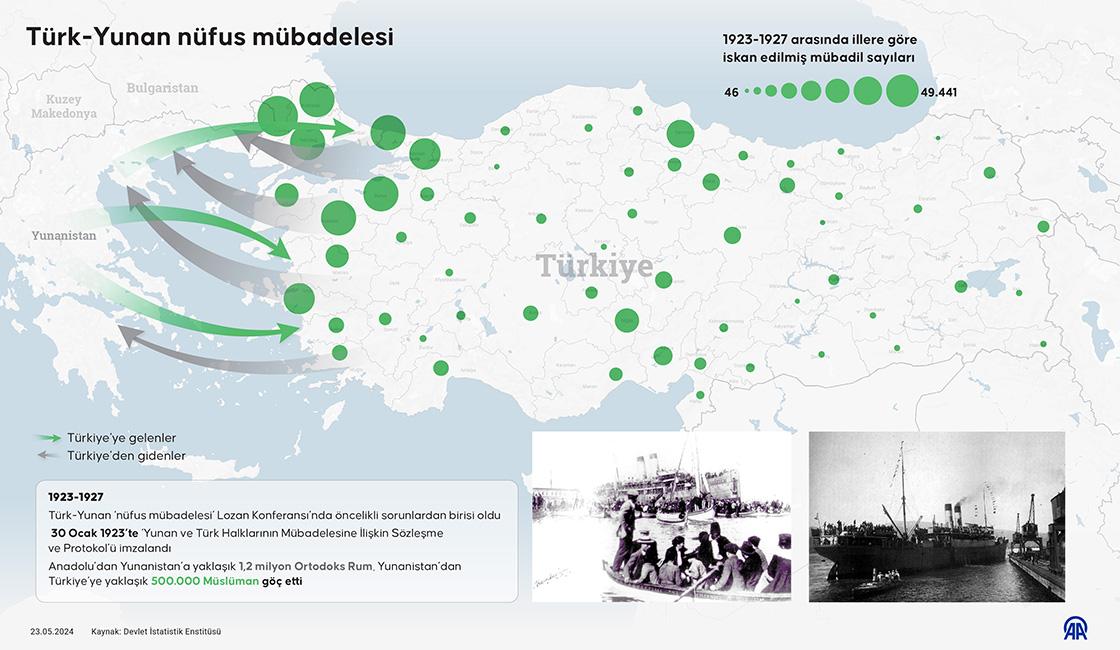
Infographic on the Turkish-Greek Population Exchange (AA)
The history of the Turkish-Greek Population Exchange is rooted in the minority policies that emerged within the multi-religious and multi-ethnic structure of the Ottoman State and the rise of nationalism in the Balkans from the 19th century onward. The process initiated by the Greek Revolt deepened through the Balkan Wars, First World War, and National Struggle years, marked by intense migrations and mutual population losses. Particularly under wartime conditions, forced population displacements in Anatolia and the Balkans became commonplace. These developments brought the homogenization of populations as a solution to the nation-state building goals of Türkiye and Greece, paving the way for the emergence of the exchange idea.
The idea of the Turkish-Greek Population Exchange took shape as a consequence of the demographic, economic, and political problems arising from the intense migration movements during the Balkan Wars and the National Struggle. Greece faced serious difficulties in settling hundreds of thousands of Greek migrants from Anatolia; this situation strengthened the notion of relocating the Muslim population of Greece to Anatolia. At the same time, in Türkiye, the presence of the non-Muslim population remaining after the war began to be discussed in the context of the new state’s security and nation-building policies. Under these conditions, with the involvement of the League of Nations, it became widely accepted that a mutual and compulsory population exchange would be a viable solution for both states.
The issue of the Turkish-Greek Population Exchange was one of the most important topics addressed during the initial phase of the Lausanne Peace Conference. The minority question, due to the forced migrations and reciprocal population movements during the war years, triggered intense debates between the Turkish and Greek delegations. Both sides viewed the presence of “foreign elements” within their territories as a threat to security, stability, and social order.
The Turkish delegation regarded the presence of the Greek Orthodox population in Anatolia as politically and socially problematic after the National Struggle; meanwhile, the Greek delegation, overwhelmed by the heavy economic and social burden created by Greek migrants from Anatolia, advocated the relocation of the Muslim population of Greece to Türkiye. These reciprocal demands created the groundwork for an agreement on the compulsory implementation of the exchange.
During the Lausanne negotiations, the scope of the exchange, which groups would be subject to it, and which populations would be excluded were discussed in detail. Ultimately, it was decided that the Greek Orthodox population of Istanbul and the Muslim Turks of Western Thrace would be exempted from the exchange, while the principle of reciprocal population transfer was accepted for all others. On 30 January 1923, the “Convention and Protocol on the Exchange of Greek and Turkish Populations” was signed, thereby placing the population exchange on a legal foundation.【1】 This decision taken at the Lausanne Conference took shape as a fundamental political solution aimed at homogenizing the populations of both countries in their nation-state building processes.
The Turkish-Greek Population Exchange was legally formalized by the “Convention and Protocol on the Exchange of Greek and Turkish Populations”, signed on 30 January 1923 during the Lausanne Peace Conference. The agreement was signed by İsmet Pasha (İnönü), head of the Turkish Delegation at the Lausanne Conference, on behalf of the Government of the Grand National Assembly of Türkiye, and by Eleftherios Venizelos, head of the Greek Delegation and former Prime Minister, on behalf of the Kingdom of Greece.【2】 The agreement mandated the compulsory exchange of the Greek Orthodox population in Türkiye and the Muslim population in Greece, thereby establishing a binding interstate arrangement that did not rely on the principle of voluntariness.
Article 1 of the agreement stipulated that all Greek Orthodox and Muslim populations, except those in Istanbul and Western Thrace, would be subject to the exchange. Accordingly, individuals covered by the exchange were required to leave their countries as of 1 May 1923, and their return to their former places of residence without the permission of the respective states was prohibited.
The agreement also detailed the status of the movable and immovable property of those subject to the exchange. It was agreed that the liquidation, valuation, and compensation for properties left behind would be carried out, and a Mixed (Joint) Exchange Commission was established to oversee and regulate these procedures.【3】 The Commission was empowered to resolve disputes arising during the implementation of the exchange.
One of the key provisions of the agreement was that the exchange was to be compulsory and irreversible. Thus, the exchange became an initiative aimed at permanently transforming the demographic structures of both countries.
The Turkish-Greek Population Exchange Agreement, while designed as an international document to resolve minority and refugee issues after the war, generated significant social, economic, and cultural consequences in both countries.
The implementation of the Turkish-Greek Population Exchange began in 1923 in accordance with the terms of the agreement and continued for several years. The transportation, resettlement, and liquidation of properties of those subject to the exchange posed serious administrative and logistical challenges for both Türkiye and Greece. The migration process largely occurred immediately after the war, resulting in major disruptions in transportation, housing, and food supply.
To oversee the implementation of the agreement and resolve disputes, the Mixed Exchange Commission was established. This commission was authorized to determine the status of those subject to the exchange, identify the populations involved, assess property values, and adjudicate disputes between the parties. One of the most contentious issues during implementation was determining whether individuals fell within the scope of the exchange, particularly disputes surrounding the “established” status.
Muslim migrants from Greece were transported to Türkiye via designated ports, held in temporary shelters, and then relocated to assigned settlement areas. Similarly, the Greek Orthodox population from Türkiye was transported under supervision. During this process, health problems, epidemics, inadequate housing, and economic hardship were among the main difficulties faced by the exchangees.
Among the epidemics, typhus emerged as one of the greatest threats due to its high mortality rate and rapid transmission. At a time when no effective treatment or preventive vaccine for typhus existed, the understanding that the disease was spread by lice placed hygiene and louse control at the center of health measures during the exchange.
Health care for exchangees was managed through the collaboration of the newly established Ministry of Exchange, Reconstruction, and Settlement and the Red Crescent (Hilâl-i Ahmer). Medical teams were deployed at embarkation ports in Greece and disembarkation piers in Türkiye, and hospitals and dispensaries were opened. Exchangees were held in quarantine centers called tahaffuzhane before being relocated, where they were washed and their belongings disinfected using steam machines. These measures constituted the most fundamental preventive steps against the spread of typhus.
Despite all preventive measures, typhus cases could not be entirely prevented. Cases were recorded especially in the Central Black Sea and Central Anatolia regions; in 1924 alone, 919 cases of typhus were reported and 110 people died.【4】 Nevertheless, strict quarantine and hygiene measures prevented the disease from becoming a nationwide epidemic.
The resettlement of Muslim exchangees arriving in Türkiye became one of the most significant social and administrative challenges faced by the early years of the Republic. The majority of the population arriving from Greece was relocated to settlements in Anatolia and Thrace that had been depopulated due to war and migration; the resettlement process was attempted to be carried out under a centralized planning framework. However, the sheer size of the population and the limitations of available resources created serious practical difficulties.
To manage resettlement activities, the Ministry of Exchange, Reconstruction, and Settlement was established within the state apparatus, and the responsibility for resettling exchangees was assigned to this institution. Exchangees were placed in areas as compatible as possible with the climate and production conditions of their regions of origin; those engaged in agriculture were directed to rural areas, while artisans and merchants were assigned to towns and cities. Nevertheless, housing shortages and inadequate infrastructure complicated the resettlement process.
The Hilâl-i Ahmer Society played a crucial role in meeting the basic needs of exchangees. Health services, food aid, and temporary housing were largely provided through this organization. At the same time, efforts were made to quickly transform exchangees into productive members of society by providing them with land, agricultural tools, and production equipment.
The exchangees, while adapting to their new environments, also encountered social and cultural challenges alongside economic hardship. Differences in language, lifestyle, and settlement patterns sometimes made integration difficult; yet over time, the exchangee population left lasting imprints on the social and economic fabric of Türkiye.
Interview with Sefer Güvenç, General Secretary of the Lausanne Exchangees Foundation, on the Exchangees (Yusuf Sami Kamadan)
The Turkish-Greek Population Exchange brought profound changes to Türkiye’s demographic structure and significantly contributed to the reshaping of its population along religious and identity lines during the early years of the Republic. With the departure of the Greek Orthodox population, significant demographic gaps emerged in Anatolia and Thrace, which were filled by Muslim exchangees from Greece. Thus, the exchange became an effective instrument in the process of homogenizing the population in line with the nation-state ideology of the newly established Republic of Türkiye.
Economically, the exchange caused serious short-term problems. The departure of the experienced Greek Orthodox population from agriculture, trade, and crafts led to disruptions in production and commerce, particularly in urban economies. In contrast, efforts were made to revive agricultural production in the regions where exchangees were resettled, through land distribution and production support to ensure economic continuity. However, this process was prolonged due to insufficient resources and inadequate infrastructure.
While establishing new social relationships in their new environments, exchangees faced cultural adaptation issues and traumatic migration experiences. Nevertheless, over time, the exchangee population adapted to their surroundings and contributed to the social fabric of Türkiye.
The Turkish-Greek Population Exchange created deep and lasting impacts on Greece’s demographic, economic, and social structure. Hundreds of thousands of Greek exchangees arriving from Anatolia and Eastern Thrace caused a rapid and significant increase in the country’s population, bringing serious challenges in housing, employment, and food supply. This intense population surge immediately after the war placed heavy pressure on Greece’s limited economic resources.
Economically, the exchange initially created major difficulties for Greece. Land distribution for resettlement, the establishment of new settlements, and infrastructure development were urgently required. Nevertheless, in the long term, the participation of exchangees in agriculture, crafts, and trade contributed to the restructuring of the Greek economy. The revival of agricultural production, in particular, has been linked to the labor and accumulated knowledge of the exchangees.
Socially and politically, the population exchange was viewed as part of the process of strengthening national unity in Greece. The population was perceived as becoming more homogeneous through resettlement; this was presented as a positive development within the framework of nation-state building. However, the adaptation problems, poverty, and marginalization experienced by the exchangees also led to long-term social tensions within Greek society.
During the Turkish-Greek Population Exchange, exchangees faced multifaceted and severe problems due to the compulsory and sudden nature of the migration. Forced to leave their ancestral lands within a short time, they lost their material possessions and experienced an irreversible rupture.
Among the most common problems during migration were inadequate housing and food shortages. A significant portion of the population subject to the exchange remained for extended periods in temporary shelters during transit and upon arrival; difficulties in accessing healthcare and outbreaks of epidemics resulted in fatalities. The elderly, women, and children were the most affected groups under these conditions.
During resettlement, exchangees encountered issues such as insufficient housing, unproductive agricultural land, and lack of production tools. Differences in language, culture, and lifestyle complicated social integration, sometimes leading to tensions between local populations and exchangees. Moreover, a large proportion of exchangees struggled to find employment suited to their professions.
Psychologically, the exchange left lasting trauma on the exchangees. The compulsory migration damaged their sense of belonging and triggered intense feelings of loss and nostalgia. This experience created a collective memory that affected subsequent generations and turned the population exchange into a deep historical wound in both countries.
The Turkish-Greek Population Exchange has been addressed differently in the historiography of both countries and has been subject to evolving interpretations over time. In early studies, the exchange was largely evaluated from a state-centered perspective, presented as a necessary but compulsory solution for homogenizing populations during the nation-state formation process. In this approach, the exchange was primarily examined through its political, legal, and administrative dimensions, while its human dimension remained secondary.
In Greek historiography, the exchange has been assessed primarily through the traumas experienced by Greek migrants from Anatolia and the economic and social difficulties faced by Greece. Nevertheless, for a long time, the exchange was portrayed positively as a process that strengthened national unity and successfully integrated migrants into society. State policies and official narratives constructed an account emphasizing the long-term contributions of the exchange to Greek society.
In Turkish historiography, the exchange was largely overlooked during the early years of the Republic. In the process of building the national identity of the new state, the exchange was often regarded as an unavoidable necessity, with the human losses involved receiving limited attention. Starting in the 1990s, however, a significant shift occurred in the historiography of both Türkiye and Greece; studies adopting a people-centered perspective on the exchange increased markedly.
The Turkish-Greek Population Exchange has generated a broad academic literature in Türkiye and Greece across disciplines such as history, sociology, economics, and political science. Early studies in the Republic’s formative years were largely shaped by official documents, legal regulations, and state policies, treating the exchange primarily as an administrative and diplomatic issue.
In Türkiye, academic interest in the exchange has increased markedly since the 1990s. Studies from this period have examined not only the resettlement, economic adaptation, and social impacts of the exchange, but also individual experiences and collective memory. Oral history projects, memoirs, and local research have made the social dimensions of the exchange more visible.
In Greece, academic research on the exchange began earlier and focused intensively on the narratives of Greek migrants from Anatolia. These studies have detailed the traumas experienced by exchangees, settlement policies, and their integration into Greek society. Over time, comparative studies between Turkish and Greek literature have increased, transforming the population exchange into a multidimensional and critical field of inquiry beyond one-sided narratives.
In Turkish literature, the Turkish-Greek Population Exchange remained largely unaddressed directly or was treated only as a historical backdrop until the 1990s. The number of novels centered on the exchange was very limited from the early years of the Republic until the 1990s; literary interest was concentrated instead on themes such as the National Struggle, the founding of the nation-state, and modernization. However, beginning in the 1990s, as the second and third generations of exchangees became more visible in the social memory, the exchange began to be treated as an independent and central theme in Turkish novels.
In these novels, the exchange is addressed not through official historical narratives but through its human and emotional dimensions. Compulsory migration, lost homelands, abandoned homes and graves, fractured families, and intergenerational trauma form the core of the narrative. In this context, Kemal Yalçın’s novel Emanet Çeyiz is an example that focuses on collective memory through memories and legacies left behind on both sides of the exchange.
Ahmet Yorulmaz’s works hold a distinct place in exchange literature. Savaşın Çocukları portrays compulsory migration through the eyes of children, revealing the destructive impact of war and exchange on innocence. In his novel Ulya, the exchange is explored alongside issues of identity, belonging, and cultural continuity through the geography of the Aegean.
Other Turkish literary works addressing the exchange also highlight similar themes. In novels such as Girit’ten Cunda’ya, migration is narrated through sea journeys and the Aegean islands; in works like Hasret, loss, waiting, and longing for the past are foregrounded. In most of these novels, historical events remain in the background; the narrative is built upon individual testimonies, family stories, and oral accounts.
The Turkish-Greek Population Exchange was long addressed indirectly in the cinema of both countries; however, beginning especially in the 1990s, it became visible through individual stories and collective memory.
In Turkish cinema, the theme of the exchange is most clearly depicted in the film Bir Tutam Baharat. Although the film does not directly address the 1923 exchange, it explores the forced separation experienced by Istanbul’s Greek Orthodox community through themes of memory, nostalgia, and the loss of homeland. Elements such as place, food, and scent provide a symbolic narrative of lives fragmented by the exchange. Similarly, Dedemin İnsanları centers on the story of a family that migrated from Crete to Türkiye, portraying compulsory migration, alienation, and identity issues from a child’s perspective. The film reflects the condition of exchangees as “strangers in the place they came to and others in the place they left.”
Trailer of Dedemin İnsanları (Most Production)
In Greek cinema, the theme of the exchange and the rupture from Anatolia has been addressed since earlier periods. In particular, Politiki Kouzina (A Touch of Spice) tells the story of a Greek family forced to migrate from Istanbul to Greece, foregrounding the identity fragmentation and nostalgic memory following the exchange. In the film, Istanbul is represented as a lost paradise, and the exchange is presented as a personal trauma and an intergenerational legacy of memory. Additionally, in Theo Angelopoulos’s films—particularly those dealing with migration and border themes—the exchange is indirectly addressed through the contexts of forced displacement and loss of homeland, even if not explicitly named.
Trailer of Politiki Kouzina (StarTvGreece)
Anadolu Ajansı. "Türk-Yunan nüfus mübadelesi." Accessed December 22, 2025.https://www.aa.com.tr/tr/info/infografik/39511
Emgili, Fahriye. “Türk–Yunan Nüfus Mübadelesi Hakkındaki Araştırmalara Bir Bakış.” *Tarih ve Günce: Atatürk ve Türkiye Cumhuriyeti Tarihi Dergisi* 1, no. 1 (Summer 2017): 29–54. Accessed December 22, 2025.https://dergipark.org.tr/tr/pub/tarihvegunce/article/331702
Genç Acar, Derya. “Beyaz Perdeden Mübadeleye Bakmak: Türk ve Yunan Sinemasında Mübadele.” *Belgi Dergisi* 30 (Summer 2025/II): 281–304.https://dergipark.org.tr/tr/pub/belgi/article/1619112
Karataş, Murat. *Türk–Yunan Nüfus Mübadelesi (1923–1925)*. Master's thesis,Gazi Üniversitesi Institute of Social Sciences, Ankara, 2004. Accessed December 22, 2025.https://tez.yok.gov.tr/UlusalTezMerkezi/TezGoster?key=Keh6sQzap4ZTp8dqWPlH1J5wHbBFTxpCbneWmSOM5aRiKQN3zYufSvZKxqw5rhsT
Kayam, H. Cevahir. “Lozan Barış Antlaşmasına Göre Türk–Yunan Nüfus Mübadelesi ve Konunun T.B.M.M.’de Görüşülmesi.” *Atatürk Araştırma Merkezi Dergisi* 11, no. 33 (1995): 581–610. Accessed December 22, 2025.https://dergipark.org.tr/tr/pub/aamd/article/759188
Kiracı, Mehmet. *Cumhuriyet Döneminin İlk Göçü: Türk–Yunan Nüfus Mübadelesi*. Master's thesis,Trakya Üniversitesi Institute of Social Sciences, Edirne, 2006. Accessed December 22, 2025.https://tez.yok.gov.tr/UlusalTezMerkezi/TezGoster?key=ePX_SaJ0b35Gq45swKG3lMVAwwctlMieD3G9RoV_yilZYDznXcQf_7s0VReqdL0R
Sapaz, Makbule. *Türk–Yunan Nüfus Mübadelesinin Tarih Yazımına Yansımaları: Türk–Yunan Literatürünün Karşılaştırmalı Analizi*. Master's thesis,Trakya Üniversitesi Institute of Social Sciences, Edirne, 2019. Accessed December 22, 2025.https://tez.yok.gov.tr/UlusalTezMerkezi/TezGoster?key=jNRDC1RLfVd4_T7x7ZXmmW-yMrFtOTqtZNvwij9OC-NtjpiVuXfnAWZBDllyR81H
YouTube. "Dedemin İnsanları - Fragman." Most Production. Accessed December 22, 2025.https://www.youtube.com/watch?v=JqUxoMxA130
YouTube. "ΠΟΛΙΤΙΚΗ ΚΟΥΖΙΝΑ - trailer." StarTV Greece. Accessed December 22, 2025.https://www.youtube.com/watch?v=0aCELzCVzQA
Yusuf Sami Kamadan. "TRT Türk / Devrialem | Türk - Yunan Nüfus Mübâdelesi." YouTube. Accessed December 22, 2025.https://www.youtube.com/watch?v=Xt3t0VDGsd0
Çelebi, Bekir. *Türk–Yunan Nüfus Mübadelesi.* Master's thesis,Gazi Üniversitesi Institute of Social Sciences, Ankara, 1987. Accessed December 22, 2025.https://tez.yok.gov.tr/UlusalTezMerkezi/TezGoster?key=1pwTzRXnomYf6jwqVORfUR0JiiBrPfTxGvxSD4e1hG-0hletajB6sWj0RLCSqPjh
Çınar, Semih. “Türk–Yunan Nüfus Mübadelesi Sırasında Tifüs.” *Atatürk Yolu Dergisi* 68 (Spring 2021): 283–314. Accessed December 22, 2025.https://dergipark.org.tr/en/pub/ankuayd/article/943731
[1]
Fahriye Emgili. "Türk Yunan Nüfus Mübadelesi Hakkındaki Araştırmalara Bir Bakış." Tarih ve Günce, 2017, 1.1: s. 30. Son Erişim: 22.12.2025. https://dergipark.org.tr/en/pub/tarihvegunce/issue/30668/331702
[2]
H. Cevahir Kayam. “Lozan Barış Antlaşmasına Göre Türk-Yunan Nüfus Mübadelesi ve Konunun T.B.M.M’de Görüşülmesi.” Atatürk Araştırma Merkezi Dergisi 9, sy. 27 (Kasım 1993): s. 592. Son Erişim: 22.12.2025. https://dergipark.org.tr/tr/pub/aamd/article/759188
[3]
Murat Karataş, Türk–Yunan Nüfus Mübadelesi (1923–1925), Yüksek Lisans Tezi, Gazi Üniversitesi Sosyal Bilimler Enstitüsü, 2004, s. 60-67. Son Erişim: 22.12.2025. https://tez.yok.gov.tr/UlusalTezMerkezi/TezGoster?key=Keh6sQzap4ZTp8dqWPlH1J5wHbBFTxpCbneWmSOM5aRiKQN3zYufSvZKxqw5rhsT
[4]
Semih Çınar. Türk Yunan Nüfus Mübadelesi Sırasında Tifüs. Atatürk Yolu Dergisi, 2021, 68: s. 286. Son Erişim: 22.12.2025. https://dergipark.org.tr/en/pub/ankuayd/article/943731

Legal Basis | Agreement and Protocol on the Exchange of Greek and Turkish Populations | ||||||||
|---|---|---|---|---|---|---|---|---|---|
Decision Location | Lausanne Peace Conference | ||||||||
Date of Decision | 30 January 1923 | ||||||||
Party | Republic of Türkiye Kingdom of Greece | ||||||||
Excluded from the Exchange | Greek Orthodox Christians of Istanbul and Turkish Muslims of Western Thrace | ||||||||
Number of Affected People | According to AA, 500 thousand Muslim Turks and 1.2 million Orthodox Christians | ||||||||
No Discussion Added Yet
Start discussion for "Turkish-Greek Population Exchange" article
History
Origins of the Exchange Idea
Lausanne Conference and the Population Exchange
The Turkish-Greek Population Exchange Agreement (30 January 1923)
Implementation of the Exchange
Resettlement of Exchangees in Türkiye
Consequences of the Exchange for Türkiye
Consequences of the Exchange for Greece
Problems Faced by the Exchangees
Population Exchange in Turkish and Greek Historiography
Academic Studies on the Exchange
The Population Exchange in Turkish Literature
Portrayal of the Exchange in Turkish and Greek Cinema