

 Recently Added:
This article was automatically translated from the original Turkish version.
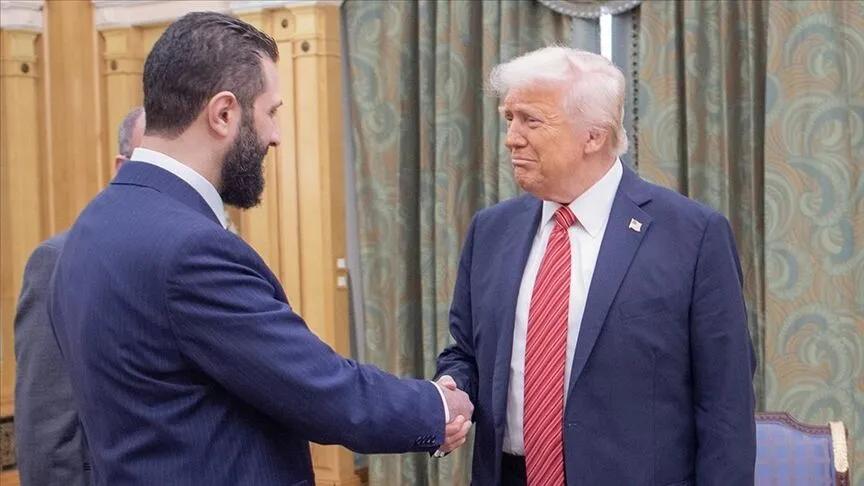
U.S. President Donald Trump and Syrian President Ahmed Şara held a bilateral meeting on 8 July 2026 during the 36th NATO Summit of Heads of State and Government hosted by Ankara. The meeting, held at the Beştepe Presidential Complex, has been regarded as one of the most significant high-level contacts between the United States and Syria since the end of Bashar al-Assad’s regime in 2024.
The meeting took place within the context of the accelerating diplomatic normalization process between Washington and Damascus. The leaders comprehensively addressed the future of bilateral relations, Syria’s reconstruction process, U.S. sanctions, economic cooperation opportunities and regional security issues. Post-meeting statements signaled significant shifts in the United States’ long-standing approach to Syria.
The primary agenda item of the meeting between Trump and Ahmed Şara was the U.S. sanctions policy toward Syria. The parties assessed how the lifting of sanctions could accelerate economic recovery, encourage international investment and reintegrate Syria into the global economic system.
The meeting also addressed the preservation of Syria’s political stability, the strengthening of central state institutions, national reconstruction and the improvement of relations with the international community. Regional security, counterterrorism and support for stability in the Middle East were also key agenda items.
The leaders expressed mutual commitment to continuing the normalization process that has gained momentum between the United States and Syria in recent months.
Following the meeting, U.S. President Donald Trump stated that Syria’s new administration had taken important steps toward restoring national stability. Trump commended Ahmed Şara for his successful efforts in reuniting the country and emphasized that the new government had adopted a fundamentally different governance approach compared to the previous regime.
Trump also noted that the steps taken by the United States toward lifting sanctions on Syria would contribute to the country’s recovery and underscored the importance of economic normalization for both Syria and regional stability.
The statements made indicated that the United States is determined to reshape its relationship with the Damascus administration and aims to enhance political and economic cooperation in the new era.
In his post-NATO Summit assessment, Trump announced that the United States is considering removing Syria from the “State Sponsors of Terrorism” list. This statement has been viewed as one of the most significant changes in U.S. policy toward Syria in recent years.
Trump stated that with the lifting of sanctions, Syria could rejoin the international trade and investment system and emphasized that supporting its economic recovery would contribute to regional stability.
Following Trump’s remarks, U.S. Secretary of State Marco Rubio announced that the President had formally initiated the process to remove Syria from the list. Under U.S. law, the decision must be reviewed by Congress for a 45-day period before it can take effect. If Congress does not block the decision within this period, Syria will be officially removed from the list after nearly half a century of inclusion.
Rubio also disclosed that the Damascus administration had provided the United States with a formal assurance that it would not support international terrorist activities in the future. The Washington administration stated that this commitment was one of the key justifications for the proposed decision.
The U.S. “State Sponsors of Terrorism” list is a core component of the sanctions regime applied to states deemed to systematically support terrorist organizations. Countries on the list are barred from receiving U.S. foreign aid, defense industry exports, participation in various financial programs and numerous commercial activities. Additionally, significant legal and financial restrictions apply to American companies and international investors engaging with these states.
Syria was added to the list by the United States in 1979. The decision was influenced by the Syrian government’s support for Palestinian armed groups, its ties to regional armed organizations and U.S. counterterrorism policies at the time.
In subsequent years, Syria’s position on the list was maintained due to Bashar al-Assad’s strategic partnership with Iran, its support for Hezbollah and its regional policies. This status served as a legal basis for U.S. economic sanctions for many years.
Syria’s removal from the list is regarded not only as a diplomatic decision but also as a development with major implications for the country’s economic reconstruction process.
Although some sanctions had been lifted previously, the continued designation as a “State Sponsor of Terrorism” created significant legal risks for international companies and financial institutions. As a result, many investors avoided operating in Syria.
If the designation is removed, international banking operations are expected to become easier, foreign investment is projected to increase, financing for reconstruction projects will become more accessible and international trade channels will expand. Additionally, Syria’s integration with international financial institutions and the global economic system is anticipated to strengthen.
The Trump-Şara meeting held during the NATO Summit in Ankara is considered one of the most important milestones in the normalization process between the United States and Syria that began in 2024. The steps discussed in the meeting—lifting sanctions, developing economic cooperation and removing Syria from the “State Sponsors of Terrorism” list—signal the beginning of a new era in bilateral relations.
If the congressional process is completed, Syria will be removed from the U.S. “State Sponsors of Terrorism” list after approximately 47 years. Consequently, only Iran, North Korea and Cuba will remain on the list, while Syria will have crossed a critical threshold in its reintegration into the international diplomatic and economic system.
ABC News. “Trump Says He’ll Remove Syria from State Sponsor of Terrorism List ‘in Time’.” ABC News. Accessed July 9, 2026.https://abcnews.com/Politics/trump-hell-remove-syria-state-sponsor-terrorism-time/story?id=134586488
Al Jazeera. “US Moves to Delist Syria as a ‘State Sponsor of Terrorism’.” Al Jazeera. Accessed July 9, 2026.https://www.aljazeera.com/news/2026/7/8/us-moves-to-delist-syria-as-a-state-sponsor-of-terrorism
Anadolu Ajansı. "Trump Eyes Syria’s Removal from Terrorism List, Praises President Al-Sharaa." Accessed July 9, 2026.https://www.aa.com.tr/en/world/trump-eyes-syrias-removal-from-terrorism-list-praises-president-al-sharaa/3991424
Reuters. “Trump Says He Thinks He Will Remove Syria from U.S. Terrorism Sponsor List.” Reuters. Accessed July 9, 2026.https://www.reuters.com/world/us/trump-says-he-thinks-he-will-remove-syria-us-terrorism-sponsor-list-2026-07-08/

U.S. President Donald Trump and Syrian President Ahmed al-Shara met in Ankara during the 36th NATO Summit of Heads of State and Government. Following their talks, Trump announced that they had considered removing Syria from the U.S. list of "States Supporting Terrorism" and declared a new step in the normalization process between the two countries.
No Discussion Added Yet
Start discussion for "Trump and Ahmed Şara's Meeting in Ankara within the Scope of the NATO Summit" article
July 9, 2026
Key Issues Discussed in the Meeting
July 9, 2026
Trump’s Statements on Syria and Ahmed Şara
July 9, 2026
Removal of Syria from the “State Sponsors of Terrorism” List on the Agenda
July 9, 2026
U.S. “State Sponsors of Terrorism” List
July 9, 2026
Economic and Diplomatic Implications of the Decision
July 9, 2026
A New Chapter in U.S.-Syria Relations