


This article was automatically translated from the original Turkish version.
+2 More
The Trojan Horse is a figure rooted in ancient Greek mythology, particularly in Homer’s Iliad and Odyssey, and represents an important symbol of the Trojan War. To overcome the ten-year siege, the Greeks constructed a massive wooden horse, concealed their soldiers inside, and at night emerged to ambush the Trojans and capture the city. This story has become a symbol of victory achieved through intelligence and deception. Although there is no definitive information regarding the historical reality of the Trojan Horse, it is widely regarded as a metaphor combining ancient siege technology and mythological elements. In the Iliad, the siege of Troy is described, while the Odyssey recounts the Greek soldiers’ journeys home; the story of the Trojan Horse is also told in the Odyssey.
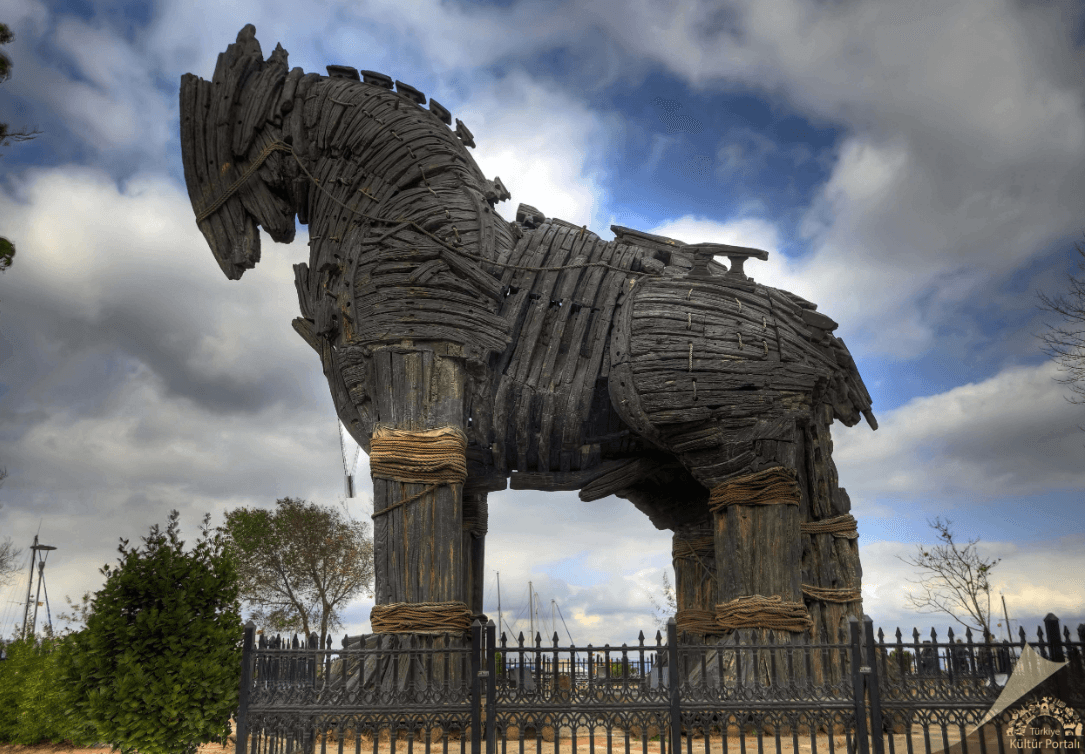
The Trojan Horse (Source:Culture Portal)
The story of the Trojan Horse relates to events during the ten-year siege of Troy by the Greeks. Throughout the war, the city of Troy was never captured. However, the ingenuity of the Greek warrior Odysseus opened the path to victory. Following Odysseus’s suggestion, the Greeks built a massive wooden horse and hid their finest warriors inside. The rest of the Greek army then abandoned the camp, leaving the horse at the gates of Troy and pretending to retreat, as if they had lost the war. The Trojans interpreted the giant horse as an offering to the goddess Athena and brought it into the city. At night, the Greek soldiers emerged from within the horse, ambushed the Trojans, and opened the city gates. As a result, the Greek army returned and captured Troy.
Beyond being merely a weapon of war, the Trojan Horse has become a symbol interpreted in many different ways over time. The simplest explanation is that the horse symbolized Troy itself, making it plausible that the Trojans accepted such a gift. Another view suggests that the horse resembled a siege engine, as siege machines of the period were often covered with animal hides to protect them from fire. Another theory holds that the Trojan Horse was not a real object but a event used metaphorically to describe the destruction of Troy. This view argues that since Poseidon was the god of both the sea and earthquakes, the horse may symbolize an earthquake.
In modern times, the Trojan Horse has been represented in many different forms. In 1975, Turkish architect İzzet Senemoğlu constructed a wooden replica of the Trojan Horse, which has been on display since then in the village of Tevfikiye near Çanakkale. Visitors can enter the two-story structure and explore its interior. Additionally, in the 2004 film Troy, the Trojan Horse was depicted cinematically as a monumental structure, using a large-scale model.
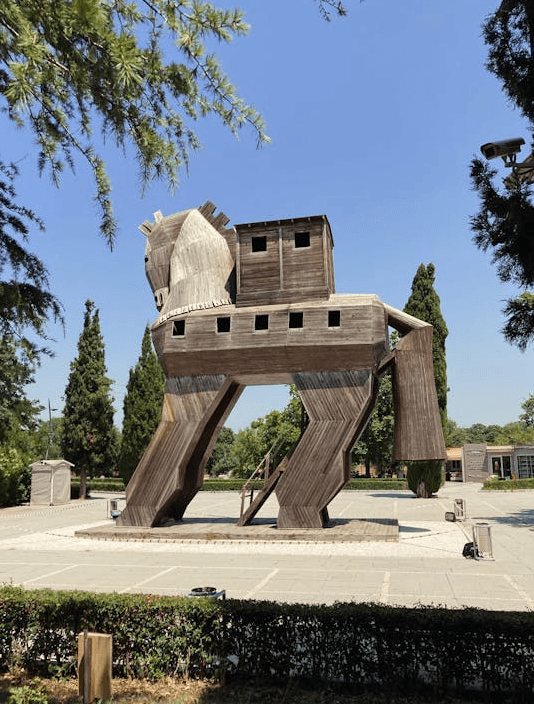
The Trojan Horse / İzzet Senemoğlu (Source: Pexels/beyzahzah)
The Trojan Horse carries an important message about military strategy: victory cannot always be achieved through strength and force alone; sometimes intelligence and strategy are essential. As a historical symbol, the Trojan Horse demonstrates how wit and cunning can determine the outcome of warfare. In ancient Greek art, the Trojan Horse was frequently depicted, and many artists across different periods portrayed the figure in their own interpretations. In modern times, particularly in film and literature, it retains a significant place as a mythological figure.
Arda, Ergün. “Troya Atı ile Çanakkale At Biçimli Seramikler Arasındaki İlişkinin Değerlendirilmesi.” Journal of Social, Humanities and Administrative Sciences 6, no. 27 (2020): 881-895. Accessed March 14, 2025.https://journalofsocial.com/files/josasjournal/1356420268_11.%20ID344_6-27.%20Arda_881-895.pdf#page=1.40
Daily Sabah. "Ancient Symbolic Trojan Horse of Çanakkale Set for Restoration." Daily Sabah, 2020. Accessed March 14, 2025.https://www.dailysabah.com/life/history/ancient-symbolic-trojan-horse-of-canakkale-set-for-restoration.
T.C. Kültür ve Turizm Bakanlığı. "Troya Atı." Kültür Portalı. Accessed March 14, 2025.https://www.kulturportali.gov.tr/portal/troyaati.
Turkish Archaeological News. "The Trojan Horse of Troy." Turkish Archaeological News. Accessed March 14, 2025.https://turkisharchaeonews.net/object/trojan-horse-troy.
University of Oxford. "Did the Trojan Horse Exist? A Classicist Tests the Greek Myths." University of Oxford News. Accessed March 14, 2025.https://www.ox.ac.uk/news/arts-blog/did-trojan-horse-exist-classicist-tests-greek-myths.

Mythological Background
Symbolic and Historical Interpretations
Modern Interpretations and Representations
The Trojan Horse in War and Art