


This article was automatically translated from the original Turkish version.
Trichotillomania (Hair-Pulling Disorder) is a chronic psychiatric disorder characterized by the repetitive and uncontrollable pulling of hair from the scalp or other body regions. This condition typically begins during adolescence and can lead to significant impairments in psychosocial functioning. The hair-pulling behavior is not limited to the head but may also affect eyebrows, eyelashes, beard, and other body areas. The behavior often emerges following a momentary feeling of tension, followed by temporary relief after the act.
The diagnosis of trichotillomania is generally based on the patient’s clinical history and observation. According to the DSM-5 (Diagnostic and Statistical Manual of Mental Disorders), diagnosis requires that the hair-pulling behavior be repetitive, result in noticeable hair loss, be preceded by increasing tension and followed by a sense of relief. This behavior may occur consciously in some individuals, while others pull hair automatically without awareness. The act commonly involves the use of the fingertips to pluck individual hairs one by one, a process often referred to as “pinching.” As a result, irregular and asymmetric bald patches may develop on the scalp. In differential diagnosis, it is essential to rule out dermatological conditions such as alopecia areata.
The lifetime prevalence of trichotillomania in the general population ranges from 0.6% to 2.4%.【1】 The disorder is reported more frequently in females than in males.【2】 The onset age typically coincides with adolescence, although cases beginning at earlier ages also occur.【3】 However, hair-pulling behaviors observed in early childhood are often transient and may be triggered by environmental factors.
The etiology of trichotillomania is multifactorial. Genetic predisposition, neurobiological differences, neurochemical imbalances, and psychological stressors may all play a role. Neuroimaging studies have identified structural abnormalities, particularly in the right frontal lobe.【4】 Furthermore, the disorder is associated with deficits in impulse control and emotional regulation. Hair-pulling often functions as a coping mechanism in response to anxiety, stress, or internal tension.
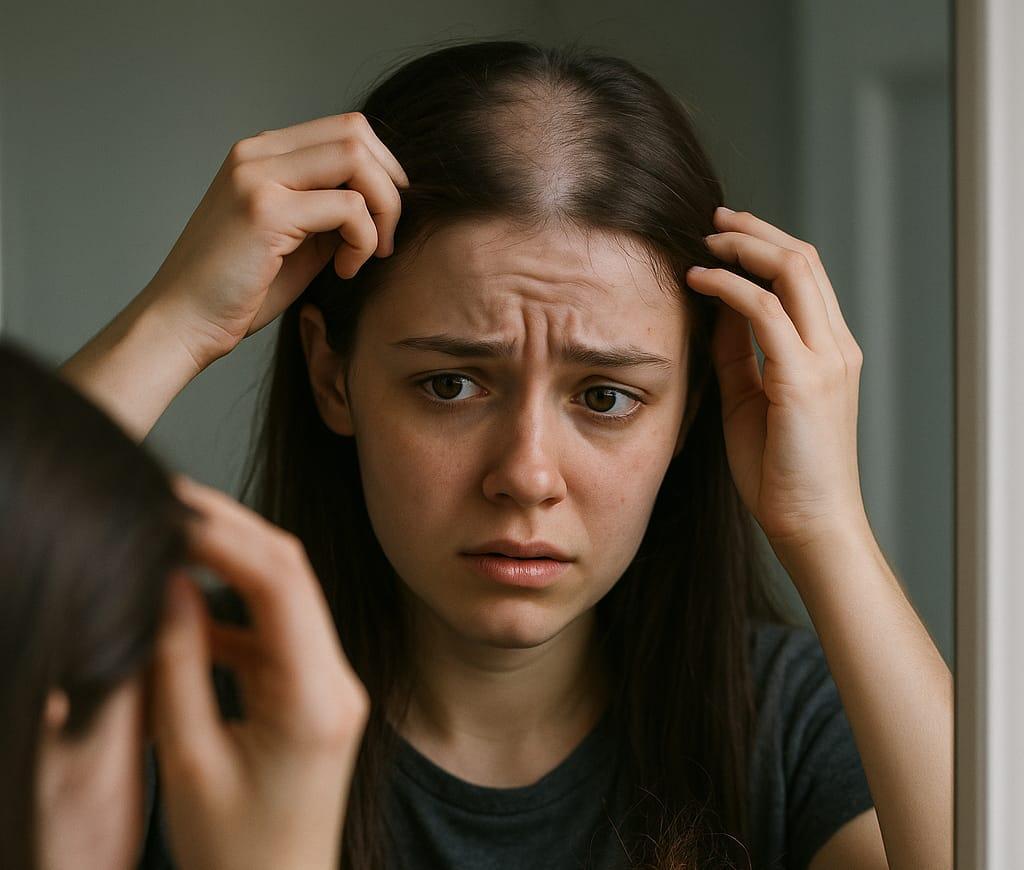
Generated by Artificial Intelligence
Trichotillomania frequently co-occurs with other psychiatric disorders. These comorbidities include major depressive disorder, anxiety disorders, eating disorders, and excoriation disorder (dermatillomania). Co-occurring psychiatric conditions can complicate treatment and lead to further declines in quality of life.
The treatment of trichotillomania generally requires a multidisciplinary approach. Currently, one of the most effective treatment modalities is Habit Reversal Training (HRT), a subcategory of cognitive behavioral therapy. This approach aims to help the individual become aware of the pulling behavior, identify triggering situations, and replace the behavior with functionally alternative responses. Other psychotherapeutic techniques include third-wave therapies such as acceptance and commitment therapy (ACT) and dialectical behavior therapy (DBT). These therapies focus on improving emotional regulation and impulse control to promote more lasting recovery.
Trichotillomania is a chronic and recurrent disorder that can cause significant negative impacts on both psychological and social functioning. Increasing awareness during diagnosis and treatment, promoting early intervention, and expanding multidisciplinary approaches are essential. The absence of standardized treatment protocols and patients’ reluctance to seek treatment due to shame can negatively affect clinical outcomes. Therefore, integrating long-term follow-up and supportive approaches into treatment is recommended.
"Warning: The content in this article is provided solely for general encyclopedic informational purposes. The information here should not be used for diagnosis, treatment, or medical referral. Before making any decisions regarding health, you must consult a physician or qualified healthcare professional. The author and KÜRE Encyclopedia assume no responsibility for any consequences arising from the use of this information for diagnostic or therapeutic purposes."
Chamberlain, Samuel R., Naomi A. Menzies, Jon E. Grant, and Edward T. Bullmore. “Trichotillomania: Neurobiology and Treatment.” *Neuroscience & Biobehavioral Reviews* 47 (2014): 509–22.https://www.sciencedirect.com/science/article/abs/pii/S0149763409000189
Duke, Danny C., Mary L. Keeley, Gary R. Geffken, and Eric A. Storch. “Trichotillomania: A Current Review.” *Clinical Psychology Review* 30, no. 2 (2010): 181–93.https://www.sciencedirect.com/science/article/abs/pii/S0272735809001445?utm_source
Grant, Jon E., and Brian L. Odlaug. “Clinical Characteristics of Trichotillomania.” Comprehensive Psychiatry, Volume 49, Issue 6, November–December 2008. Accessed July 25, 2025.
Hocaoğlu, Çiçek. “Trikotillomani.” *Türkiye Klinikleri Psikiyatri Dürtü Denetim Bozuklukları Özel Sayısı* 2, no. 1 (2009): 57–65. Accessed July 3, 2025.https://www.turkiyeklinikleri.com/article/en-trikotillomani-54335.html
Konkan, Ramazan, Ömer Şenormancı, and Mehmet Z. Sungur. “Trikotillomani: Tanı, Farmakoterapi ve Kognitif Davranışçı Terapisi.” *Klinik Psikofarmakoloji Bülteni - Bulletin of Clinical Psychopharmacology* 21, no. 3 (2021): 265–74. Accessed July 3, 2025.https://www.tandfonline.com/doi/abs/10.5455/bcp.20110904062905
Mansueto, S. Charles, Ruth M. Townsley Stemberger, Amanda McCombs Thomas, and Ruth Goldfinger Golomb. “Trichotillomania: A Comprehensive Behavioral Model.” *Clinical Psychology Review* 17, no. 5 (1997): 567–577. Accessed July 25, 2025.
NHS. "Trichotillomania (Hair Pulling Disorder)." NHS. Accessed July 3, 2025.https://www.nhs.uk/mental-health/conditions/trichotillomania/
Pixabay. "Frustrated Girl, Child, Tantrum." Accessed July 3, 2025.https://pixabay.com/illustrations/frustrated-girl-child-tantrum-8678140/
Roberts, Sarah, Kieron O'Connor, and Claude Bélanger. “Emotion Regulation in Trichotillomania and Skin-Picking Disorder.” *Clinical Psychology Review* Volume 33, no. 6, August 2013.https://www.sciencedirect.com/science/article/abs/pii/S027273581300072X?utm_source
Çoban, Mert Can. “Trikotillomani Tanı ve Tedavisine Güncel Bakış.” *Sosyal, Beşerî ve İdari Bilimler Dergisi* 4, no. 12 (2021): 1193-1210. Accessed July 3, 2025.https://www.sobibder.org/index.php/sobibder/article/view/221/221
[1]
Duke, Danielle C., et al. “The Prevalence of Trichotillomania: A Systematic Review and Meta-Analysis.” Clinical Psychology Review 30, no. 8 (2010): 952–958. Erişim 25 Temmuz 2025.
[2]
Grant, Jon E. ve Brian L. Odlaug. “Clinical Characteristics of Trichotillomania.” The Journal of Clinical Psychiatry 68, no. 8 (2007): 1210–1216. Erişim 25 Temmuz 2025. https://www.sciencedirect.com/science/article/abs/pii/S0010440X08000734?utm_source
[3]
Grant, Jon E. ve Brian L. Odlaug. “Clinical Characteristics of Trichotillomania.” The Journal of Clinical Psychiatry 68, no. 8 (2007): 1210–1216. Erişim 25 Temmuz 2025. https://www.sciencedirect.com/science/article/abs/pii/S0010440X08000734?utm_source
[4]
Jon E. Grant et al., “Neurobiology of Subtypes of Trichotillomania and Skin Picking Disorder,” CNS Spectrums 28, no. 1 (2023): 98–103, https://europepmc.org/article/MED/34730081?utm_source.
No Discussion Added Yet
Start discussion for "Trichotillomania (Hair-Pulling Disorder)" article
Clinical Presentation and Diagnostic Criteria
Epidemiological Findings
Psychopathological Foundations
Comorbid Conditions
Treatment Approaches