


This article was automatically translated from the original Turkish version.
+1 More
Original Title of the Work | Der Lebensbaumfries (Hayat Ağacı Frizi) | ||||||||
|---|---|---|---|---|---|---|---|---|---|
Artist Who Produced the Work | Gustav Klimt | ||||||||
German Title | Der Lebensbaumfries | ||||||||
English Title | The Tree of Life | ||||||||
Date(s) of Creation | 1905–1911 | ||||||||
Technique Used | Mosaic with marble inlay technique; semi-precious stones, enamel, ceramic, gold leaf. | ||||||||
Dimensions of the Work | 195 × 102 cm. | ||||||||
Location | Palais Stoclet, Brussels, Belgium (dining room). | ||||||||
Depicted Figures | Tree of Life (two, golden), Horus hawks, Knight, Dancer, Lovers, rose bushes and butterflies. | ||||||||
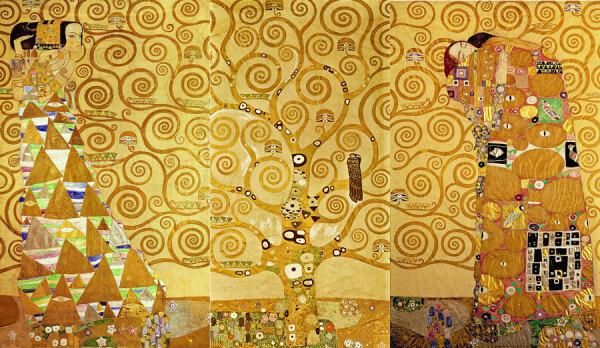
Tree of Life Gustav Klimt (NIH)
Title of the Work | The Tree of Life (Hayat Ağacı) | ||||||||
|---|---|---|---|---|---|---|---|---|---|
Artist of the Work | Gustav Klimt | ||||||||
Date(s) of Creation | 1905–1911 | ||||||||
Technique Used | Mosaic with marquetry (inlay) technique; semi-precious stones, enamel, ceramic, gold leaf. | ||||||||
Dimensions of the Work | 195 × 102 cm | ||||||||
Location of the Work | Palais Stoclet, Brussels, Belgium (dining room). | ||||||||
Depicted Figures | Trees of Life (two, golden color), Horus hawks, Knight, Dancer, Lovers, rose bushes and butterflies. | ||||||||
The Tree of Life (The Tree of Life), is the central panel of the Stoclet Frieze, designed by Gustav Klimt for the dining room of the Palais Stoclet in Brussels, Belgium. The work is regarded as one of the most comprehensive examples of modern mosaic art from the period, associated with movements such as surrealism and magical realism.
The frieze was produced using the inlaid marble technique and is considered a masterpiece of applied art. The dining room, where Josef Hoffmann’s architecture, Klimt’s frieze and the furniture of Wiener Werkstätte come together, has become one of the most famous interior spaces of the twentieth century.【1】
The work holds the distinction of being the only one preserved nearly in its original state since it was delivered to its clients in 1911.【2】
Klimt worked on the Stoclet Frieze for five years, combining semi-precious stones, gilded tiles, enamel, marble, ceramic, gold leaf and various ornamental materials. Art historian A.N. Hodge emphasizes that the work demonstrates Klimt’s mastery of mosaic technique, which he studied intensively during his visit to Ravenna, Italy.【3】
On both long walls of the frieze, two golden Trees of Life rise above a meadow ground adorned with colorful flowers; their twisted, spiral branches cover the entire wall surface.
Black Horus hawks rest individually on each curl, while two rose bushes are surrounded by swarms of butterflies, forming together with the meadow and trees an artificial garden composition.【4】
The central panel features a golden mosaic of a tree with twisted, coiled branches adorned with repetitive decorative patterns. The tree rises from a patch of ochre-colored earth, surrounded by striking jeweled flowers. A large black bird rests on a lower branch, contrasting with the bright gold background; this element is interpreted by scholars as Klimt’s symbol of death.【5】
Dominating the front wall of the dining room is a powerful, abstract figure known as the Knight, standing as if overseeing the scene. On the western wall, beside the windows, a Dancer stands in ornate garments and finest jewelry on the meadow before the golden Tree of Life. On the eastern wall, the Lovers are depicted in close embrace; the man’s elaborate cloak nearly completely conceals the slender female figure in her floral-patterned dress, adding an erotic dimension to the garden motif.【6】
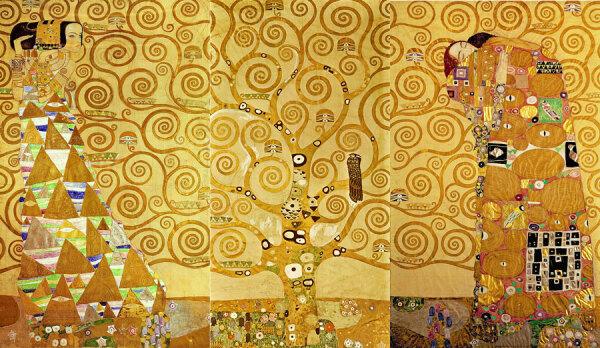
Hayat Ağacı Gustav Klimt (NIH)
The Tree of Life is a universal archetype found across mythological, religious, philosophical and shamanic traditions worldwide.【7】
For the frieze, Klimt chose one of humanity’s most enduring symbolic motifs.
The frieze’s program embodies the goal of Klimt’s group, which separated from the Vienna Secession in 1905, to infuse art into every aspect of life.【8】
This holistic composition in the Palais Stoclet, where house, interior and garden are conceived as a single artistic composition, is recognized as a masterpiece of Hoffmann and Wiener Werkstätte.【9】
The Tree of Life panel is among the most renowned works of Klimt’s so-called “Golden Period,” an phase that began several years before his break with the Vienna Secession.【10】
The work represents a mature expression of Klimt’s style, which harmonized natural elements with expansive abstract geometric ornamentation.【11】 It occupies a unique position in the modern era for its fusion of symbolic and metaphorical content with the mosaic technique.
The visual language and archetypal content of The Tree of Life have found resonance beyond the boundaries of art history, extending into the scientific realm. Charles Darwin employed a similar tree motif to represent the diversity of species, while Ernst Haeckel developed this metaphor through visual diagrams.【12】
Klimt’s golden tree, with its magnificent structure celebrating the continuity and complexity of life, continues to be regarded as one of the most powerful visual representations of this archetypal image in art.【13】
Breedlove, Byron. "The Tree of Life, Archetype and Artifice." *Emerg Infect Dis.* 2024;30(8):1740–2. doi: 10.3201/eid3008.AC3008.
Freytag, Anette. “The Tree of Life Frieze by Gustav Klimt as Artificial Garden in the Traumhaus.” Gustav Klimt. Expectation and Fulfillment. Cartoons for the Mosaic Frieze at Stoclet House, edited by Christoph Thun-Hohenstein and Beate Mur, 2012, pp. 59–87.https://www.academia.edu/38129321/The_Tree_of_Life_Frieze_by_Gustav_Klimt_as_Artificial_Garden_in_the_Traumhaus
[1]
Anette Freytag, "Der Lebensbaumfries von Gustav Klimt als künstlicher Garten im Traumhaus / The Tree of Life Frieze by Gustav Klimt as Artificial Garden in the Dream House," Academia.edu, s. 69, erişim tarihi: 4 Ağustos 2026, https://www.academia.edu/38129321/The_Tree_of_Life_Frieze_by_Gustav_Klimt_as_Artificial_Garden_in_the_Traumhaus.
[2]
Freytag, "Der Lebensbaumfries," 69.
[3]
"The Tree of Life, Archetype and Artifice," Emerging Infectious Diseases 30, no. 8 (Ağustos 2024), erişim tarihi: 4 Ağustos 2026, https://pmc.ncbi.nlm.nih.gov/articles/PMC11286045/.
[4]
Freytag, "Der Lebensbaumfries," 69.
[5]
"The Tree of Life," Emerging Infectious Diseases 30, no. 8.
[6]
Freytag, "Der Lebensbaumfries," 69.
[7]
"The Tree of Life," Emerging Infectious Diseases 30, no. 8.
[8]
Freytag, "Der Lebensbaumfries," 69.
[9]
Freytag, "Der Lebensbaumfries," 69.
[10]
"The Tree of Life," Emerging Infectious Diseases 30, no. 8.
[11]
"The Tree of Life," Emerging Infectious Diseases 30, no. 8.
[12]
"The Tree of Life," Emerging Infectious Diseases 30, no. 8.
[13]
"The Tree of Life," Emerging Infectious Diseases 30, no. 8.

Original Title of the Work | Der Lebensbaumfries (Hayat Ağacı Frizi) | ||||||||
|---|---|---|---|---|---|---|---|---|---|
Artist Who Produced the Work | Gustav Klimt | ||||||||
German Title | Der Lebensbaumfries | ||||||||
English Title | The Tree of Life | ||||||||
Date(s) of Creation | 1905–1911 | ||||||||
Technique Used | Mosaic with marble inlay technique; semi-precious stones, enamel, ceramic, gold leaf. | ||||||||
Dimensions of the Work | 195 × 102 cm. | ||||||||
Location | Palais Stoclet, Brussels, Belgium (dining room). | ||||||||
Depicted Figures | Tree of Life (two, golden), Horus hawks, Knight, Dancer, Lovers, rose bushes and butterflies. | ||||||||
Tree of Life Gustav Klimt (NIH)
Title of the Work | The Tree of Life (Hayat Ağacı) | ||||||||
|---|---|---|---|---|---|---|---|---|---|
Artist of the Work | Gustav Klimt | ||||||||
Date(s) of Creation | 1905–1911 | ||||||||
Technique Used | Mosaic with marquetry (inlay) technique; semi-precious stones, enamel, ceramic, gold leaf. | ||||||||
Dimensions of the Work | 195 × 102 cm | ||||||||
Location of the Work | Palais Stoclet, Brussels, Belgium (dining room). | ||||||||
Depicted Figures | Trees of Life (two, golden color), Horus hawks, Knight, Dancer, Lovers, rose bushes and butterflies. | ||||||||
No Discussion Added Yet
Start discussion for "Tree of Life (Painting)" article
Technical Features
Iconographic Features
Historical Context
Place in Art History
Influences