


This article was automatically translated from the original Turkish version.
One of the most captivating paradoxes in literary history lies in the story of a woman who never wrote a single line of poetry herself, yet inspired the most powerful and monumental three poets of Turkish verse to compose their most beautiful, most tender verses. This mysterious and profoundly deep woman is none other than Tomris Uyar. Her presence transformed the poets’ souls into emotional dead ends, passionate entanglements, and the inexplicable tides of relationships. To understand how one woman became three distinct climates and three separate love paradoxes within three different poets’ worlds is to discover the multifaceted nature of love itself.
The calmest yet most internally turbulent harbor of this story takes shape with Turgut Uyar. His love was not the pursuit of a distant dream that vanishes into the horizon, but the unique bliss of grasping the real happiness right beside him. Turgut Uyar, when turning his profound attachment into words, seemed to melt time itself into the presence of his beloved. For him, the scorpion cursed the hour hand, because every second without her was an empty void. The poet defies time when he declares, "My heart has been a broken clock, always resting on you," and cries out that the very functioning of that clock would be his death.【1】 Yet such immense and time-stopping love carries within it a profound relational impasse.
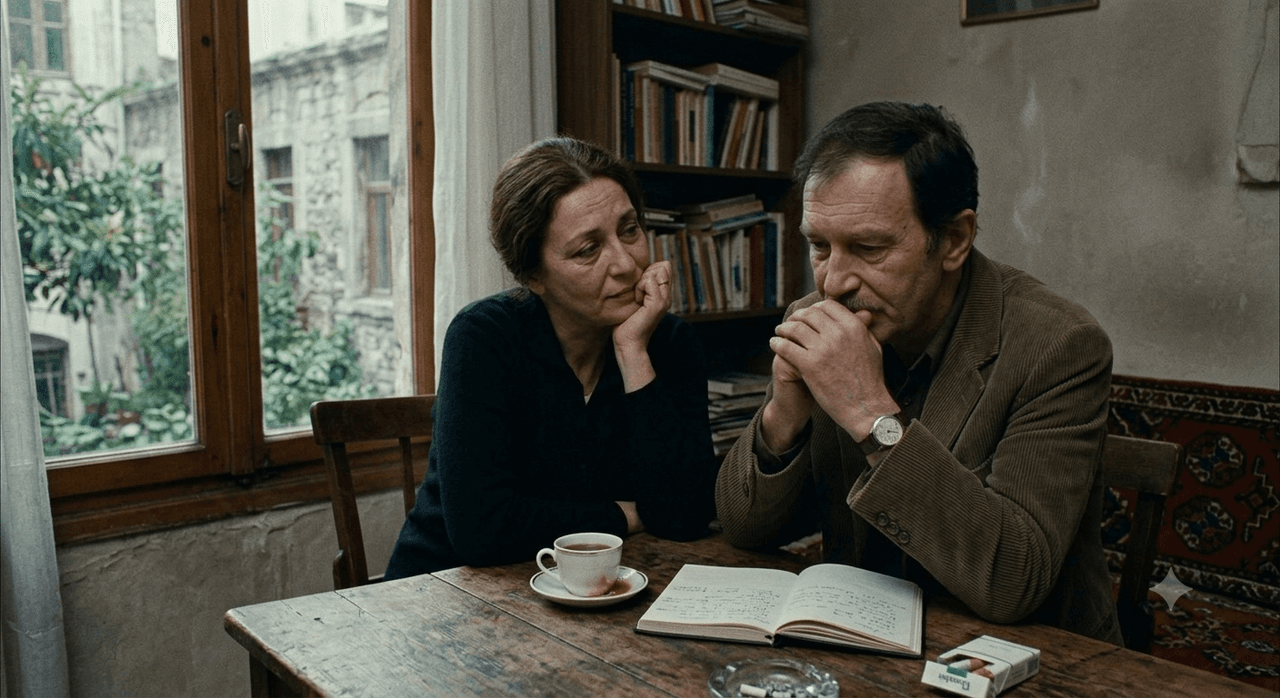
A Moment Reflecting Turgut Uyar and Tomris Uyar's Intimate Storms, Melancholy, and Depth (Generated by Artificial Intelligence.)
Tomris Uyar’s perspective on this relationship reveals love’s wearying, exhausting, anxious face. In recounting her union with Turgut Uyar, she describes how she was worn down by an unfounded and unnecessary fear—that he might slip away from her at any moment.【2】
On the other hand, she admits that she was exhausted by the constant, unrelenting pressure to be chosen first, in a domain where no competition or rivalry existed.【3】 This aspect of love is the impasse of a soul caught on the fine line between belonging and freedom, perpetually trembling at the fear of loss.
When we turn the medal over, we encounter the tumultuous and passionate love story with Cemal Süreya, a love that shattered established orders.
Cemal Süreya’s verses portray this love as a hopeless surrender, spreading into every moment of life—kissing his beloved under moonlight, on her feet, from her lips, from her breath, even drawing her out onto the streets to kiss her at the source. The poet, whose pride was melted in the crucible of love to the point where he could say, "I wish I were even more unworthy, for you are unworthy of me!," is trapped in a helpless surrender to his beloved.【4】
Yet this great passion also has its own immense love impasse. According to Tomris’s account, Cemal Süreya left her but could never find peace, because to him, Tomris was a woman who could never be possessed or captured.【5】 When the moment of separation came, Cemal Süreya swore he would never utter a single word that might reveal anything about her, her love, or their story—and indeed, he never spoke or wrote a word on the subject.【6】
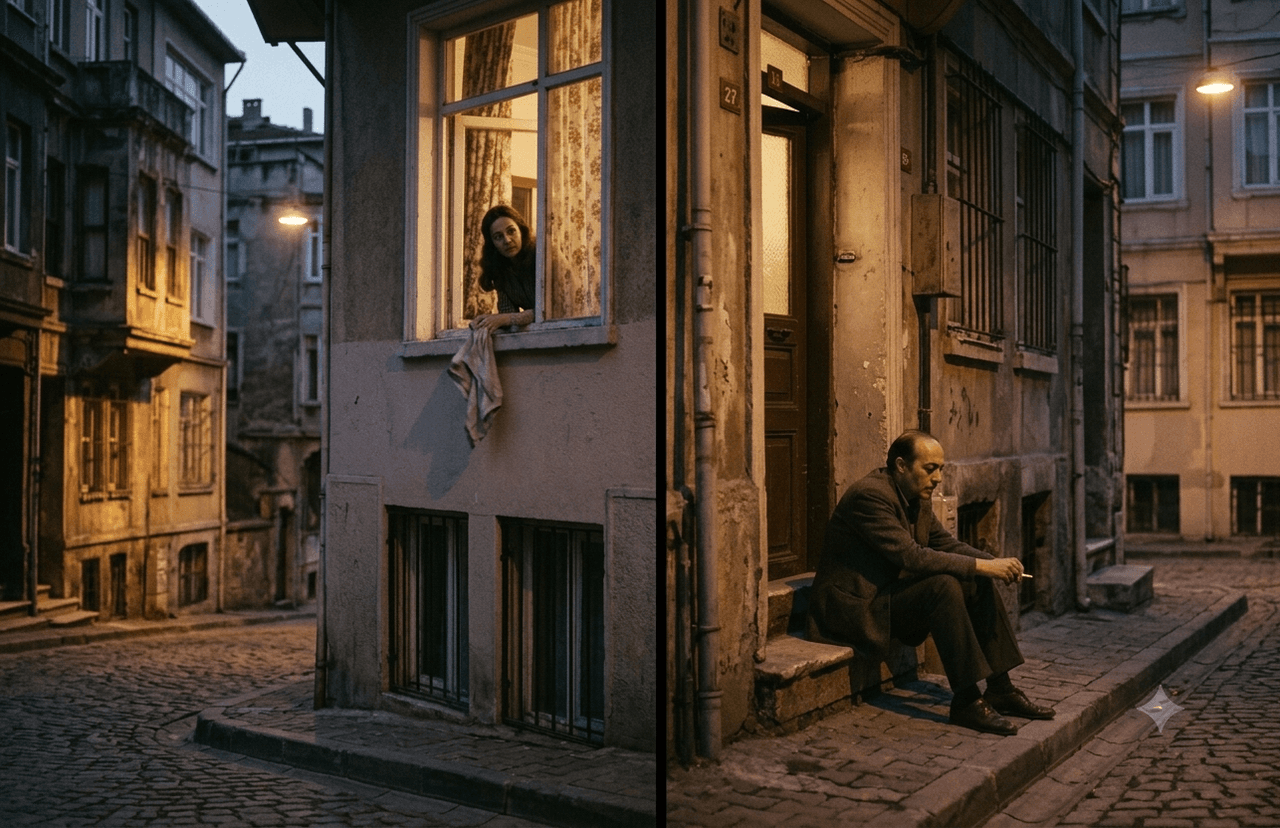
Sokakta, Akşamın Loşluğunda Tomris ve Cemal Süreya Arasındaki Sessiz ve Hüzünlü "Şahsiyet Rötarı" Anı (Yapay Zeka ile Oluşturulmuştur.)
The most beautiful moment summarizing this relationship and its complex, endearing psychology is the poet’s famous delays. Every evening, Turgut Uyar would rush home the moment he finished work, but after Tomris suggested he spend a little time with friends, Cemal Süreya began arriving home later and later. One evening, as Tomris looked out the window to shake out a curtain, she noticed Cemal sitting quietly at the entrance of the building, deliberately “delaying” his arrival.
Tomris immediately gave this playful, rule-bound, yet unyielding behavior its unforgettable name: “Personality Delay.”【7】 Here lies another paradox of love: even when utterly in love, the timid respect one feels toward the beloved can create a profound contradiction—enough to make one wait outside one’s own door.
Beyond all these storms of emotion, fears of loss, and crises of possession, there is another admiration story well known in the literary world—one that blossoms in the world of Edip Cansever. Edip Cansever repeated his profound admiration for Tomris Uyar every year, without tiring, like a sacred ritual. Every March 15, on her birthday, he published a new poem dedicated to her, sealing his feelings into literary history.【8】 In Cansever’s verses, Tomris is a magical figure—never seen walking long roads, always beneath rain, holding a glass or gazing at a shore and weeping, etched into memory as if she wandered the world. He pays homage to her uniqueness when he writes, "Renew your name this year, but let it still be Tomris Uyar."【9】
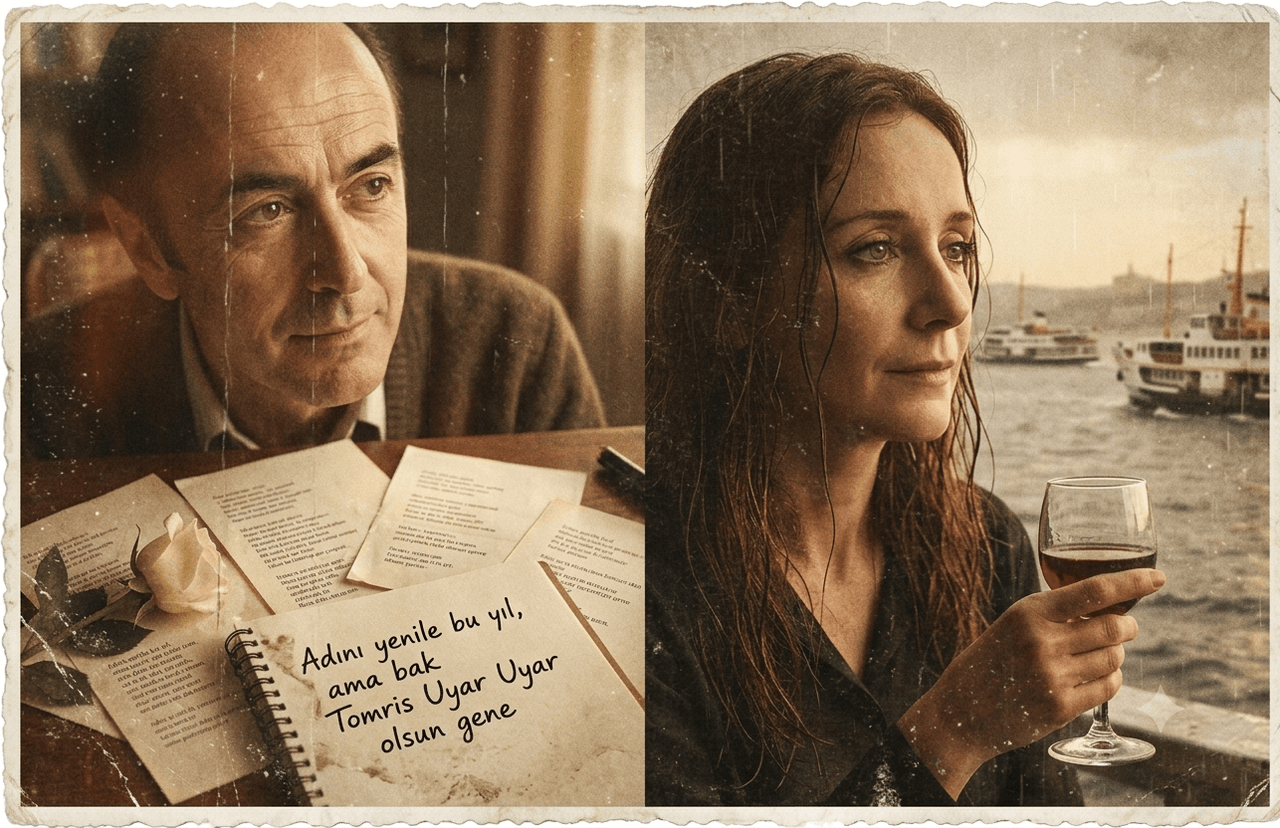
Edip Cansever’in Tomris Uyar’a Duyduğu Lirik ve Zamansız Hayranlığı Anlatan İki Parçalı, Eskitilmiş Bir Anı Fotoğrafı (Yapay Zeka ile Oluşturulmuştur.)
Tomris has keenly experienced how intense feelings like love and romance can wound, wear down, and even fade over time. Yet through Edip Cansever’s pure admiration, she discovered life’s most important truth. In her own words, it was Edip Cansever who taught her that the only love time cannot destroy or end is a true and lyrical friendship.【10】
This long journey, shaped between one woman and three great poets amid countless emotional complexities, reveals that love sometimes means stopping time with unwavering loyalty, sometimes deliberately delaying one’s arrival at the entrance of an apartment building, and sometimes transforming into a timeless friend by writing a poem every birthday. Though Tomris Uyar never wrote a single verse herself, she authored Turkish literature’s most unforgettable, most naive, and most lyrical love ballad through the immense love impasses she inspired in others’ hearts.
The shocking aspect of this love impasse is that each of the three poets loved Tomris Uyar by coloring her in the hue of their own souls, while she remained at the center of this intense enclosure—as both a refuge and an insurmountable wall. Turgut Uyar made her presence his ceiling, the backbone of his life, and felt the fear of losing her in every cell; in doing so, he struggled with love’s most vulnerable side—the way it renders us defenseless. When he says, "The scorpion hates the hour hand," he admits how love can sever us from life and the flow of the world, turning every moment not belonging to the beloved into a loss of time. Tomris’s weariness in this love resembled the breathless exhaustion of an athlete forced to remain on the podium of first place; for being loved can sometimes become as heavy a burden as loving, an unbearable responsibility.【11】
When we step away from this heavy, rule-bound atmosphere of love into Cemal Süreya’s world, we are shaken by the lawless, passionate, and destructive nature of their relationship. In this bond, where marriages were ended and social norms disregarded, Cemal Süreya poured his love like a raging river over Tomris, placing her at the very center of life and streets. Yet such immense passion inevitably brought with it jealousy and the famous crisis of “unattainability.” To Cemal Süreya, Tomris was a woman who could never be fully confined within a man’s world.【12】 This relationship, woven with personality delays and secret minutes spent waiting at building entrances, was a timeless love paradox, revealing how love can infantilize us while simultaneously leaving us utterly helpless.
Edip Cansever, however, stood far from these two stormy seas, acting like a breakwater that braved every wave for Tomris. His devotion, offered every March 15, was far beyond fleeting romantic infatuations—it was the work of a lyrical admiration that defied time and decay. His recurring depiction of her gazing at a shore and weeping, or holding a glass, proved how deeply he internalized her melancholy and depth.【13】 In Edip Cansever’s unreciprocated stance, Tomris Uyar found the purest truth of life. While navigating the complex and dead-end alleys of human relationships, she realized that the most refined form of love is not passion or possession, but a lyrical friendship that never diminishes, never ends, and accepts a person exactly as they are.
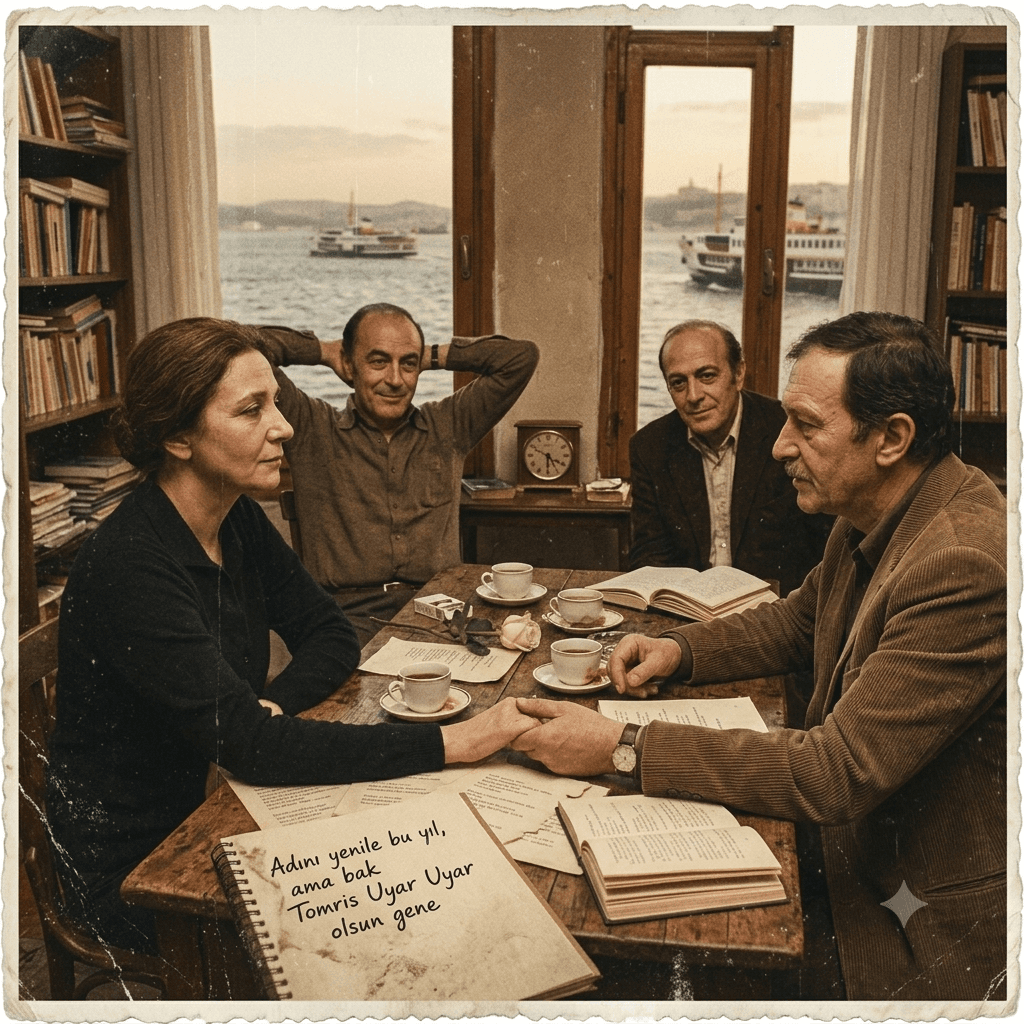
A Nostalgic Memory Frame Bringing Together Tomris Uyar, Turgut Uyar, Edip Cansever and Cemal Süreya (Generated by Artificial Intelligence.)
Though Tomris Uyar wrote nothing, she succeeded in becoming three different women in the hearts of three different men, inspiring each to compose the unique poems their souls needed. On one side, loyalty so immense it stops time; on the other, a burning passion that shatters pride; and right beside them, a lifelong spiral of lyrical friendship.
In Turgut Uyar, love became unwavering loyalty and the fear of loss, so powerful it halted time; in Cemal Süreya, it transformed into a burning passion that spilled onto the streets, disregarding honor yet forever unattainable; in Edip Cansever, it evolved into a lyrical harbor of friendship that blooms anew each year, beyond time.
Amid all these monumental poems, crises of possession, and love impasses, Tomris Uyar preserved her own lyrical power and independence, remaining as Turkish literature’s greatest source of inspiration and noblest woman.
From writer to reader, a small note on relationships...
Tomris Uyar’s story reminds us that love has no winner or loser. A person is not the same person with everyone they love; sometimes one brings peace, another passion, and yet another a friendship that lasts a lifetime. Indeed, relationships are the story of how one soul touches another. What remains is neither the pain of separations nor the sorrow of ended loves. What endures is the imprint one human leaves on another’s soul. People depart, time changes, paths diverge; but the traces left with kindness, loyalty, and love continue to live as life’s most enduring memories.
Kara, Elif Nur, and Hayriye Ulaş. "1 Kadın 3 Şair." *Hızır Reis Mesleki ve Teknik Anadolu Lisesi Dergisi*, 4, Antalya. Accessed July 9, 2026.https://hizirreistml.meb.k12.tr/meb_iys_dosyalar/07/18/969928/dosyalar/2017_10/05225603_3_hizirca-4_HIZIRCA_SAYI_4-min.pdf
[1]
Elif Nur Kara ve Hayriye Ulaş, "1 Kadın 3 Şair". Hızır Reis Mesleki ve Teknik Anadolu Lisesi Dergisi 4, Antalya, s. 3, Erişim 9 Temmuz 2026, https://hizirreistml.meb.k12.tr/meb_iys_dosyalar/07/18/969928/dosyalar/2017_10/05225603_3_hizirca-4_HIZIRCA_SAYI_4-min.pdf.
[2]
Elif Nur Kara ve Hayriye Ulaş, s. 3.
[3]
Elif Nur Kara ve Hayriye Ulaş, s. 3.
[4]
Elif Nur Kara ve Hayriye Ulaş, s. 3.
[5]
Elif Nur Kara ve Hayriye Ulaş, s. 3.
[6]
Elif Nur Kara ve Hayriye Ulaş, s. 3.
[7]
Elif Nur Kara ve Hayriye Ulaş, s. 3.
[8]
Elif Nur Kara ve Hayriye Ulaş, s. 3.
[9]
Elif Nur Kara ve Hayriye Ulaş, s. 3.
[10]
Elif Nur Kara ve Hayriye Ulaş, s. 3.
[11]
Elif Nur Kara ve Hayriye Ulaş, s. 3.
[12]
Elif Nur Kara ve Hayriye Ulaş, s. 3.
[13]
Elif Nur Kara ve Hayriye Ulaş, s. 3.
